Not legal advice. This page summarizes FCC rules (47 CFR Part 95) from the official sources linked in the text. Rules and fees checked . The FCC sets its fees annually and can change its rules, so confirm the current version on fcc.gov before you rely on it.
The contenders
Side by side
 Stock photo
The walkie-talkie: a handheld pair
Cobra RX680 (2-pack)
Two license-free FRS handhelds with Cobra's stated 2 W high setting, IP54, NOAA alerts and 38 preset channel/code combos. Handheld reach, no license.
Check price · Amazon#ad · Price set by Amazon · How we make money for the link to Cobra RX680 (2-pack)
 Stock photo
The mobile: a radio for the truck
Midland MXT275 MicroMobile (15 W)
A 15 W GMRS mobile that plugs into a 12V socket, with a magnet-mount antenna in the box and the controls on the mic. It needs a GMRS license.
Check price · Amazon#ad · Price set by Amazon · How we make money for the link to Midland MXT275 MicroMobile (15 W)
- Stock photo
The base: a radio for the house or shop
BTECH GMRS-50V2 (50 W mobile/base)
50 W with an SO-239 jack for a mast antenna. BTECH says to wire it to a battery or fuse block, and the antenna is sold separately. It needs a GMRS license.
Check price · Amazon#ad · Price set by Amazon · How we make money for the link to BTECH GMRS-50V2 (50 W mobile/base)
If you're searching this, you probably have a practical question behind the vocabulary one: will the thing I buy reach the people I need, where the phones don't work? The words matter less than the shape of the radio and the service it runs on. This page untangles both, using the FCC's own definitions and the makers' published specs.
Every walkie-talkie is a two-way radio
A two-way radio is any radio that both sends and receives. The FCC's rules for personal radio define two-way communications as "communications where information flows in both directions through a communications channel, either simultaneously (duplex operation) or alternately (simplex operation)" ( 47 CFR 95.303). Walkie-talkies work the alternate way: you press to talk, let go to listen.
In the FCC's rules, the term for a walkie-talkie is a hand-held portable unit: "a physically small mobile station that can be operated while being held in the operator's hand" (47 CFR 95.303). So the regulator's own answer is that a walkie-talkie is a small, hand-held two-way radio, and the other members of the family are built for vehicles and buildings. For what's inside one and how the signal gets from radio to radio, read how walkie-talkies work.
In stores the words blur. Listings say "two-way radio," "walkie-talkie" and "handheld" for the same product, and some people hear "walkie-talkie" as a kids' toy. When you shop, ignore the label and look for two things: the form factor (handheld, mobile or base) and the radio service (FRS, GMRS, CB or business).
The three shapes of two-way radio
The FCC's definitions give you the three shapes you'll actually buy, plus the repeater that links them:
| Shape | FCC definition (47 CFR 95.303) | Where it lives | Power and antenna, in practice |
|---|---|---|---|
| Handheld (walkie-talkie) | "A physically small mobile station that can be operated while being held in the operator's hand" | Your hand, belt, pack strap or chest rig | Built-in battery; short antenna at chest height. FRS tops out at 2 W ERP; GMRS handhelds are typically rated at 5 W by their makers |
| Mobile | "A station, intended to be used while in motion or during halts at unspecified locations" | Truck, Jeep, UTV, tractor | Vehicle power; an antenna on the roof or a bracket. GMRS mobiles can run up to 50 W on the main channels |
| Base | "A station at a fixed location that communicates directly with mobile stations and other base stations" | House, shop, barn, hunting camp | A DC power supply or battery; an antenna on a mast above the roofline. Also up to 50 W on GMRS main channels |
| Repeater | "A station in a fixed location used to extend the communications range of mobile stations, hand-held portable units and control stations" | A tower or hilltop | Receives on one channel and retransmits on another, from height. Among family radios, only GMRS radios can use one |
The power figures come from the GMRS rule: "The transmitter output power of mobile, repeater and base stations must not exceed 50 Watts" on the main channels (47 CFR 95.1767), and FRS radios are held to 2 W ERP on channels 1-7 and 15-22 (FCC FRS page). The rules also name which station types may use which channels: on the 462 MHz main channels, "only mobile, hand-held portable, repeater, base and fixed stations may transmit" (47 CFR 95.1763). A GMRS repeater is the fourth piece, and it's how a handheld on one side of a valley reaches a truck on the other.
The radio service matters more than the shape
"Walkie-talkie vs GMRS" is a common search, and it mixes two different questions. Walkie-talkie is a shape. GMRS is a radio service, a set of FCC rules for who can transmit, on what channels, at what power. A GMRS radio can be a walkie-talkie, a truck radio or a base. These are the services you'll run into:
- FRS (Family Radio Service): handhelds only, fixed antennas, no license. The FCC says FRS is "licensed by rule" and an individual license "is not required" (FCC FRS page). Most family walkie-talkies are FRS. Our GMRS vs FRS guide explains the line between them.
- GMRS (General Mobile Radio Service): handhelds, mobiles, bases and repeaters on 30 channels. "An FCC license is required to operate GMRS," issued for a ten-year term (FCC GMRS page), and the application fee is $35 per the FCC's fee table (checked September 2026; FCC fee page). See our GMRS license guide.
- CB (Citizens Band): the classic truck radio. No license, 40 shared channels, up to 4 W on AM and 12 W PEP on single sideband (FCC consumer guide). CB handhelds exist, but most CB is mobile. Compare the two in GMRS vs CB radio.
- Business radios: the radios on job sites and in warehouses. Many aren't FRS or GMRS at all and need their own license. The Retevis RT29, for example, is a 10 W UHF radio, and Retevis says "Because the RT29 operates on professional high-power frequencies, a valid radio license is required" (Retevis RT29 page). That's why we don't recommend business radios to families: without the right license, you can't legally use them.
Ham (amateur) radio is another licensed service with its own rules, radios and bands; our GMRS vs ham radio comparison covers who it suits.
Why the shape changes the reach
FRS and GMRS are UHF radios in the 462-467 MHz range (Midland Support), and signals at those frequencies travel best along a clear path, so antenna height and transmit power decide most of what you'll reach. A handheld has a short antenna at chest height running on a small battery. A mobile puts a longer antenna on a metal roof with the vehicle's power behind it. A base can put its antenna on a mast above the trees. Look at how the makers' own figures change with the shape:
- A GMRS walkie-talkie pair: Midland says its GXT line "averages 1/2-2 miles in normal conditions" (Midland GXT1000VP4 page).
- A 15 W mobile: Midland rates the MXT275 at "5-10 Miles OBSTRUCTED" and "10-15 Miles IDEAL," with a "50 Miles MAX" headline for no obstruction (Midland MXT275 spec sheet).
- A 50 W mobile or base: BTECH says typical simplex range "may be around 2–5 miles in-town or wooded areas, 5–15 miles in open rural terrain, and farther in ideal line-of-sight conditions" (BTECH GMRS-50V2 page).
These are advertised figures, and they come from different makers measuring different things, so don't read them as a scoreboard. The pattern is the point, and it matches the FCC's own expectation that GMRS range runs "one to twenty-five miles depending on station class, terrain, and repeater use" ( FCC GMRS page). "Station class" is exactly the handheld-mobile-base difference. Terrain still beats wattage: a 50 W base in a creek bottom can lose to a handheld on a ridge. Our GMRS handheld vs mobile range page goes deeper.
They all talk to each other
You don't have to choose one shape. A handheld, a mobile and a base on the same service and channel form one system. FRS radios can join too: the FCC says FRS has 22 channels, "all of which are shared with General Mobile Radio Service (GMRS)" (FCC FRS page). A common ranch setup looks like this:
- A base radio at the house, with its antenna on a mast above the roofline.
- A mobile radio in each truck or UTV.
- Handhelds for whoever is on foot: at the barn, in the stand, out checking fence.
The base and the mobiles carry the distance, and the handhelds only need to reach the nearest truck or the house. Pick a channel every radio can transmit on at a decent power (channels 15-22 suit a mixed group, because FRS radios get their full 2 W there and the rule limits channels 1-7 to 5 W ERP for mobiles and bases), and match the privacy code. The GMRS license covers the licensee's family on the GMRS radios. Our guide to covering your property with radios builds this plan step by step.
Four shopping mistakes the words cause
Because "two-way radio" covers so much, search results mix radios you can use with radios you can't. These are the ones that catch people:
- A business radio sold as a walkie-talkie. It looks like a family radio, but it may need a business license, like the Retevis RT29 above. If the listing doesn't say FRS or GMRS, find out what it is before you buy.
- A ham radio sold as a GMRS radio. The FCC requires that "each GMRS transmitter... must be certified" for GMRS (47 CFR 95.1761), and popular ham handhelds such as the Baofeng UV-5R aren't GMRS radios. Our is Baofeng GMRS legal? guide explains the difference and the certified alternatives.
- A toy sold as a walkie-talkie. Some kids' sets are toys with very short reach. For what separates a toy from a real FRS radio, see toy walkie-talkies vs real FRS radios.
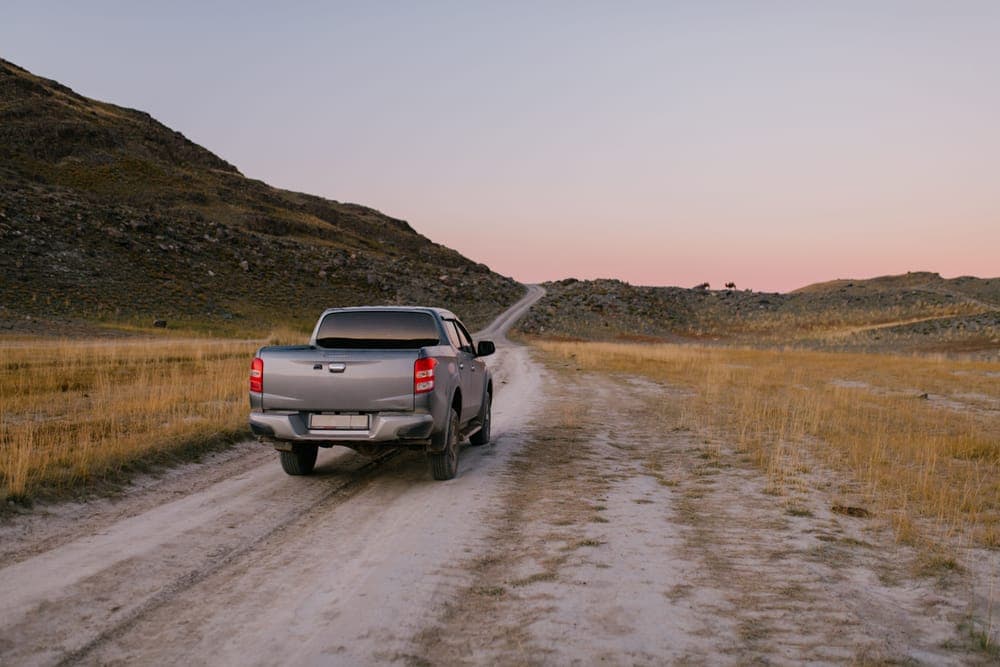
- The wrong shape for the job. Handhelds on the dash of a moving truck, with the antenna inside a steel cab, give up much of their reach. A mobile radio with an outside antenna is built for that seat. The reverse mistake happens too: a mobile needs vehicle power and an antenna, so it isn't something you carry to the stand.
Which do you need?
Here are the three shapes side by side, one real radio each:
- Everyone is on foot and within a mile or two (camp, trail, neighborhood, a big store or park): walkie-talkies. A license-free FRS pair like the Cobra RX680 is enough. Our best walkie-talkies ranking has the full field.
- You drive together (convoy, trail run, farm trucks): a mobile in each vehicle. The Midland MXT275 plugs into a 12V socket; our best GMRS mobile radios ranks the rest.
- Someone at home needs to reach the whole place (a ranch house, a hunting camp, a shop): a base radio on a mast. The BTECH GMRS-50V2 takes any antenna with an SO-239 plug, but plan for a 13.8 V DC source and an antenna bought separately. Our best GMRS antennas page covers the mast.
- All of the above: mix them. Handhelds for the people, a mobile for the truck, a base for the house, all on the same channel.
If I were starting from nothing on a big piece of land, I'd buy the handhelds first, learn where they fail, and then put a mobile or base where the dead spots are. That tells you exactly what to buy next. The walkie-talkies hub has the rest of the buying guides.
In detail
The contenders, in full
Stock photoThe walkie-talkie: a handheld pair
Cobra RX680 (2-pack)
Two license-free FRS handhelds with Cobra's stated 2 W high setting, IP54, NOAA alerts and 38 preset channel/code combos. Handheld reach, no license.
Published specsResearched · not tested by us
How the 6.3 score breaks down
- Real-world reach (30%)
- 4.5
- Ease of use (20%)
- 8
- Toughness & weather (15%)
- 6
- Power & battery (15%)
- 6
- Field features (10%)
- 8
- Value (10%)
- 7
What the specs support
- Cobra states the power (0.5 or 2 W) and says no license is required
- 38 preset channel/code combos make it simple to find a clear channel
- IP54, NOAA alerts and an SOS flashlight
Where it falls short
- No AA fallback listed; it relies on its Li-ion packs
- Micro-USB charging
Skip this if…
…Skip it if you need to run on store-bought batteries during a long outage: it charges its own Li-ion packs, so an AA radio like the ACXT645 suits that better.
#ad · Price set by Amazon · How we make money for the link to Cobra RX680 (2-pack)
Stock photoThe mobile: a radio for the truck
Midland MXT275 MicroMobile (15 W)
A 15 W GMRS mobile that plugs into a 12V socket, with a magnet-mount antenna in the box and the controls on the mic. It needs a GMRS license.
Published specsResearched · not tested by us
How the 6.9 score breaks down
- Real-world reach (30%)
- 8
- Ease of use (20%)
- 7
- Toughness & weather (15%)
- 4
- Power & battery (15%)
- 8
- Field features (10%)
- 6
- Value (10%)
- 7
What the specs support
- Plugs into a 12V socket, with no hardwiring needed
- Hideaway body and control mic keep the dash clear
- Repeater capable, and the SO-239 jack takes an upgraded antenna
Where it falls short
- Midland states no IP or water rating
- No PA or intercom jack listed, unlike the MXT115P PRO
- Channels 1-7 stay on low power (manual)
Skip this if…
…Skip it if the radio goes in an open-cab tractor or UTV that sees rain and dust: Midland states no water rating for the MXT275, while the MXT115P PRO at the same 15 W is IP67.
#ad · Price set by Amazon · How we make money for the link to Midland MXT275 MicroMobile (15 W)
Stock photoThe base: a radio for the house or shop
BTECH GMRS-50V2 (50 W mobile/base)
50 W with an SO-239 jack for a mast antenna. BTECH says to wire it to a battery or fuse block, and the antenna is sold separately. It needs a GMRS license.
Published specsResearched · not tested by us
How the 7.5 score breaks down
- Real-world reach (30%)
- 9
- Ease of use (20%)
- 6
- Toughness & weather (15%)
- 5
- Power & battery (15%)
- 8
- Field features (10%)
- 8
- Value (10%)
- 8
What the specs support
- 50 W with 20 W and 5 W steps, a list-price tier below Midland's 50 W MicroMobiles
- Quad watch and VHF/UHF scanner receive
- Standard SO-239 jack for any GMRS mobile or base antenna
- BTECH publishes a typical simplex range (2-5 miles in town or woods), not just a max figure
Where it falls short
- Needs direct 13.8 V wiring and an antenna bought separately
- IP54 splash resistance only
- 256 channels and many menus mean more setup than a Midland
Skip this if…
…Skip it if you want to plug into a 12V socket and drive off: BTECH says the GMRS-50V2 needs a direct battery or fuse-block connection, and it ships without an antenna.
#ad · Price set by Amazon · How we make money for the link to BTECH GMRS-50V2 (50 W mobile/base)
How we scored this
Radios we claim to have lab-tested: 0
Plenty of radio sites say they range-tested everything they list. We haven't, and we say so. Every pick here is labeled Researched: we read each maker's published specs, manuals and range tables, check the license rules against the FCC, and score every radio on a public rubric. Every figure links to where it came from, and every range number is labeled “advertised.”
Scores are editorial judgments from that documented research, not test results. Commissions never set a score or decide a pick. The rubric and its weights are published.
What changed
- Published.
Questions
Frequently asked
What is the difference between a walkie talkie and a 2-way radio?
Are two way radios and walkie talkies the same?
Is a GMRS radio a walkie-talkie?
Can a walkie-talkie talk to a radio in a truck?
Do I need a license for a two-way radio?
Is a CB radio a two-way radio?
Receipts
Sources
- 47 CFR 95.303, Part 95 definitions (via Cornell LII, checked 2026-09-22)
- 47 CFR 95.1763, GMRS channels (via Cornell LII, checked 2026-09-22)
- 47 CFR 95.1767, GMRS transmitter power limits (via Cornell LII, checked 2026-09-22)
- FCC: Family Radio Service (FRS) page (checked 2026-09-22)
- FCC: General Mobile Radio Service (GMRS) page (checked 2026-09-22)
- FCC: Personal Radio Services consumer guide (checked 2026-09-22)
- FCC: Personal service and amateur application fees (checked 2026-09-22)
- Retevis: RT29 product page (checked 2026-09-22)
- Midland: GXT1000VP4 product page (checked 2026-09-22)
- Midland: MXT275 spec sheet PDF (checked 2026-09-22)
- BTECH: GMRS-50V2 product page (checked 2026-09-22)
- Cobra: RX680 product page (checked 2026-09-22)
- Midland Support: FRS and GMRS 101 (checked 2026-09-22)
- 47 CFR 95.963, CB channel frequencies (via Cornell LII, checked 2026-09-22)
- 47 CFR 95.1761, GMRS transmitter certification (via Cornell LII, checked 2026-09-22)
We haven't tested the radios on this page and we don't pretend to. Specs and range figures come from each maker's own pages and manuals (linked on every product), and license, power and channel rules come from the FCC and 47 CFR Part 95. Range numbers are the maker's advertised claims and are labeled that way. Prices are set by Amazon and change often, so we don't print them. Where a figure isn't published, we say so. Read the full method.