Not legal advice. This page summarizes FCC rules (47 CFR Part 95) from the official sources linked in the text. Rules and fees checked . The FCC sets its fees annually and can change its rules, so confirm the current version on fcc.gov before you rely on it.
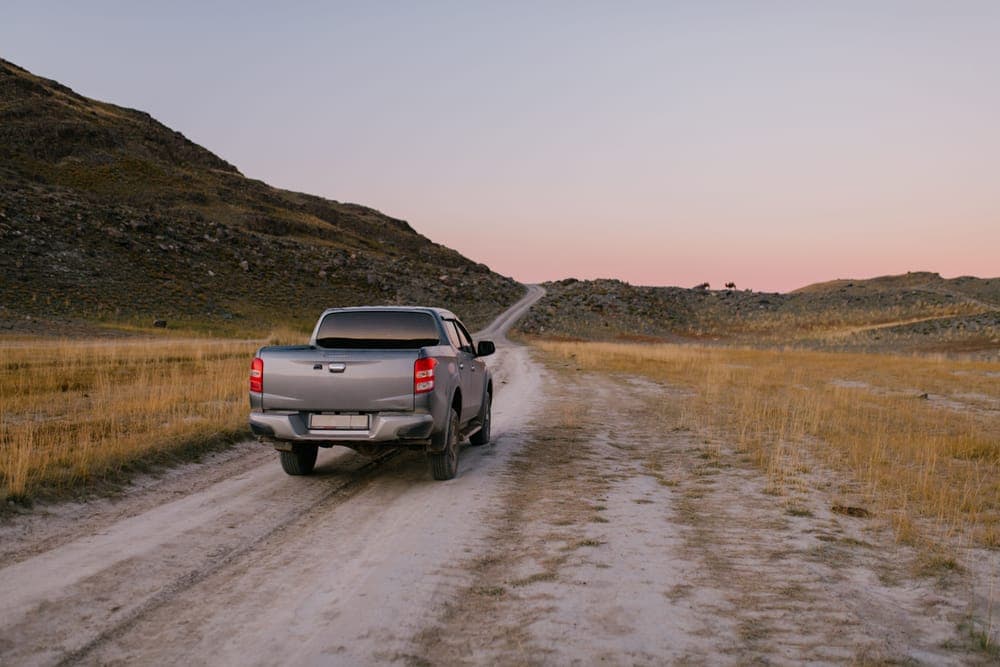
Here's the problem a repeater solves. Two people on a lease, a ridge between them, each holding a handheld about chest high. The FCC's own expectation for FRS is "up to two miles on the 2 watt channels, depending on conditions," and a ridge is the kind of condition that eats most of that. A GMRS handheld with more power does better, but it's still a radio near the ground trying to reach another radio near the ground.
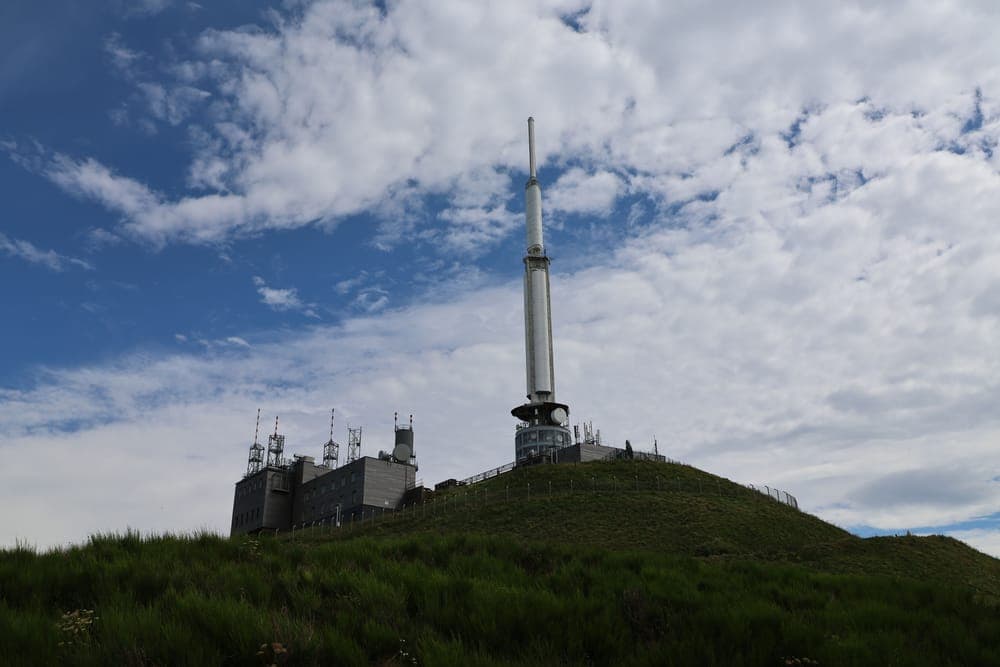
Now put a radio on top of that ridge, on a tall antenna, and have it repeat whatever it hears. Both people can reach the ridge top, so both can reach each other. That's a repeater. It's one of the things a GMRS license gets you that license-free FRS can't. This guide covers how they work, how to find one near you, how to get permission and set your radio up, the rules, and whether a private repeater makes sense for a ranch or a lease. Rules are quoted from the FCC and 47 CFR Part 95, checked September 22, 2026. More GMRS guides are on the GMRS & FRS hub.
What a GMRS repeater does
Part 95 defines it in 95.303: a repeater station is "A station in a fixed location used to extend the communications range of mobile stations, hand-held portable units and control stations by receiving their signals on one channel (the input channel) and simultaneously retransmitting these signals on another channel (the output channel), typically with higher transmitting power from a favorable antenna location (typically high above the surrounding terrain)."
On GMRS, those two channels are fixed by 95.1763. The repeater transmits on one of the eight 462 MHz main channels (channels 15 to 22), the only group of channels the rule opens to repeater stations. Your radio transmits to it on the matching 467 MHz main channel, which the rule says mobiles and handhelds may use "only when communicating through a repeater station or making brief test transmissions." Each input sits 5 MHz above its output: you talk on 467.6500 MHz, and everyone hears you on 462.6500 MHz. The full pairing chart is on our GMRS channels and frequencies page.
The FCC's consumer guide describes the idea in one line: "Some land stations operate as repeaters, thereby extending the range of GMRS mobile units." Everyone set to that repeater hears everyone else, so a repeater works like a shared party line for a whole area, not a private link between two radios.
Why a repeater multiplies your range
The key words in that definition are "favorable antenna location." Terrain and height beat wattage. A handheld in a creek bottom can't see over the bank, let alone the next ridge. A repeater antenna on a hilltop tower can see into a lot of creek bottoms at once. Your signal only has to go up to the repeater, and the repeater's signal comes down to everyone else, usually with more power behind it.
The FCC's GMRS page builds repeaters right into its range expectation: "A GMRS user can expect a communications range of one to twenty-five miles depending on station class, terrain, and repeater use." Makers say the same in their own terms. BTECH's GMRS-V2 page advertises "Open line-of-sight (simplex): 1–5+ miles typical | With GMRS repeaters: 15–50+ miles." Treat the big number as the maker's claim for good conditions, not a promise.
One catch. Your radio still has to reach the repeater. A repeater that booms into your handheld from 20 miles away may not hear your handheld answer, because the repeater has height and power on its side and you don't. If you can hear a repeater but can't get into it, the fix is usually on your end: move higher, fit a longer antenna, or use a mobile radio with a roof antenna. Our GMRS radio range guide goes deeper on what reaches how far.
How to find GMRS repeaters near you
None of the FCC pages we checked offer a repeater map. Two volunteer-built directories fill that gap, and we have no affiliation with either.
myGMRS.com. myGMRS describes itself as "a two-way radio community focused on the General Mobile Radio Service (GMRS) offering a repeater directory, license lookup, and forums." It ties accounts to real licenses. Its help center says it uses FCC license data "to verify our users are actually licensed by the FCC," and another help article says the site is "usually 24-48 hours behind the FCC website," so a brand-new call sign may not work there for a day or two. Users on its forums describe requesting access through a repeater's listing or messaging the owner directly, and waiting on owners who don't check often.
RepeaterBook.com. RepeaterBook is a larger directory that lists amateur (ham) repeaters as well as GMRS, so make sure you're in its U.S. GMRS section. That page calls itself "a comprehensive GMRS repeater database compiled by the GMRS community" and invites users to "find GMRS repeaters in your desired area. Update them, comment on them, and recommend them." You can search by proximity, by map or by state. Its Route Search and Line-of-Sight Finder are paid RepeaterBook Plus features, and it offers phone apps.
Treat any listing as a lead, not a fact. Both directories are maintained by users, so a listing can be out of date. A repeater can move, change its tone or go off the air. Confirm with the owner before you count on it for a hunt or a trip.
Listen before you look. You can also find active repeaters the old way. Set a radio to scan channels 15 to 22, the eight frequencies repeaters transmit on, and listen around your area for a few days. You don't transmit anything while you scan. If you hear regular traffic with a call sign and a repeater identifying itself, look that frequency up in the directories.
Tones, permission and asking the owner
Every repeater has an owner, and the owner decides who uses it. The rule says so directly. Under 95.1705(d), the licensee "May allow any person to use... its GMRS repeater, or alternatively, may limit the use of its GMRS repeater to specific persons," and "May disallow the use of its GMRS repeater by specific persons." Midland's MXT275 manual turns that into instructions: "Prior to using a repeater you must coordinate with the owner of the repeater to gain permission to use the repeater. Be sure to understand and follow the sharing and usage rules for each repeater system."
The tone is the key to the door. A repeater can be set to open only for radios that send a particular CTCSS or DCS code on the input, the same kind of code your radio calls a privacy code. That's why GMRS radios with repeater channels let you set the transmit and receive codes separately. Midland calls it "Split Tones," which in its GXT67 PRO manual means "selection of separate Receive and transmit privacy codes, which may be the same or different." How the codes work is covered in our privacy codes guide.
How to ask. Use the owner contact in the directory listing. Give your name and GMRS call sign, say where you'll be and roughly how you'll use it ("my family, weekends at our lease north of town"), and ask for:
- the output frequency or channel, and the input tone (and output tone, if it uses one)
- whether to run wide or narrow bandwidth
- any house rules: nets, family-only use, times to stay off
Be patient and polite. In one myGMRS forum thread, a user reported two weeks without a reply. And you need your own license to transmit through a repeater, just as on any GMRS channel. Your immediate family is covered under yours.
Setting up your radio for a repeater
The exact buttons vary, but the sequence is the same on almost every repeater-capable GMRS radio:
- Turn the repeater channels on. Many radios hide them until you do. On Midland's MXT275 it's the "rP" menu set to ON, after which the repeater channels show up as 15rP, 16rP and so on after channel 22. On the GXT67 PRO you select REPEATER from the top menu and set it to Enabled. Garmin's Rino 750 manual has a "Repeater Channel" setting that enables "the GMRS repeater channels in the United States."
- Pick the repeater channel that matches the output frequency. A repeater listed at 462.6500 MHz is channel 19, so choose 19R (Garmin), RP19 (Midland GXT67 PRO) or 19rP (MXT275).
- Set the tones. Put the owner's input tone on transmit. If the repeater also sends a tone, set it on receive; if not, leave receive open so you hear the repeater. On the MXT275 these are the "tC" (transmit) and "rC" (receive) menus. On the GXT67 PRO you pick separate RX and TX privacy codes for each repeater channel.
- Set wide bandwidth, unless the owner says otherwise. Midland's GXT67 PRO manual calls wideband "the setting used by most repeaters."
- Use high power. The MXT275 manual recommends HI "to ensure you get maximum range from your radio."
- Make a short test and identify. Listen first. Then key up briefly with your call sign. The rules allow brief test transmissions, and you should hear the repeater come back.
Some radios need a little more work. Keypad-and-menu radios let you build your own repeater channels: Wouxun says the KG-935G Plus has a Channel Wizard that programs a simplex or repeater channel from the keypad, and Radioddity lists 24 customizable GMRS repeater channels (31 to 54) on the GM-30 so you can store the same repeater with different codes. Baofeng says the UV-5G ships with "the 8 repeater pairs programmed in from Channel 23 to 30," with advanced settings done by computer. And one gotcha on Midland handhelds: the GXT67 PRO manual warns that "Repeaters are not compatible with Group Mode operation." Turn group mode off first.
Repeater etiquette, and the rules that apply
A repeater is shared by everyone in range of it, so manners matter more than on a simplex channel. Most of what follows is written into Part 95.
- Listen before you talk. The FCC's GMRS page says users "must cooperate in the selection and use of the channels under a 'listen-before-talk' etiquette."
- Keep it short and leave gaps. 95.1733(a)(10) prohibits "Continuous or uninterrupted transmissions, except for communications involving the immediate safety of life or property." A pause between exchanges lets someone with an urgent call get in.
- Give way to emergencies. Under 95.1731(a), operators "must, at all times and on all channels, give priority to emergency communications."
- Identify. 95.1751 requires your call sign at the end of a transmission or series, and at least every 15 minutes during a long one.
- Watch what you send. 95.1733 bars, among other things, "Music, whistling, sound effects or material to amuse or entertain," advertisements, and "Coded messages or messages with hidden meanings ('10 codes' are permissible)."
- Follow the owner's rules. Some repeaters are open, some are family-only, some run scheduled nets. The owner can limit or revoke access under 95.1705(d).
Why GMRS repeaters can't be linked over the internet
On GMRS, the FCC says no to linking repeaters over the internet. From its GMRS page: "repeaters may not be linked via the internet—an example of an 'other network' in the rules—to extend the range of the communications across a large geographic area. Linking multiple repeaters to enable a repeater outside the communications range of the handheld or mobile device to retransmit messages violates sections 95.1733(a)(8) and 95.1749 of the Commission's rules."
There is one allowed use of a network connection: remote control. 95.1745 allows GMRS repeater, base and fixed stations to be "operated by remote control," and 95.1749 lets them connect to the phone network or other networks "for the sole purpose of operation by remote control." The FCC's page sums it up: repeaters may be connected to networks "only for purposes of remote control of a GMRS station, not for carrying communication signals."
The FCC also explains why. "Because GMRS spectrum is limited and used on a shared 'commons' basis, the service only works well on a localized basis when users can hear each other and cooperate in the sharing of channels." If you come across a listing that promises statewide coverage by linking repeaters together over the internet, that's the arrangement the FCC's page says violates the rules.
Radios that work with repeaters
Now you know what a radio needs to use a repeater: repeater channels, separate transmit and receive tones, wide bandwidth, and ideally an antenna you can upgrade so your signal actually gets up the hill. The three below have all of that between them, two handhelds and one mobile. All three need a GMRS license to transmit. For more, see the best GMRS handheld radios and the best GMRS mobile radios.
Our picks for this job
Two handhelds and a truck radio for repeater work
A budget handheld with an antenna you can upgrade, a menu-deep handheld for whoever programs the group's radios, and a 50 W mobile for reaching a distant repeater from the truck or camp. All three need a GMRS license.
 Stock photo
Best budget GMRS for repeater users
BTECH GMRS-V2 (single radio)
The budget repeater radio: rated at 5 W, repeater compatible, an SMA-female jack for a longer antenna, and USB-C. BTECH advertises 15-50+ miles with repeaters against 1-5+ miles simplex. Set up by keypad menu or CHIRP.
Check price · Amazon#ad · Price set by Amazon · How we make money for the link to BTECH GMRS-V2 (single radio)
- Stock photo
Best power-user GMRS handheld
Wouxun KG-935G Plus (single radio)
For the person who programs everyone's radios: 8 GMRS repeater channels, a keypad Channel Wizard that builds a repeater channel without a computer, IP66 and a removable SMA-male antenna. Wouxun lists 5.5 W / 2 W / 0.5 W.
Check price · Amazon#ad · Price set by Amazon · How we make money for the link to Wouxun KG-935G Plus (single radio)
 Stock photo
Best 50 W Midland for trucks and farms
Midland MXT500 MicroMobile (50 W)
The truck or camp radio for a far-off repeater: 50 W, 8 repeater channels, a PA function and a water-resistant body (IPX6 in the manual, IP66 on the page). Midland publishes no range figure for it.
Check price · Amazon#ad · Price set by Amazon · How we make money for the link to Midland MXT500 MicroMobile (50 W)
Should you put up your own repeater on the ranch or lease?
Sometimes no public repeater covers the ground you care about. A big ranch in rolling country, a lease with a river bottom, a farm where the combines work miles from the shop. If there's a high point on the property (a hill, a barn, a tower), a private repeater there can tie the whole place together. It's a real project, though, and the rules come with it.
What the rules require. A repeater is a GMRS station, so it runs under a license: yours. Its output goes on a 462 MHz main channel and it's held to 50 W transmitter output (95.1767). You decide who may use it (95.1705(d)). You can run it by remote control (95.1745), but not link it over the internet to carry traffic. On identification, 95.1751(c) says a repeater doesn't have to transmit its own ID if it retransmits only stations under the same license and those stations identify themselves. Once other licensees use it, plan on the repeater identifying itself.
For a hunting club or a group of neighbors. Everyone who transmits still needs their own license or has to be your immediate family. Part 95 has a mechanism for sharing, called cooperative use. Under 95.1705(f), licensees "may share the use of their stations with other persons eligible in the GMRS," without charge, on a non-profit cost-sharing basis or on a reciprocal basis. The licensee "must maintain access to and control over all stations," and "All sharing arrangements must be conducted in accordance with a written agreement to be kept as part of the station records." If the club is splitting the cost of a repeater, write it down.
The equipment. A repeater has to listen and talk at the same time, which normally takes a duplexer so it can do both through one antenna. BTECH sells an all-in-one unit, the GMRS-RPT50. BTECH lists "50W RF output," a built-in duplexer, "100% maximum work cycle," built-in CW ID, and "All eight GMRS repeater pairs" configurable from the front panel. It even pitches the unit for "farms, ranches and large private properties." BTECH is clear that it isn't the whole system: "A properly installed GMRS antenna and quality 50-ohm coax are required and sold separately," and it runs on mains power with a 13.8 V DC backup. We don't rank repeaters, so there's no buy link here. It's a far bigger purchase than any radio on this page, so check BTECH's store for the current price and specs.
Try the simpler fix first. Before you build a repeater, I'd put a 50 W mobile at camp or the shop on a good antenna mounted as high as you can get it. For a lot of properties, one base radio up high plus mobiles in the trucks covers the ground without a repeater. Our how to cover your property with radios guide walks through that plan, and the best GMRS antennas covers the part that matters most: the antenna. If you still can't reach the back forty, then the repeater is the next step.
How we scored this
Radios we claim to have lab-tested: 0
Plenty of radio sites say they range-tested everything they list. We haven't, and we say so. Every pick here is labeled Researched: we read each maker's published specs, manuals and range tables, check the license rules against the FCC, and score every radio on a public rubric. Every figure links to where it came from, and every range number is labeled “advertised.”
Scores are editorial judgments from that documented research, not test results. Commissions never set a score or decide a pick. The rubric and its weights are published.
Questions
Frequently asked
How do I find GMRS repeaters near me?
Do I need a license to use a GMRS repeater?
How far can a GMRS repeater reach?
What is the GMRS repeater offset?
What tone do I need for a GMRS repeater?
Can FRS radios use a GMRS repeater?
Can GMRS repeaters be linked together?
Receipts
Sources
- FCC: General Mobile Radio Service (GMRS) page, updated Aug. 14, 2024 (checked 2026-09-22)
- FCC consumer guide: Personal Radio Services (PRS) - Keeping in Touch (checked 2026-09-22)
- 47 CFR 95.303, definitions: repeater station (Cornell LII, checked 2026-09-22)
- 47 CFR 95.1705, licenses, repeater use and cooperative use (Cornell LII, checked 2026-09-22)
- 47 CFR 95.1731, permissible GMRS uses (Cornell LII, checked 2026-09-22)
- 47 CFR 95.1733, prohibited GMRS uses (Cornell LII, checked 2026-09-22)
- 47 CFR 95.1745, GMRS remote control (Cornell LII, checked 2026-09-22)
- 47 CFR 95.1749, GMRS network connection (Cornell LII, checked 2026-09-22)
- 47 CFR 95.1751, GMRS station identification (Cornell LII, checked 2026-09-22)
- 47 CFR 95.1763, GMRS channels (Cornell LII, checked 2026-09-22)
- 47 CFR 95.1767, GMRS transmitting power limits (Cornell LII, checked 2026-09-22)
- myGMRS.com home page (checked 2026-09-22)
- myGMRS Help Center: Why is my home address listed on the website? (checked 2026-09-22)
- myGMRS Help Center: Why can't I register? My GMRS callsign was just assigned (checked 2026-09-22)
- myGMRS Forums: Repeater access requests thread (checked 2026-09-22)
- RepeaterBook.com home page (checked 2026-09-22)
- RepeaterBook: U.S. GMRS repeaters (checked 2026-09-22)
- BTECH: GMRS-RPT50 repeater product page (checked 2026-09-22)
- BTECH: GMRS-V2 product page (checked 2026-09-22)
- Midland: MXT275 owner's manual PDF, repeater channels (checked 2026-09-22)
- Midland: GXT67 PRO owner's manual PDF, repeater operation (checked 2026-09-22)
- Garmin: Rino 750/750t/755t owner's manual PDF (checked 2026-09-22)
- Wouxun: KG-935G Plus product page (checked 2026-09-22)
- Radioddity: GM-30 product page (checked 2026-09-22)
- Baofeng: UV-5G (UV-5X) GMRS product page (checked 2026-09-22)
- Midland: MXT500 product page (checked 2026-09-22)
We haven't tested the radios on this page and we don't pretend to. Specs and range figures come from each maker's own pages and manuals (linked on every product), and license, power and channel rules come from the FCC and 47 CFR Part 95. Range numbers are the maker's advertised claims and are labeled that way. Prices are set by Amazon and change often, so we don't print them. Where a figure isn't published, we say so. Read the full method.