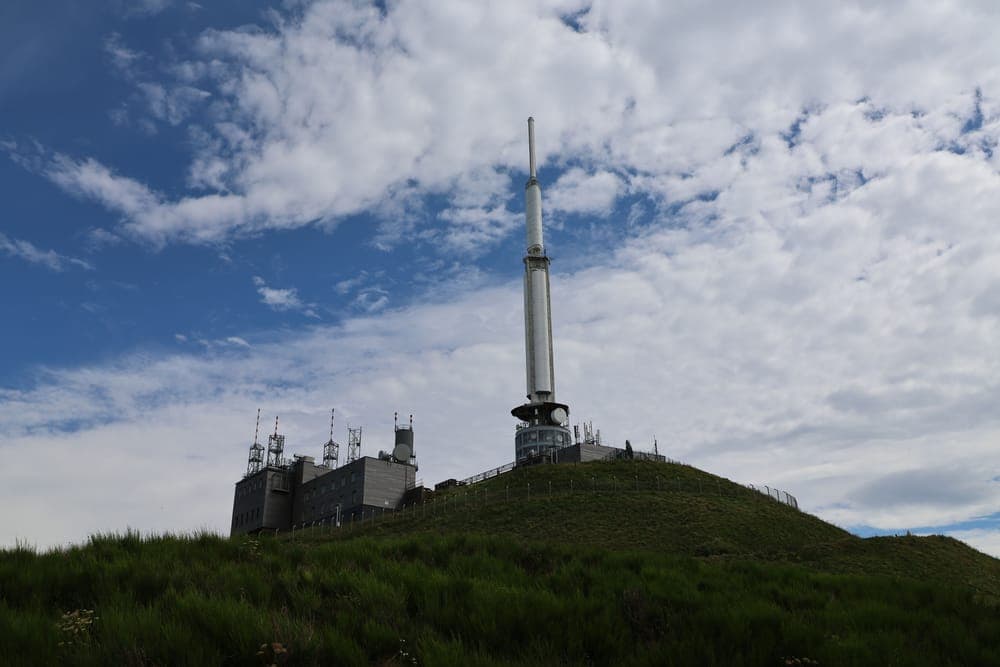
You're on the lease, the ridge or the far loop of the campground, and the phone shows no bars. The question isn't what the box says. It's whether your voice gets from this stand to that truck. So this page answers how far walkie-talkies reach using the only honest numbers there are: the radio makers' own terrain figures, printed in their fine print, and the FCC's own expectations for each radio service. We don't run range trials of our own, so every figure below is labeled with whose number it is, and every maker figure is an advertised one.
If you already know you want the radios that reach farthest, our ranked best long-range walkie-talkies is the buying page. If you're trying to make sense of a 38-mile promise on a blister pack, start with walkie-talkie range claims explained. This page is the plain question: what do they really reach, and why?
How far can walkie-talkies reach? Realistic range by terrain
Every number in this table comes from a manufacturer's own product page, spec sheet or FAQ, or from the FCC. None of them are ours. Where a maker gives a span, we print the whole span.
| Where you're talking | Published range | Whose figure |
|---|---|---|
| Mountaintop to valley, clear line of sight | Up to 35 miles (FRS); 35+ miles (FRS and GMRS) | Motorola Talkabout footnote; Rocky Talkie line-of-sight row |
| Open water | Up to 6 miles | Motorola Talkabout T800 / T600 / T470 footnote |
| Mountains, backcountry | 1 to 5 miles (FRS); 2 to 8 miles (GMRS); 0.5 to 6 miles (FRS ski radio) | Rocky Talkie Mountain; Rocky Talkie Expedition; BCA BC Link terrain range |
| Forest and hills | 0.5 to 3 miles (FRS); 0.5 to 5 miles (GMRS) | Rocky Talkie Mountain; Rocky Talkie Expedition |
| River corridors | 0.5 to 3 miles (GMRS) | Rocky Talkie Expedition |
| "Normal conditions," family GMRS pair | 1/2 to 2 miles | Midland GXT FAQ |
| Neighborhood | Up to 2 miles | Motorola Talkabout footnote |
| City | Up to 1 mile (FRS); up to 1.5 miles (GMRS) | Rocky Talkie Mountain; Rocky Talkie Expedition |
| Any FRS radio, per the regulator | Less than 0.5 mile on the 0.5 W channels; up to 2 miles on the 2 W channels | FCC consumer guide |
| Vehicle radio, in town or woods | 2 to 5 miles | BTECH GMRS-50V2 (50 W mobile) |
| Vehicle radio, open rural ground | 5 to 15 miles | BTECH GMRS-50V2 (50 W mobile) |
| GMRS handheld through a repeater | 15 to 50+ miles (advertised) | BTECH GMRS-V2 page |
| Any GMRS station, per the regulator | 1 to 25 miles "depending on station class, terrain, and repeater use" | FCC GMRS page |
One pattern jumps out. The only rows with double-digit miles are the ones with nothing in the way (a mountaintop, open water, open rural ground) or with a repeater doing the heavy lifting. Put a hill, a stand of timber or a town between two handhelds and every maker's number drops to a few miles or less.
How to read those numbers
Three things are worth knowing before you plan around any row.
The top of each span is a good day. Rocky Talkie describes its license-free Mountain Radio as having a "tested max range of 35+ miles—though 1–5 miles is typical in backcountry terrain" (Rocky Talkie Mountain Radio page). Midland's own FAQ says its GXT radios' "36 mile range is in perfect conditions such as mountain top to mountain top" and that "the GXT averages 1/2-2 miles in normal conditions" (Midland GXT1000VP4 page). Motorola says its T470, T600 and T800 series reach "up to 35 miles in ideal line-of-sight conditions," then adds "Range may vary depending on your environment" (Motorola Talkabout lineup). The makers are telling you the small number too. It's just in smaller type.
The same maker, same terrain, is the fairest comparison. Rocky Talkie sells a 2 W FRS radio and a 5 W GMRS radio and publishes the same terrain rows for both. In mountains it goes from 1 to 5 miles to 2 to 8 miles. In forest and hills it goes from 0.5 to 3 miles to 0.5 to 5 miles. In the city, from up to 1 mile to up to 1.5 miles. The bigger radio stretches the top of each span. The bottom, half a mile in the trees, doesn't move. Terrain sets the floor.
The regulator's numbers are the sanity check. The FCC expects FRS radios to cover "generally less than one-half mile on the 0.5 watt channels and up to two miles on the 2 watt channels, depending on conditions" (FCC consumer guide), and GMRS users to expect "one to twenty-five miles depending on station class, terrain, and repeater use" (FCC GMRS page). The makers' terrain rows sit inside those bands. The 35-mile headlines don't.
If I were planning a hunt or a trip around these numbers, I'd plan on the low figure for my kind of ground and treat anything past it as a bonus. You never get to pick the day the radio has to work.
Why range changes so much: line of sight
FRS and GMRS radios work on channels around 462 and 467 MHz (FCC GMRS page). At those frequencies the signal mostly travels in a straight line. Midland puts it plainly in its mobile-radio FAQ: "With GMRS (UHF) frequencies, radio wave optimization has the most to do with line of sight, with some ability to penetrate foliage and walls." Then it gives the example every radio owner eventually lives through. Two radios a mile apart with "a large hill between them" may not communicate at all, while two radios "ten miles apart with nothing between them (picture a mountain top to a mountain top)" may do fine (Midland MXT575 page, FAQ).
That one idea explains most of what people call bad radios. The creek bottom that kills a call the ridge carries easily. The two stands a half mile apart that can't hear each other because a finger ridge runs between them. The lead truck that drops out as soon as it rounds a bend in a canyon. Even on flat ground, the Earth curves away between two people standing up, which is why every ideal-case figure on the box starts from a high place: "mountain to valley" for Motorola, "mountain top to mountain top" for Midland.
Height beats watts
If line of sight is the rule, height is the cheapest way to get more of it. The FCC's own definition of a repeater says it extends range by retransmitting signals "typically with higher transmitting power from a favorable antenna location (typically high above the surrounding terrain)" ( 47 CFR 95.303). BTECH says the range of its 50 W mobile "depends heavily on antenna choice, antenna height, terrain, obstructions, installation quality, and whether you are using simplex or a repeater" (BTECH GMRS-50V2 page). Midland's MXT275 manual, under "To ensure you get maximum range," starts with "mount the antenna (included) as high as possible on your vehicle" (Midland MXT275 owner's manual).
In the field that means small, free moves. Climb into the stand before you call. Walk up out of the draw. Stand on the tailgate. Talk from the second-story window instead of the basement. If a call won't go through from the creek bottom, I'd walk uphill before I'd reach for the power button.
Hills, trees, buildings and you
Anything between the two antennas costs you. Midland's T10 FAQ says it flatly: "As with all two way radios, any obstructions between radios will reduce the range" (Midland T10 page). Backcountry Access, which builds radios for avalanche terrain, lists the usual suspects: "A really thick batch of trees, rock bands, walls, or other obstructions will reduce the transmit range" (BCA BC Link FAQ).
- Hills and ridges are the big one, because they block the straight line completely. A handheld on each side of a ridge may not connect at any wattage.
- Timber soaks up signal rather than stopping it outright, which is why the makers' forest-and-hills rows start at half a mile.
- Buildings are covered below, in the town section.
- You and your truck count too. A radio clipped under a jacket or lying on the floorboard is behind one more obstruction. Hold it up and clear of your body and the cab when a call matters.
What power and antennas really add
Power matters. It just matters less than the box implies. Here is where each class of radio sits:
- FRS radios are capped by the FCC at 2 W ERP on channels 1 to 7 and 15 to 22 and 0.5 W on channels 8 to 14, and the FCC says FRS-only units "have antennas that are integrated with the unit" (FCC FRS page; FCC consumer guide). Every FRS radio lives under the same ceiling.
- GMRS handhelds are typically rated at 5 W by their makers (Rocky Talkie's Expedition, Midland's GXT67 PRO and BTECH's GMRS-V2 all list 5 W), and the FCC says GMRS units "may have detachable antennas" (FCC consumer guide).
- GMRS mobile, base and repeater stations may run up to 50 W on the main channels under 47 CFR 95.1767, usually into an antenna on a roof or a mast.
Midland's own vehicle-radio charts show how far watts go on their own. Its 15 W MXT275 lists "50 Miles MAX" with no obstruction, "10-15 Miles IDEAL" with partial obstruction and "5-10 Miles OBSTRUCTED" with major obstruction (MXT275 spec sheet). Its 50 W MXT575 lists 75, 20 to 25 and 10 to 15 miles for the same three conditions (MXT575 spec sheet). More than three times the power moves the obstructed figure from 5 to 10 miles up to 10 to 15. The drop from Midland's own MAX row to its OBSTRUCTED row is far bigger than the gap between the two radios. That's what "terrain beats wattage" looks like in a maker's own numbers.
A better antenna is the other lever, and only GMRS gives it to you on a handheld. Cobra's TrailBlazer FAQ notes that "for handheld radios add-on antennas can provide greater range" ( Cobra TrailBlazer 450 FAQ), and Rocky Talkie advertises that its longer whip "improves your Expedition Radio's signal strength and audio quality by up to 30%, depending on terrain" (Rocky Talkie whip antenna page). Treat that as a maker claim, like any other.
FRS vs GMRS: the service sets the ceiling
Most walkie-talkies in a big-box store are FRS (Family Radio Service) radios. The FCC says FRS is "licensed by rule," so "an individual license is not required," and anyone can use one regardless of age (FCC FRS page). That convenience comes with the 2 W ceiling and the fixed antenna, which is why the FCC's own FRS expectation tops out around two miles.
GMRS radios share all 22 FRS channels (the FCC lists 30 GMRS channels in all) and add higher power, removable antennas and access to repeaters. The catch is a GMRS license: "An FCC license is required to operate GMRS," licenses run for a ten-year term, and any family member, regardless of age, can operate within the licensed system (FCC GMRS page). A new license application is $35 per the FCC's fee table (checked September 2026); the FCC sets fees annually. Our GMRS radio range guide goes deeper on what each GMRS station type reaches.
For the problem-solver, the choice usually comes down to this. If everyone will be within a mile or two on broken ground, FRS is fine and no one needs paperwork. If you need to reach across a big property, over a ridge or down a long canyon, GMRS is the real step up, not a bigger number on a license-free box.
Repeaters: borrowing someone else's height
A GMRS repeater is a radio on a tower or hilltop that hears your handheld on one channel and re-sends it on another. The FCC's consumer guide says "some land stations operate as repeaters, thereby extending the range of GMRS mobile units" ( FCC consumer guide). It is the single biggest range jump available to a handheld. BTECH's GMRS-V2 page lists "open line-of-sight (simplex): 1–5+ miles typical" for the radio alone and "with GMRS repeaters: 15–50+ miles (terrain and repeater height dependent)" ( BTECH GMRS-V2 page). Both are advertised figures, but the gap between them is the point.
Two limits. First, FRS radios can't use repeaters: the repeater inputs sit on the 467 MHz main channels, and the FCC says a radio that transmits on those channels "is a GMRS device and an individual FCC license is needed" (FCC FRS page). Second, the FCC says GMRS repeaters "may not be linked via the internet" to stretch coverage across a large area (FCC GMRS page), so a repeater helps locally, not nationwide.
How far can walkie-talkies reach in a city, and through walls?
Town is hard ground for radios. Rocky Talkie's city row is "up to 1 mile" for its FRS radio and "up to 1.5 miles" for its GMRS radio. Motorola's neighborhood figure for its larger Talkabouts is "up to 2 miles." Even BTECH's 50 W mobile, with a proper vehicle antenna, is listed at "2–5 miles in-town or wooded areas" (BTECH GMRS-50V2 page).
Walls are the same story at close range. Midland says GMRS frequencies have "some ability to penetrate foliage and walls," and BCA lists walls among the obstructions that "will reduce the transmit range." Big buildings are worse. NIST researchers studying radio for firefighters and police, at about 750 MHz (near, but not the same as, the 462 to 467 MHz FRS and GMRS channels), describe "the strong attenuation of radio signals caused by losses and scattering in the building materials and structure" of large buildings (NIST Technical Note 1552).
The honest answer: walkie-talkies usually work through a wall or two inside a house or between nearby houses, and they get less reliable with every wall, floor and building you add. Inside a big building, a store or a parking structure, expect dead spots, and check the specific spots you'll use before you depend on them.
How to get more reach, in the order I'd try it
- Get higher. Stand, ridge, hilltop, tailgate, upstairs window. It costs nothing and it's the fix every maker's fine print points to.
- Get out from behind the obstacle. Step to the edge of the timber or the top of the draw. A few yards can open the straight line.
- Pick the right channel. On FRS, channels 8 to 14 are limited to 0.5 W, and the FCC says their usual range is "less than one-half mile" (FCC FRS page). Use 1 to 7 or 15 to 22. Our walkie-talkie channels guide covers the rest.
- Set high power and keep the battery up. Many radios have a low setting to save battery. BCA notes that on a very low battery its BC Link "can often receive but not transmit" (BCA BC Link FAQ).
- Step up to GMRS with a removable antenna and repeater channels, and get the license.
- Fit a longer antenna on a GMRS handheld, or put a mobile radio in the truck with its antenna on the roof.
- Use a repeater if there's one in your area. It's the biggest single jump a handheld can make.
Run your own range test before the day it matters
No table knows your property. BCA's advice to its own customers is the right one: "Testing the range in different terrain environments will get you and your group familiar with conditions that might cause an issue with range" (BCA BC Link FAQ). A simple walk-around range test takes an afternoon:
- Put every radio on the same channel and the same privacy code, on high power, with fresh batteries.
- One person stays at the base spot you'll really use: camp, the house, the truck.
- The other walks or drives to the places that matter (each stand, the back gate, the far pasture) and checks in from each one.
- Where a call fails, try again standing up, from a few yards uphill, and on another channel. Note what fixed it.
- Mark the dead spots on a map, and agree on a fallback spot to walk to if you lose contact.
Do it once with the radios you have. If the dead spots are where you need to talk, you'll know exactly what problem you're buying a fix for.
What to buy for real reach
Once you know line of sight is the limit, the shopping list writes itself: a radio whose maker publishes honest terrain figures, a GMRS option with a removable antenna and repeater channels, and a vehicle radio with a roof antenna for the truck at camp. These three cover those jobs.
Our picks for this job
Radios whose makers publish the real range
Each maker below prints terrain figures, not just a headline number, so you can plan on what the radio really reaches. Two need a GMRS license; one doesn't.
 Stock photo
Best rugged GMRS for backcountry trips
Rocky Talkie Expedition Radio (single radio)
Needs a GMRS license. Rated at 5 W with a removable antenna and 8 repeater channels; Rocky Talkie lists 2 to 8 miles in mountains and 0.5 to 5 in forest and hills.
Check price · Amazon#ad · Price set by Amazon · How we make money for the link to Rocky Talkie Expedition Radio (single radio)
 Stock photo
Best for climbers and ski tourers
Rocky Talkie Mountain Radio (single radio)
No license. The same terrain table at FRS power: 1 to 5 miles in mountains, 0.5 to 3 in forest and hills, up to 1 mile in the city.
Check price · Amazon#ad · Price set by Amazon · How we make money for the link to Rocky Talkie Mountain Radio (single radio)
 Stock photo
Best 15 W with the controls on the mic
Midland MXT275 MicroMobile (15 W)
Needs a GMRS license. A 15 W truck radio with a magnet-mount roof antenna; Midland lists 10 to 15 miles with partial obstruction and 5 to 10 with major obstruction.
Check price · Amazon#ad · Price set by Amazon · How we make money for the link to Midland MXT275 MicroMobile (15 W)
What else you'll need: a GMRS license for the Expedition Radio and the MXT275 (one license covers the family), a second radio for every pair (Rocky Talkie sells singles), and a steel roof or a mount for the MXT275's magnetic antenna. For the full ranked list, see our best long-range walkie-talkies. Covering a whole property from a house or shop is a different job, handled in our farm and ranch radio picks. Everything else on real-world range lives on the Real Range hub.
How we scored this
Radios we claim to have lab-tested: 0
Plenty of radio sites say they range-tested everything they list. We haven't, and we say so. Every pick here is labeled Researched: we read each maker's published specs, manuals and range tables, check the license rules against the FCC, and score every radio on a public rubric. Every figure links to where it came from, and every range number is labeled “advertised.”
Scores are editorial judgments from that documented research, not test results. Commissions never set a score or decide a pick. The rubric and its weights are published.
Questions
Frequently asked
How far can walkie talkies reach in a city?
Do walkie talkies work through walls?
What is the range of a walkie-talkie in miles?
Does a higher-wattage walkie-talkie always reach farther?
How do I test walkie-talkie range?
Can I get more range without a license?
Receipts
Sources
- FCC: General Mobile Radio Service (GMRS) page (checked 2026-09-22)
- FCC: Family Radio Service (FRS) page (checked 2026-09-22)
- FCC consumer guide: Personal Radio Services (checked 2026-09-22)
- FCC: Personal service and amateur application fees (checked 2026-09-22)
- 47 CFR 95.303, definitions (Cornell LII, checked 2026-09-22)
- 47 CFR 95.1767, GMRS transmitting power limits (Cornell LII, checked 2026-09-22)
- Rocky Talkie: Mountain Radio product page (checked 2026-09-22)
- Rocky Talkie: Expedition Radio product page (checked 2026-09-22)
- Rocky Talkie: Whip Antenna for Expedition Radio (checked 2026-09-22)
- Motorola Solutions: Talkabout T800 series page (checked 2026-09-22)
- Motorola Solutions: consumer Talkabout lineup page (checked 2026-09-22)
- Midland: GXT1000VP4 product page and FAQ (checked 2026-09-22)
- Midland: MXT575 product page and FAQ (checked 2026-09-22)
- Midland: MXT575 spec sheet PDF (checked 2026-09-22)
- Midland: MXT275 spec sheet PDF (checked 2026-09-22)
- Midland: MXT275 owner's manual PDF (checked 2026-09-22)
- Midland: X-Talker T10 product page and FAQ (checked 2026-09-22)
- BTECH: GMRS-V2 product page (checked 2026-09-22)
- BTECH: GMRS-50V2 product page (checked 2026-09-22)
- Backcountry Access: BC Link 2.0 product page (checked 2026-09-22)
- Backcountry Access: BC Link radios FAQ (checked 2026-09-22)
- Cobra: TrailBlazer 450 product page and FAQ (checked 2026-09-22)
- NIST Technical Note 1552, radio signal attenuation in large buildings, 2009 (checked 2026-09-22)
We haven't tested the radios on this page and we don't pretend to. Specs and range figures come from each maker's own pages and manuals (linked on every product), and license, power and channel rules come from the FCC and 47 CFR Part 95. Range numbers are the maker's advertised claims and are labeled that way. Prices are set by Amazon and change often, so we don't print them. Where a figure isn't published, we say so. Read the full method.