Not legal advice. This page summarizes FCC rules (47 CFR Part 95) from the official sources linked in the text. Rules and fees checked . The FCC sets its fees annually and can change its rules, so confirm the current version on fcc.gov before you rely on it.
This question comes from four different places: a basement in a house, a parking garage, a tunnel or storm drain, and a cave. The physics is the same in all four, and so is the answer — radio signal does not travel through solid ground, it travels through the openings.
What happens to the signal
FRS and GMRS radios work around 462-467 MHz, which is UHF. Those wavelengths are absorbed and scattered by water, soil, rock, concrete and steel reinforcement, and the loss is measured in tens of decibels through a single structure (NIST: electromagnetic signal attenuation in construction materials). NIOSH's own mine-communications material puts the practical consequence plainly: handheld radios "can establish a physical communications link through air, but the range is very limited underground" ( NIOSH: mine communications and tracking tutorial).
That phrase — through air — is the whole explanation. Your signal is not going through the earth above you; it is bouncing along whatever air path exists. A straight tunnel behaves a bit like a waveguide and you get surprisingly far. A tunnel with a bend in it, a stairwell, or a cave passage that turns and drops, kills the link in a few yards.
How far you actually get
The FCC puts a 2-watt FRS radio at "up to two miles, depending on conditions" in the open (FCC personal radio services guide). Below ground, with no official figures to quote, the honest guidance is structural rather than numeric:
- A house basement to the ground floor: normally fine. One floor and a wooden deck is not much attenuation.
- A basement to outdoors across a yard: unreliable, and worse if the foundation is poured concrete with rebar.
- A parking garage, same level: usually workable; the structure is mostly open air with pillars.
- A garage two or three levels down to the street: expect failure, and expect it to be the ramp that saves you when it works.
- A straight tunnel or storm drain: hundreds of feet is plausible. Around the first bend, nothing.
- A cave: line of sight within one chamber, and essentially nothing between chambers. Cavers use entirely different equipment for a reason.
The same logic governs buildings above ground, which is a more common version of this problem — see best two-way radios for concrete buildings.
What mines and tunnels actually use
Underground industry gave up on direct radio decades ago. The standard answer is a leaky feeder: a specially designed coaxial cable with regular openings in its outer shield, run along the passageways, so RF energy leaks in and out along its whole length and the antenna is effectively everywhere people are working (NIOSH: mine communications and tracking tutorial). Alongside that sit node-based wireless systems and dedicated through-the-earth research systems at much lower frequencies.
None of that is a consumer purchase, and that is the useful takeaway: if professionals install cable to solve this, a 5-watt handheld was never going to.
What helps, in order
- A relay person. Station someone at the entrance, the ramp or the top of the stairs. Two short hops beat one impossible one, and it costs nothing.
- Get the radio into the opening. Stand in the doorway, on the ramp, under the grate, at the mouth of the passage. Signal follows air.
- A better antenna, if the radio allows one. FRS radios are required to have a fixed antenna (47 CFR 95.567), so this is a GMRS-only option — and it improves receive as well as transmit.
- Agree a check-in schedule instead of live contact. "Call me when you are back at the entrance at 4" works underground; continuous contact does not.
- Power, last. It is the least effective lever here, though hi power costs you nothing but battery.
Our picks for this job
Three radios for work below ground
None of these transmits through rock. They are chosen for the things that matter when you are in and out of a basement, a garage or a tunnel mouth: durability, a battery that lasts, and an antenna you can improve.
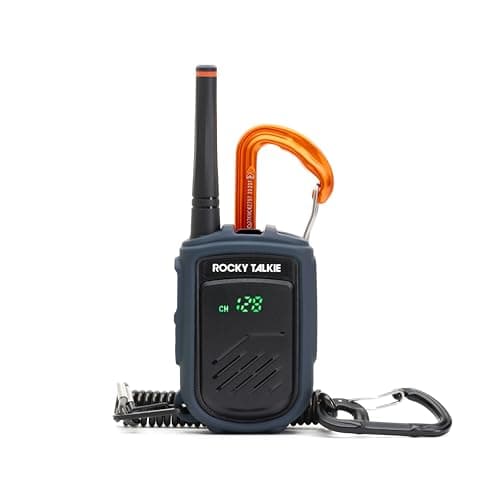
Best for climbers and ski tourers
Rocky Talkie Mountain Radio (single radio)
License-free, IP56, a replaceable Li-ion Rocky Talkie rates at 3 to 5 days, and a shatterproof screen with a climbing-rated carabiner. The one to clip to a harness.
$120.00Amazon#ad · Price as of November 2, 2026 · How we make money for the link to Rocky Talkie Mountain Radio (single radio)
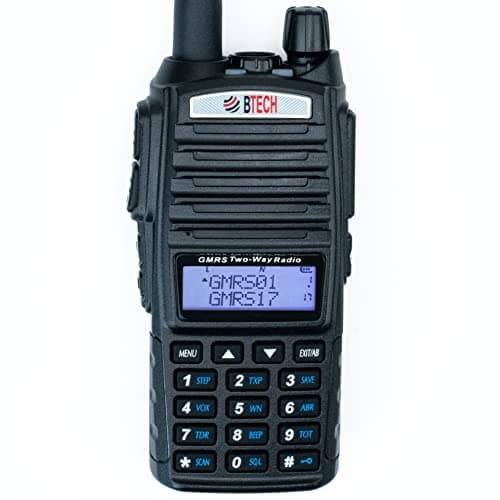
Best budget GMRS for repeater users
BTECH GMRS-V2 (single radio)
The cheap GMRS option with a removable antenna, which is the only real signal upgrade available on this list. Repeater capable if there is a machine above ground.
Check price · Amazon#ad · Price as of November 2, 2026 · How we make money for the link to BTECH GMRS-V2 (single radio)
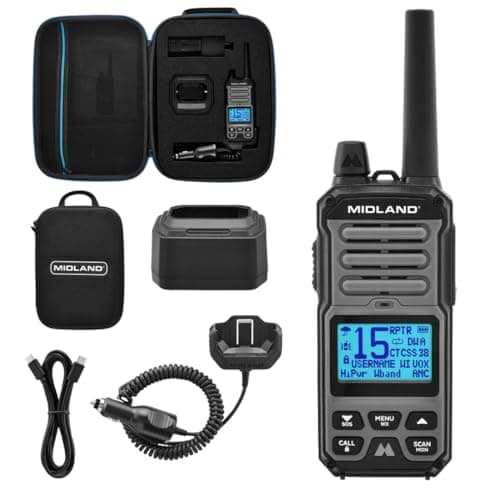
Best Midland handheld for wet weather
Midland GXT67 PRO (single radio)
IP67 against dust and water, a stated 5 W and a sealed body - the radio for a wet basement, a storm drain or a utility vault.
$219.99Amazon#ad · Price as of November 2, 2026 · How we make money for the link to Midland GXT67 PRO (single radio)
The safety rule that matters
Never treat a consumer radio as the safety system for going below ground. It is a convenience when it works and silent when it does not, and the failure is sudden rather than gradual. Anyone going underground should leave a written plan and a return time with a person on the surface, and that person should have a phone, not just a radio.
Confined spaces have their own hazards that have nothing to do with communication — air quality, water, falls — and no radio addresses any of them. If radio contact is genuinely required for the work, that is a professionally installed system, not a pair of handhelds.
For the above-ground versions of this problem, see how to increase walkie-talkie range and best walkie-talkies for mountains, where terrain rather than rock is what gets in the way.
How we scored this
Every pick here is backed by the paperwork
Every pick is labeled Researched: we read each maker's published specs, manuals and range tables, check the license rules against the FCC, and score every radio on a public rubric out of 10. Every figure links to where it came from, and every range number is labeled “advertised” so you can see the difference between the box and the terrain.
Scores are our editorial judgment on that documented evidence. Commissions never set a score or decide a pick. The rubric and its weights are published.
What changed
- Published.
Questions
Frequently asked
Do walkie-talkies work in a basement?
Do walkie-talkies work in caves?
Do walkie-talkies work in tunnels or parking garages?
Will a more powerful radio reach underground?
What do mine rescue teams use instead?
Receipts
Sources
- NIOSH: basic wireless communication and electronic tracking tutorial for mines (CDC archive, checked 2026-10-17)
- NIST: electromagnetic signal attenuation in construction materials (checked 2026-10-17)
- FCC: personal radio services guide, FRS distance (checked 2026-10-17)
- FCC: Family Radio Service (FRS) page (checked 2026-10-17)
- 47 CFR 95.567, FRS power limits per channel (via Cornell LII, checked 2026-10-17)
- Rocky Talkie: Mountain Radio product page (checked 2026-09-22)
- BTECH: GMRS-V2 product page (checked 2026-09-22)
- Midland: GXT67 PRO FAQs (checked 2026-09-22)
Specs and range figures come from each maker's own pages and manuals, linked on every product, and license, power and channel rules come from the FCC and 47 CFR Part 95. Range numbers are the maker's advertised claims and are labeled that way, so you can tell the box number from the terrain number. Prices come live from Amazon with the time we checked. Read the full method.