Not legal advice. This page summarizes FCC rules (47 CFR Part 95) from the official sources linked in the text. Rules and fees checked . The FCC sets its fees annually and can change its rules, so confirm the current version on fcc.gov before you rely on it.

Wattage is the number buyers reach for because it is the only number that looks like a specification. It is also the number that disappoints most people, because radio range does not scale the way the figure suggests. Here is what power actually does, starting with how much of it you are allowed to have.
What the FCC lets you have
- FRS: up to 2 watts on channels 1-7 and 15-22, and 0.5 watts on channels 8-14, with an antenna that cannot be removed (47 CFR 95.567, 47 CFR 95.587). No license (FCC: Family Radio Service).
- GMRS: higher limits, set channel by channel in 47 CFR 95.1767, which is why GMRS handhelds are commonly sold at 5 watts and mobile radios at 15 to 50. Needs an individual license covering your family.
- CB: 4 watts AM, on a different band entirely — see CB radio vs walkie-talkie.
So the honest range of choices available to a consumer is 0.5 W to about 5 W in a handheld, and up to 50 W if you mount a radio in a vehicle. That is one power decade, which matters less than you would think.
The arithmetic: watts to distance
Radio signal spreads out as it travels, and received power falls with the square of the distance in free space. Turn that around and you get the rule that governs every power decision: to double your range you need about four times the power. Which means:
- 0.5 W to 2 W (four times the power) — about double the distance, in the open.
- 2 W to 5 W (2.5 times the power) — about 1.6 times the distance, in the open.
- 5 W to 50 W (ten times the power) — about three times the distance, in the open, and only if the antenna is up where a vehicle radio puts it.
And "in the open" is doing a lot of work in those lines. Through trees, buildings or a hill, the signal is being absorbed rather than simply spread thin, and extra watts are a much worse investment. Which is why Midland can publish 5 watts on one radio and still say "up to 5 miles, depending on the terrain" (Midland GXT67 FAQs), while the FCC describes the 2-watt FRS channels as reaching "up to two miles, depending on conditions" (FCC personal radio services guide).
1 watt vs 2 watt radios
This is a common comparison because many radios offer both as high and low settings. Four times the power doubles range, so twice the power is about 1.4 times the range: a radio that manages a mile on 1 watt manages roughly a mile and a half on 2 watts in the open, and often no further at all in woods or buildings.
What the 2-watt setting always does is flatten your battery faster. Both settings exist so you can choose, and most of the time the low setting is the right choice — see below.
Three things that beat watts
- Height. These are line-of-sight radios, so the limit is usually the horizon or the ridge, not the transmitter. Walking fifty feet up a hill does more than any power setting, which is the whole reason repeaters sit on towers. The physics is in how far can walkie-talkies reach.
- The antenna. A longer or higher-gain antenna improves both transmit and receive, which is double the benefit of extra transmit power — and it is the reason GMRS's removable antenna matters more than its wattage. See best GMRS antennas.
- A repeater. One hilltop machine can turn two 5-watt handhelds into a twenty-mile network, which no amount of handheld power will do. See GMRS repeaters.
There is a fourth, unglamorous one: holding the radio away from your body, with the antenna vertical and clear of a pack strap. A hand wrapped around an antenna costs more signal than the step from 2 watts to 5.
When to turn the power down
- When the group is close together. A crew working one hall or one field does not need to be heard two miles away, and low power keeps the channel usable for everyone else.
- When battery life matters more than reach — a long day, a multi-day trip, a radio that has to last until evening.
- When you are using channels 8-14 anyway. Those are capped at 0.5 watts for everyone, so high power does nothing there.
Our picks for this job
What each power level actually looks like
One radio at each step of the practical range: license-free 2 W, a 5 W GMRS handheld, a cheap 5 W GMRS single, and the 15 W vehicle radio that shows what height plus power does.
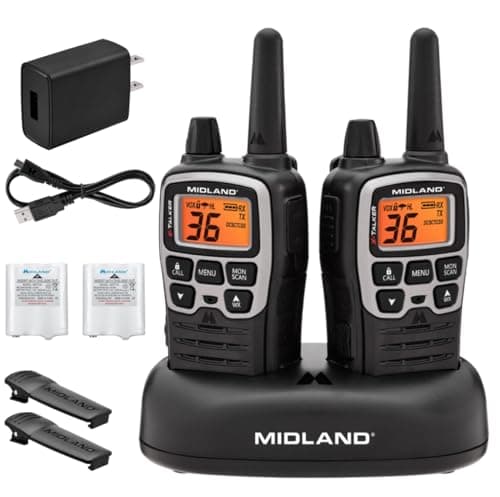
Best license-free Midland for hikes
Midland X-Talker T71VP3 (2-pack)
License-free FRS with hi/lo power settings, so you can hear the difference the 'high' setting does and does not make.
$89.99Amazon#ad · Price as of November 2, 2026 · How we make money for the link to Midland X-Talker T71VP3 (2-pack)
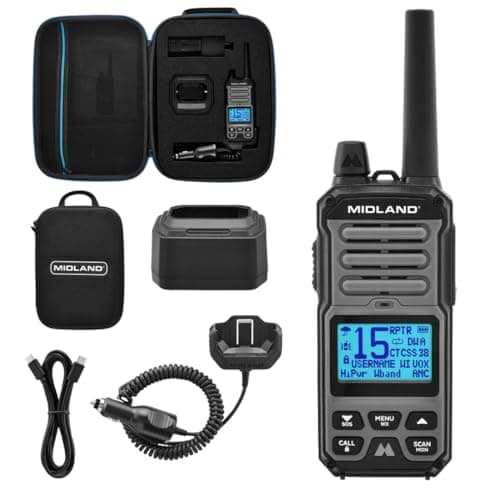
Best Midland handheld for wet weather
Midland GXT67 PRO (single radio)
One of the few handhelds whose maker states the wattage: 5 W, with an honest 'up to 5 miles depending on terrain' alongside it.
$219.99Amazon#ad · Price as of November 2, 2026 · How we make money for the link to Midland GXT67 PRO (single radio)
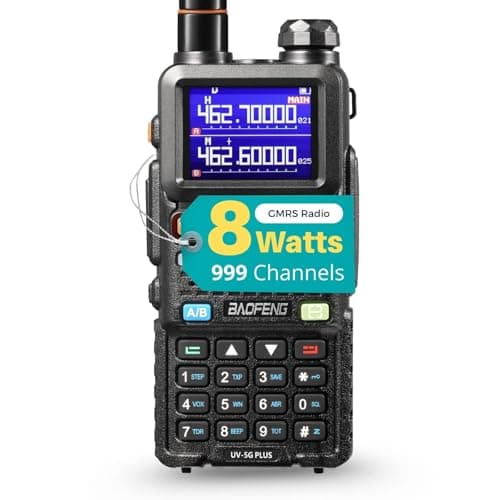
Best cheap GMRS radio with USB-C
Baofeng UV-5G Plus GMRS (single radio)
A stated 5 W and, more importantly, a removable SMA-female antenna with a long whip option - the upgrade that beats the wattage.
$36.99Amazon#ad · Price as of November 2, 2026 · How we make money for the link to Baofeng UV-5G Plus GMRS (single radio)
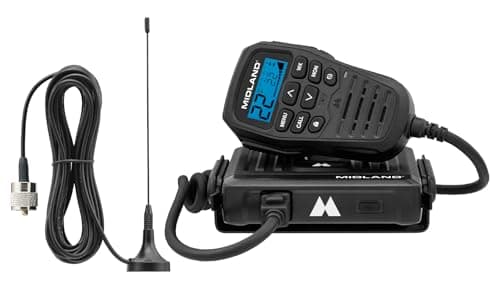
Best 15 W with the controls on the mic
Midland MXT275 MicroMobile (15 W)
15 W in the vehicle with the antenna on the roof. The jump from handheld to mobile is mostly the antenna height, not the watts.
$199.99Amazon#ad · Price as of November 2, 2026 · How we make money for the link to Midland MXT275 MicroMobile (15 W)
So how many watts do you need?
- A campsite, a store, a yard, a school, a venue: 0.5 to 2 W. Buy license-free FRS and spend the difference on earpieces.
- A wooded property, a hunting lease, a hilly neighborhood: 5 W GMRS handhelds with a long whip, plus the license.
- A convoy, a farm, a ranch, anything vehicle-based: 15 to 50 W mobile radios on roof antennas. See best GMRS mobile radios.
- A property you want covered from the house: a base station and an antenna on a mast — best GMRS base stations.
If your current radios fail in one specific place, more watts is rarely the fix. Start with how to increase walkie-talkie range, which goes through the fixes in order of how much they actually help.
How we scored this
Every pick here is backed by the paperwork
Every pick is labeled Researched: we read each maker's published specs, manuals and range tables, check the license rules against the FCC, and score every radio on a public rubric out of 10. Every figure links to where it came from, and every range number is labeled “advertised” so you can see the difference between the box and the terrain.
Scores are our editorial judgment on that documented evidence. Commissions never set a score or decide a pick. The rubric and its weights are published.
What changed
- Published.
Questions
Frequently asked
How many watts should a walkie-talkie have?
Does more watts mean more range?
What is the difference between a 1 watt and a 2 watt walkie-talkie?
What is the highest-wattage walkie-talkie I can buy?
Why do makers not publish the wattage?
Receipts
Sources
- 47 CFR 95.567, FRS transmitter power limits per channel (via Cornell LII, checked 2026-10-17)
- 47 CFR 95.587, FRS non-removable antenna requirement (via Cornell LII, checked 2026-10-17)
- 47 CFR 95.1767, GMRS transmitting power limits (via Cornell LII, checked 2026-10-17)
- FCC: Family Radio Service (FRS) page (checked 2026-10-17)
- FCC: personal radio services guide, FRS distance (checked 2026-10-17)
- Midland: GXT67 PRO FAQs, 5 W and the 5-mile figure (checked 2026-09-22)
- Midland: X-Talker T71VP3 product page, hi/lo power (checked 2026-09-22)
- Baofeng: UV-5G Plus product page, stated 5 W (checked 2026-09-22)
- Midland: MXT275 MicroMobile product page, 15 W (checked 2026-09-22)
Specs and range figures come from each maker's own pages and manuals, linked on every product, and license, power and channel rules come from the FCC and 47 CFR Part 95. Range numbers are the maker's advertised claims and are labeled that way, so you can tell the box number from the terrain number. Prices come live from Amazon with the time we checked. Read the full method.