Not legal advice. This page summarizes FCC rules (47 CFR Part 95) from the official sources linked in the text. Rules and fees checked . The FCC sets its fees annually and can change its rules, so confirm the current version on fcc.gov before you rely on it.
"Is GMRS worth it" is really two questions pretending to be one: is the license worth the paperwork, and are the radios worth the extra money. The license is the easy half — there is no exam, it lasts ten years and it covers your whole immediate family on one grant (47 CFR 95.1705). The radios are the half that depends entirely on your terrain.
What the license actually costs
You create an FCC account, file an application in the Universal Licensing System and pay the application fee the FCC sets for personal radio services (FCC: applying for a new license, FCC: personal service application fees). No test, no study, no club membership. The grant runs ten years, and your spouse, children, parents, parents-in-law and grandchildren can all transmit under your call sign. You do have to identify with that call sign (47 CFR 95.1751) — our call sign guide covers how, and how to get a GMRS license walks the form field by field.
The four things GMRS buys
- More power. FRS is capped at 2 watts on the main channels and 0.5 watts on channels 8-14 (47 CFR 95.567). GMRS handhelds commonly run 5 watts and mobile radios 15 to 50, within the limits at 47 CFR 95.1767.
- A removable antenna. This is the big one, and it is bigger than the wattage. FRS radios are required to have a non-removable antenna; a GMRS radio can take a long whip, a roof mount or a mast. See best GMRS antennas.
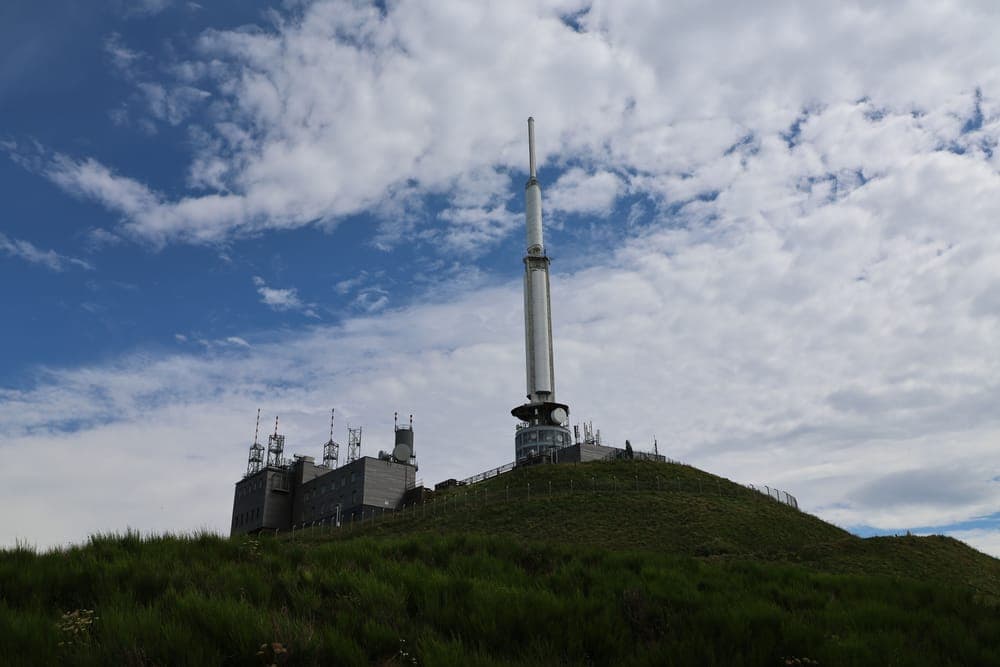
- Repeaters. Eight channel pairs exist for them, and a hilltop repeater can turn a two-mile radio into a twenty-mile one — if there is one near you and you are allowed on it. Check first: GMRS repeaters.
- Vehicle and base stations. A dash-mounted mobile radio on a roof antenna is a different class of coverage from anything handheld — best GMRS mobile radios and base stations.
What GMRS does not buy is distance in a straight line from a handheld. A 5-watt handheld is not 2.5 times the range of a 2-watt one; doubling power is roughly a 40% range gain in free space, and far less in trees. The arithmetic is in what watts really buy you.
Who it is worth it for
- Anyone with acreage. A farm, ranch or hunting lease is the single clearest yes: a mobile radio in the truck and handhelds in the field is the setup FRS cannot build.
- Convoys and overlanders. Vehicle-to-vehicle on a roof antenna is what GMRS was made for.
- Hilly or wooded neighborhoods where you want to reach a family member half a mile away through trees.
- Preppers and storm-season planners who want a base station and a repeater plan rather than a bubble pack.
- Anyone who has already bought FRS radios and hit the wall. If your current radios fail at the spot you need them to work, more FRS will not fix it.
When it is not worth it
- Campgrounds, theme parks, cruise decks, school fields. These are short distances with obstacles, and a 5-watt radio does not get through a building any better than a 2-watt one. The FCC puts FRS at "up to two miles, depending on conditions" (FCC personal radio services guide) and that covers the whole site.
- Kids. A child transmitting under your call sign is legal, but kids need simple radios, not powerful ones.
- Any organization. It is not an option at all — see the callout above.
- If you want to talk to other people's walkie-talkies. You already can: GMRS and FRS share channels 1-22, so a license changes nothing about compatibility.
What to look for in a first GMRS radio
- Certified for GMRS. The rules require a transmitter certified for the service (47 CFR 95.1731) — a ham handheld programmed onto GMRS frequencies is not legal, however well it works. See is a Baofeng legal on GMRS?
- A removable antenna, because it is the cheapest real upgrade you will ever make.
- Repeater channels — but only pay for them if a repeater exists near you.
- A stated wattage. Several makers publish none at all.
- A published battery life and, ideally, a replaceable pack.
Our picks for this job
Four radios that answer the question
Two cheap ways into GMRS, the family default, and the license-free radio to buy instead if this page talked you out of it.
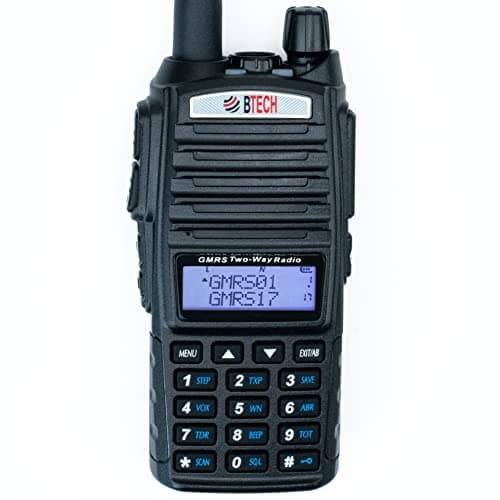
Best budget GMRS for repeater users
BTECH GMRS-V2 (single radio)
The cheapest sensible way to find out if GMRS helps you: repeater capable, removable antenna, and BTECH publishes a radio service guide that explains what it may and may not do.
Check price · Amazon#ad · Price as of November 2, 2026 · How we make money for the link to BTECH GMRS-V2 (single radio)
Best simple GMRS pair for families
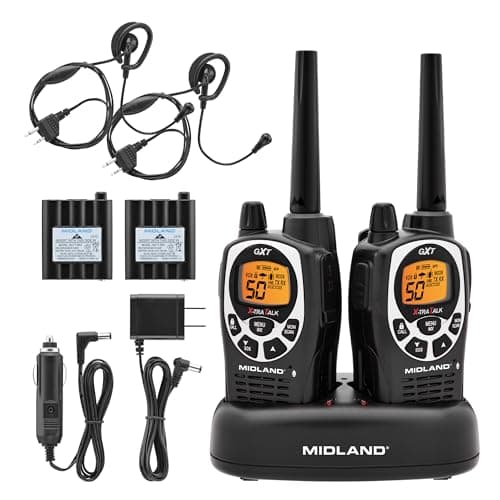
Midland GXT1000VP4 (2-pack)
The family default. No repeater channels, but NOAA alerts, AA fallback and Midland's own honest figure of half a mile to two miles in normal conditions.
$89.99Amazon#ad · Price as of November 2, 2026 · How we make money for the link to Midland GXT1000VP4 (2-pack)
Best cheap GMRS radio with USB-C
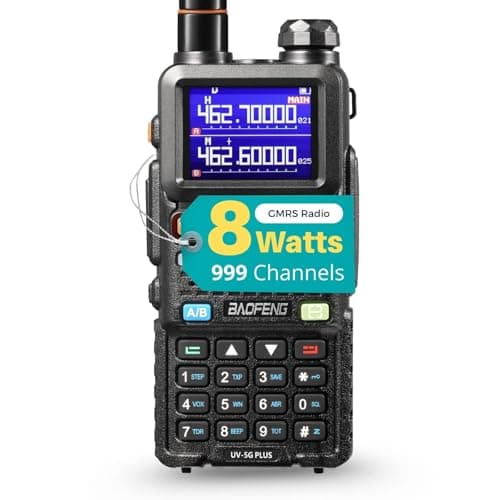
Baofeng UV-5G Plus GMRS (single radio)
A stated 5 W, a 2500 mAh pack, USB-C and a removable SMA-female antenna, which is where the range upgrade actually comes from.
$36.99Amazon#ad · Price as of November 2, 2026 · How we make money for the link to Baofeng UV-5G Plus GMRS (single radio)
Best license-free Midland for hikes
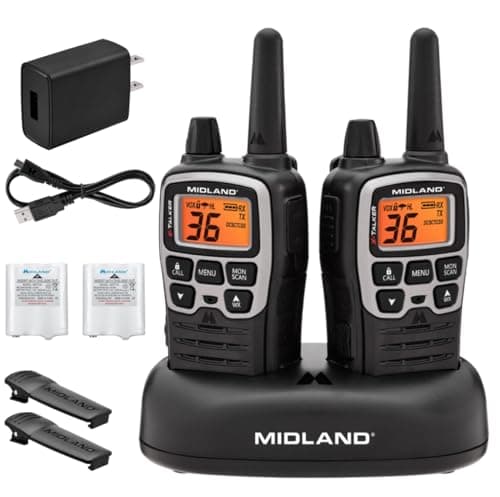
Midland X-Talker T71VP3 (2-pack)
If the answer turned out to be no: the best license-free Midland, with hi/lo power, Weather Scan and a 3 AA fallback.
$89.99Amazon#ad · Price as of November 2, 2026 · How we make money for the link to Midland X-Talker T71VP3 (2-pack)
Three expensive mistakes
- Buying GMRS radios and skipping the license. The radios are legal to own and not legal to transmit on without the grant. The license is the cheap part of the purchase.
- Buying 5-watt handhelds to fix a terrain problem. If a ridge is in the way, the fix is height, an antenna or a repeater — not watts.
- Buying a business or organization GMRS radios. It cannot be licensed. Start at two-way radios for business.
If the honest answer here is "no," the right next page is best walkie-talkies without a license. If it is "yes," start with best GMRS radio for beginners and the license page.
How we scored this
Every pick here is backed by the paperwork
Every pick is labeled Researched: we read each maker's published specs, manuals and range tables, check the license rules against the FCC, and score every radio on a public rubric out of 10. Every figure links to where it came from, and every range number is labeled “advertised” so you can see the difference between the box and the terrain.
Scores are our editorial judgment on that documented evidence. Commissions never set a score or decide a pick. The rubric and its weights are published.
What changed
- Published.
Questions
Frequently asked
Is a GMRS license worth the money?
Is GMRS better than FRS?
Do I need a test for a GMRS license?
Can my whole family use one GMRS license?
Is GMRS worth it without a repeater nearby?
What happens if I use GMRS without a license?
Receipts
Sources
- FCC: General Mobile Radio Service (GMRS) page (checked 2026-10-17)
- FCC: Family Radio Service (FRS) page (checked 2026-10-17)
- FCC: personal radio services guide (checked 2026-10-17)
- FCC: applying for a new license in ULS (checked 2026-10-17)
- FCC: personal service and amateur application fees (checked 2026-10-17)
- 47 CFR 95.1705, GMRS eligibility: individuals and family (via Cornell LII, checked 2026-10-17)
- 47 CFR 95.1731, permissible GMRS transmitters (via Cornell LII, checked 2026-10-17)
- 47 CFR 95.1751, GMRS station identification (via Cornell LII, checked 2026-10-17)
- 47 CFR 95.1767, GMRS transmitting power limits (via Cornell LII, checked 2026-10-17)
- 47 CFR 95.567, FRS power limits per channel (via Cornell LII, checked 2026-10-17)
- BTECH: GMRS-V2 product page (checked 2026-09-22)
- Midland: GXT1000VP4 product page (checked 2026-09-22)
- Baofeng: UV-5G Plus product page (checked 2026-09-22)
- Midland: X-Talker T71VP3 product page (checked 2026-09-22)
Specs and range figures come from each maker's own pages and manuals, linked on every product, and license, power and channel rules come from the FCC and 47 CFR Part 95. Range numbers are the maker's advertised claims and are labeled that way, so you can tell the box number from the terrain number. Prices come live from Amazon with the time we checked. Read the full method.