Not legal advice. This page summarizes FCC rules (47 CFR Part 95) from the official sources linked in the text. Rules and fees checked . The FCC sets its fees annually and can change its rules, so confirm the current version on fcc.gov before you rely on it.

Search for "commercial two-way radios" and you get two kinds of result: bubble-pack family radios with a mileage number on the front, and dealer pages for licensed business systems with no price at all. Neither tells you the thing that actually decides your purchase, which is not the radio. It is which radio service your business is legally allowed to transmit on.
Get that wrong and you can spend a few thousand dollars on radios your company is not eligible to operate. Get it right and most businesses discover the honest answer is cheaper than they expected.
The license map, in one pass
Four services matter for business use in the US, and they sort cleanly:
- FRS — license-free by rule. Up to 2 W on channels 1-7 and 15-22, 0.5 W on 8-14, and a non-removable antenna (47 CFR 95.567, 47 CFR 95.587). Nothing in the FRS rules restricts it to personal use — the only prohibition in the rule is on one-way broadcasting (47 CFR 95.533). This is what most businesses should buy.
- MURS — also license-free. Five VHF channels, 2 W, no repeaters, no phone interconnection (47 CFR 95.2703, 47 CFR 95.2767). Quieter than FRS and it allows external antennas, which is why warehouses and farms like it.
- GMRS — licensed, and individual only. New licenses go to a person, not a company (47 CFR 95.1705). Off the table for crew use. See the next section, because this is where the money gets wasted.
- Part 90 Industrial/Business — the real commercial answer: licensed land mobile radio for "persons primarily engaged in... the operation of a commercial activity" (47 CFR 90.35). Higher power, repeaters, encryption on digital systems, and a dedicated frequency rather than a public channel.
Why a business cannot use GMRS
This matters because GMRS radios are everywhere, they are cheap, and they are the radios that actually reach across a yard. A site manager buys six 5-watt GMRS handhelds because the reviews say they go farther — and issues radios the company has no license to operate. If what you need is the reach, the legitimate route is Part 90, not GMRS. (If you are buying for your own family rather than a crew, GMRS is excellent and the license is an application, not an exam: how to get a GMRS license.)
What license-free radios really cover
FRS is capped at 2 W with a fixed antenna, and the FCC describes the 2-watt channels as reaching "up to two miles, depending on conditions" (FCC personal radio services guide). In practice, for a business:
- A restaurant, retail floor, salon, small hotel, event venue: covered easily. One floor, one building, line of sight or close to it.
- A construction site, a yard, a car lot, a farm shop: usually covered, with dead spots. Steel and concrete are the enemy, not distance — our radios for concrete buildings page covers why.
- A multi-story building, a large campus, a plant with several structures: marginal. This is where handhelds start failing and a licensed system with a repeater earns its cost.
- Vehicles across a town, a tow fleet, a delivery route, a county-wide operation: not covered. No license-free radio does this. Nothing on a shelf does this.
The "commercial two-way radios, long range" search that brings people to pages like this one is usually asking for the last case. The honest answer is that the long-range part is a licensed system, and the thing being sold cheaply with "35 miles" on the box is not it. Our range claims explained page shows where those numbers come from.
MURS: the forgotten license-free option
MURS gets overlooked and it deserves a look for certain businesses. Five VHF channels, 2 W, no license — the same power ceiling as FRS, but on frequencies almost nobody uses, and with the ability to run an external antenna. For a warehouse, a grain operation, a campground or a self-storage facility, a base antenna on the roof plus MURS handhelds can outperform FRS handhelds considerably, and it is still license-free.
The catch is the catalog: there are far fewer MURS radios and accessories, and MURS allows no repeaters and no phone patching (47 CFR 95.2703). The full comparison is in GMRS vs MURS.
When to pay for a Part 90 license
Three signals say you have outgrown license-free radios: coverage gaps you cannot fix by moving people, channels crowded by other businesses nearby, or a real need for privacy. All three point the same way.
A Part 90 Industrial/Business license gives your business its own authorized frequency, with power levels and repeater options that license-free services do not allow, and digital systems that can encrypt. Eligibility is broad — commercial activities, schools, religious institutions, hospitals and clinics all qualify (47 CFR 90.35). What it is not is a form you fill in over lunch: applications go through a frequency coordinator, and in practice you buy the radios, the license help and the repeater from the same dealer. Motorola Solutions, for example, sells its business radio line this way, separately from the consumer Talkabouts covered in our Motorola lineup guide. The FCC's guide to applying for a new license describes the filing side.
What to look for in a crew radio
- No screen, few buttons. A radio handed to a different person each shift should have nothing to misconfigure. Pre-paired pairs and knob-only controls survive turnover.
- A published wattage. 2 W on the main FRS channels is the ceiling; makers that state it are easier to trust than makers that print a mileage figure instead.
- USB charging and a multi-bay option. Charging a crew's radios in a rack is an operational detail that decides whether the radios are usable at 7 a.m.
- An accessory jack, and the right one. The connector decides your headset options forever; Kenwood-style K1 two-pin is the most widely supported. See earpieces and headsets.
- Enough channels to get off a busy one. FRS channels are shared with every family radio in the area; a 22-channel radio has more room to move than a 16-channel one.
- Pack economics. Multi-packs with headsets included are the cheapest way to equip a crew, and spares matter more than features: assume you will lose one a year.
- NOAA weather alerts for any outdoor crew. Weather is the one business emergency a cheap radio can genuinely help with.
What to buy
Our picks for this job
Three license-free radios and the earpiece to go with them
All three radios are FRS, which is the service a business may use without a license. None of them is GMRS, and that is deliberate: a company cannot hold a GMRS license. Prices and stock come from the live Amazon listings, checked the day this page was published.
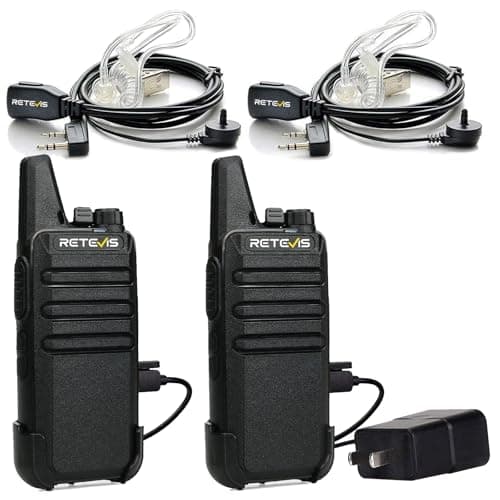
Best cheap pair for short-range crews
Retevis RT22 (2-pack)
The crew-issue default: screenless, pre-paired, 2 W stated, USB-C, and Retevis publishes an honest 0.5 to 2 miles. 16 channels is the limitation to know about.
$29.98Amazon#ad · Price as of November 2, 2026 · How we make money for the link to Retevis RT22 (2-pack)
Best license-free Baofeng multi-pack
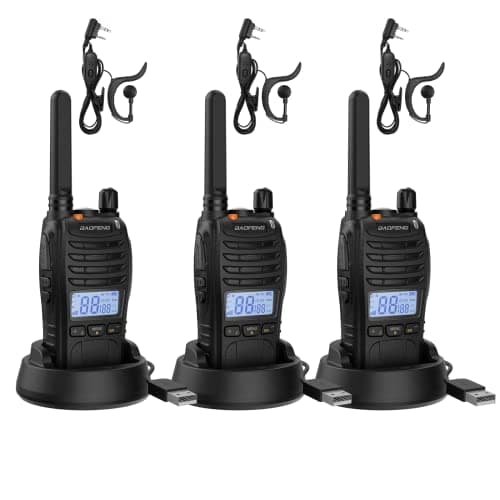
Baofeng BF-88ST Pro FRS (multi-pack)
The cheapest honest way to equip four people: a full 2 W on 22 FRS channels, 12 NOAA weather channels, a sealed antenna, and headsets in the box on the larger packs.
$41.99Amazon#ad · Price as of November 2, 2026 · How we make money for the link to Baofeng BF-88ST Pro FRS (multi-pack)
Best license-free Midland for hikes
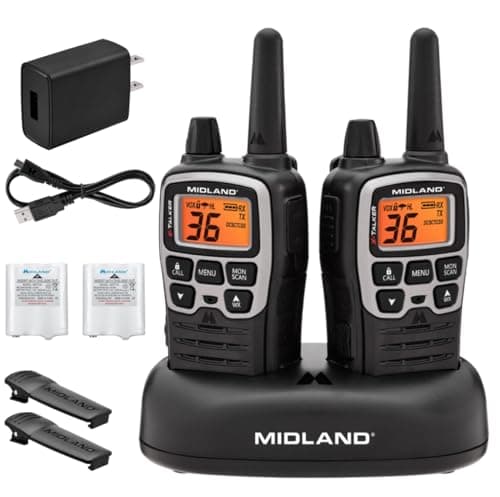
Midland X-Talker T71VP3 (2-pack)
The front-of-house option: Weather Scan, silent operation, eVOX and a three-AA fallback for a radio that sits in a drawer between shifts. Midland's own runtime figure is about 5 hours on high power.
$89.99Amazon#ad · Price as of November 2, 2026 · How we make money for the link to Midland X-Talker T71VP3 (2-pack)
Best budget K1 earpiece
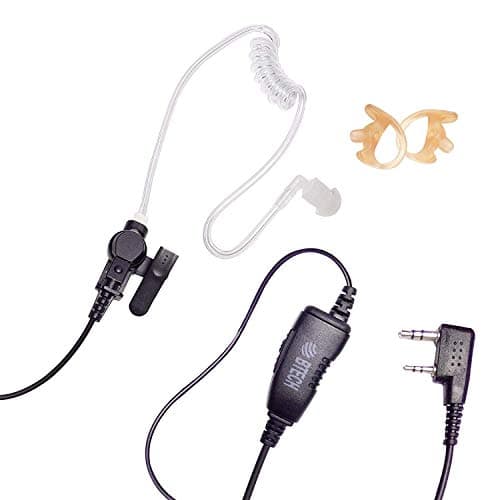
BTECH QHM07 Surveillance Earpiece and Microphone Kit
The accessory that makes a radio usable in public: a locking clear-tube earpiece with an in-line PTT on the K1 two-pin plug most crew radios use.
$16.25Amazon#ad · Price as of November 2, 2026 · How we make money for the link to BTECH QHM07 Surveillance Earpiece and Microphone Kit
If your crew works a loud site or a security detail, the use-case rankings go deeper: radios for construction sites and radios for security teams, plus headsets for security teams for the discreet end of the accessory range.
Kitting out a crew
- One radio per person, plus one spare per six. A shared radio is a radio nobody carries.
- Pick one channel and one privacy code, and write them on a label inside the radio case. Privacy codes are not privacy — they only mute other traffic (how privacy codes really work).
- Assume you are being overheard. No license-free radio encrypts. Never pass card numbers, door codes, cash movements or personal medical details over FRS or MURS. Encryption starts at licensed digital systems.
- Write a two-line radio protocol into onboarding: who calls whom, and what to say in an emergency. It takes five minutes and it is the difference between a radio and a toy.
- Charge in a rack overnight, not in a drawer. Buy the multi-bay charger with the radios, not after the first missed shift.
Five expensive mistakes
- Buying GMRS radios for employees. The license cannot be issued to your business. This is the big one.
- Buying for the box mileage. Every FRS radio is capped at the same 2 W, so the number is marketing. Buy for battery, build and accessories instead.
- Skipping headsets. On a public-facing crew the earpiece matters more than the radio; without one, the radio gets turned down and then ignored.
- Mixing channel counts. A 16-channel radio and a 22-channel radio can only meet on the channels both have. Standardize before you scale.
- Expecting privacy. Anyone with a $25 radio can hear your channel. Plan your traffic around that, or license a digital system.
Still deciding between services for your own use rather than a crew? GMRS vs FRS is the short version, and how to choose walkie-talkies walks the whole decision.
How we scored this
Every pick here is backed by the paperwork
Every pick is labeled Researched: we read each maker's published specs, manuals and range tables, check the license rules against the FCC, and score every radio on a public rubric out of 10. Every figure links to where it came from, and every range number is labeled “advertised” so you can see the difference between the box and the terrain.
Scores are our editorial judgment on that documented evidence. Commissions never set a score or decide a pick. The rubric and its weights are published.
What changed
- Published.
Questions
Frequently asked
Can a business get a GMRS license?
Can a business use FRS walkie-talkies legally?
What are commercial two-way radios?
How far will business walkie-talkies actually reach?
Do business radios need a license in the US?
Are two-way radios private?
Receipts
Sources
- FCC: Family Radio Service (FRS) page (checked 2026-10-12)
- FCC: personal radio services guide, FRS distance (checked 2026-10-12)
- FCC: applying for a new license, Universal Licensing System (checked 2026-10-12)
- 47 CFR 95.533, prohibited FRS uses (via Cornell LII, checked 2026-10-12)
- 47 CFR 95.567, FRS transmitter power limits per channel (via Cornell LII, checked 2026-10-12)
- 47 CFR 95.587, FRS non-removable antenna requirement (via Cornell LII, checked 2026-10-12)
- 47 CFR 95.1705, GMRS eligibility: individuals, immediate family, and pre-1987 grandfathered entities (via Cornell LII, checked 2026-10-12)
- 47 CFR 95.2703, MURS definition and prohibited uses (via Cornell LII, checked 2026-10-11)
- 47 CFR 95.2767, MURS 2 W transmitting power limit (via Cornell LII, checked 2026-10-11)
- 47 CFR 90.35, Industrial/Business Pool eligibility (via Cornell LII, checked 2026-10-12)
- Motorola Solutions: business two-way radio line, sold through dealers (checked 2026-09-22)
Specs and range figures come from each maker's own pages and manuals, linked on every product, and license, power and channel rules come from the FCC and 47 CFR Part 95. Range numbers are the maker's advertised claims and are labeled that way, so you can tell the box number from the terrain number. Prices come live from Amazon with the time we checked. Read the full method.