Not legal advice. This page summarizes FCC rules (47 CFR Part 95) from the official sources linked in the text. Rules and fees checked . The FCC sets its fees annually and can change its rules, so confirm the current version on fcc.gov before you rely on it.
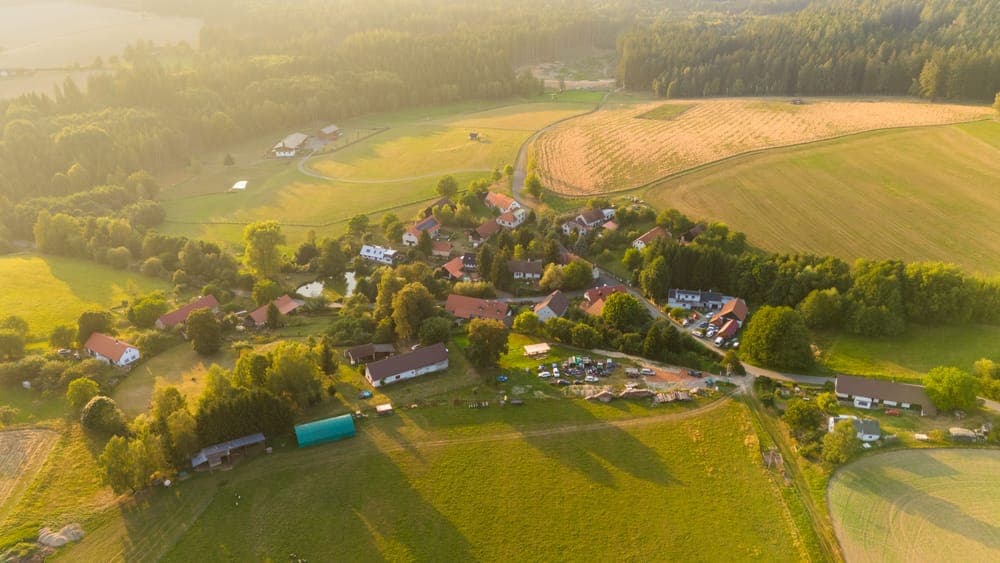
Most people arrive at MURS after reading that it needs no license and allows 2 W - the same power cap as the main FRS channels - on frequencies that are not shared with every family radio in the country. That is all true, and it is a genuinely interesting option for a farm, a shop or a property. The reasons it stays niche are that the radio choice is small, the service is VHF rather than UHF, and a radio certified for MURS is not allowed to also work on GMRS.
Everything below comes from 47 CFR Part 95, subpart J for MURS and subpart E for GMRS. If you are weighing GMRS against the license-free service you have actually heard of, that comparison is GMRS vs FRS.
The short version
- License: MURS needs none. GMRS needs one individual license covering your immediate family.
- Power: MURS is capped at 2 W. GMRS allows up to 50 W on its main channels.
- Channels: MURS has five, all VHF. GMRS has 22, all UHF, plus eight repeater pairs.
- Repeaters: GMRS has them. MURS does not.
- Radio choice: GMRS is a mass market. MURS is a handful of mostly business-oriented radios.
- Crowding: MURS channels are far quieter, because almost nobody uses them.
What MURS actually is
The FCC defines MURS as "a two-way, short distance voice or data communication service for facilitating personal or business activities of the general public" (47 CFR 95.2703). It is one of the Personal Radio Services, alongside FRS, GMRS and CB (FCC personal radio services guide).
It was created in 2000 out of frequencies that had previously been licensed under Part 90, the business pool - and the rules still carry that history: stations that held Part 90 licenses on MURS frequencies as of 13 November 2000 are authorised by rule to carry on under identical terms (47 CFR 95.2705). That origin is why MURS radios tend to look and feel like business radios rather than family ones.
The rules, side by side
GMRS, by contrast, is licensed: a new license goes to "an individual who is at least 18 years old" and covers that person's immediate family (47 CFR 95.1705, FCC GMRS page). In return it allows up to 50 W on the main 462/467 MHz channels, with lower limits on the shared 467 MHz interstitial channels (47 CFR 95.1767).
Read as a table of trade-offs:
- No license, less power, fewer radios: MURS. Five channels, 2 W, VHF, no repeaters, no phone interconnection, and a small catalog of radios.
- A license, far more capability: GMRS. Twenty-two channels plus eight repeater pairs, up to 50 W, removable antennas on many radios, vehicle and base installs, and the whole consumer market to choose from.
- No license, no planning at all: FRS, which is what most walkie talkies already are - 2 W on channels 1-7 and 15-22, 0.5 W on 8-14, fixed antenna (47 CFR 95.531, FCC FRS page).
VHF versus UHF on real land
This is the part that actually decides whether MURS is interesting for you, and it has nothing to do with licenses. MURS sits around 151-154 MHz (VHF); GMRS sits around 462-467 MHz (UHF). Same 2 W on a MURS radio as on an FRS radio, but the signals behave differently:
- Open, flat or rolling land favors VHF. Longer wavelengths cope better with distance over open ground and with light vegetation, which is why farms, ranches and marine users have historically lived on VHF.
- Buildings and dense structures favor UHF. Shorter wavelengths get through doorways, windows and interior gaps more readily, which is why schools, hotels and warehouses run UHF business radios - and why GMRS tends to do better around a house or a yard full of equipment.
- Antennas get bigger on VHF. A half-wave antenna for 151 MHz is about three times the length of one for 462 MHz. On a handheld that means the stock antenna is a bigger compromise; on a vehicle or a mast, it means a bigger install.
So: a flat ranch with few buildings is the case where MURS can genuinely outperform GMRS at the same power. A house, a shop full of steel, or hilly ground is not - and GMRS's ability to go to 50 W or use a repeater beats any band advantage anyway. Our GMRS radio range page covers what the UHF side really does, and covering a property with radios works through acreage.
Why no radio does both
This is the rule that kills most MURS plans, and it is explicit: "A grant of equipment certification will not be issued for MURS transmitters capable of operating under both this subpart (MURS) and under any other subparts of this chapter (except part 15)" (47 CFR 95.2761).
In plain terms: a legally certified MURS radio cannot also be a certified GMRS or FRS radio. There is no do-everything handheld. If you want both services you buy two sets of radios, and the two sets cannot talk to each other - different bands entirely.
It is also why you should be cautious about cheap "programmable" VHF handhelds marketed as MURS radios. The question to ask is whether the specific model holds an FCC certification under Part 95 subpart J. BTECH publishes a plain-language guide to which of its radios is certified for which service (BTECH radio service guide), and that is the kind of statement to look for before buying. A radio certified for the amateur service is not a MURS radio, however well it tunes to 151 MHz.
What to buy
We do not currently recommend a MURS radio, for a simple reason: the radios we have researched and can source with confidence are FRS and GMRS, and we will not list a model we have not checked. If MURS is right for your land, buy from a business-radio dealer who will confirm the Part 95 subpart J certification in writing.
For everyone else - which is most people - the GMRS and FRS radios below are the practical answer, and they cover the two decisions this page is really about: do you want the license, or not?
Our picks for this job
The GMRS and FRS answer instead
Two GMRS radios for the licensed route, and one FRS radio for the license-free one. All three are UHF, so none of them works on MURS - that is the rule, not a product limitation.
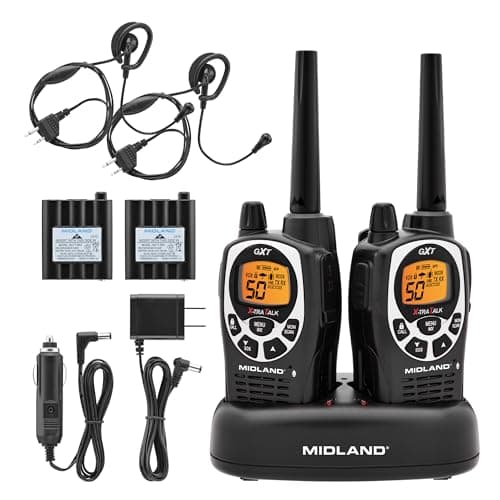
Best simple GMRS pair for families
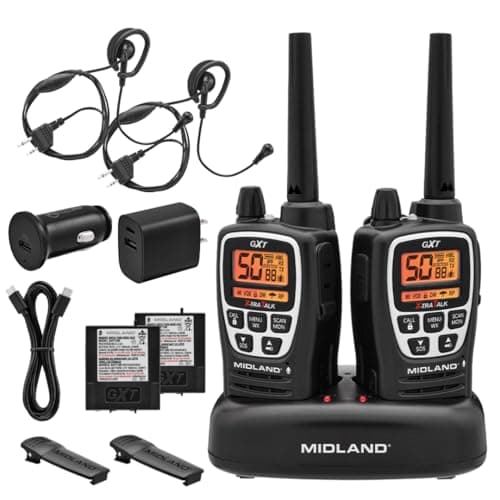
Midland GXT1000VP4 (2-pack)
Needs a GMRS license. High/medium/low power, 142 privacy codes, NOAA weather alerts, whisper mode and an AA fallback. Midland's own typical figure is half a mile to two miles.
$89.99Amazon#ad · Price as of November 2, 2026 · How we make money for the link to Midland GXT1000VP4 (2-pack)
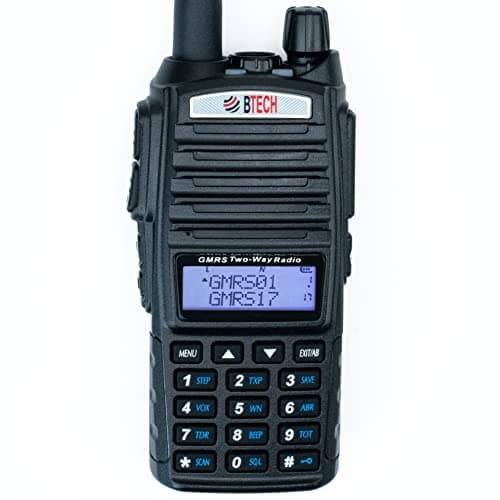
Best budget GMRS for repeater users
BTECH GMRS-V2 (single radio)
Needs a GMRS license. 5 W, repeater compatible, an SMA-female antenna jack and a K1 accessory jack; BTECH publishes 1 to 5+ miles simplex and 15 to 50+ miles through a repeater.
Check price · Amazon#ad · Price as of November 2, 2026 · How we make money for the link to BTECH GMRS-V2 (single radio)
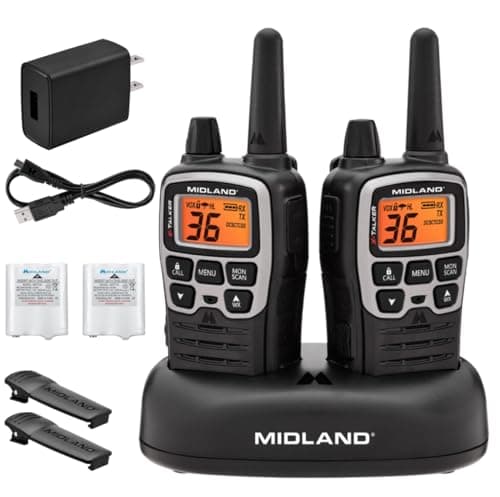
Best license-free Midland for hikes
Midland X-Talker T71VP3 (2-pack)
No license. 36 channels, 121 codes, silent operation, eVOX, rechargeable packs plus a three-AA fallback and a three-year warranty. The license-free comparison point.
$89.99Amazon#ad · Price as of November 2, 2026 · How we make money for the link to Midland X-Talker T71VP3 (2-pack)
Which service should you choose?
Choose GMRS if you want range, a repeater, a vehicle or base install, or simply a wide choice of radios and accessories. The license is an application and a fee, not an exam, and it covers your whole immediate family - see how to get a GMRS license.
Choose MURS if all four of these are true: you cannot or will not get a license, your land is flat and open rather than built up, you are willing to buy from a business-radio supplier, and the quietness of five little-used channels is worth more to you than 50 W and repeaters. Telemetry - a driveway sensor, a gate alarm - is the other genuinely good MURS use, because the rules explicitly allow it.
Choose FRS if you just want radios that work out of the box with no paperwork and no planning, and a mile or two is enough. That is most buyers, and it is why radios that need no license is the page most people should read next.
How we scored this
Every pick here is backed by the paperwork
Every pick is labeled Researched: we read each maker's published specs, manuals and range tables, check the license rules against the FCC, and score every radio on a public rubric out of 10. Every figure links to where it came from, and every range number is labeled “advertised” so you can see the difference between the box and the terrain.
Scores are our editorial judgment on that documented evidence. Commissions never set a score or decide a pick. The rubric and its weights are published.
What changed
- Published.
Questions
Frequently asked
Does MURS require a license?
How many MURS channels are there, and what frequencies?
Is MURS more powerful than GMRS?
Can one radio do both MURS and GMRS?
Is MURS better than GMRS on a farm?
Receipts
Sources
- 47 CFR 95.2703, definition of MURS (via Cornell LII, checked 2026-10-11)
- 47 CFR 95.2705, grandfathered MURS stations (via Cornell LII, checked 2026-10-11)
- 47 CFR 95.2731, permissible MURS uses (via Cornell LII, checked 2026-10-11)
- 47 CFR 95.2749, MURS network connection prohibited (via Cornell LII, checked 2026-10-11)
- 47 CFR 95.2761, MURS transmitter certification: no dual-service grants (via Cornell LII, checked 2026-10-11)
- 47 CFR 95.2763, the five MURS channel center frequencies (via Cornell LII, checked 2026-10-11)
- 47 CFR 95.2767, MURS 2 W transmitting power limit (via Cornell LII, checked 2026-10-11)
- 47 CFR 95.1705, GMRS eligibility (via Cornell LII, checked 2026-10-11)
- 47 CFR 95.1767, GMRS transmitting power limits (via Cornell LII, checked 2026-10-11)
- 47 CFR 95.531, FRS channel power limits (via Cornell LII, checked 2026-10-11)
- FCC: Personal Radio Services consumer guide (checked 2026-10-11)
- FCC: General Mobile Radio Service (GMRS) page (checked 2026-10-11)
- FCC: Family Radio Service (FRS) page (checked 2026-10-11)
- BTECH: radio service guide, which radio is certified for which service (checked 2026-10-11)
- Midland: GXT1000VP4 product page and range FAQ (checked 2026-10-11)
- BTECH: GMRS-V2 product page (checked 2026-10-11)
- Midland: X-Talker T71VP3 product page (checked 2026-10-11)
Specs and range figures come from each maker's own pages and manuals, linked on every product, and license, power and channel rules come from the FCC and 47 CFR Part 95. Range numbers are the maker's advertised claims and are labeled that way, so you can tell the box number from the terrain number. Prices come live from Amazon with the time we checked. Read the full method.