Not legal advice. This page summarizes FCC rules (47 CFR Part 95) from the official sources linked in the text. Rules and fees checked . The FCC sets its fees annually and can change its rules, so confirm the current version on fcc.gov before you rely on it.
The contenders
Side by side
 Stock photo
For the family or lease crew
Midland GXT3000VP4 (2-pack)
A GMRS pair anyone in the family can pick up and use, with 8 repeater channels, Li-ion packs and a 3 AA fallback. Covered by one license, no exam for anyone.
Check price · Amazon#ad · Price set by Amazon · How we make money for the link to Midland GXT3000VP4 (2-pack)
- Stock photo
For the tinkerer who wants GMRS
Wouxun KG-935G Plus (single radio)
The GMRS handheld for the person who likes menus: Wouxun lists 5.5 W, IP66, a keypad Channel Wizard for repeaters and a removable SMA antenna. All the fiddling a ham radio offers, inside GMRS rules.
Check price · Amazon#ad · Price set by Amazon · How we make money for the link to Wouxun KG-935G Plus (single radio)
 Stock photo
For the trail rig
BTECH GMRS-20V2 (20 W compact mobile)
A compact 20 W GMRS mobile rated IP67 that plugs into a 12V socket and programs with CHIRP. Add a GMRS antenna; none is in the box.
Check price · Amazon#ad · Price set by Amazon · How we make money for the link to BTECH GMRS-20V2 (20 W compact mobile)
Picture two groups. One is a family with a hunting lease: a dad, two teenagers and a grandfather who need to know who's on which stand and when to head back to the truck. The other is one person who wants to reach a station three states away, build an antenna in the garage and learn how radio actually works. The first group wants GMRS. The second wants ham radio. Most of the confusion comes from the fact that the radios can look identical.
Both services are run by the FCC, both have repeaters, and both use UHF frequencies (ham adds many more bands). What differs is the license, who it covers, and what you're allowed to do with the equipment. We sourced every rule below from the FCC or the rule text itself. We don't test radios, and this site doesn't rank ham radios; the GMRS picks are scored on the published rubric on our How We Rank page.
GMRS vs ham radio at a glance
| GMRS | Ham (Amateur Radio Service) | |
|---|---|---|
| License and exam | One individual FCC license; no exam | A license for every operator, after an exam given by volunteer examiners |
| Entry exam | None | Technician: 35 questions, 26 correct to pass |
| Who's covered | You plus immediate family, any age | Only the licensed operator |
| Age | 18 or older to apply; family members any age | "Qualified persons of any age" |
| FCC application fee | $35 (fee table checked September 2026) | $35 on the same table, plus the exam session fee ($15 with the ARRL VEC in 2026) |
| License term | 10 years | Normally 10 years |
| Where you transmit | 30 channels near 462 and 467 MHz (UHF) | Technician: all amateur frequencies above 30 MHz, including 2 m (144-148 MHz) and 70 cm (420-450 MHz), plus limited HF; General and Extra open much more HF |
| Power | Up to 50 W for mobile, base and repeater stations on the main channels; handhelds typically rated at 5 W by their makers | Up to 1.5 kW PEP, but only "the minimum transmitter power necessary" |
| Equipment | Must be FCC-certified for GMRS; users may not modify it | Equipment certification "does not generally apply"; hams may build and modify |
| Call sign | After a transmission or series, and at least every 15 minutes | At the end of each communication, and at least every 10 minutes |
| Best for | Families, hunting parties, farms, convoys | Radio hobbyists and long-distance talk |
Sources: the FCC's GMRS page and Amateur Radio Service page (fcc.gov blocks automated readers, so we read it through the Internet Archive copy of September 16, 2026), the FCC fee table, the ARRL VEC exam fee page, and the rules at 47 CFR 95.1767, 95.1751, 97.301, 97.313, 97.503, 97.25 and 97.119.
License and exam: none for GMRS, a test for ham
GMRS is paperwork only. The FCC says "An FCC license is required to operate GMRS system. Licenses are issued for a ten-year term," and you can apply at 18 or older (FCC, GMRS). There is no test. The FCC fee table lists $35 for a new GMRS license with no regulatory fee (FCC fee table, checked September 2026; the FCC sets fees annually). Our GMRS license guide covers the whole decision.
Ham radio starts with an exam. In the FCC's words, "Operation of an amateur station requires an amateur operator license grant from the FCC. Before receiving a license grant, you must pass an examination administered by a team of volunteer examiners (VEs)" (FCC, Amateur Radio Service). The ARRL describes those examiners as licensed hams "holding a General Class license or higher, who offer their time to administer the FCC licensing exams" (ARRL).
There are three license classes you can earn today. The FCC says "Most new amateur operators start at the Technician Class and then may advance to the General Class or Amateur Extra Class operator license." The Technician exam is 35 questions "on radio theory, regulations and operating practices" (ARRL), and you need 26 correct to pass (47 CFR 97.503). General adds a second exam element, and Extra a third (47 CFR 97.501). The FCC notes the examiners build the tests "from question pools that have been made public," and that study guides and courses are widely available (FCC). On cost, the same FCC fee table lists $35 for a new amateur license, and the ARRL's exam program lists a 2026 exam fee of $15 (ARRL VEC). A ham license normally runs 10 years, like GMRS (47 CFR 97.25).
Who the license covers: the family vs the individual
This is the difference that decides it for most families. A GMRS license covers your immediate family: "the licensee's spouse, children, grandchildren, stepchildren, parents, grandparents, stepparents, brothers, sisters, aunts, uncles, nieces, nephews, and in-laws" (47 CFR 95.1705). The FCC adds that they can operate "regardless of age" (FCC, GMRS).
A ham license covers one person. Every amateur station needs a control operator when it transmits, and that operator must be someone whose own license grant appears in the FCC's database (47 CFR 97.7). Kids can get licensed, since the service is open to "qualified persons of any age," but each one has to pass the exam.
Put it in lease terms. A family of five with two stands and a camp: GMRS means one license and no exams. Ham means five people studying for and passing a test before anyone can key up. There's also a purpose difference. The FCC describes amateur radio as for people "interested in radio technique solely with a personal aim and without pecuniary interest," while the GMRS rule allows talk "concerning personal or business activities" (47 CFR 95.1731). If the radios are for running the farm's workday, ham isn't the service for it. Farm hands outside your family would still need their own GMRS license.
Bands, and why the radios get mixed up
GMRS lives on 30 channels around 462 and 467 MHz (FCC, GMRS). A Technician ham license gives "access to all Amateur Radio frequencies above 30 megahertz" (ARRL). In the US that includes the 2 meter band (144-148 MHz) and the 70 centimeter band (420-450 MHz) (47 CFR 97.301). Technicians get only "some limited privileges" on the HF bands. General class grants "some operating privileges on all Amateur Radio bands and all operating modes," which the ARRL says "opens the door to world-wide communications" (ARRL).
Notice where the 70 cm band stops: 450 MHz. The GMRS channels sit above it, at 462 and 467 MHz. So a ham license gives no privileges on GMRS channels, and a GMRS license gives none on ham bands.
Here's where people get tripped up. Many cheap dual-band handhelds tune a wide slice of UHF. Baofeng lists the UV-5R's UHF range as 400-520 MHz, receive and transmit, which spans both the 70 cm ham band and the GMRS channels. Baofeng sells it as a "Dual Band Ham Radio" and says "An Amateur Radio License is required for legal transmission on ham frequencies" (Baofeng). It is not a GMRS radio: every GMRS transmitter must be certified for GMRS (47 CFR 95.1761). Our page on whether a Baofeng is legal on GMRS explains what to buy instead.
Power and reach
On paper ham wins by a mile. Amateur rules allow up to 1.5 kW PEP, though a ham "must use the minimum transmitter power necessary to carry out the desired communications" (47 CFR 97.313). GMRS caps mobile, base and repeater stations at 50 watts on the main channels (47 CFR 95.1767). Handhelds on both services live in single digits: Baofeng rates the UV-5R ham handheld at 5 W, and GMRS handhelds are typically rated at 5 W by their makers.
On the lease or the trail, the gap is smaller than those numbers suggest. For local talk on UHF, a hill between you and the other radio matters more than the wattage, which is why both services lean on repeaters and tall antennas. The FCC's own expectation for GMRS is "one to twenty-five miles depending on station class, terrain, and repeater use" (FCC, GMRS). Ham's real distance advantage is HF, which in practice means a General license and HF equipment. If you just need to cover a property, our guide to GMRS radio range shows what power tiers, antennas and repeaters actually add.
Equipment rules: certified vs build-your-own
GMRS is strict about hardware. "Each GMRS transmitter ... must be certified" (47 CFR 95.1761), "no person shall operate a transmitter in any Personal Radio Service unless it is a certified transmitter," and "Only the grantee of the equipment certification may modify the design" (47 CFR 95.335). The certification rule also says no GMRS transmitter will be certified "if it is equipped with the capabilities to operate in services that do not require equipment certification, such as the Amateur Radio Service." In plain terms, a certified GMRS radio can't also be a ham radio. That's why makers sell GMRS versions as separate models.
Ham is the opposite. The FCC says hams "design, construct, modify, and repair their stations," and "The FCC equipment authorization program does not generally apply to amateur station transmitters" (FCC, Amateur Radio Service). That freedom is the hobby. It's also why a ham radio isn't something to hand a 12-year-old on opening morning: it covers far more spectrum than GMRS, and the licensed operator is responsible for keeping it on frequencies their license allows.
Overlanding and convoys
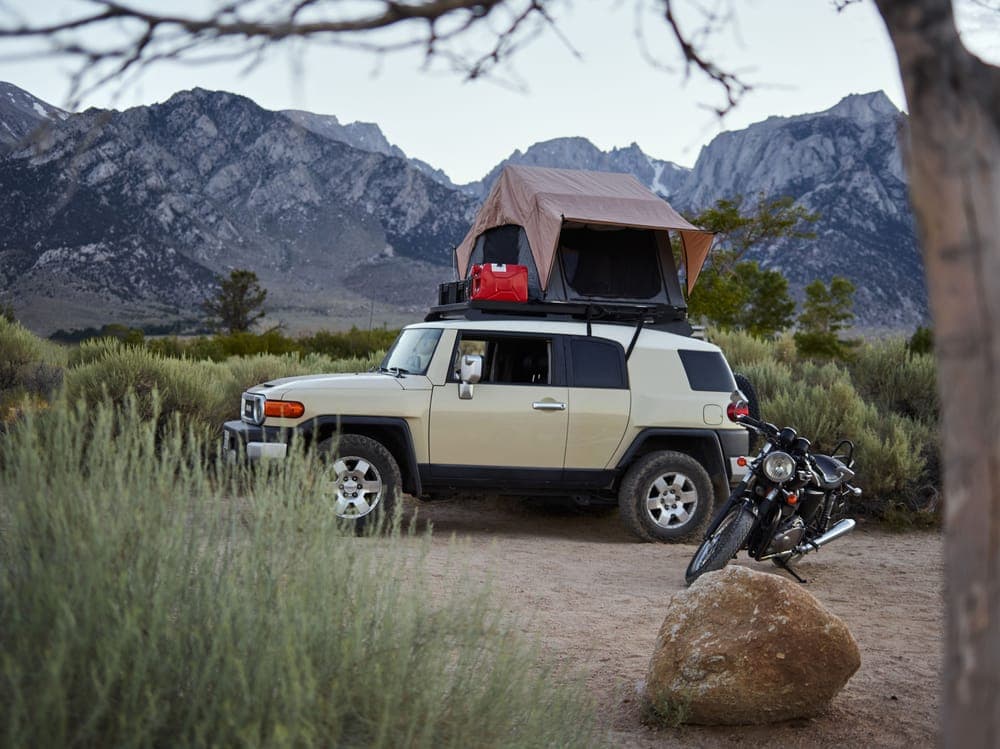
Trail groups are where the two services most often meet. The practical rule is simple: run what your group runs. If the club talks on GMRS, a licensed GMRS mobile with a roof antenna does the job, and one license covers everyone in your family who rides along. If some members are hams, they may run a separate ham channel as well. And if the group still talks on CB, that's a third radio; our GMRS vs CB radio comparison covers that choice. Our overlanding radio setup guide lays out a full rig, and the convoy radio guide covers channel plans and who calls what.
Choose GMRS if, choose ham if
Choose GMRS if...
- The radios are for the family, the lease, the ranch or the convoy, not a hobby in themselves.
- Kids, grandparents or anyone who won't take an exam need to talk.
- You want radios that work out of the box on a fixed set of channels.
- You want repeaters and a vehicle radio without studying for a test.
Choose ham if...
- You enjoy the technical side: programming, antennas, experimenting.
- You want to talk well beyond local range, which means working toward a General license and HF.
- You're the only one who needs to transmit, or everyone in your group is willing to get licensed.
- You want to build or modify your own equipment, which GMRS rules don't allow.
If GMRS fits: three radios to start with
We only recommend GMRS radios here, because this site doesn't rank ham gear. Every radio below is sold by its maker as a GMRS radio and needs a GMRS license.
Midland GXT3000VP4 (needs a GMRS license). The family pick: a two-pack with 8 repeater channels, Li-ion packs with a 3 AA backup, USB-C charging, NOAA alerts and a flashlight (Midland). Buy it if there's a GMRS repeater near your lease or town. Skip it if there isn't one; without a repeater, most of what you pay for over a simpler pair is the battery.
Wouxun KG-935G Plus (needs a GMRS license). The radio for the person who would otherwise be tempted by ham gear. Wouxun lists "5.5W / 2W / 0.5W" output, IP66, a 2600 mAh USB-C battery, NOAA alerts and a keypad Channel Wizard for adding repeaters (Wouxun), and its authorized dealer lists a removable SMA-male antenna (BuyTwoWayRadios). Buy it for whoever manages the group's radios. Skip it for the kids; it's menu-deep and sold one at a time.
BTECH GMRS-20V2 (needs a GMRS license). The trail-rig pick: 20 W, IP67, a control mic, and a 12V plug-in cable. BTECH says it is "FCC Part 95E certified and requires a GMRS license to transmit" (BTECH). No antenna comes in the box, so budget for a GMRS mobile antenna and mount. For more vehicle options, see the best GMRS mobile radios.
Doing both
Nothing stops you from holding both licenses. Just keep them separate in your head, because the rules don't blend:
- Two services, usually two radios. A GMRS-certified radio can't be certified with ham capability (95.1761), and a ham radio isn't certified for GMRS.
- Two call signs, two schedules. On GMRS you identify after a transmission or a series and at least every 15 minutes (95.1751); on ham, at the end of each communication and at least every 10 minutes (97.119).
- Your family rides on the GMRS license only. On the ham side, each of them needs their own.
If you're starting from zero and the goal is keeping people in touch, get the GMRS license first. The rest of the GMRS picture, from channels to repeaters, is on our GMRS and FRS hub.
In detail
The contenders, in full
Stock photoFor the family or lease crew
Midland GXT3000VP4 (2-pack)
A GMRS pair anyone in the family can pick up and use, with 8 repeater channels, Li-ion packs and a 3 AA fallback. Covered by one license, no exam for anyone.
Published specsResearched · not tested by us
How the 6.7 score breaks down
- Real-world reach (30%)
- 6
- Ease of use (20%)
- 7
- Toughness & weather (15%)
- 5
- Power & battery (15%)
- 8
- Field features (10%)
- 8
- Value (10%)
- 7
What the specs support
- 8 repeater channels, so it can use a local GMRS repeater for real distance
- Li-ion packs with a 3 AA fallback and a 4-hour USB-C recharge
- Flashlight, Dual Watch and NOAA alerts cover a camp or a lease
Where it falls short
- JIS4 splash rating only
- Transmit power isn't stated, and the battery-life figures conflict (27 vs 18 hours)
- Midland doesn't list a removable antenna
Skip this if…
…Skip it if there's no GMRS repeater in your area: without one, the extra over a GXT1000 buys you mainly a better battery and a flashlight.
#ad · Price set by Amazon · How we make money for the link to Midland GXT3000VP4 (2-pack)
Stock photoFor the tinkerer who wants GMRS
Wouxun KG-935G Plus (single radio)
The GMRS handheld for the person who likes menus: Wouxun lists 5.5 W, IP66, a keypad Channel Wizard for repeaters and a removable SMA antenna. All the fiddling a ham radio offers, inside GMRS rules.
Published specsResearched · not tested by us
How the 7.6 score breaks down
- Real-world reach (30%)
- 8
- Ease of use (20%)
- 7
- Toughness & weather (15%)
- 8
- Power & battery (15%)
- 7
- Field features (10%)
- 8
- Value (10%)
- 7
What the specs support
- Wouxun lists 5.5 W on high, with all 8 repeater channels
- IP66 and a 2600 mAh USB-C battery
- Keypad Channel Wizard adds repeaters without a computer
- Removable SMA-male antenna for an upgrade
Where it falls short
- Sold as a single radio
- Deep menus and 999 channels are more than a casual family user needs
- Wouxun doesn't state battery runtime
Skip this if…
…Skip it if you want radios the kids can pick up and use: it's a keypad-and-menu power-user radio sold one at a time.
#ad · Price set by Amazon · How we make money for the link to Wouxun KG-935G Plus (single radio)
Stock photoFor the trail rig
BTECH GMRS-20V2 (20 W compact mobile)
A compact 20 W GMRS mobile rated IP67 that plugs into a 12V socket and programs with CHIRP. Add a GMRS antenna; none is in the box.
Published specsResearched · not tested by us
How the 7.8 score breaks down
- Real-world reach (30%)
- 8
- Ease of use (20%)
- 6
- Toughness & weather (15%)
- 9
- Power & battery (15%)
- 8
- Field features (10%)
- 8
- Value (10%)
- 8
What the specs support
- IP67 at the mid list-price tier
- Runs from the included 12V cigarette-plug cable
- Control-mic design lets the small body hide under a seat
- Tri watch and scanner receive
Where it falls short
- No antenna in the box
- Programming-heavy: 200 channels, with CHIRP and a cable for bulk setup
- The page's 75-mile figure contradicts its own 1-5 mile typical-range statement
Skip this if…
…Skip it if you want one box with everything: the GMRS-20V2 ships without an antenna, so it can't transmit until you add a GMRS mobile antenna and mount.
#ad · Price set by Amazon · How we make money for the link to BTECH GMRS-20V2 (20 W compact mobile)
How we scored this
Radios we claim to have lab-tested: 0
Plenty of radio sites say they range-tested everything they list. We haven't, and we say so. Every pick here is labeled Researched: we read each maker's published specs, manuals and range tables, check the license rules against the FCC, and score every radio on a public rubric. Every figure links to where it came from, and every range number is labeled “advertised.”
Scores are editorial judgments from that documented research, not test results. Commissions never set a score or decide a pick. The rubric and its weights are published.
What changed
- Published.
Questions
Frequently asked
Is GMRS the same as ham radio?
Do you need a test for a GMRS license?
Can I use my ham radio on GMRS channels?
Does a ham license cover my family?
Is GMRS or ham better for overlanding?
How hard is the ham radio Technician exam?
Receipts
Sources
- FCC: General Mobile Radio Service (GMRS) page (checked 2026-09-22)
- FCC: Amateur Radio Service page (fcc.gov, checked 2026-09-22)
- FCC: Amateur Radio Service page, Internet Archive capture of 2026-09-16 (read 2026-09-22)
- FCC: Personal Service and Amateur Application Fees, page effective May 23, 2025 (checked 2026-09-22)
- 47 CFR 95.1705, GMRS individual licenses and immediate family (via Cornell LII, checked 2026-09-22)
- 47 CFR 95.1731, permissible GMRS uses (via Cornell LII, checked 2026-09-22)
- 47 CFR 95.1751, GMRS station identification (via Cornell LII, checked 2026-09-22)
- 47 CFR 95.1761, GMRS transmitter certification (via Cornell LII, checked 2026-09-22)
- 47 CFR 95.1767, GMRS transmitting power limits (via Cornell LII, checked 2026-09-22)
- 47 CFR 95.335, operation of non-certified transmitters prohibited (via Cornell LII, checked 2026-09-22)
- 47 CFR 97.7, control operator required (via Cornell LII, checked 2026-09-22)
- 47 CFR 97.25, amateur license term (via Cornell LII, checked 2026-09-22)
- 47 CFR 97.119, amateur station identification (via Cornell LII, checked 2026-09-22)
- 47 CFR 97.301, authorized amateur frequency bands (via Cornell LII, checked 2026-09-22)
- 47 CFR 97.313, amateur transmitter power standards (via Cornell LII, checked 2026-09-22)
- 47 CFR 97.501, qualifying for an amateur operator license (via Cornell LII, checked 2026-09-22)
- 47 CFR 97.503, amateur exam element standards (via Cornell LII, checked 2026-09-22)
- ARRL: Getting licensed, license classes and the Technician exam (checked 2026-09-22)
- ARRL: ARRL VEC exam fee, 2026 (checked 2026-09-22)
- ARRL: Volunteer Examiners (checked 2026-09-22)
- Baofeng: UV-5R Dual Band Ham Radio 25th Anniversary Edition product page (checked 2026-09-22)
- Midland: GXT3000VP4 product page (checked 2026-09-22)
- Wouxun: KG-935G Plus product page (checked 2026-09-22)
- BuyTwoWayRadios (authorized Wouxun dealer): KG-935G Plus listing (checked 2026-09-22)
- BTECH: GMRS-20V2 product page (checked 2026-09-22)
We haven't tested the radios on this page and we don't pretend to. Specs and range figures come from each maker's own pages and manuals (linked on every product), and license, power and channel rules come from the FCC and 47 CFR Part 95. Range numbers are the maker's advertised claims and are labeled that way. Prices are set by Amazon and change often, so we don't print them. Where a figure isn't published, we say so. Read the full method.