Not legal advice. This page summarizes FCC rules (47 CFR Part 95) from the official sources linked in the text. Rules and fees checked . The FCC sets its fees annually and can change its rules, so confirm the current version on fcc.gov before you rely on it.
The contenders
Side by side
 Stock photo
GMRS pick: the plug-in upgrade
Midland MXT275 MicroMobile (15 W)
15 W of GMRS that plugs into a 12V socket, with the controls on the mic, 8 repeater channels and a magnet-mount antenna in the box. The easiest way to put GMRS in a trail rig.
Check price · Amazon#ad · Price set by Amazon · How we make money for the link to Midland MXT275 MicroMobile (15 W)
- Stock photo
GMRS pick: full 50 W
Midland MXT575 MicroMobile (50 W)
The most power GMRS allows a mobile, with a hideaway body and a control mic. Midland's own chart says 20-25 miles with partial obstruction, advertised; it lists no water rating.
Check price · Amazon#ad · Price set by Amazon · How we make money for the link to Midland MXT575 MicroMobile (50 W)
 Stock photo
CB pick: the classic
Cobra 29 LTD Classic AM/FM CB
No license, 4 W, AM and FM on all 40 channels, and a built-in SWR meter to tune the antenna you'll have to buy separately. The pick if your group or the road you drive runs on CB.
Check price · Amazon#ad · Price set by Amazon · How we make money for the link to Cobra 29 LTD Classic AM/FM CB
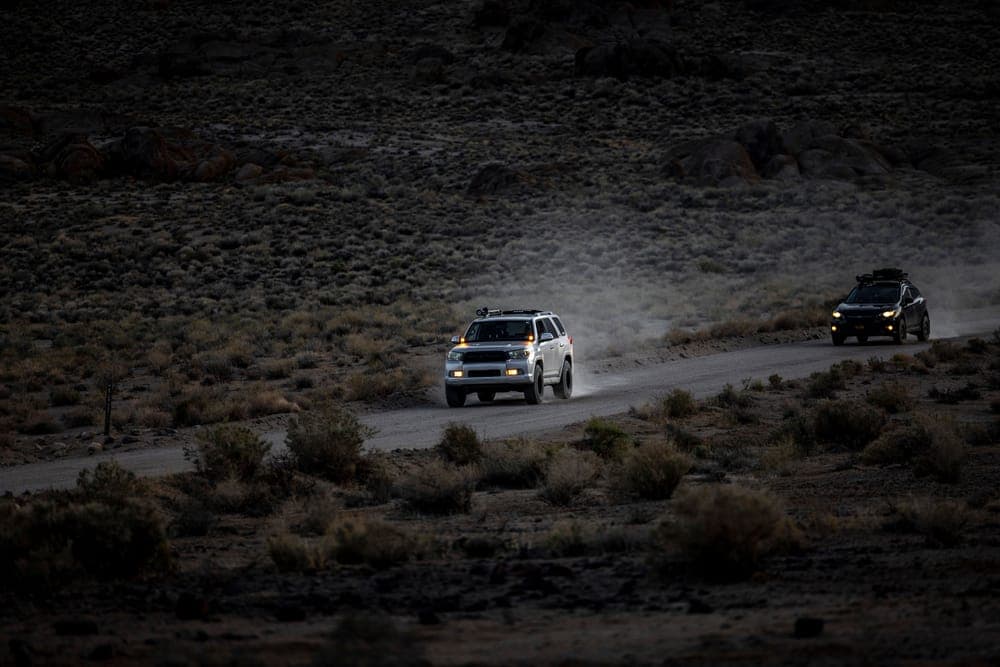
You're the tail truck in a four-rig convoy on a forest road, a mile of dust and switchbacks behind the leader. You need to hear "oncoming traffic" and "stopping at the fork," and you'd like to hear any big truck coming the other way. That is the GMRS vs CB question in one scene: GMRS is usually the better tool for the group, and CB is still how you talk to the big trucks.
Both are FCC personal radio services under 47 CFR Part 95, but they sit in very different parts of the radio spectrum, and almost every practical difference, from antenna size to who you can talk to, follows from that. Every rule below is linked to the FCC or the rule text, and every product figure to the maker. We don't test radios; the picks are scored on the rubric on our How We Rank page.
GMRS vs CB radio at a glance
| CB (Citizens Band) | GMRS | |
|---|---|---|
| Band | 26.965 to 27.405 MHz (HF); wavelength about 11 meters | About 462 and 467 MHz (UHF); wavelength about 65 cm |
| Channels | 40, shared | 30: 22 shared with FRS plus 8 repeater inputs |
| License | None, at any age | Individual FCC license, 18 or older; covers immediate family; $35 per the fee table (checked September 2026) |
| Power | AM or FM: 4 W mean carrier power. SSB: 12 W PEP. No amplifiers | Up to 50 W for mobile, base and repeater stations on the main channels; handhelds typically rated at 5 W by their makers |
| Quarter-wave antenna | About 9 feet (108 inches) at channel 19 | About 6.4 inches at 462 MHz |
| Antenna in the box (our picks) | No: sold separately | Yes: Midland includes a 2.1 dB magnet-mount antenna |
| Repeaters | None in the 40-channel plan | Yes, through the 467 MHz repeater inputs |
| Emergency channel | Channel 9, for emergencies and traveler assistance only | No channel reserved by rule; any channel may carry emergency traffic |
| Talk-time rule | No more than 5 minutes continuously, then a 1-minute break | Listen before you talk; say your call sign at least every 15 minutes |
| Typical users | Truckers, highway travelers, clubs that standardized on CB | Families, overlanders, hunters, trail groups with spotters on foot |
Sources: CB channels from 47 CFR 95.963, CB power from 95.967, channel 9 from 95.931, the CB talk-time rule and license status from the FCC's personal radio services guide; GMRS facts from the FCC's GMRS page, 95.1767 (power), 95.1763 (channels), 95.1731 (emergencies) and 95.1751 (call signs); the fee from the FCC fee table. Antenna lengths are our arithmetic from the speed of light (NIST), explained below.
Band: 27 MHz vs 462 MHz
CB's 40 channels run from 26.965 MHz (channel 1) to 27.405 MHz (channel 40) (47 CFR 95.963). That's the HF end of the spectrum. GMRS uses channels "around 462 MHz and 467 MHz" (FCC, GMRS), which is UHF, the same neighborhood as FRS walkie-talkies.
The practical consequence is wavelength. Divide the speed of light, 299,792,458 meters per second (NIST), by the frequency and you get the length of one radio wave: about 11 meters on CB channel 19 (27.185 MHz), and about 65 centimeters at 462 MHz. Antennas are sized to that wave, which is why CB antennas are long and GMRS antennas are short. It's also why the two services can't interoperate: a radio built for one band doesn't transmit or receive on the other.
The license question
CB needs no license. The FCC lists CB among the personal radio services and notes that "only General Mobile Radio Service requires an FCC license to operate" (FCC consumer guide). Cobra's manual puts it plainly: "the Citizens Band service does not require a license for operation, regardless of age" (Cobra 29 LTD manual). The radio itself must still be legal: "CB equipment used in the United States must be FCC-certified and labeled as such by the manufacturer," per the same FCC guide.
GMRS needs an individual license. You apply at 18 or older, it runs ten years, and "any family member, regardless of age, can operate GMRS stations and units within the licensed system" (FCC, GMRS). The FCC's fee table lists $35 for a new application (FCC fee table, checked September 2026; fees are set annually). No exam. For a family convoy that's one license for the whole crew; for a club, each family needs its own. Our GMRS license guide covers the details.
Power and modes
CB power is low and fixed. For AM or FM voice, "the mean carrier power must not exceed 4 Watts," and for single sideband (SSB), "the peak envelope power must not exceed 12 Watts" (47 CFR 95.967). The FCC adds: "You may not raise the power output of your CB unit, attach any type of power amplifier or modify the unit internally" (FCC consumer guide).
CB is also the only one of the two with a choice of modes. CB radios must transmit AM or single sideband and "may also transmit FM voice" (47 CFR 95.971). FM is new to CB: Cobra says it petitioned the FCC in 2016 and that "In 2021, Part 95 officially was updated to include FM as an option," arguing that FM "offers improved speech quality and lower noise interference" (Cobra manual). Plenty of CBs are still AM only (the Uniden PRO520XL is one), so if your group mixes radios, talk on AM.
GMRS allows far more in a vehicle: "The transmitter output power of mobile, repeater and base stations must not exceed 50 Watts" on the main channels (47 CFR 95.1767). The Midland MXT575 is rated at 50 W on high and the MXT275 at 15 W. One detail Midland's manuals point out: channels 1-7 stay on low power, so the full wattage is on channels 15-22 and the repeater channels. That follows the rule, which holds the 462 MHz interstitial channels to 5 W ERP.
Antenna size: 9 feet vs 6 inches
A basic quarter-wave antenna is a quarter of that wavelength long. Doing the arithmetic: about 108 inches, or 9 feet, on CB channel 19, and about 6.4 inches at 462 MHz. That's why the classic full-size CB whip towers over the truck, and why most vehicles use shorter "loaded" CB antennas instead. Cobra's own manual recommends its loaded antennas "for most installations" ( Cobra manual).
Cobra is also blunt about how much the antenna matters on CB: "Since the maximum allowable power output of the transmitter is limited by the FCC, the antenna is critical in affecting transmission distance. Only a properly matched antenna system will allow maximum power output," and "the ideal antenna location is on the center of the roof." That's why the Cobra 29 LTD's built-in SWR meter is worth having; SWR is how you check the antenna is tuned. The compact Cobra 19 MINI has no SWR meter, so you'd need a separate one. None of the CB radios we list ships with an antenna.
GMRS antennas are short enough to come in the box. Midland includes a 2.1 dB magnet-mount antenna with both the MXT275 and the MXT575 (Midland MXT275, MXT575). The common upgrade is a taller whip: Midland's MXTA26 is a 32-inch, 6 dB "5/8 wave" antenna on an NMO mount (Midland), still a fraction of a full-size CB whip. Our best GMRS antennas and how to install a GMRS radio in your vehicle cover mounting it right.
Which reaches farther?
In a vehicle, GMRS has the edge on paper: up to 50 W against CB's 4 W on AM or FM, with an antenna that is easy to mount in the best spot, the center of the roof. The FCC's expectation for GMRS is "one to twenty-five miles depending on station class, terrain, and repeater use" ( FCC, GMRS). Midland publishes terrain charts for its mobiles, and they're worth reading as the maker's advertised figures: for the MXT275, "10-15 Miles IDEAL" with partial obstruction and "5-10 Miles OBSTRUCTED" (spec sheet); for the MXT575, "20-25 Miles IDEAL" and "10-15 Miles OBSTRUCTED" (spec sheet).
For CB, the FCC's guide gives no range figure, and Cobra says only that "range can vary depending on the terrain and quality of the product" (Cobra manual). We won't invent a number for it. What we can say: on either service, terrain and antenna height beat wattage. A radio in a canyon bottom loses to a radio on a ridge. GMRS adds one tool CB doesn't have, the repeater, which can carry a handheld's signal from a hilltop; see GMRS repeaters and GMRS handheld vs mobile range.
Do walkie-talkies work with CB radios?
No. The walkie-talkies most families buy are FRS or GMRS radios, which transmit near 462 and 467 MHz. CB is near 27 MHz. A radio only transmits and receives on the band it's built for, so a Midland or Motorola walkie-talkie can't talk to a CB, and a CB can't hear it. To talk to a CB, you need a CB radio.
This is the strongest practical argument for GMRS in a trail group. A GMRS mobile in the truck talks directly to GMRS handhelds, and on the shared channels to FRS radios too, so a spotter walking an obstacle, a kid at camp or a hunter on a stand is on the same network as the driver. A CB-only rig can't do that.
How convoys use each
- CB for the road. CB caught on in the 1970s "as a method of communication between drivers to report police speed traps and road hazards," as Cobra tells the story (Cobra manual). If you want to hear truckers and highway traffic, or your club still runs CB, carry one. Channel 9 is reserved by rule: it "may be used only for emergency communications or traveler assistance" (47 CFR 95.931).
- GMRS for the group. Pick one channel for the convoy, and a second for when the first gets busy. The FCC asks GMRS users to share channels under a "listen-before-talk" etiquette (FCC, GMRS), since nobody owns a channel.
- Both, if you can. Two radios, two antennas: CB for the highway, GMRS for the trail. Our convoy radio guide has a channel plan and call order, and the overlanding radio setup guide shows a full rig with GMRS, CB and ham side by side.
If you're weighing ham radio too, our GMRS vs ham radio comparison covers the exam, the bands and who the license covers.
Choose CB if, choose GMRS if
Choose CB if...
- You want to hear truckers and highway traffic, or your club already runs CB.
- You want no license at all, for anyone who drives the truck.
- You have room for a proper antenna and will tune it with an SWR meter.
Choose GMRS if...
- You're building a family or trail-group setup from scratch.
- You want handhelds for spotters, hunters or kids to talk to the truck.
- You want more power, a short antenna, or access to a repeater.
- You're fine with one FCC license that covers your immediate family.
The radios side by side
Midland MXT275 MicroMobile (needs a GMRS license). 15 W, a hideaway body with every control on the mic, 8 split-tone repeater channels, and a 12V plug so there's no hardwiring. The stock magnet-mount antenna gets you going, and the SO-239 jack takes an upgrade. Skip it for an open-cab UTV: Midland states no water rating. Compare it with its siblings in our MXT115 vs MXT275 vs MXT575 breakdown.
Midland MXT575 MicroMobile (needs a GMRS license). The full 50 W GMRS allows a mobile, in the same hideaway, control-mic design, with NOAA alerts and a USB-C port. It's top-tier, and Midland publishes no water rating for it either. Buy it when the group spreads out over long, open miles; on a tight wooded trail, a 15 W radio with a better antenna does most of the same job.
Cobra 29 LTD Classic AM/FM (no license). The full-size trucker CB: 4 W, AM and FM on all 40 channels, instant channel 9, a PA output and built-in SWR calibration (Cobra). Cobra's spec sheet says "Standard CB Antenna Required (Sold Separately)." Skip it if your group already runs GMRS; it can't talk to those radios. For a Jeep with no dash room, the Cobra 19 MINI is the compact alternative. More vehicle picks are in the best GMRS mobile radios.
A dash means the maker doesn't publish that figure. The whole GMRS picture, from licenses to repeaters, is on our GMRS and FRS hub.
In detail
The contenders, in full
Stock photoGMRS pick: the plug-in upgrade
Midland MXT275 MicroMobile (15 W)
15 W of GMRS that plugs into a 12V socket, with the controls on the mic, 8 repeater channels and a magnet-mount antenna in the box. The easiest way to put GMRS in a trail rig.
Published specsResearched · not tested by us
How the 6.9 score breaks down
- Real-world reach (30%)
- 8
- Ease of use (20%)
- 7
- Toughness & weather (15%)
- 4
- Power & battery (15%)
- 8
- Field features (10%)
- 6
- Value (10%)
- 7
What the specs support
- Plugs into a 12V socket, with no hardwiring needed
- Hideaway body and control mic keep the dash clear
- Repeater capable, and the SO-239 jack takes an upgraded antenna
Where it falls short
- Midland states no IP or water rating
- No PA or intercom jack listed, unlike the MXT115P PRO
- Channels 1-7 stay on low power (manual)
Skip this if…
…Skip it if the radio goes in an open-cab tractor or UTV that sees rain and dust: Midland states no water rating for the MXT275, while the MXT115P PRO at the same 15 W is IP67.
#ad · Price set by Amazon · How we make money for the link to Midland MXT275 MicroMobile (15 W)
Stock photoGMRS pick: full 50 W
Midland MXT575 MicroMobile (50 W)
The most power GMRS allows a mobile, with a hideaway body and a control mic. Midland's own chart says 20-25 miles with partial obstruction, advertised; it lists no water rating.
Published specsResearched · not tested by us
How the 7.2 score breaks down
- Real-world reach (30%)
- 9
- Ease of use (20%)
- 7
- Toughness & weather (15%)
- 4
- Power & battery (15%)
- 8
- Field features (10%)
- 7
- Value (10%)
- 6
What the specs support
- 50 W on high, the top power in Midland's MicroMobile line
- Hideaway body with the controls on the mic frees dash space in Jeeps and side-by-sides
- 8 split-tone repeater channels for reaching a local GMRS repeater
- Midland publishes a terrain chart (20-25 miles with partial obstruction), not just a max figure
Where it falls short
- Midland states no IP or water rating for the MXT575; the MXT500 is listed as water resistant
- Same list-price tier as the MXT500, which adds a PA function and noise canceling
- Channels 1-7 stay on low power (manual), so full power is only on 15-22 and the repeater channels
Skip this if…
…Skip it if the radio will ride in an open-cab UTV or tractor: Midland lists no water rating for the MXT575, so the IP67 MXT115P PRO or the water-resistant MXT500 fits that job better.
#ad · Price set by Amazon · How we make money for the link to Midland MXT575 MicroMobile (50 W)
Stock photoCB pick: the classic
Cobra 29 LTD Classic AM/FM CB
No license, 4 W, AM and FM on all 40 channels, and a built-in SWR meter to tune the antenna you'll have to buy separately. The pick if your group or the road you drive runs on CB.
Published specsResearched · not tested by us
How the 6.2 score breaks down
- Real-world reach (30%)
- 6
- Ease of use (20%)
- 7
- Toughness & weather (15%)
- 4
- Power & battery (15%)
- 8
- Field features (10%)
- 5
- Value (10%)
- 7
What the specs support
- Built-in SWR meter lets you tune the antenna without extra gear
- AM/FM, and it still talks to AM-only CBs on the AM band
- PA output and a 9 ft mic cord for trucks and rigs
Where it falls short
- No NOAA weather channels listed on the Classic
- Full-size body needs real dash or overhead space
- Antenna sold separately
Skip this if…
…Skip it if your group already runs GMRS radios: a CB can't talk to them, and a 4 W CB only performs with a properly tuned external antenna.
#ad · Price set by Amazon · How we make money for the link to Cobra 29 LTD Classic AM/FM CB
How we scored this
Radios we claim to have lab-tested: 0
Plenty of radio sites say they range-tested everything they list. We haven't, and we say so. Every pick here is labeled Researched: we read each maker's published specs, manuals and range tables, check the license rules against the FCC, and score every radio on a public rubric. Every figure links to where it came from, and every range number is labeled “advertised.”
Scores are editorial judgments from that documented research, not test results. Commissions never set a score or decide a pick. The rubric and its weights are published.
What changed
- Published.
Questions
Frequently asked
Is GMRS better than CB?
Is GMRS the same as CB?
Do walkie-talkies work with CB radios?
Do I need a license for a CB radio?
What is CB channel 9 for?
Can I run a CB and a GMRS radio in the same truck?
Receipts
Sources
- FCC consumer guide: Personal Radio Services, keeping in touch (CB section; checked 2026-09-22)
- FCC: General Mobile Radio Service (GMRS) page (checked 2026-09-22)
- FCC: Personal Service and Amateur Application Fees, page effective May 23, 2025 (checked 2026-09-22)
- 47 CFR 95.963, CBRS channel frequencies (via Cornell LII, checked 2026-09-22)
- 47 CFR 95.967, CBRS transmitter power limits (via Cornell LII, checked 2026-09-22)
- 47 CFR 95.971, CBRS emission types (via Cornell LII, checked 2026-09-22)
- 47 CFR 95.931, permissible CBRS uses (via Cornell LII, checked 2026-09-22)
- 47 CFR 95.1731, permissible GMRS uses (via Cornell LII, checked 2026-09-22)
- 47 CFR 95.1751, GMRS station identification (via Cornell LII, checked 2026-09-22)
- 47 CFR 95.1763, GMRS channels (via Cornell LII, checked 2026-09-22)
- 47 CFR 95.1767, GMRS transmitting power limits (via Cornell LII, checked 2026-09-22)
- NIST: SI redefinition, meet the constants (speed of light; checked 2026-09-22)
- Cobra: 29 LTD product page (checked 2026-09-22)
- Cobra: 29 LTD AM/FM Classic owner's manual PDF (checked 2026-09-22)
- Cobra: 29 LTD Classic AM/FM spec sheet PDF (checked 2026-09-22)
- Cobra: 19 MINI AM/FM product page (checked 2026-09-22)
- Midland: MXT275 product page (checked 2026-09-22)
- Midland: MXT275 spec sheet PDF (checked 2026-09-22)
- Midland: MXT575 product page (checked 2026-09-22)
- Midland: MXT575 spec sheet PDF (checked 2026-09-22)
- Midland: MXTA26 6 dB whip antenna product page (checked 2026-09-22)
We haven't tested the radios on this page and we don't pretend to. Specs and range figures come from each maker's own pages and manuals (linked on every product), and license, power and channel rules come from the FCC and 47 CFR Part 95. Range numbers are the maker's advertised claims and are labeled that way. Prices are set by Amazon and change often, so we don't print them. Where a figure isn't published, we say so. Read the full method.