Not legal advice. This page summarizes FCC rules (47 CFR Part 95) from the official sources linked in the text. Rules and fees checked . The FCC sets its fees annually and can change its rules, so confirm the current version on fcc.gov before you rely on it.
The contenders
Side by side
 Stock photo
Handheld: BTECH's budget 5 W
BTECH GMRS-V2 (single radio)
Rated at 5 W with an SMA antenna connector and repeater support. BTECH's own figure: 1 to 5+ miles simplex in open line of sight, 15 to 50+ through repeaters.
Check price · Amazon#ad · Price set by Amazon · How we make money for the link to BTECH GMRS-V2 (single radio)
- Stock photo
Handheld: Midland's 5 W, IP67
Midland GXT67 PRO (single radio)
Rated at 5 W, IP67 and repeater capable, with Midland's own figure of up to 5 miles depending on the terrain. The antenna is fixed.
Check price · Amazon#ad · Price set by Amazon · How we make money for the link to Midland GXT67 PRO (single radio)
 Stock photo
Mobile/base: BTECH's 50 W
BTECH GMRS-50V2 (50 W mobile/base)
50 W with 20 W and 5 W steps and an SO-239 jack for a real antenna. BTECH's figure: 2 to 5 miles in town or woods, 5 to 15 in open rural terrain. The antenna and the 13.8 V wiring are on you.
Check price · Amazon#ad · Price set by Amazon · How we make money for the link to BTECH GMRS-50V2 (50 W mobile/base)
- Stock photo
Mobile: Midland's 50 W MicroMobile
Midland MXT575 MicroMobile (50 W)
50 W with a magnet-mount antenna in the box and the controls on the mic. Midland's chart: 10-15 miles obstructed, 20-25 with partial obstruction, 75 max.
Check price · Amazon#ad · Price set by Amazon · How we make money for the link to Midland MXT575 MicroMobile (50 W)
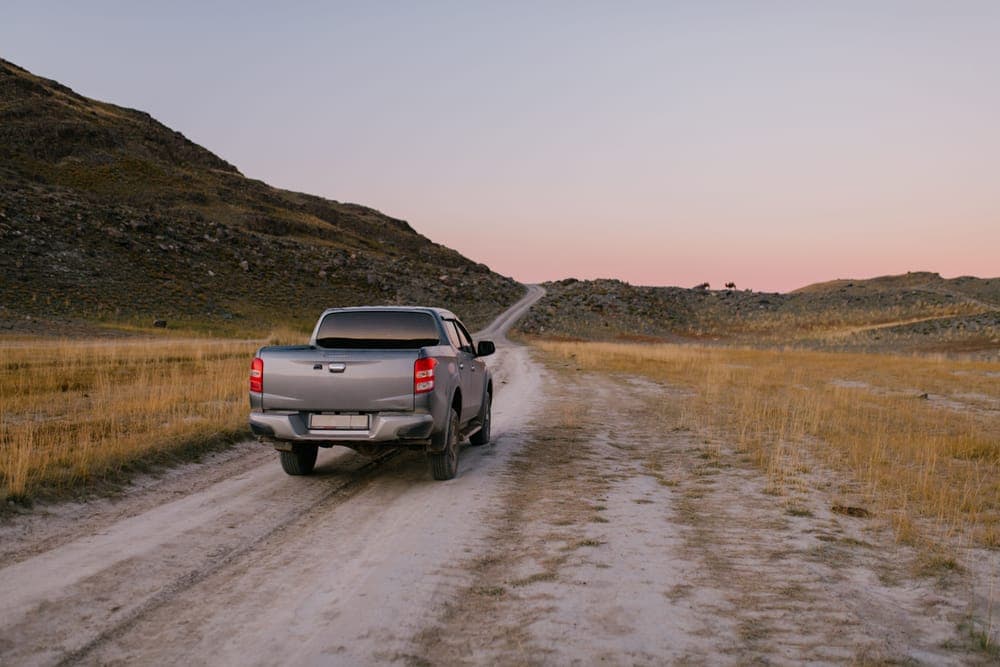
Here's the situation this page is for. You're at the house or the truck, your partner is at the far pasture or the back of the lease, and the handhelds that talk fine across the yard go quiet out there. The question is whether a mobile radio in the truck (or a base in the house) fixes it, and why. Every range figure below is the maker's advertised claim. The rule quotes come from the FCC's text. The rest is ordinary radio physics, kept to what we can state without inventing numbers. GMRS needs an FCC license for any of these radios; the GMRS license guide covers it, and one license covers your family's handhelds and mobiles alike.
The radios side by side
Two handhelds and two mobiles, from two makers, so you can compare each maker's own numbers within its own line. That matters: makers don't measure range the same way, so a BTECH figure next to a BTECH figure tells you more than a BTECH figure next to a Midland one. Scores follow our standard rubric (see How We Rank), built from published specs; we don't run our own range trials.
What the FCC power rule actually says
Translated into the channel numbers on your radio (the FCC's FRS channel list gives the frequencies; FCC FRS page): channels 15 to 22 are the 462 MHz main channels, where a mobile or base can run its full power. Channels 1 to 7 are the 462 MHz interstitials, held to 5 W ERP for everyone. Channels 8 to 14 are the 467 MHz interstitials, handhelds only, at 0.5 W ERP. That's why Midland's MXT575 manual keeps channels 1 to 7 on low power (Midland manual), and why BTECH lists channels 8 to 14 as receive-only on its mobiles and caps channels 1 to 7 at 5 W on the GMRS-50PRO (BTECH GMRS-50V2, BTECH GMRS-50PRO). If your group wants the mobile's full reach, put your simplex channel on 15 to 22, or use a GMRS repeater.
What the rule doesn't contain is a separate power cap for handhelds on the main channels. The "5 W handheld" figure you'll see repeated online is a maker convention, not rule text: handhelds are typically rated at 5 W by their makers. The practical gap between a handheld and a mobile is real either way. Channel-by-channel details are in GMRS channels and frequencies.
Why the mobile reaches farther
The FCC's own range expectation names the reason. A GMRS user "can expect a communications range of one to twenty-five miles depending on station class, terrain, and repeater use" ( FCC GMRS page). "Station class" is exactly the handheld versus mobile question. A mobile wins on four things at once.
1. More power, with a caveat
A 50 W mobile puts out ten times the power of a radio rated at 5 W. That buys margin: a signal that was fading in and out at the edge of a handheld's reach comes through. But ten times the power is nowhere near ten times the distance, and it does nothing about a hill in the way. At GMRS frequencies signals travel mostly in straight lines, and a ridge blocks 50 W as surely as it blocks 5. Power is the least important of the four.
2. Antenna height and a clear view
This is the big one. A handheld's antenna is at chest height, next to your body, often under trees. A mobile's antenna sits on the roof, above the vehicle and above the people around it. A base antenna on a mast above the roofline is higher still. The higher the antenna, the more ground it can see before the curve of the land and the nearest hill cut it off. Everything else being equal, height is the upgrade that pays back most, and it works for both sending and receiving.
3. A bigger antenna, and a ground plane under it
A handheld carries a short antenna because it has to fit in a hand. A mobile can carry a full-size whip: Midland's MXTA26, for instance, is a 32-inch whip with a stated 6 dB gain (Midland). Gain doesn't create power; it concentrates the signal toward the horizon instead of wasting it up into the sky.
Most mobile antennas also rely on the vehicle itself. Midland's antenna FAQ says all of its current antennas "require a ground plane to perform as expected," that the minimum is about 12 inches across for GMRS, and that "Steel or aluminum can serve as a ground plane" ( Midland MXTA25 FAQ). A metal roof is an ideal one. A handheld has nothing like it.
4. No cab around the antenna
Use a handheld inside a truck and you're transmitting from inside a metal box with windows. A mobile's antenna is outside that box. If you only take one thing from this page: a handheld on the dash is the worst of both worlds. Either step out to use it, put its antenna on the roof, or put a mobile in the truck. The Nagoya UT-72G magnet-mount antenna (sold in the US by BTECH), for example, ships with adapters for both SMA genders so a handheld can use a roof antenna (BTECH).
What the makers' own charts show
Two makers publish figures for both their handhelds and their mobiles, which lets you see the gap in their own words. All of these are advertised claims, and none of them is a promise for your ground:
| Radio | Class and rated power | Maker's own figure (advertised) |
|---|---|---|
| BTECH GMRS-V2 | Handheld, 5 W | "Open line-of-sight (simplex): 1–5+ miles typical | With GMRS repeaters: 15–50+ miles" |
| BTECH GMRS-50V2 | Mobile/base, 50 W | "around 2–5 miles in-town or wooded areas, 5–15 miles in open rural terrain" |
| Midland GXT1000VP4 | Handheld, wattage not stated | "The GXT averages 1/2-2 miles in normal conditions" |
| Midland GXT67 PRO | Handheld, 5 W | "up to 5 miles, depending on the terrain" |
| Midland MXT115P PRO | Mobile, 15 W | Up to 5 mi neighborhood or dense forest; up to 10 mi suburban or rural; up to 15 mi peak to peak |
| Midland MXT275 | Mobile, 15 W | 5-10 mi obstructed; 10-15 mi partial obstruction; 50 mi max |
| Midland MXT575 | Mobile, 50 W | 10-15 mi obstructed; 20-25 mi partial obstruction; 75 mi max |
Sources: BTECH GMRS-V2, BTECH GMRS-50V2, Midland GXT1000VP4, Midland GXT67 PRO, Midland MXT115P PRO spec sheet, Midland MXT275 spec sheet, Midland MXT575 spec sheet.
Read down each maker's rows and the pattern is consistent. BTECH's handheld figure tops out at 5+ miles in open line of sight; its 50 W mobile's runs to 15 miles in open rural terrain. Midland's handheld figures run from 1/2-2 miles (GXT1000, normal conditions) to up to 5 (GXT67 PRO), while its mobiles' obstructed figures are 5-10 miles at 15 W and 10-15 at 50 W. Notice, too, what the mobiles' own charts do to the "max" numbers: Midland's 75-mile MXT575 figure drops to 10-15 miles once there's major obstruction. And BTECH's handheld figure through a repeater (15 to 50+ miles) beats its own 50 W mobile radio to radio, which is the best argument there is for a repeater. More on that in GMRS radio range.
The 5 W mobile: it isn't only watts
Midland's MXT105 is a useful test case. It's a mobile rated at 5 W, the same figure many handhelds carry, yet it comes with a magnet-mount roof antenna and an SO-239 jack for a better one (Midland). Midland's own range figures for it are 40 miles on the product page and "50 Miles MAX" with 10-15 miles obstructed on the spec sheet, which conflict with each other (Midland spec sheet). Whatever you make of the numbers, the design makes the point: the same power, lifted onto the roof, out of the cab and onto a ground plane, is a different radio. That's also why the first upgrade for a truck is often a mobile, and the first upgrade for a handheld is a longer antenna and higher ground.
Where a handheld still wins
- You can carry it. A mobile stays with the truck. The deer stand, the trail, the far gate and the spot where you're fixing fence all need a handheld.
- No install. Out of the box, charged, on the air. A mobile needs a power source, an antenna mount and a place to put the radio; BTECH says the GMRS-50V2 must be wired to a battery or fuse block, not a cigarette outlet (BTECH).
- It can climb. A handheld carried to a ridge top can beat a mobile parked in a hollow. Height still rules.
- Repeaters level the field. A handheld that can reach a GMRS repeater borrows the repeater's height and power. The FCC describes land stations that "operate as repeaters, thereby extending the range of GMRS mobile units" (FCC consumer guide). See our GMRS repeaters guide.
One more thing about mixing the two. A tall base or roof antenna helps in both directions, because height and gain work for receiving as well as sending. But the handheld at the far end still transmits with its own few watts through its own short antenna. So in a base-to-handheld conversation, the handheld's reply is usually the weak side. If the far handheld can hear the base but the base can't hear it, the fix is the handheld's antenna or position, not more base power.
If you're choosing a handheld now, our best GMRS handheld radios rank them on repeater support and removable antennas.
Setups that use both
The property: one base, handhelds in the field
Put a mobile or base radio in the house or shop, with a GMRS base antenna on a mast above the roofline, and give everyone in the field a handheld. The base becomes the fixed, high point everyone can reach. Our guide to covering your property with radios walks through it, the best GMRS antennas list covers base and mast antennas, and the best radios for farm and ranch include tractor and truck kits.
The vehicles: a mobile in each truck, handhelds for the walk
On a convoy or a ranch with several trucks, a mobile in each vehicle does the long talking, and a handheld per person covers anyone who gets out. Our convoy radio guide covers channels and roles, and how to install a GMRS radio in your vehicle covers the antenna and wiring. If you're choosing between Midland's MicroMobiles, see MXT115 vs MXT275 vs MXT575.
The valley: a repeater for everyone
If there's a GMRS repeater on a hill above your ground, handhelds and mobiles can both use it, and the difference between them shrinks. Check whether one exists and whether its owner allows use before you plan around it.
Who should buy which
- Hunters on stands and walkers on trails: a handheld, ideally one with a removable antenna and repeater channels, like the BTECH GMRS-V2.
- Anyone who needs a waterproof handheld from a familiar brand: the Midland GXT67 PRO, accepting its fixed antenna.
- A house or shop base for the whole property: the BTECH GMRS-50V2 with a mast antenna and a 13.8 V supply.
- A truck that needs full power with a clean dash: the Midland MXT575, which comes with a magnet-mount antenna. Midland lists no water rating for it, so keep it in a closed cab. More choices are in the best GMRS mobile radios.
- Most working setups: both. One mobile or base, plus a handheld for every person who leaves it.
A GMRS license is required for all four radios; the FCC's fee table lists a new application at $35 (checked September 2026; the FCC sets fees annually, FCC fee table). For every radio on the site ranked purely on reach, see the best long-range walkie-talkies, and for more on range in general, the Real Range hub.
In detail
The contenders, in full
Stock photoHandheld: BTECH's budget 5 W
BTECH GMRS-V2 (single radio)
Rated at 5 W with an SMA antenna connector and repeater support. BTECH's own figure: 1 to 5+ miles simplex in open line of sight, 15 to 50+ through repeaters.
Published specsResearched · not tested by us
How the 6.7 score breaks down
- Real-world reach (30%)
- 7
- Ease of use (20%)
- 6
- Toughness & weather (15%)
- 5
- Power & battery (15%)
- 7
- Field features (10%)
- 7
- Value (10%)
- 9
What the specs support
- SMA antenna connector and repeater support at the budget tier
- USB-C charging plus a desktop charger, with up to 18 hours claimed
- BTECH publishes a realistic simplex figure (1 to 5+ miles typical)
Where it falls short
- Custom channels mean CHIRP or the keypad menu
- IP54 splash rating only
Skip this if…
…Skip it if the radio is for a child or a non-technical user: it's a keypad-and-menu radio with 200 programmable memories, not a push-and-talk family unit.
#ad · Price set by Amazon · How we make money for the link to BTECH GMRS-V2 (single radio)
Stock photoHandheld: Midland's 5 W, IP67
Midland GXT67 PRO (single radio)
Rated at 5 W, IP67 and repeater capable, with Midland's own figure of up to 5 miles depending on the terrain. The antenna is fixed.
Published specsResearched · not tested by us
How the 7.1 score breaks down
- Real-world reach (30%)
- 7
- Ease of use (20%)
- 7
- Toughness & weather (15%)
- 9
- Power & battery (15%)
- 7
- Field features (10%)
- 7
- Value (10%)
- 5
What the specs support
- IP67 waterproof and dustproof, where the GXT1000 and GXT3000 are splash-rated JIS4
- Rated at 5 W with 8 repeater channels and split tones
- USB-C (PD) and 12 V vehicle charging in the box
Where it falls short
- Sold as a single radio, so a pair means buying two
- Fixed antenna and a factory-sealed battery you can't swap in the field
- Midland's battery-life figures conflict (16 hours vs up to 4 days)
Skip this if…
…Skip it if you want to carry a spare battery or fit a longer antenna for the far side of the property: the battery is sealed and the antenna doesn't come off.
#ad · Price set by Amazon · How we make money for the link to Midland GXT67 PRO (single radio)
Stock photoMobile/base: BTECH's 50 W
BTECH GMRS-50V2 (50 W mobile/base)
50 W with 20 W and 5 W steps and an SO-239 jack for a real antenna. BTECH's figure: 2 to 5 miles in town or woods, 5 to 15 in open rural terrain. The antenna and the 13.8 V wiring are on you.
Published specsResearched · not tested by us
How the 7.5 score breaks down
- Real-world reach (30%)
- 9
- Ease of use (20%)
- 6
- Toughness & weather (15%)
- 5
- Power & battery (15%)
- 8
- Field features (10%)
- 8
- Value (10%)
- 8
What the specs support
- 50 W with 20 W and 5 W steps, a list-price tier below Midland's 50 W MicroMobiles
- Quad watch and VHF/UHF scanner receive
- Standard SO-239 jack for any GMRS mobile or base antenna
- BTECH publishes a typical simplex range (2-5 miles in town or woods), not just a max figure
Where it falls short
- Needs direct 13.8 V wiring and an antenna bought separately
- IP54 splash resistance only
- 256 channels and many menus mean more setup than a Midland
Skip this if…
…Skip it if you want to plug into a 12V socket and drive off: BTECH says the GMRS-50V2 needs a direct battery or fuse-block connection, and it ships without an antenna.
#ad · Price set by Amazon · How we make money for the link to BTECH GMRS-50V2 (50 W mobile/base)
Stock photoMobile: Midland's 50 W MicroMobile
Midland MXT575 MicroMobile (50 W)
50 W with a magnet-mount antenna in the box and the controls on the mic. Midland's chart: 10-15 miles obstructed, 20-25 with partial obstruction, 75 max.
Published specsResearched · not tested by us
How the 7.2 score breaks down
- Real-world reach (30%)
- 9
- Ease of use (20%)
- 7
- Toughness & weather (15%)
- 4
- Power & battery (15%)
- 8
- Field features (10%)
- 7
- Value (10%)
- 6
What the specs support
- 50 W on high, the top power in Midland's MicroMobile line
- Hideaway body with the controls on the mic frees dash space in Jeeps and side-by-sides
- 8 split-tone repeater channels for reaching a local GMRS repeater
- Midland publishes a terrain chart (20-25 miles with partial obstruction), not just a max figure
Where it falls short
- Midland states no IP or water rating for the MXT575; the MXT500 is listed as water resistant
- Same list-price tier as the MXT500, which adds a PA function and noise canceling
- Channels 1-7 stay on low power (manual), so full power is only on 15-22 and the repeater channels
Skip this if…
…Skip it if the radio will ride in an open-cab UTV or tractor: Midland lists no water rating for the MXT575, so the IP67 MXT115P PRO or the water-resistant MXT500 fits that job better.
#ad · Price set by Amazon · How we make money for the link to Midland MXT575 MicroMobile (50 W)
How we scored this
Radios we claim to have lab-tested: 0
Plenty of radio sites say they range-tested everything they list. We haven't, and we say so. Every pick here is labeled Researched: we read each maker's published specs, manuals and range tables, check the license rules against the FCC, and score every radio on a public rubric. Every figure links to where it came from, and every range number is labeled “advertised.”
Scores are editorial judgments from that documented research, not test results. Commissions never set a score or decide a pick. The rubric and its weights are published.
What changed
- Published.
Questions
Frequently asked
Is a GMRS mobile radio better than a handheld?
How far can a 50-watt GMRS radio reach?
Can I use a handheld GMRS radio in my car?
Do I need a separate license for a mobile GMRS radio?
Is 50 watts allowed on every GMRS channel?
Receipts
Sources
- 47 CFR 95.1767, GMRS transmitting power limits (Cornell LII, checked 2026-09-22)
- 47 CFR 95.1763, GMRS channels (Cornell LII, checked 2026-09-22)
- FCC: General Mobile Radio Service (GMRS) page (checked 2026-09-22)
- FCC: Personal Radio Services consumer guide (checked 2026-09-22)
- FCC: Family Radio Service (FRS) page, channel frequencies (checked 2026-09-22)
- FCC: Personal service and amateur application fees (checked 2026-09-22)
- BTECH: GMRS-V2 product page (checked 2026-09-22)
- BTECH: GMRS-50V2 product page (checked 2026-09-22)
- BTECH: GMRS-50PRO product page (checked 2026-09-22)
- BTECH: Nagoya UT-72G product page (checked 2026-09-22)
- Midland: GXT67 PRO product page (checked 2026-09-22)
- Midland: GXT1000VP4 product page and FAQ (checked 2026-09-22)
- Midland: MXT575 product page (checked 2026-09-22)
- Midland: MXT575 spec sheet PDF (checked 2026-09-22)
- Midland: MXT575 owner's manual PDF (checked 2026-09-22)
- Midland: MXT275 spec sheet PDF (checked 2026-09-22)
- Midland: MXT115P PRO spec sheet PDF (checked 2026-09-22)
- Midland: MXT105 product page (checked 2026-09-22)
- Midland: MXT105 spec sheet PDF (checked 2026-09-22)
- Midland: MXTA25 Ghost antenna page and FAQ, ground plane (checked 2026-09-22)
- Midland: MXTA26 6 dB whip antenna page (checked 2026-09-22)
We haven't tested the radios on this page and we don't pretend to. Specs and range figures come from each maker's own pages and manuals (linked on every product), and license, power and channel rules come from the FCC and 47 CFR Part 95. Range numbers are the maker's advertised claims and are labeled that way. Prices are set by Amazon and change often, so we don't print them. Where a figure isn't published, we say so. Read the full method.