Not legal advice. This page summarizes FCC rules (47 CFR Part 95) from the official sources linked in the text. Rules and fees checked . The FCC sets its fees annually and can change its rules, so confirm the current version on fcc.gov before you rely on it.
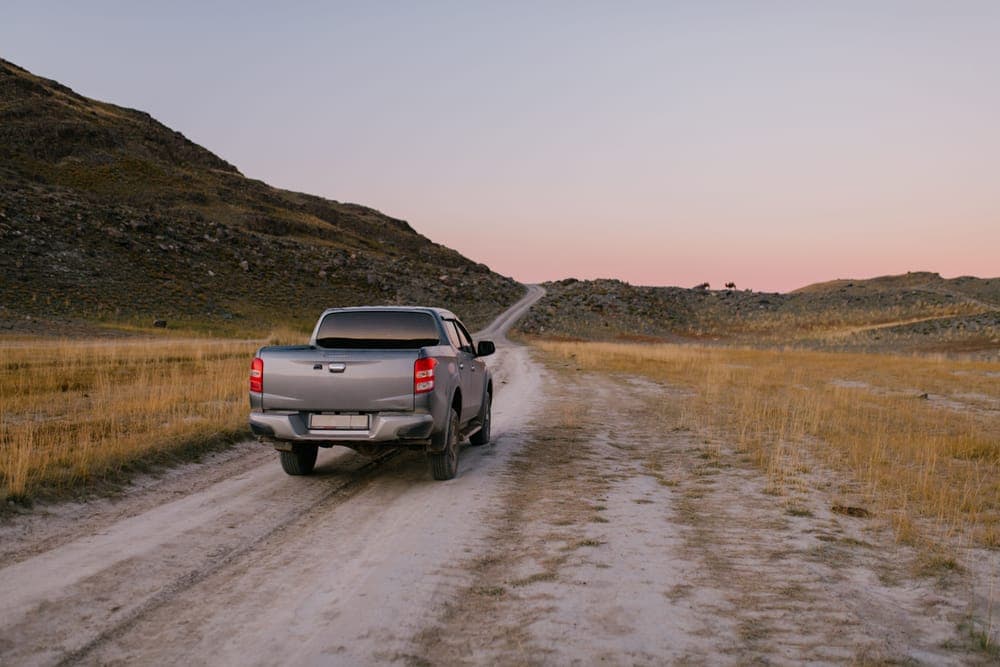
You've got a GMRS license, or you're about to, and the question is how far it really gets you: the house to the back pasture, the lead Jeep to the tail, camp to the hunters on the far ridge. The FCC's answer is honest and not very specific: "A GMRS user can expect a communications range of one to twenty-five miles depending on station class, terrain, and repeater use" (FCC GMRS page). This page fills in that range using the three things the FCC names, with the makers' own figures for each kind of radio.
We don't run our own range trials, so every mileage figure here is a maker's advertised number or the FCC's. For range across all radios, license-free included, start with how far walkie-talkies can reach. This page is GMRS only.
GMRS radio range chart, from the makers and the FCC
| Station and setup | Published range | Whose figure |
|---|---|---|
| Any GMRS station | 1 to 25 miles, "depending on station class, terrain, and repeater use" | FCC |
| Family GMRS handheld pair, normal conditions | 1/2 to 2 miles | Midland GXT FAQ |
| 5 W handheld, fixed antenna | Up to 5 miles, "depending on the terrain" | Midland GXT67 PRO |
| 5 W handheld, backcountry | Mountains 2 to 8 miles; forest and hills 0.5 to 5; rivers 0.5 to 3; city up to 1.5 | Rocky Talkie Expedition |
| 5 W handheld, open line of sight (simplex) | 1 to 5+ miles typical | BTECH GMRS-V2 |
| 15 W mobile | Up to 15 miles peak to peak; up to 10 suburban or rural; up to 5 neighborhood or dense forest | Midland MXT115P PRO |
| 15 W mobile | 10 to 15 miles, partial obstruction; 5 to 10, major obstruction | Midland MXT275 |
| 50 W mobile | 20 to 25 miles, partial obstruction; 10 to 15, major obstruction | Midland MXT575 |
| 50 W mobile or base | 2 to 5 miles in town or woods; 5 to 15 in open rural terrain | BTECH GMRS-50V2 |
| Handheld through a repeater | 15 to 50+ miles, "terrain and repeater height dependent" | BTECH GMRS-V2 |
| Repeater coverage | "~5 miles to 15 miles to 25+ miles" | Cobra TrailBlazer FAQ |
Two patterns matter. First, handhelds cluster in the same few miles whatever the brand, because the terrain row, not the badge, decides it. Second, the big jumps come from changing the station: a radio in the truck with its antenna on the roof, or a repeater on a hill. The rest of this page is about those levers.
Power by station type: what 47 CFR 95.1767 allows
"Station class" is the first thing the FCC names, and it's where the power rules live. The headroom is very different for a handheld on your belt and a radio bolted into a truck.
Notice what isn't there: the rule sets no separate main-channel figure just for handhelds. What you'll see on the box is the maker's rating, and most GMRS handhelds are typically rated at 5 W by their makers. Rocky Talkie's Expedition, Midland's GXT67 PRO and BTECH's GMRS-V2 all list 5 W; Wouxun lists "5.5W / 2W / 0.5W" for its KG-935G Plus (Wouxun KG-935G Plus page); Cobra rates its TrailBlazer handhelds at 2.5 W.
One more distinction that matters on a ranch. A base station at the house, talking to trucks and handhelds, falls under the 50 W figure. A "fixed" station is a different thing in the rules: one that talks only to other fixed stations (47 CFR 95.303), and it gets 15 W.
Your channel choice changes your range
This is the GMRS range fact most owners never hear. The 22 channels your radio shows are not equal, because the power rules above apply by frequency. Here's how the familiar channel numbers line up with the rules, using the FCC's channel list (FCC FRS page; 47 CFR 95.1763):
| Channels | Frequencies (MHz) | GMRS rule | What the radios do |
|---|---|---|---|
| 1 to 7 | 462.5625 to 462.7125 (462 MHz interstitial) | 5 W ERP for every station type | Midland's MXT275 manual: "Due to output power regulations channels 1 through 7 cannot be removed from the Low transmit power setting" (manual). BTECH limits its GMRS-50PRO to 5 W there (BTECH). |
| 8 to 14 | 467.5625 to 467.7125 (467 MHz interstitial) | Handhelds only, 0.5 W ERP | Receive-only on Midland's MXT115P PRO (Midland); low power only on the BTECH GMRS-V2 (BTECH). The FCC puts usual FRS range here at "less than one-half mile." |
| 15 to 22 | 462.5500 to 462.7250 (462 MHz main) | Up to 50 W for mobile, base and repeater stations | Where a mobile runs full power, and where handhelds run their rated power. |
| Repeater channels | Transmit on 467.5500 to 467.7250 (467 MHz main) | Handhelds and mobiles transmit here only through a repeater | Your radio talks up to the repeater, which re-sends on the matching 462 MHz main channel. |
The practical rule: for distance on direct radio-to-radio (simplex) talk, put your group on channels 15 to 22. Channels 1 to 7 hold a 50 W mobile to 5 W ERP by rule, and 8 to 14 are the short-range channels. If your group mixes GMRS and license-free FRS radios, 15 to 22 are still the right choice, since FRS radios run their full 2 W there too. Our GMRS channels and frequencies reference has the full chart.
GMRS handheld vs mobile range
Line up Midland's own figures and the gap is plain. Its GXT handheld pair "averages 1/2-2 miles in normal conditions," and its 5 W GXT67 PRO is listed at up to 5 miles. Its 15 W MXT115P PRO mobile is charted at up to 5 miles in neighborhoods or dense forest and up to 10 in suburban or rural areas, and Midland's page says it "triples the effective range of standard handheld radios" (Midland MXT115P PRO). BTECH says of its 50 W radio: "With a proper mobile antenna and clean install, the GMRS-50V2 will generally outperform a handheld by a wide margin" (BTECH GMRS-50V2 page).
Three things stack up in the mobile's favor: up to 50 W on the main channels instead of a handheld's typical 5 W, an antenna outside the steel cab, and the height of the roof. Midland's MXT275 manual puts the antenna first: "mount the antenna (included) as high as possible on your vehicle" (Midland MXT275 manual). The antenna works both ways, too, so a well-mounted mobile is also better at hearing the handheld on the far end.
The trade-off is that a mobile is stuck to the truck, the tractor or a 12 V supply at the house, and the person on foot still carries a handheld. The usual answer is both: mobiles at camp and in the vehicles, handhelds for the people who walk away from them. Our head-to-head, GMRS handheld vs mobile range, works through that decision, and our best GMRS mobile radios ranks the vehicle radios.
Removable antennas: the GMRS advantage
FRS radios are stuck with what they came with. The FCC says FRS-only units "have antennas that are integrated with the unit," while "GMRS units transmit at higher power levels and may have detachable antennas" (FCC consumer guide). Cobra's FAQ spells out why that matters: "For handheld radios add-on antennas can provide greater range," and removable antennas are what allow "Mobile GMRS radios that are installed into a vehicle or used as a base station" (Cobra TrailBlazer FAQ).
Before you buy an antenna, check two things:
- Whether it comes off at all. Midland says of the GXT67 PRO's antenna, "The design of this radio does not allow it to be removed" (Midland GXT67 FAQ).
- The connector gender. The BTECH GMRS-V2 takes an SMA-female antenna (BTECH), so it fits a whip like the Nagoya NA-771G (Nagoya). Rocky Talkie's Expedition uses SMA-male, and Rocky Talkie advertises that its longer whip improves signal strength and audio "by up to 30%, depending on terrain" (Rocky Talkie whip page). Mobiles use larger connectors, like the SO-239 jack on Midland's MXT275 and BTECH's GMRS-50V2, which ships with no antenna at all.
A longer antenna on a handheld helps at the margin. Getting any antenna higher helps more: onto the truck roof, onto a mast above the house roofline, onto the stand. Our best GMRS antennas covers handheld whips, vehicle antennas and base antennas, and how to install a GMRS radio in your vehicle covers the mount.
Repeaters: where GMRS range really comes from
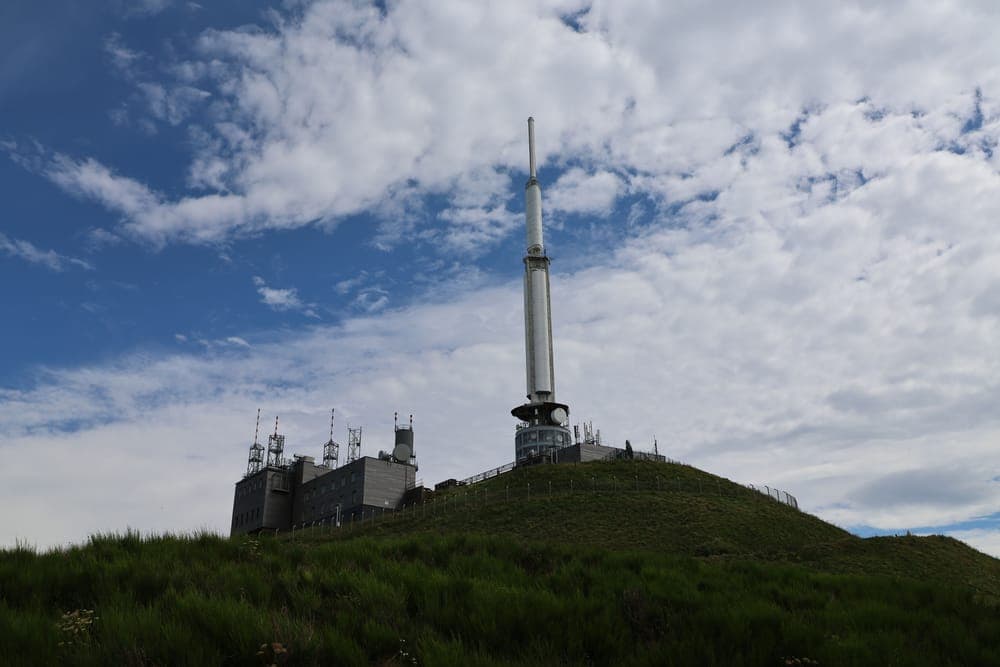
A GMRS repeater is the FCC's third variable, and the biggest. The rules describe one as a station that extends the range of mobiles and handhelds by receiving on one channel and retransmitting on another, "typically with higher transmitting power from a favorable antenna location (typically high above the surrounding terrain)" (47 CFR 95.303). Repeaters, like mobiles, may run up to 50 W on the main channels (47 CFR 95.1767).
Cobra's FAQ says repeaters "are placed on top of buildings or on dedicated towers up to hundreds of feet in the air," and that because of that location and power they "can provide coverage from ~5 miles to 15 miles to 25+ miles" (Cobra TrailBlazer FAQ). BTECH lists its GMRS-V2 handheld at 1 to 5+ miles typical on simplex and "15–50+ miles" with repeaters (BTECH GMRS-V2 page). Treat both as advertised figures that depend entirely on where the repeater sits.
What you need to use one:
- Repeater channels on your radio. Not every GMRS radio has them. Midland's GXT1000VP4 has none; its GXT67 PRO, Rocky Talkie's Expedition and Midland's MXT575 each list 8, and BTECH's GMRS-V2 supports repeaters.
- The repeater's tones, so your radio can open it. Most people use a repeater someone else put up, so ask the owner before you rely on it.
- Realistic expectations about linking. The FCC says GMRS repeaters "may not be linked via the internet" to extend coverage across a large area (FCC GMRS page). A repeater gives you a local footprint, not a nationwide one.
GMRS radio range in the mountains and in the city
In the mountains, GMRS range swings harder than anywhere else. Rocky Talkie lists its 5 W Expedition Radio at 2 to 8 miles in mountains and 0.5 to 3 miles along rivers (Rocky Talkie Expedition page). The difference between those two rows is where you stand. On a ridge or a peak, you're the mountaintop in the box claim. Down in a drainage, you're behind the hill. Repeaters on high points help most in this kind of country, when there's one within reach.
In the city, GMRS helps less than you'd hope. Rocky Talkie's city row for the same radio is "up to 1.5 miles," and BTECH lists its 50 W mobile at "2–5 miles in-town or wooded areas." Buildings block the straight line the signal needs, and NIST researchers studying public-safety radio (at about 750 MHz, near the GMRS band) describe "the strong attenuation of radio signals caused by losses and scattering in the building materials and structure" of large buildings (NIST Technical Note 1552). A repeater on a tall building is the town answer.
The license that unlocks it
One license covers the family's handhelds, mobiles and base radios. There's no exam. Our GMRS license guide explains who it covers and whether it's worth it, and how to get a GMRS license walks through the application. If you're still deciding between services, GMRS vs FRS lays out the trade.
What to buy for GMRS reach
Everything above points to the same kit: a GMRS handheld with repeater channels and an antenna you can change, a longer antenna for it, and a mobile radio with a roof antenna for the truck or the house. These three cover it, from the budget tier up.
Our picks for this job
A handheld, its antenna upgrade and a 50 W mobile
The handheld and the whip are made to go together (SMA-female). The MXT575 is the step up for the vehicle or a base at the house. Both radios need a GMRS license.
 Stock photo
Best budget GMRS for repeater users
BTECH GMRS-V2 (single radio)
Needs a GMRS license. Budget handheld rated at 5 W with repeater support and a removable SMA-female antenna; BTECH lists 1 to 5+ miles simplex and 15 to 50+ through repeaters.
Check price · Amazon#ad · Price set by Amazon · How we make money for the link to BTECH GMRS-V2 (single radio)
 Stock photo
Best budget whip for SMA-female radios
Nagoya NA-771G GMRS Whip (SMA-female)
A 15.6-inch half-wave GMRS whip that fits SMA-female radios like the GMRS-V2. It won't fit SMA-male radios such as the Rocky Talkie Expedition.
Check price · Amazon#ad · Price set by Amazon · How we make money for the link to Nagoya NA-771G GMRS Whip (SMA-female)
 Stock photo
Best 50 W radio for a clean dash
Midland MXT575 MicroMobile (50 W)
Needs a GMRS license. 50 W on the main channels with 8 repeater channels and a magnet-mount antenna; Midland charts 20 to 25 miles with partial obstruction.
Check price · Amazon#ad · Price set by Amazon · How we make money for the link to Midland MXT575 MicroMobile (50 W)
What else you'll need: the license (one covers the family), a second handheld for every pair, a steel roof or a mount for the MXT575's magnetic antenna, and the local repeater's tones if you plan to use one. If you'd rather compare every long-range radio in one ranked list, see best long-range walkie-talkies. For a house, shop and trucks on one property, our farm and ranch radio picks is the better starting point. More range guides live on the Real Range hub.
How we scored this
Radios we claim to have lab-tested: 0
Plenty of radio sites say they range-tested everything they list. We haven't, and we say so. Every pick here is labeled Researched: we read each maker's published specs, manuals and range tables, check the license rules against the FCC, and score every radio on a public rubric. Every figure links to where it came from, and every range number is labeled “advertised.”
Scores are editorial judgments from that documented research, not test results. Commissions never set a score or decide a pick. The rubric and its weights are published.
Questions
Frequently asked
How far can a GMRS radio reach?
What is GMRS radio range in the mountains?
What is GMRS radio range in a city?
Does GMRS have better range than FRS?
Does a 50-watt GMRS radio reach ten times farther than a 5-watt handheld?
How far does a GMRS repeater reach?
Receipts
Sources
- FCC: General Mobile Radio Service (GMRS) page (checked 2026-09-22)
- FCC: Family Radio Service (FRS) page, channel list (checked 2026-09-22)
- FCC consumer guide: Personal Radio Services (checked 2026-09-22)
- FCC: Personal service and amateur application fees (checked 2026-09-22)
- 47 CFR 95.303, definitions (Cornell LII, checked 2026-09-22)
- 47 CFR 95.1763, GMRS channels (Cornell LII, checked 2026-09-22)
- 47 CFR 95.1767, GMRS transmitting power limits (Cornell LII, checked 2026-09-22)
- 47 CFR 95.1761, GMRS transmitter certification (Cornell LII, checked 2026-09-22)
- Midland: GXT1000VP4 product page and FAQ (checked 2026-09-22)
- Midland: GXT67 PRO product page and FAQ (checked 2026-09-22)
- Midland Support: GXT67 FAQs (checked 2026-09-22)
- Midland: MXT575 product page (checked 2026-09-22)
- Midland: MXT575 spec sheet PDF (checked 2026-09-22)
- Midland: MXT275 spec sheet PDF (checked 2026-09-22)
- Midland: MXT275 owner's manual PDF (checked 2026-09-22)
- Midland: MXT115P PRO product page and FAQ (checked 2026-09-22)
- Midland: MXT115P PRO spec sheet PDF (checked 2026-09-22)
- Rocky Talkie: Expedition Radio product page (checked 2026-09-22)
- Rocky Talkie: Whip Antenna for Expedition Radio (checked 2026-09-22)
- BTECH: GMRS-V2 product page (checked 2026-09-22)
- BTECH: GMRS-50V2 product page (checked 2026-09-22)
- BTECH: GMRS-50PRO product page (checked 2026-09-22)
- BTECH: Nagoya NA-771G product page (checked 2026-09-22)
- Wouxun: KG-935G Plus product page (checked 2026-09-22)
- Cobra: TrailBlazer 450 product page and FAQ (checked 2026-09-22)
- NIST Technical Note 1552, radio signal attenuation in large buildings, 2009 (checked 2026-09-22)
We haven't tested the radios on this page and we don't pretend to. Specs and range figures come from each maker's own pages and manuals (linked on every product), and license, power and channel rules come from the FCC and 47 CFR Part 95. Range numbers are the maker's advertised claims and are labeled that way. Prices are set by Amazon and change often, so we don't print them. Where a figure isn't published, we say so. Read the full method.