Not legal advice. This page summarizes FCC rules (47 CFR Part 95) from the official sources linked in the text. Rules and fees checked . The FCC sets its fees annually and can change its rules, so confirm the current version on fcc.gov before you rely on it.
Quick picks
The picks at a glance
| # | Product | Best for | Score | Price |
|---|---|---|---|---|
| 1 |  Midland MXT115AGVP3 Farm Tractor Bundle (15 W) The IP67, 15 W MXT115P PRO with a cab-mount kit: a 3 dB NMO Ghost antenna, a roll bar/mirror bracket and a 20 ft cable. It runs from a DC vehicle adapter, has PA and intercom jacks, and Midland says to expect 8 to 15 miles in normal conditions. | Best for tractors, combines and UTVsGMRS licensePremium | 8.1/10Researched | Check price · Amazon #ad · Disclosure |
| 2 | Midland MXT500AGVP3 Ag Bundle (50 W) Midland's 50 W MXT500 with two antenna options in the box: a Ghost antenna on a mirror or roll-bar bracket, or an NMO magnet base. The pick when fields sit many miles from the shop, though the warranty is 1 year, not 3. | Best for big acreageGMRS licenseHigh-end | 8.0/10Researched | Check price · Amazon #ad · Disclosure |
| 3 | BTECH GMRS-50V2 (50 W mobile/base) 50 W with 20 W and 5 W steps, quad watch and a standard SO-239 jack for a mast antenna. It needs a 13.8 V supply good for BTECH's 20 A peak and an antenna bought separately, so plan the install. | Best base radio for the house or shopGMRS licensePremium | 7.5/10Researched | Check price · Amazon #ad · Disclosure |
| 4 |  Midland GXT67 PRO (single radio) Rated at 5 W and IP67, with 8 repeater channels, VOX and a vehicle charger in the box, so it charges in the truck. The battery is sealed and the antenna is fixed, and it's sold singly. | Best rugged handheld for the barn and yardGMRS licensePremium | 7.1/10Researched | Check price · Amazon #ad · Disclosure |
| 5 | Wouxun KG-935G Plus (single radio) Wouxun lists 5.5 W, IP66, a 2600 mAh USB-C battery, all 8 repeater channels and a keypad Channel Wizard, and its dealer lists a removable antenna. A menu-deep radio for whoever runs the farm's radios. | Best handheld for a farm repeaterGMRS licenseMid-price | 7.6/10Researched | Check price · Amazon #ad · Disclosure |
| 6 |  Comet CA-GMRS Base Antenna A 42-inch, GMRS-only base antenna with an SO-239 jack, 5.5 dBi stated gain and a 135 mph wind rating. On a mast above the shop roof, it's how the base radio gets its signal up and out over the property. | The antenna that makes the base workAccessoryMid-price | 7.7/10Researched | Check price · Amazon #ad · Disclosure |
#ad · Prices are set by Amazon and change often, so we don't print them. Scores are ours, built from published specs, manuals and FCC rules, not hands-on tests. Photos are illustrative stock. Tap a row for the full write-up.
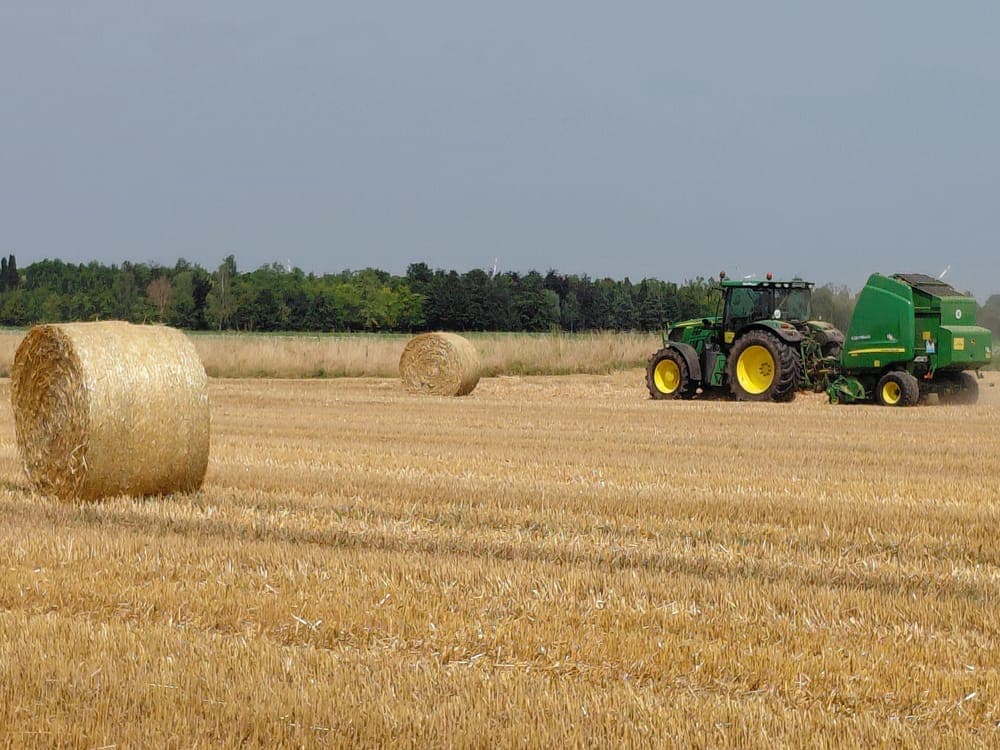
The combine is two sections over, your hired man is fixing fence at the back of the north pasture, and the parts you need are sitting on the bench in the shop. None of the three spots gets a reliable bar of cell service. On a farm or ranch, a two-way radio isn't a toy. It's how the day gets coordinated. This page ranks six pieces of gear for that job, and it treats the farm as a system: radios in the machines, a base at the shop or house, handhelds for people on foot, and the antenna that makes the base worth buying. For the rest of the land-and-lease section, see our hunting and land hub.
Start with who has to reach whom
Almost every farm radio plan comes down to three kinds of station:
- Machines and trucks carry a mobile radio: more power than a handheld, a real antenna up on the cab, and 12-volt power so the battery never dies.
- The house or shop carries a base radio, often a mobile radio on a desk with a power supply and an antenna on a mast.
- People on foot or horseback carry handhelds. These are always the weak link: the lowest power, the smallest antenna, held at chest height behind whatever hill is in the way.
Plan around the longest link that includes a handheld. A tractor talking to the shop across open fields is the easy case. A person on foot in a draw at the far end of the place, trying to reach anyone, is the hard one. Our GMRS handheld vs mobile range comparison explains why the two differ so much, and our guide to covering your property with radios maps out the layout step by step.
What each kind of radio reaches, in the makers' own words
No maker can promise a number for your ground, but several publish honest ones. Here is what they say, next to the FCC's own expectation. None of these figures is ours.
| Link | Source | What the source says |
|---|---|---|
| Handheld to handheld | Midland GXT FAQ | "averages 1/2-2 miles in normal conditions" |
| 5 W handheld | Midland GXT67 PRO | "up to 5 miles, depending on the terrain" |
| 15 W tractor radio | Midland MXT115AGVP3 FAQ | "between 8 and 15 miles" in normal conditions |
| 15 W mobile, by terrain | Midland MXT115P PRO spec sheet | Up to 15 miles peak to peak; up to 10 suburban or rural; up to 5 in a neighborhood or dense forest |
| 50 W mobile or base | BTECH GMRS-50V2 | "around 2–5 miles in-town or wooded areas, 5–15 miles in open rural terrain" |
| Any GMRS station | FCC GMRS page | "one to twenty-five miles depending on station class, terrain, and repeater use" |
Read the table from the bottom up and the pattern is clear. The FCC's range depends first on station class (handheld, mobile, base or repeater) and terrain. Open, flat ground favors you. Timbered draws, river bottoms and rolling hills don't. Height beats wattage: a 50 W radio with its antenna on the dashboard will usually lose to a 15 W radio with its antenna on a mast.
How we picked
Every radio was scored on the rubric published on our How We Rank page, from the makers' own specs, manuals and FAQs. Range counts only as the maker's claim, and nobody here has installed these radios on a farm. The antenna is scored on our antenna rubric, so its number isn't directly comparable to the radios'. For this page the order also weighs what farm work demands: a radio that runs from machine or shop power, a water and dust rating fit for an open cab, a way to mount the antenna high, a PA or intercom option, and the warranty. That's why the 15 W tractor bundle ranks first. It's the only pick built for machines out of the box, with the best water rating and the longest radio warranty of the mobiles.
The published specs side by side
And what each one puts out, runs on and uses for an antenna:
| Radio | Stated output | Runs on | Antenna |
|---|---|---|---|
| Midland MXT115AGVP3 | 15 W high / 5 W low | 12V power cord with DC vehicle adapter | 3 dB NMO Ghost on a bracket, plus a 2.1 dB magnet mount |
| Midland MXT500AGVP3 | 50 W / 25 W / 5 W | Vehicle power cord (in the box) | Ghost NMO on a bracket, or an NMO antenna on a large magnetic base |
| BTECH GMRS-50V2 | 50 W / 20 W / 5 W | 13.8 V DC, 20 A peak; battery or fuse block, not a socket | None included; SO-239 jack |
| Midland GXT67 PRO | 5 W (high / medium / low) | Sealed Li-ion; USB-C or vehicle adapter | Fixed |
| Wouxun KG-935G Plus | 5.5 W / 2 W / 0.5 W (Wouxun's figure) | 2600 mAh Li-ion, USB-C | Removable SMA-male (per its dealer) |
The picks in context
1. Midland MXT115AGVP3 Farm Tractor Bundle: the machine radio
Midland packaged this bundle for exactly one job. It's the MXT115P PRO MicroMobile, rated 15 W and IP67 waterproof and dustproof, plus a 3 dB NMO Ghost antenna (3.5 inches), a roll bar/mirror mounting bracket and a 20 ft low-profile NMO cable, so the antenna goes on the cab instead of on a magnet that needs a steel roof. The stock 2.1 dB magnetic antenna is in the box too (Midland MXT115AGVP3 page). It has PA and wired intercom jacks, NOAA weather alerts, a noise-canceling mic and 8 split-tone repeater channels, and it runs from the included DC vehicle adapter. The radio carries a 3-year warranty, and the accessories get 1 year. Midland's FAQ answer on range is the most useful line on the page: "you could expect this radio to reach between 8 and 15 miles" in normal conditions.
Two things to know. It's 15 W, not 50 W, so very large or broken operations may want pick #2. And Midland's pages disagree on privacy codes (142 on the bundle page, 154 on the MXT115P PRO page), while the spec sheet linked from the bundle page still describes the older MXT115. Buy it if the radio goes in a tractor, combine, sprayer or UTV. Skip it if it goes in a steel-roof pickup, where the plain MXT115P PRO and its magnet antenna do the same job without the bracket kit.
2. Midland MXT500AGVP3 Ag Bundle: 50 W for big acreage
The same idea at full power. The MXT500 inside is Midland's 50 W MicroMobile, with 25 W and 5 W steps (Midland MXT500 FAQ), a PA function, automatic noise canceling and NOAA weather. The ag kit adds the Ghost antenna, the roll bar/mirror bracket and low-profile cable, plus an NMO stock antenna on a large magnetic base and a metal plate for mounting it (Midland MXT500AGVP3 page). That gives you a cab install and a quick magnet install from one box.
The trade-offs are paperwork more than hardware. The warranty is 1 year. Midland's manual rates the MXT500 IPX6 while the bundle page says IP66, and the channel count is "up to 99" on one page and "up to 128" on another. Midland publishes no range figure for it. Buy it if your fields or pastures sit many miles from the shop, or the ground rolls enough that 15 W leaves you short. Skip it if everything sits within a few miles, where the IP67 MXT115AGVP3 is a tier lower and carries the longer warranty. More mobiles are ranked in our best GMRS mobile radios.
3. BTECH GMRS-50V2: the base for the house or shop
A base radio is where a farm system gets its reach, and the GMRS-50V2 is built to be one. It's rated 50 W with 20 W and 5 W steps, has 256 channels, quad watch, repeater support and NOAA weather, and uses a standard SO-239 antenna jack that takes the PL-259 coax most base antennas use (BTECH GMRS-50V2 page). BTECH also publishes a typical simplex range instead of a fantasy number: "around 2–5 miles in-town or wooded areas, 5–15 miles in open rural terrain, and farther in ideal line-of-sight conditions."
It is not plug-and-play. There's no antenna in the box, and BTECH says to power it from 13.8 V DC at up to 20 A peak, connected to a battery or fuse block rather than a cigarette outlet. At a desk in the shop, that means buying a 13.8 V power supply that can deliver that current. It's IP54, which is fine indoors. Buy it if you want one radio at the shop or house that every machine and handheld on the place can reach. Skip it if you want to plug in and go, because this is a planned install.
4. Midland GXT67 PRO: the rugged handheld
For the people on foot, the GXT67 PRO is Midland's toughest handheld: rated 5 W, IP67 with the accessory jack cover tightened, 8 repeater channels with split tones, VOX, Dual Watch Pro and a noise-canceling mic (Midland GXT67 PRO page). It charges by USB-C or the included vehicle adapter, so it can ride on the dash of the feed truck and stay topped up. Midland's own range claim is "up to 5 miles, depending on the terrain."
The battery is factory sealed and the antenna can't be removed (Midland GXT67 FAQ), so there's no spare pack and no antenna upgrade. It's sold as a single radio. Buy it if your hands work in rain, dust and mud and need a radio that shrugs it off. Skip it if you need to swap batteries mid-shift.
5. Wouxun KG-935G Plus: the handheld for a farm repeater
The KG-935G Plus is a business-radio-style GMRS handheld. Wouxun lists "5.5W / 2W / 0.5W" output, IP66, a 2600 mAh Li-ion pack with USB-C, NOAA alerts, dual receive, VOX, a flashlight and 23 GMRS channels plus all 8 repeater channels (Wouxun KG-935G Plus page). Its Channel Wizard programs a simplex or repeater channel from the keypad, without a computer, and its authorized dealer lists a removable SMA-male antenna (dealer listing).
With 999 memory channels and deep menus, it's more radio than a seasonal hand needs to learn. Wouxun doesn't state a runtime. Buy it if you run the radios, want a longer antenna option, or plan to put up a repeater. Skip it if the radio goes to someone who just needs one button.
6. Comet CA-GMRS: the base antenna
A base radio is only as good as its antenna and how high it sits. The Comet CA-GMRS is tuned only for 462 to 468 MHz. It's 42 inches long with a stated 5.5 dBi gain, an SO-239 connector, a 150 W rating and a 135 mph wind rating, and it clamps to masts from 1.18 to 2.44 inches with the included hardware (Comet CA-GMRS page). No coax, mast or lightning grounding comes in the box, so budget for all three. Buy it if you can get a mast above your roofline. Skip it if the only spot you have is an attic or a porch rail.
Also considered: the plain Midland MXT500 and MXT115P PRO (the same radios without the ag mounting kits, better for pickups), the BTECH GMRS-20V2 (a compact 20 W IP67 mobile that ships without an antenna) and the BTECH GMRS-V2 (a budget 5 W handheld that takes a longer SMA-female whip, if you want to put a cheap radio in every truck).
When a base antenna on the house or shop changes everything
In my view, the most common farm radio mistake is planning for power and forgetting height. The single biggest upgrade is usually not a bigger radio. It's getting the base antenna up above the roofline, where it can see over the barns, tree lines and low rises that block a handheld at ground level. A base on a mast becomes the hub of the whole place: tractors and handhelds may not reach each other across the farm, but they can each reach the tall antenna at the shop, and whoever is at the base can relay.
A few practical notes:
- Use a radio with an antenna jack. The GMRS-50V2 takes PL-259 coax straight into its SO-239 jack, the same connector the Comet uses. FRS radios and fixed-antenna handhelds can't use a mast antenna at all.
- Mind the mast rules. Antenna structures more than 200 feet above ground may need FAA notification and FCC registration, and near a military or public-use airport, anything taller than 20 feet may face extra limits (47 CFR 95.317). A mast on a house or shop is usually far below 200 feet, but check if you're near an airport.
- Ground it and route it well. The Comet ships without coax, mast or lightning grounding. If you're not sure how to ground a mast, pay an electrician. That's cheap next to a lightning strike on the shop.
Our best GMRS antennas page ranks base, vehicle and handheld antennas side by side.
The license, the family and the hired hand
That family list matters on a farm. Your son and your brother-in-law are covered. A hired hand or a neighbor helping at harvest is not, and needs a GMRS license of their own before transmitting on GMRS. The license-free alternative is an FRS radio: FRS is "licensed by rule" and its 22 channels are all shared with GMRS (FCC FRS page), so a hand with an FRS radio can talk to your GMRS radios on a shared channel, with FRS's shorter reach. The full rundown is on our GMRS license page.
In detail
The picks, in full
Rank 01
Stock photoBest for tractors, combines and UTVs
Midland MXT115AGVP3 Farm Tractor Bundle (15 W)
The IP67, 15 W MXT115P PRO with a cab-mount kit: a 3 dB NMO Ghost antenna, a roll bar/mirror bracket and a 20 ft cable. It runs from a DC vehicle adapter, has PA and intercom jacks, and Midland says to expect 8 to 15 miles in normal conditions.
Published specsResearched · not tested by us
How the 8.1 score breaks down
- Real-world reach (30%)
- 8
- Ease of use (20%)
- 7
- Toughness & weather (15%)
- 9
- Power & battery (15%)
- 8
- Field features (10%)
- 8
- Value (10%)
- 9
What the specs support
- Antenna kit made for machines: mirror or roll-bar bracket plus an NMO Ghost antenna and 20 ft cable
- IP67 radio for dusty, open or wash-down cabs
- PA jack for yard announcements; powers from the DC adapter, no hardwiring
Where it falls short
- 15 W, so very large or hilly operations may want the 50 W MXT500AGVP3
- Midland's pages disagree on privacy codes (142 here, 154 for the MXT115P PRO)
- The spec sheet linked from the page still describes the older MXT115, so rely on the page list
Skip this if…
…Skip it if the radio goes in a pickup with a steel roof: the plain MXT115P PRO already includes a magnet-mount antenna, so the bracket and NMO kit add nothing you need.
#ad · Price set by Amazon · How we make money for the link to Midland MXT115AGVP3 Farm Tractor Bundle (15 W)
Rank 02
Stock photoBest for big acreage
Midland MXT500AGVP3 Ag Bundle (50 W)
Midland's 50 W MXT500 with two antenna options in the box: a Ghost antenna on a mirror or roll-bar bracket, or an NMO magnet base. The pick when fields sit many miles from the shop, though the warranty is 1 year, not 3.
Published specsResearched · not tested by us
How the 8.0 score breaks down
- Real-world reach (30%)
- 9
- Ease of use (20%)
- 7
- Toughness & weather (15%)
- 7
- Power & battery (15%)
- 8
- Field features (10%)
- 8
- Value (10%)
- 8
What the specs support
- Two antenna options in the box: a magnetic NMO base and a Ghost antenna on a mirror/roll-bar bracket
- 50 W for long base-to-field distances
- PA and noise canceling for loud machinery
Where it falls short
- Top list-price tier
- 1-year warranty, and Midland's documents disagree on the water rating (IPX6 vs IP66)
- Not IP67 like the 15 W MXT115AGVP3
Skip this if…
…Skip it if your fields sit within a few miles of each other: the 15 W MXT115AGVP3 is IP67, carries a 3-year radio warranty and sits a tier lower.
#ad · Price set by Amazon · How we make money for the link to Midland MXT500AGVP3 Ag Bundle (50 W)
Rank 03
Stock photoBest base radio for the house or shop
BTECH GMRS-50V2 (50 W mobile/base)
50 W with 20 W and 5 W steps, quad watch and a standard SO-239 jack for a mast antenna. It needs a 13.8 V supply good for BTECH's 20 A peak and an antenna bought separately, so plan the install.
Published specsResearched · not tested by us
How the 7.5 score breaks down
- Real-world reach (30%)
- 9
- Ease of use (20%)
- 6
- Toughness & weather (15%)
- 5
- Power & battery (15%)
- 8
- Field features (10%)
- 8
- Value (10%)
- 8
What the specs support
- 50 W with 20 W and 5 W steps, a list-price tier below Midland's 50 W MicroMobiles
- Quad watch and VHF/UHF scanner receive
- Standard SO-239 jack for any GMRS mobile or base antenna
- BTECH publishes a typical simplex range (2-5 miles in town or woods), not just a max figure
Where it falls short
- Needs direct 13.8 V wiring and an antenna bought separately
- IP54 splash resistance only
- 256 channels and many menus mean more setup than a Midland
Skip this if…
…Skip it if you want to plug into a 12V socket and drive off: BTECH says the GMRS-50V2 needs a direct battery or fuse-block connection, and it ships without an antenna.
#ad · Price set by Amazon · How we make money for the link to BTECH GMRS-50V2 (50 W mobile/base)
Rank 04
Stock photoBest rugged handheld for the barn and yard
Midland GXT67 PRO (single radio)
Rated at 5 W and IP67, with 8 repeater channels, VOX and a vehicle charger in the box, so it charges in the truck. The battery is sealed and the antenna is fixed, and it's sold singly.
Published specsResearched · not tested by us
How the 7.1 score breaks down
- Real-world reach (30%)
- 7
- Ease of use (20%)
- 7
- Toughness & weather (15%)
- 9
- Power & battery (15%)
- 7
- Field features (10%)
- 7
- Value (10%)
- 5
What the specs support
- IP67 waterproof and dustproof, where the GXT1000 and GXT3000 are splash-rated JIS4
- Rated at 5 W with 8 repeater channels and split tones
- USB-C (PD) and 12 V vehicle charging in the box
Where it falls short
- Sold as a single radio, so a pair means buying two
- Fixed antenna and a factory-sealed battery you can't swap in the field
- Midland's battery-life figures conflict (16 hours vs up to 4 days)
Skip this if…
…Skip it if you want to carry a spare battery or fit a longer antenna for the far side of the property: the battery is sealed and the antenna doesn't come off.
#ad · Price set by Amazon · How we make money for the link to Midland GXT67 PRO (single radio)
Rank 05
Stock photoBest handheld for a farm repeater
Wouxun KG-935G Plus (single radio)
Wouxun lists 5.5 W, IP66, a 2600 mAh USB-C battery, all 8 repeater channels and a keypad Channel Wizard, and its dealer lists a removable antenna. A menu-deep radio for whoever runs the farm's radios.
Published specsResearched · not tested by us
How the 7.6 score breaks down
- Real-world reach (30%)
- 8
- Ease of use (20%)
- 7
- Toughness & weather (15%)
- 8
- Power & battery (15%)
- 7
- Field features (10%)
- 8
- Value (10%)
- 7
What the specs support
- Wouxun lists 5.5 W on high, with all 8 repeater channels
- IP66 and a 2600 mAh USB-C battery
- Keypad Channel Wizard adds repeaters without a computer
- Removable SMA-male antenna for an upgrade
Where it falls short
- Sold as a single radio
- Deep menus and 999 channels are more than a casual family user needs
- Wouxun doesn't state battery runtime
Skip this if…
…Skip it if you want radios the kids can pick up and use: it's a keypad-and-menu power-user radio sold one at a time.
#ad · Price set by Amazon · How we make money for the link to Wouxun KG-935G Plus (single radio)
Rank 06
Stock photoThe antenna that makes the base work
Comet CA-GMRS Base Antenna
A 42-inch, GMRS-only base antenna with an SO-239 jack, 5.5 dBi stated gain and a 135 mph wind rating. On a mast above the shop roof, it's how the base radio gets its signal up and out over the property.
Published specsResearched · not tested by us
| Frequency | 462-468 MHz (GMRS and UHF business) |
|---|---|
| Stated gain | 5.5 dBi |
| Length | 42 inches, single-section radome |
| Connector | SO-239 (UHF female) |
| Power / wind | 150 W max; 135 mph wind rating |
| Mast / hardware | Attaches to mast diameter 1.18-2.44 in; mounting hardware included |
| VSWR / weight | 1.5:1 or less; 2 lb 2 oz |
How the 7.7 score breaks down
- Gain & height for the job (30%)
- 8
- Fit & connector match (25%)
- 9
- Build & weather (20%)
- 8
- Install burden (15%)
- 5
- Value (10%)
- 7
What the specs support
- Tuned only for 462-468 MHz, so there's no dual-band compromise
- SO-239 takes standard PL-259 coax, the same jack type as the BTECH GMRS-50V2 mobile/base
- 135 mph wind rating, and mounting hardware is included
Where it falls short
- No coax, mast or lightning grounding in the box, and the mast height does most of the work
- Needs a mobile or base radio with an antenna jack; FRS radios and fixed-antenna handhelds can't use it
Skip this if…
…Skip it if you can't mount a mast above your roofline: a base antenna in an attic or on a porch rail gives up the height that makes it worth buying.
#ad · Price set by Amazon · How we make money for the link to Comet CA-GMRS Base Antenna
What to look for in a farm or ranch radio
- The right power source. A tractor wants a radio that runs from a 12V outlet. A shop base wants a proper 13.8 V supply. A handheld wants USB-C or a vehicle charger so it can top up in the truck.
- Dust and water ratings for an open cab. IP67 (MXT115AGVP3, GXT67 PRO) is the one to want where dust and rain get in. IP54 is fine indoors.
- A way to mount the antenna high. NMO mounts, roll-bar brackets and SO-239 jacks let you put the antenna where it can see. A fixed stubby antenna can't be improved.
- PA and intercom. The Midland mobiles have PA functions or jacks, handy for calling across a loud yard.
- Repeater channels. Every radio here supports repeaters, which keeps the door open to a farm repeater later.
- A warranty you can read. Midland gives the MXT115-based bundle 3 years on the radio and the MXT500 bundle 1 year.
A channel plan that uses the power you paid for
The GMRS rules set power by channel, and it matters when you're paying for a 50 W radio. In the FCC's channel numbering, channels 15–22 are the 462 MHz main channels, 1–7 are the 462 MHz interstitials and 8–14 are the 467 MHz interstitials (FCC FRS channel table). Here's what 47 CFR allows on each:
- Channels 15–22: mobile, repeater and base stations may run up to 50 W (47 CFR 95.1767). This is where your farm channel belongs.
- Channels 1–7: mobile, handheld and base stations are limited to 5 W ERP, so a 50 W radio gives up most of its power here.
- Channels 8–14: only handhelds may transmit, at 0.5 W ERP (47 CFR 95.1763). That's why the Midland and BTECH mobiles list 8–14 as receive-only.
One more definition helps. Under 47 CFR 95.303, a base station is "a station at a fixed location that communicates directly with mobile stations and other base stations," while a fixed station talks "with other fixed stations only" (47 CFR 95.303). A shop radio talking to your tractors is a base station, so the 50 W main-channel limit applies to it, not the 15 W fixed-station limit.
So pick one channel between 15 and 22, add a privacy code so you hear less of the neighbors, and put it on every radio. Remember that a privacy code filters what you hear. It doesn't keep anyone else from hearing you.
When the farm needs a repeater
If handhelds in the far corners still can't reach the shop, even with a mast antenna, the next step is a GMRS repeater. The FCC defines a repeater station as one "in a fixed location used to extend the communications range of mobile stations, hand-held portable units and control stations," typically "from a favorable antenna location (typically high above the surrounding terrain)" (47 CFR 95.303). On a farm that could mean a grain leg, a silo or the highest hill on the place. A licensee may limit use of the repeater to specific people (47 CFR 95.1705), and repeaters may not be linked over the internet (FCC GMRS page). Every radio ranked here has repeater channels, so a repeater can be added later without replacing them.
Mistakes to avoid
- Buying watts instead of height. A 50 W base with its antenna on the desk is a waste. Put the antenna up first.
- Running the farm on channels 1–7. Everybody is capped at 5 W ERP there. Use 15–22.
- Powering a 50 W base from a wall wart. BTECH lists a 20 A peak at 13.8 V. Size the supply to match.
- Assuming the license covers the crew. It covers your immediate family. Hired hands need their own license, or FRS radios.
- Skipping the lightning plan. A mast is the tallest metal thing near the shop. Ground it.
How we scored this
Radios we claim to have lab-tested: 0
Plenty of radio sites say they range-tested everything they list. We haven't, and we say so. Every pick here is labeled Researched: we read each maker's published specs, manuals and range tables, check the license rules against the FCC, and score every radio on a public rubric. Every figure links to where it came from, and every range number is labeled “advertised.”
Scores are editorial judgments from that documented research, not test results. Commissions never set a score or decide a pick. The rubric and its weights are published.
What changed
- Published.
Questions
Frequently asked
What is the best two-way radio for farm use?
What is the best walkie-talkie for a ranch?
Do farm workers need a GMRS license?
How far will a GMRS base station reach on a farm?
Can I put a GMRS radio in a tractor?
Receipts
Sources
- FCC: General Mobile Radio Service (GMRS) page (checked 2026-09-22)
- FCC: Family Radio Service (FRS) page and channel table (checked 2026-09-22)
- FCC: Personal service and amateur application fees (checked 2026-09-22)
- 47 CFR 95.303, Personal Radio Services definitions (via Cornell LII, checked 2026-09-22)
- 47 CFR 95.317, antenna structure registration (via Cornell LII, checked 2026-09-22)
- 47 CFR 95.1705, GMRS individual licenses and who may operate (via Cornell LII, checked 2026-09-22)
- 47 CFR 95.1763, GMRS channels (via Cornell LII, checked 2026-09-22)
- 47 CFR 95.1767, GMRS transmitting power limits (via Cornell LII, checked 2026-09-22)
- Midland: MXT115AGVP3 Farm Tractor Bundle page and FAQ (checked 2026-09-22)
- Midland: MXT115P PRO product page (checked 2026-09-22)
- Midland: MXT115P PRO spec sheet PDF (checked 2026-09-22)
- Midland: MXT500AGVP3 Ag Bundle page (checked 2026-09-22)
- Midland: MXT500 product page and FAQ (checked 2026-09-22)
- Midland: MXT500 owner's manual PDF (checked 2026-09-22)
- BTECH: GMRS-50V2 product page (checked 2026-09-22)
- Midland: GXT1000VP4 product page and FAQ (checked 2026-09-22)
- Midland: GXT67 PRO product page (checked 2026-09-22)
- Midland Support: GXT67 FAQs (checked 2026-09-22)
- Wouxun: KG-935G Plus product page (checked 2026-09-22)
- BuyTwoWayRadios (authorized Wouxun dealer): KG-935G Plus listing (checked 2026-09-22)
- Comet: CA-GMRS product page (checked 2026-09-22)
We haven't tested the radios on this page and we don't pretend to. Specs and range figures come from each maker's own pages and manuals (linked on every product), and license, power and channel rules come from the FCC and 47 CFR Part 95. Range numbers are the maker's advertised claims and are labeled that way. Prices are set by Amazon and change often, so we don't print them. Where a figure isn't published, we say so. Read the full method.