Not legal advice. This page summarizes FCC rules (47 CFR Part 95) from the official sources linked in the text. Rules and fees checked . The FCC sets its fees annually and can change its rules, so confirm the current version on fcc.gov before you rely on it.
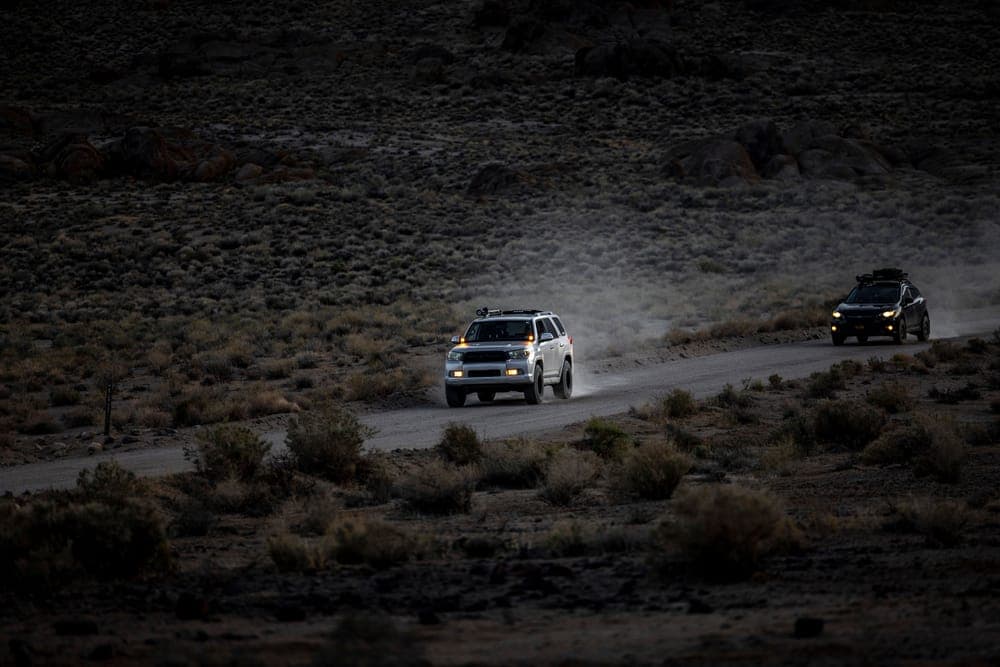
Two trucks and a trailer on the interstate, or five Jeeps strung out on a forest road: either way, the phone in the cupholder is the wrong tool. Calls drop in the canyons, texting behind the wheel is a bad idea, and the tail rig is usually the first to lose signal. A set of walkie-talkies fixes most of that, but only if every rig runs the same plan. This page is that plan: who does what, which channel and privacy code to use, what to say, how far apart to drive, and what to do when the convoy splits. The gear comes after the plan, because the plan is what makes the gear work. If you only want the radios, our best walkie-talkies for road trips ranks them, and the road trips hub covers everything else on the road.
Will walkie-talkies reach from the lead truck to the tail?
Usually, if you keep the convoy tight and put the right radio at each end. The FCC's own expectation for license-free FRS radios is "up to two miles on the 2 watt channels, depending on conditions" (FCC consumer guide). For GMRS, the FCC says to expect "one to twenty-five miles depending on station class, terrain, and repeater use" (FCC GMRS page). Station class is the big variable. A handheld held inside a steel cab sits at the short end of that range. A mobile radio with its antenna on the roof is where the longer numbers come from.
The makers say the same thing in their own fine print. Midland advertises its 15 W MXT275 at "50 Miles MAX" with no obstruction, then lists "10-15 Miles" with partial obstruction and "5-10 Miles" with major obstruction (MXT275 spec sheet). BTECH puts typical simplex range for its 50 W GMRS-50V2 at "around 2–5 miles in-town or wooded areas, 5–15 miles in open rural terrain" (BTECH GMRS-50V2 page). And Midland's FAQ on the MXT575 page says the part that matters most on a winding road: two radios a mile apart with a large hill between them may not communicate at all.
So plan on the small numbers. Terrain and height beat wattage. A convoy on flat interstate can stretch out a little; one on a mountain two-lane has to stay bunched, whatever the box says.
Lead, tail and everyone between
A convoy radio plan starts with jobs, not gear. Three roles cover almost every trip:
- Lead. Knows the route, sets the pace and calls every turn, stop and hazard ahead. The lead talks the most and has to reach everyone, so it carries the best radio.
- Tail (the sweep). The last rig. It never passes anyone, confirms the group is together after every light, turn and hill, and calls a gap the moment it opens. If the tail can't reach the lead, nobody knows someone is missing, so the tail needs the second-best radio.
- Middle rigs. Mostly listen. They call problems in their own spot, and they relay a call when the lead and tail can't hear each other.
Number the rigs in driving order (lead is one, the tail is the highest number, or just "tail") and keep that order all day. If the order changes at a fuel stop, say so on the radio before you pull out. In each vehicle, a passenger runs the radio whenever there is one. A driver alone should keep the mic on its hanger and keep calls short.
If I were leading a four-rig trip, I'd put the two radios with roof antennas at the front and the back, and let the handhelds ride in the middle, where they are never more than half the convoy away from someone who can hear them.
The channel and privacy-code plan
FRS and GMRS share 22 channels, but the rules for those channels are not the same for every radio, and that matters more than anything else when you pick a convoy channel:
| Channels | FRS handheld | GMRS handheld | GMRS mobile (in the truck) |
|---|---|---|---|
| 1-7 (462 MHz interstitial) | 2 W | Capped at 5 W ERP | Capped at 5 W ERP; Midland's manuals lock 1-7 to low power |
| 8-14 (467 MHz interstitial) | 0.5 W | Capped at 0.5 W ERP | Cannot transmit: "only hand-held portable units" may |
| 15-22 (462 MHz main) | 2 W | The radio's full rated power | Up to 50 W |
Sources: FRS power from the FCC FRS page; GMRS channel use from 47 CFR 95.1763 and power from 47 CFR 95.1767. Midland's MXT575 manual says channels 1-7 "cannot be removed from the Lo transmit power setting due to power output regulations" and marks 8-14 "Restricted to Portable Use Only."
So pick your convoy channel from 15 to 22. It is the only block where every radio in a mixed group, from a license-free FRS pair to a 50 W mobile, can transmit at its best power. Put the group on channel 10 and the mobiles can't transmit at all. Put it on channel 3 and they talk at low power all day.
Listen before you pick. The FCC says none of the GMRS channels are assigned to anyone, and users share them under "listen-before-talk" etiquette (FCC GMRS page). Before you leave, park somewhere and listen to your chosen channel for a minute with privacy codes off (the monitor button does this on most radios). If you hear chatter, try another. Then pick a backup channel from the same 15-22 block, so a busy channel on the road is a one-word fix: "Go to backup."
Add one privacy code for the whole convoy. A privacy code (CTCSS or DCS) doesn't make your channel private. It filters out other groups so your speaker stays quiet between your own calls. Anyone on the channel without a code still hears you, and you can talk over another group without knowing it, so press monitor before a long call. Code counts differ by brand (Midland lists 142, Cobra and Rocky Talkie 121), and some radios add preset "privacy channels" that bundle a channel and a code, like Midland's 23-50. Set every radio by its base channel number and the code number from its own manual, then do the driveway check: each radio keys up once, and every other radio has to hear it. The troubleshooting chart in Midland's MXT575 manual gives the same first step when radios can't hear each other: "Verify both radios have the same channel selection and Privacy Code settings."
Identify on GMRS. Every GMRS station must transmit its FCC call sign "following a single transmission or a series of transmissions," and at least once every 15 minutes during a long series (47 CFR 95.1751). In practice, each licensed rig gives its call sign at the end of a string of calls and about every 15 minutes while you keep talking. Our guide to walkie-talkie channels goes deeper on choosing and sharing channels.
Standard calls: turn, stop, hazard, gap
There's no official convoy language, so agree on yours before you roll. Keep every call short: who you are, what's happening, where. Say the important part twice. Press the button a beat before you speak, so the first word isn't lost.
| Call | Who makes it | Example |
|---|---|---|
| Radio check | Lead, before leaving | "Radio check, this is lead. Answer in order." Each rig replies with its number. |
| Turn | Lead | "Left turn in half a mile at the gas station. Left at the gas station." |
| Stop | Anyone | "Two pulling over, right shoulder, low tire." |
| Hazard | Whoever sees it first | "Rock in the lane, right side, past the bridge." |
| Gap | Tail (or any rig that loses sight) | "Tail. Lost sight of three at the light. Lead, ease off." |
| All together | Tail | "Tail's through the light. Everyone's together." |
| Pace | Lead | "Slowing to 45 for the grade." |
| Emergency | Anyone | "Emergency, emergency. Rig two is off the road. Everyone stop." |
The rules back you up when something goes wrong. On GMRS, "any GMRS channel may be used for emergency communications or for traveler assistance," and operators must "give priority to emergency communications" (47 CFR 95.1731). The same section allows one-way calls warning of hazardous road conditions. A radio still doesn't replace 911: if anyone has a signal, the first call goes there.
Spacing: keep the tail inside radio reach
Radio reach sets how far the convoy can stretch, not the other way around. If anyone in the group is on FRS handhelds, remember the FCC's figure of up to two miles on the 2 W channels, depending on conditions. I'd keep the whole line well inside a mile in that case, and tighter in hills. With a GMRS mobile at each end and antennas on the roofs, you can give the line more room on open highway, but a big hill, a town or a deep road cut can still drop the tail.
Make the check-in a habit rather than a worry. The tail calls "tail's with you" after every turn, town and big hill. If the lead hasn't heard it, the lead slows down and asks. Traffic lights are where most convoys split, so the lead pulls over just past a light when the group gets caught by it. On dirt roads, dust pushes rigs farther apart, which is one more reason the tail wants a roof antenna.
One more thing the radio can't do: see for you. Each driver still drives their own vehicle, leaves room for other traffic to merge, and never runs a light to keep up.
When the convoy splits
It will. A red light, a wrong exit, a truck that needs fuel sooner than the rest. Ready.gov's advice for any group is to "know how you'll contact one another and reconnect if separated" ( Ready.gov, Make a Plan). For a convoy, that means agreeing on these before you leave:
- A rally point for every leg. The next named fuel stop, exit or trail junction. If you lose contact, everyone goes there and waits.
- The lead's rule. If the tail misses a check-in, the lead pulls over at the next safe spot and waits, instead of driving on and hoping.
- Relay through the middle. A middle rig that can hear both ends repeats the message: "Lead, three here, tail says they're fueling at the last exit."
- Try from higher ground. GMRS and FRS signals "primarily depend on line of sight," as Midland's FAQ puts it, so the rig that lost contact often gets through once it crests the next rise, or from a pull-off on a hill.
- Don't chase. The rig that fell behind drives at a normal pace to the rally point. A convoy is not a race.
- Text as a backup. Whoever gets a cell signal first sends one group text: where they are and where they're headed.
If your route passes a GMRS repeater your group has arranged to use, it can bridge a split over many miles. Repeaters belong to their owners, and the rules let an owner allow anyone or "limit the use of its GMRS repeater to specific persons" (47 CFR 95.1705), so ask before the trip, not from the shoulder.
Highway vs trail
On the highway, speed spreads the line out and the calls are about exits, lanes and fuel. This is where a mobile with a roof antenna earns its keep, because the tail may be a mile back behind a semi. Keep calls early ("our exit is in two miles"), not late. If you run CB as well, Cobra's manual calls channel 19 "the information and calling channel" ( Cobra 19 MINI manual), and listening there is one way to hear about a backup ahead.
On the trail, everything is slow and close, and the radio work changes. Calls are about obstacles, lines and spotters. One voice at a time on a hard section: the driver on the obstacle and the spotter, nobody else. Handhelds matter more here, because the spotter is on foot. Trees and ridges block more signal than distance does, and a tall whip on the roof can catch low limbs (our best GMRS antennas covers short trail antennas). The overlanding radio setup guide goes further on trail radios, camp channels and repeaters.
Handhelds or a mobile in each rig
A handheld pair is the cheap, simple start. It moves between vehicles, a passenger can run it, and it walks with the spotter or to the campsite. The trade-off is reach. Inside a car, the antenna sits low and behind metal and glass, and a long day of driving drains batteries, so keep a USB or vehicle charger in every rig. Some GMRS handhelds with removable antennas can be connected to a roof antenna: the Nagoya UT-72G magnet mount, for one, ships with adapters for both SMA connector types. FRS radios can't do this, because the FCC requires their antennas to be built in (FCC FRS page).
A GMRS mobile is the real upgrade for lead and tail. It runs on the vehicle's power, puts the antenna on the roof and gives you 15 to 50 W depending on the model, with a mic on a hanger that's easy to grab. It needs a GMRS license, and it needs an install, though some plug into the 12V socket: Midland's MXT275 ships with a cigarette-lighter adapter (MXT275 manual). Our GMRS install guide covers the rest, and GMRS handheld vs mobile range explains the difference in reach.
The practical middle ground is the one in the roles section: mobiles at the front and back, handhelds in between. When you're ready to buy mobiles, our best GMRS mobile radios ranking lays out the options.
GMRS vs CB for mixed groups
GMRS and CB are different radio services on different bands, and a GMRS radio can't talk to a CB. Midland puts the gap plainly on its MXT575 page: CB radios "operate in the 26.968-27.405 MHz frequency range and up to an FCC maximum carrier output power of 4 Watts," while GMRS radios operate in "the 462.550-467.725 MHz frequency range and up to an FCC maximum carrier output power of 50 Watts (on the GMRS main frequencies)."
CB still matters in two situations: your trail club or group already runs it, or you want to hear truckers and road reports on the highway. It needs no license. Of the personal radio services, the FCC says "only General Mobile Radio Service requires an FCC license to operate" (FCC consumer guide). CB runs on 40 shared channels at up to four watts PEP on AM, or twelve on single sideband, and the FCC forbids power amplifiers and internal modifications.
Two more CB details trip up convoys. First, current CBs like Cobra's 29 LTD and 19 MINI run both AM and FM, while others, like Uniden's PRO520XL, are AM only. An AM/FM radio still talks to an AM-only CB on AM, so agree on the mode along with the channel. Second, a CB needs its own tuned antenna, and none of the CBs we list ships with one. If half the group has CB and half has GMRS, one rig (usually the lead) runs both and relays. Our GMRS vs CB radio comparison covers range, antennas and cost side by side.
Who in the convoy needs a license
FRS radios need no license. GMRS does: "An FCC license is required to operate GMRS system," licenses run for a ten-year term, and you must be 18 or older to apply (FCC GMRS page). A new GMRS license application is $35, per the FCC's fee table (checked September 2026), and there's no exam.
One license covers more of a family road trip than people expect. A licensee may let immediate family operate, and the rule lists them: "spouse, children, grandchildren, stepchildren, parents, grandparents, stepparents, brothers, sisters, aunts, uncles, nieces, nephews, and in-laws" (47 CFR 95.1705). Friends in the next truck are not on that list. They need their own GMRS license, or they can join on license-free FRS radios, because the rules allow GMRS stations to talk "with other GMRS stations and with FRS units" (47 CFR 95.1731). That's the other reason the convoy channel belongs in 15-22: an FRS radio there gets its full 2 W. Our best walkie-talkies without a license lists FRS radios for the unlicensed rigs.
Our picks for this job
Radios for the lead, the tail and the CB crowd
One pick per job in the plan above: a mobile for the lead and tail rigs, a handheld pair for passengers and spotters, and a CB for groups that already talk on 27 MHz. The two GMRS radios need a GMRS license; the CB doesn't.
 Stock photo
Best 15 W with the controls on the mic
Midland MXT275 MicroMobile (15 W)
The lead and tail radio: 15 W from a roof magnet antenna, a hideaway body with the controls on the mic, and a cigarette-lighter plug so it can move between trucks. Needs a GMRS license.
Check price · Amazon#ad · Price set by Amazon · How we make money for the link to Midland MXT275 MicroMobile (15 W)
 Stock photo
Best mid-price GMRS pair for road trips
Cobra TrailBlazer 450 (2-pack)
Passenger and spotter radios: a GMRS pair rated at 2.5 W with a 16-hour Li-ion battery, USB-C and a 1.3-inch screen that makes checking the channel easy. Needs a GMRS license.
Check price · Amazon#ad · Price set by Amazon · How we make money for the link to Cobra TrailBlazer 450 (2-pack)
 Stock photo
Best full-size CB for trucks and convoys
Cobra 29 LTD Classic AM/FM CB
For groups that already run CB: 40 channels on AM and FM, a built-in SWR meter for tuning the antenna and an instant channel 9. No license, but you add a CB antenna.
Check price · Amazon#ad · Price set by Amazon · How we make money for the link to Cobra 29 LTD Classic AM/FM CB
Printable convoy cheat sheet
Fill this in the night before, print one per rig and tape it where the passenger can see it. The example column shows how one group might fill it in; pick your own channel and code by listening first.
| Item | Our convoy | Example | Why |
|---|---|---|---|
| Main channel | ______ | 18 | From 15-22, so every radio transmits at full power |
| Backup channel | ______ | 21 | "Go to backup" if the main gets busy |
| Privacy code | ______ | CTCSS code 12 | Same code number on every radio; checked in the driveway |
| CB (if used) | Ch ___ , AM / FM | Ch 12, AM | Never channel 9 for chatter; it's for emergencies |
| Lead | ______ | Rig 1, the blue truck | Calls turns, stops, hazards, pace |
| Tail | ______ | Rig 4, with the trailer | Checks in after every turn, town and hill |
| Check-in | Every ___ min | Every 15 min, plus after lights | Silence means slow down and ask |
| Rally points | ______ | Exit 142 fuel stop, then the trailhead lot | Where everyone goes if contact is lost |
| GMRS call signs | ______ | One per licensed family | ID at the end of a series and every 15 min |
| Emergency | 911 first | "Emergency, emergency" on the main channel | Radios never replace 911 when you have signal |
Bring the cheat sheet, a charger for every handheld, and ten minutes in the driveway for the radio check. That is most of what separates a convoy that talks all day from one that spends the afternoon at the wrong exit.
How we scored this
Radios we claim to have lab-tested: 0
Plenty of radio sites say they range-tested everything they list. We haven't, and we say so. Every pick here is labeled Researched: we read each maker's published specs, manuals and range tables, check the license rules against the FCC, and score every radio on a public rubric. Every figure links to where it came from, and every range number is labeled “advertised.”
Scores are editorial judgments from that documented research, not test results. Commissions never set a score or decide a pick. The rubric and its weights are published.
Questions
Frequently asked
What are the best walkie-talkies for car convoys?
What channel should a convoy use?
How far apart can convoy vehicles be and still talk?
Can walkie-talkies talk to CB radios in a convoy?
Does everyone in the convoy need a GMRS license?
What do you say on the radio in a convoy?
Receipts
Sources
- FCC: General Mobile Radio Service (GMRS) page (checked 2026-09-22)
- FCC: Family Radio Service (FRS) page (checked 2026-09-22)
- FCC consumer guide: Personal Radio Services (checked 2026-09-22)
- FCC: Personal service and amateur application fees (checked 2026-09-22)
- 47 CFR 95.1705, GMRS licenses and who may operate, via Cornell LII (checked 2026-09-22)
- 47 CFR 95.1731, permissible GMRS uses, via Cornell LII (checked 2026-09-22)
- 47 CFR 95.1751, GMRS station identification, via Cornell LII (checked 2026-09-22)
- 47 CFR 95.1763, GMRS channels, via Cornell LII (checked 2026-09-22)
- 47 CFR 95.1767, GMRS power limits, via Cornell LII (checked 2026-09-22)
- 47 CFR 95.931, permissible CB uses, via Cornell LII (checked 2026-09-22)
- Midland: MXT275 spec sheet PDF (checked 2026-09-22)
- Midland: MXT275 owner's manual PDF (checked 2026-09-22)
- Midland: MXT575 product page and FAQ (checked 2026-09-22)
- Midland: MXT575 owner's manual PDF (checked 2026-09-22)
- BTECH: GMRS-50V2 product page (checked 2026-09-22)
- Cobra: 19 MINI AM/FM owner's manual PDF (checked 2026-09-22)
- Cobra: 29 LTD product page (checked 2026-09-22)
- Cobra: TrailBlazer 450 product page (checked 2026-09-22)
- Uniden: PRO520XL owner's manual PDF (checked 2026-09-22)
- BTECH: Nagoya UT-72G product page (checked 2026-09-22)
- Ready.gov: Make a Plan (checked 2026-09-22)
We haven't tested the radios on this page and we don't pretend to. Specs and range figures come from each maker's own pages and manuals (linked on every product), and license, power and channel rules come from the FCC and 47 CFR Part 95. Range numbers are the maker's advertised claims and are labeled that way. Prices are set by Amazon and change often, so we don't print them. Where a figure isn't published, we say so. Read the full method.