Not legal advice. This page summarizes FCC rules (47 CFR Part 95) from the official sources linked in the text. Rules and fees checked . The FCC sets its fees annually and can change its rules, so confirm the current version on fcc.gov before you rely on it.
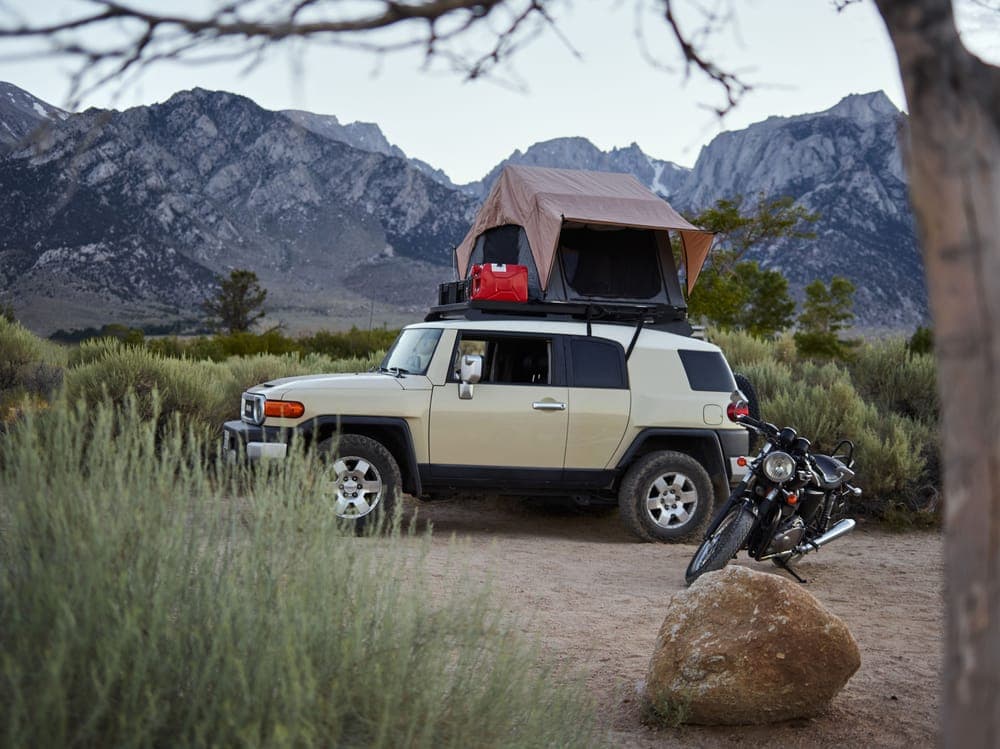
The pavement ended forty miles back, the last bar of signal went with it, and your group is spread across three rigs, a spotter on foot and a campsite on a ridge. That is the problem an overlanding radio setup has to solve. No single radio covers all of it well, so the setup that works is layered: one radio for each job, chosen for where it has to reach. This guide lays out those layers, when CB and ham radio earn a place, how repeaters fit on trail routes, and a channel plan the whole group can run. If you already know you want the rig radio, our best GMRS radio for overlanding ranking is the shortcut, and the road trips hub covers everything else on four wheels.
The overlanding radio setup at a glance
| Layer | Its job | What to carry | License |
|---|---|---|---|
| 1. Rig radio | Rig to rig on the move; the trail to camp | GMRS mobile, 15 to 50 W, with a roof antenna | GMRS license (covers immediate family) |
| 2. Handhelds | Spotters on foot, camp, short hikes | GMRS handhelds; FRS for kids and unlicensed friends | GMRS license, or none for FRS |
| 3. CB (optional) | Clubs that run it; truckers on the drive in | Compact CB plus a tuned CB antenna | None |
| Ham (optional) | More bands and more gear for the group's radio person | A ham radio, used only by licensed operators | Exam; one license per operator |
| Outside help | Reaching rescuers when no radio in range is listening | A satellite messenger or personal locator beacon | Per the device maker |
The first two layers do almost all the talking on a typical trip. The rest are about who else you need to reach.
Layer 1: a GMRS mobile in the rig
The rig radio is the backbone because it has the two things a handheld lacks: an antenna on the roof, above the vehicle body, and the vehicle's own power. GMRS mobiles may run up to 50 W on the main channels (47 CFR 95.1767), and the mobiles in our lineup run from 5 W (Midland's MXT105) to 50 W. The FCC's own expectation for GMRS is "one to twenty-five miles depending on station class, terrain, and repeater use" ( FCC GMRS page), and the makers' terrain figures sit well inside that. Midland's MXT115P PRO spec sheet says "Up to 5 miles" in a neighborhood or dense forest and "Up to 15 miles" mountain peak to mountain peak (MXT115P PRO spec sheet). BTECH says typical simplex range for its 50 W GMRS-50V2 "may be around 2–5 miles in-town or wooded areas, 5–15 miles in open rural terrain" (BTECH GMRS-50V2 page).
That's the honest range of an overland rig: a few miles in timber and canyons, more across open desert, and not much at all with a ridge in the way. Midland's FAQ puts the rule in one line: two radios a mile apart with a large hill between them "may not communicate at all," while two radios ten miles apart on mountaintops may talk fine (Midland MXT575 FAQ). Terrain and height beat wattage.
Three choices shape the rig radio:
- 15 W or 50 W. A 15 W mobile covers most rig-to-rig talk in a group that stays together. 50 W helps when you need margin: a camp on a ridge, a rig that drove ahead to scout, a distant repeater. It only pays off with a roof antenna, and it draws more current on transmit: BTECH lists a 20 A peak for its 50 W GMRS-50V2.
- Enclosed cab or open rig. In an open Jeep or side-by-side, weather rating matters. Midland rates the MXT115P PRO IP67, while it lists the MXT500 as IPX6 in the manual and IP66 on the product page, and states no water rating for the MXT575.
- Tall whip or trail stub. A tall whip reaches farther; a short stub survives low branches. Midland's 32-inch MXTA26 and 3.5-inch MXTA25 Ghost fit the same NMO mount, so you can swap for the day's terrain. Our best GMRS antennas compares them.
Two more things to know before you buy. Midland's MicroMobile manuals hold channels 1-7 at low power, and mobiles can't transmit at all on 8-14, which only "hand-held portable units" may use (47 CFR 95.1763); that's why the channel plan below lives on 15-22. And the install decides your reach as much as the radio does: our GMRS install guide covers power, antenna placement and SWR. For the full field of rig radios, see the best GMRS mobile radios.
Layer 2: handhelds for spotting and camp
Handhelds do the jobs the rig radio can't, because they leave the vehicle. Three jobs come up on every trip:
- Spotting. A spotter on foot guiding a driver over a ledge needs a radio in hand, and the driver needs to hear it over the engine. Calls are short and constant: "Driver's left, more left. Hold. Now easy." An earpiece or speaker-mic keeps the spotter's hands free; see our earpieces and headsets guide.
- Camp. Whoever stays at camp keeps a handheld on the trail channel, or the parked rig's mobile does the listening.
- Hikes from camp. A pair of handhelds lets the hikers check in with camp, within the limits of terrain.
For the adults, a GMRS handheld with a removable antenna and repeater channels is the step up worth making. Rocky Talkie's Expedition Radio is rated at 5 W, is IP67, runs a replaceable battery for "4–6 days" and ships with two antennas; the maker advertises "over 35 miles" but says "2–8 miles more typical in backcountry terrain," and lists 0.5 to 5 miles in forest and hills (Rocky Talkie Expedition page). Those terrain numbers are the ones to plan around.
For the kids at camp, license-free FRS radios are fine. The FCC says you may operate an FRS radio "regardless of your age" (FCC FRS page), and GMRS stations are allowed to talk "with other GMRS stations and with FRS units" (47 CFR 95.1731), so the kids' radios can reach the rig on the trail channel. Keep the handhelds charged from the rig between stops; a dead handheld at the obstacle is a radio failure you can fully prevent.
Layer 3: when CB still matters
CB is older, needs no license and lives on a completely different band, so it can't talk to GMRS. Midland sums up the difference: CB runs at 26.968-27.405 MHz with an FCC maximum carrier output of 4 W, GMRS at 462.550-467.725 MHz with up to 50 W on the main frequencies, and "CB frequencies benefit from ionosphere and ground reflection to increase range, under some conditions, where GMRS frequencies primarily depend on line of sight" ( Midland MXT575 FAQ).
CB earns a place in the rig in two cases:
- Your group or club runs it. If the trail leader calls the route on CB, you need a CB. That's the whole argument.
- The drive in. On the highway leg, Cobra calls channel 19 "the information and calling channel" (Cobra 19 MINI manual), which is where you'll hear road reports.
The cost of CB is the antenna. A CB needs its own tuned 27 MHz antenna. Cobra's own example of a temporary CB antenna is a 42-inch magnet mount, against the 3.5-inch Ghost or 32-inch whip on the GMRS side. And a CB antenna should be tuned with an SWR meter, which a compact CB like the 19 MINI doesn't have built in. The etiquette is written into the rules: the FCC says CB users "must never talk with another station for more than 5 minutes continuously, and must wait at least one minute before starting another communication on the same channel" ( FCC consumer guide), and channel 9 is for "emergency communications or traveler assistance" only (47 CFR 95.931).
My take: if nobody you drive with runs CB, skip it and spend the money on a better GMRS antenna. If your club does, add a compact CB and a properly tuned antenna. Our GMRS vs CB radio comparison covers the trade-offs in full.
When ham radio is worth it
Ham (amateur) radio is a different service with a different deal. You get far more frequencies and equipment choices, and in return every operator earns a license by exam. The rule is direct: applicants must "pass an examination for a new amateur operator license grant" (47 CFR 97.501), and a transmitting ham station needs a control operator who holds a license grant (47 CFR 97.7). GMRS works the other way: no exam, and one GMRS license covers a long list of family members, from spouse and kids to parents, siblings, aunts, uncles and in-laws (47 CFR 95.1705).
So ham is worth it for the person who wants to be the group's radio operator and will put in the study, and for groups that travel remote routes often enough to want more options than GMRS gives. It isn't a replacement for GMRS in the family rig, because the spouse and kids can't use it without their own licenses. One caution: a ham radio is not a GMRS radio. Every GMRS transmitter must be FCC-certified for GMRS (47 CFR 95.1761), which is why we explain whether a Baofeng is GMRS legal separately. We don't pick ham radios on this site; our GMRS vs ham radio comparison walks through the decision.
Calling for help from outside the group
Every radio above talks to people within range who are listening. None of them reliably reaches rescuers from a remote trail. That job belongs to a satellite messenger or a personal locator beacon, which work where there is no cell signal and no one on your channel. Check the device maker's coverage and subscription terms before you rely on one. And when anyone in the group has a cell signal, 911 comes first.
Your radios still matter in an emergency. On GMRS, "any GMRS channel may be used for emergency communications or for traveler assistance," and everyone must give those calls priority (47 CFR 95.1731). A licensee may also let anyone operate their GMRS station "if necessary to communicate an emergency message" (47 CFR 95.1705), so the friend in your passenger seat can use your radio to call for help. Before you leave, follow Ready.gov's advice to "know how you'll contact one another and reconnect if separated" ( Ready.gov, Make a Plan): a named rally point for each day, and someone at home who knows your route and when to expect you.
Repeaters on trail routes
A GMRS repeater is a radio on a high site that listens on one frequency and retransmits on another, so two rigs that can't hear each other can both hear the repeater. The rules build GMRS around this: mobiles and handhelds may transmit on the 467 MHz main channels "only when communicating through a repeater station or making brief test transmissions" ( 47 CFR 95.1763). On a trail route with a repeater on a nearby peak, a group spread over a whole valley can stay in touch.
How to use one well:
- Find it before the trip. Directories such as myGMRS.com list GMRS repeaters by area.
- Ask the owner. The rules let a repeater owner allow anyone, or "limit the use of its GMRS repeater to specific persons" (47 CFR 95.1705). Ask first, and get the tones you need.
- Program it at home. A repeater channel needs the right split tones, and not every radio can do it. The MXT500 and the Rocky Talkie Expedition each list 8 repeater channels; the Cobra 19 MINI, as a CB, has none.
- Don't plan the trip around it. Repeaters go down, and the FCC says they may not be linked via the internet to extend range across a large area (FCC GMRS page). Your simplex channel plan comes first; the repeater is the bonus.
A group channel plan for the trail
People search for "overland radio frequencies," but there's no assigned overland channel. The FCC says none of the GMRS channels are assigned for the exclusive use of anyone, and users share them under "listen-before-talk" etiquette (FCC GMRS page). So your group writes its own plan, and it fits on one card:
| Channel role | Pick from | Example | Notes |
|---|---|---|---|
| Trail (main) | GMRS/FRS 15-22 | 16 | Every rig, handheld and kid's radio at full power; listen first |
| Spotting | A second channel from 15-22 | 20 | Spotter and the driver on the obstacle only, so trail chatter doesn't cover the calls |
| Camp | Same as trail | 16 | Check in at set times to save batteries |
| Repeater | The repeater's channel and tones | Varies | Only with the owner's OK; program before the trip |
| CB (if used) | Your club's channel, AM or FM | Ch 12, AM | Never channel 9 for trail talk |
| Emergency | Any channel | The trail channel | 911 first if anyone has signal; "Emergency" gets priority on air |
Add one privacy code for the whole group, and remember what it does: it filters other groups out of your speaker, not you out of theirs. Set a check-in schedule for when the group splits (at the top of every hour, for example), so camp knows when to turn a radio on. Give your FCC call sign at the end of a series of transmissions and every 15 minutes during a long one. Our convoy radio guide has the standard calls and a printable cheat sheet for the drive between camps, and GMRS channels and frequencies lists every channel.
Our picks for this job
One radio for each layer
A rig radio, a handheld for the spotter and camp, and a compact CB for groups that run it. The GMRS radios need a GMRS license (one covers your immediate family); the CB needs none but ships without an antenna.
 Stock photo
Best 50 W Midland for trucks and farms
Midland MXT500 MicroMobile (50 W)
Layer 1: Midland's 50 W flagship, with 25 W and 5 W steps, 8 repeater channels, a PA function and a water-resistant body (IPX6 in the manual, IP66 on the page). Needs a GMRS license.
Check price · Amazon#ad · Price set by Amazon · How we make money for the link to Midland MXT500 MicroMobile (50 W)
 Stock photo
Best rugged GMRS for backcountry trips
Rocky Talkie Expedition Radio (single radio)
Layer 2: rated at 5 W, IP67, 8 repeater channels and a removable antenna, with a 4-6 day battery and honest terrain figures. Sold singly, so buy one per person. Needs a GMRS license.
Check price · Amazon#ad · Price set by Amazon · How we make money for the link to Rocky Talkie Expedition Radio (single radio)
 Stock photo
Best compact CB for Jeeps and overlanding
Cobra 19 MINI AM/FM CB
Layer 3: a palm-size AM/FM CB with VOX, instant channels 9 and 19, a 12V plug and a hardwire kit. No license, but add a CB antenna and an SWR meter to tune it.
Check price · Amazon#ad · Price set by Amazon · How we make money for the link to Cobra 19 MINI AM/FM CB
The trailhead checklist
Before the pavement ends, run this with the whole group:
- Every GMRS user is licensed or covered as immediate family, and knows the call sign to give.
- Trail, spotting and backup channels, and the privacy code, are set on every radio and written on a card.
- Radio check in the lot: each radio keys up once, and every other radio hears it.
- Handhelds charged, chargers in each rig, and spare batteries for anything that takes them.
- Repeater programmed, if you have the owner's OK.
- Rally points named for each day, and someone at home who knows the route.
- A satellite messenger or beacon in at least one rig for the call no radio can make.
If I were setting up a first overland trip for a family, I'd stop at layers one and two: a 15 or 50 W mobile with a roof antenna in each rig and a GMRS handheld per adult, all on one license. Everything else can wait until a trip shows you need it.
How we scored this
Radios we claim to have lab-tested: 0
Plenty of radio sites say they range-tested everything they list. We haven't, and we say so. Every pick here is labeled Researched: we read each maker's published specs, manuals and range tables, check the license rules against the FCC, and score every radio on a public rubric. Every figure links to where it came from, and every range number is labeled “advertised.”
Scores are editorial judgments from that documented research, not test results. Commissions never set a score or decide a pick. The rubric and its weights are published.
Questions
Frequently asked
What radio setup do overlanders use?
What frequencies do overlanders use?
Is CB still worth it for overlanding?
Do I need a ham radio for overlanding?
Can I use a GMRS repeater on the trail?
How far can overlanding radios reach?
Receipts
Sources
- FCC: General Mobile Radio Service (GMRS) page (checked 2026-09-22)
- FCC: Family Radio Service (FRS) page (checked 2026-09-22)
- FCC consumer guide: Personal Radio Services (checked 2026-09-22)
- FCC: Personal service and amateur application fees (checked 2026-09-22)
- 47 CFR 95.1705, GMRS licenses, family operators and repeater use, via Cornell LII (checked 2026-09-22)
- 47 CFR 95.1731, permissible GMRS uses, via Cornell LII (checked 2026-09-22)
- 47 CFR 95.1761, GMRS equipment certification, via Cornell LII (checked 2026-09-22)
- 47 CFR 95.1763, GMRS channels, via Cornell LII (checked 2026-09-22)
- 47 CFR 95.1767, GMRS power limits, via Cornell LII (checked 2026-09-22)
- 47 CFR 95.931, permissible CB uses, via Cornell LII (checked 2026-09-22)
- 47 CFR 97.501, qualifying for an amateur license, via Cornell LII (checked 2026-09-22)
- 47 CFR 97.7, control operator required, via Cornell LII (checked 2026-09-22)
- Midland: MXT500 product page (checked 2026-09-22)
- Midland: MXT575 product page and FAQ (checked 2026-09-22)
- Midland: MXT115P PRO spec sheet PDF (checked 2026-09-22)
- BTECH: GMRS-50V2 product page (checked 2026-09-22)
- Rocky Talkie: Expedition Radio product page (checked 2026-09-22)
- Cobra: 19 MINI AM/FM product page (checked 2026-09-22)
- Cobra: 19 MINI AM/FM owner's manual PDF (checked 2026-09-22)
- myGMRS.com: GMRS repeater directory (checked 2026-09-22)
- Ready.gov: Make a Plan (checked 2026-09-22)
We haven't tested the radios on this page and we don't pretend to. Specs and range figures come from each maker's own pages and manuals (linked on every product), and license, power and channel rules come from the FCC and 47 CFR Part 95. Range numbers are the maker's advertised claims and are labeled that way. Prices are set by Amazon and change often, so we don't print them. Where a figure isn't published, we say so. Read the full method.