Not legal advice. This page summarizes FCC rules (47 CFR Part 95) from the official sources linked in the text. Rules and fees checked . The FCC sets its fees annually and can change its rules, so confirm the current version on fcc.gov before you rely on it.
Quick picks
The picks at a glance
| # | Product | Best for | Score | Price |
|---|---|---|---|---|
| 1 |  BTECH GMRS-50PRO (50 W, Bluetooth + GPS) 50 W with 25 W and 5 W steps, a color control mic, built-in GPS with location sharing and phone-app programming with CSV import, so the trail leader can load a route's repeaters before the trip. Hardwired; antenna sold separately. | Best for overlanding overallGMRS licensePremium | 7.6/10Researched | Check price · Amazon #ad · Disclosure |
| 2 | BTECH GMRS-20V2 (20 W compact mobile) 20 W, IP67 and a 12V cigarette-plug cable in the box, with a small control-mic body that hides under a seat. No antenna is included, so budget for one. | Best for doors-off and open rigsGMRS licenseMid-price | 7.8/10Researched | Check price · Amazon #ad · Disclosure |
| 3 | Midland MXT575 MicroMobile (50 W) Midland's 50 W hideaway radio with every control on the mic and a magnet-mount antenna in the box. It hardwires to the fuse block or battery, and Midland states no water rating, so keep the body inside the cab. | Best complete 50 W kit for a crowded dashGMRS licenseHigh-end | 7.2/10Researched | Check price · Amazon #ad · Disclosure |
| 4 | Midland MXT275 MicroMobile (15 W) 15 W, a 12V plug, a magnet roof antenna and the controls on the mic: the easiest way to get a second or third rig on the air. No stated water rating. | Best plug-in mobile for tag-along rigsGMRS licensePremium | 6.9/10Researched | Check price · Amazon #ad · Disclosure |
| 5 |  Rocky Talkie Expedition Radio (single radio) IP67, rated at 5 W, a removable antenna with short and long options, 8 repeater channels and a claimed 4-6 day battery. Sold singly. | Best spotter handheldGMRS licensePremium | 7.9/10Researched | Check price · Amazon #ad · Disclosure |
| 6 | Midland GXT67 PRO (single radio) IP67, rated at 5 W, 8 repeater channels, with USB-C and a vehicle power adapter for charging. The battery is sealed and the antenna is fixed. | Best handheld that charges from the rigGMRS licensePremium | 7.1/10Researched | Check price · Amazon #ad · Disclosure |
#ad · Prices are set by Amazon and change often, so we don't print them. Scores are ours, built from published specs, manuals and FCC rules, not hands-on tests. Photos are illustrative stock. Tap a row for the full write-up.
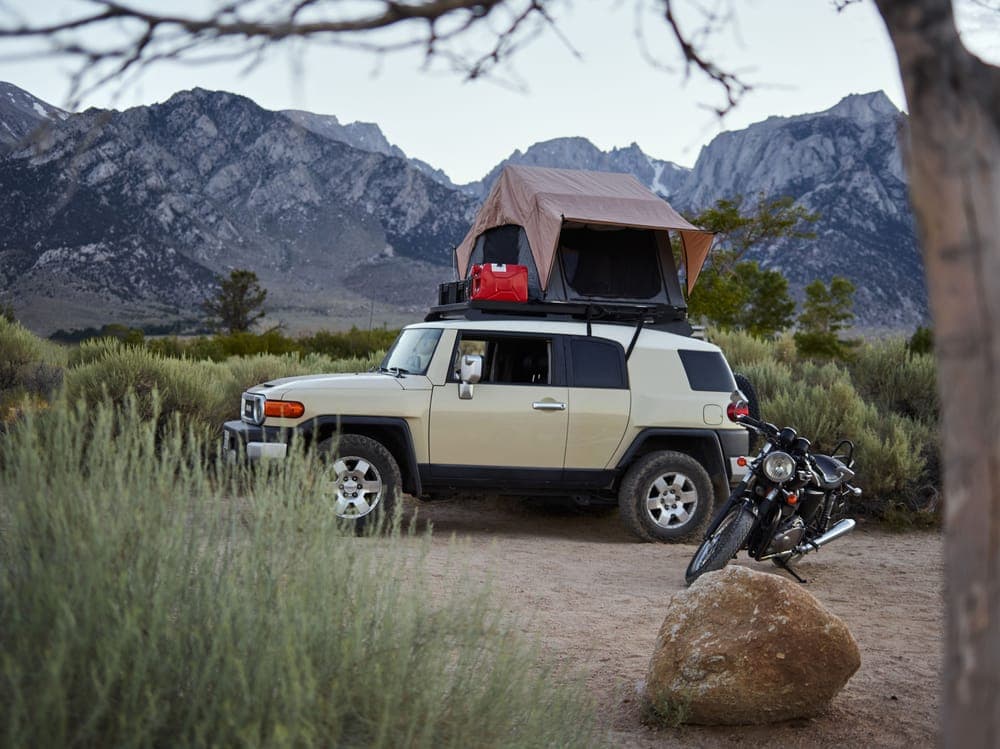
Picture five rigs strung out along a forest road. The tail rig is two switchbacks back, the spotter is on foot in a rock garden, and the phones quit an hour ago. That's the job for GMRS: a mobile radio in each rig with its antenna on the roof, a rugged handheld for anyone who steps out, and a channel plan everyone set before the trailhead. This page ranks the radios for that job. For the full rig plan, including where CB and ham radio fit, see our overlanding radio setup guide, and for the rest of the category, the road trips and overlanding hub.
What actually reaches on the trail
The FCC's own expectation is the honest starting point: "A GMRS user can expect a communications range of one to twenty-five miles depending on station class, terrain, and repeater use" ( FCC GMRS page). BTECH puts it well on the GMRS-50PRO page: "Coverage depends on antenna height, terrain, obstructions, installation quality, and repeater availability. A properly installed mobile antenna and accessible repeater can materially extend practical range" (BTECH GMRS-50PRO page).
The makers that publish terrain figures back that up. Midland's chart for the 50 W MXT575 reads "75 Miles MAX" with no obstruction, "20-25 Miles IDEAL" with partial obstruction and "10-15 Miles OBSTRUCTED" (MXT575 spec sheet). BTECH says the 20 W GMRS-20V2's typical simplex range "may be around 1–5 miles in-town or wooded areas, 5–15 miles in open rural terrain." Rocky Talkie lists its Expedition handheld at 2 to 8 miles in mountains and 0.5 to 5 miles in forest and hills. Down in a timbered canyon, plan on the small numbers; up on an open ridge, the big ones start to show up. Terrain and height beat wattage.
One rule shapes every channel plan. Under 47 CFR 95.1767, mobiles may run up to 50 W on the GMRS main channels but only 5 W ERP on the 462 MHz interstitial channels, which are FRS channels 1 to 7 (47 CFR 95.1767). That's why Midland's manual says channels 1 to 7 "cannot be removed from the Lo transmit power setting" and BTECH limits them to 5 W. Put the group on a channel from 15 to 22, or on a repeater channel, to use the power you paid for.
How we picked
Every pick is sold by its maker as a GMRS radio, because 47 CFR 95.1761 requires every GMRS transmitter to be certified for GMRS (47 CFR 95.1761). We kept the mobiles and handhelds in our registry that fit trail use: repeater channels, a way to get an antenna up high, a stated water rating (or an honest note that there isn't one), and an install a weekend overlander can do. Then we scored each on our published rubric: real-world reach (30%), ease of use (20%), toughness and weather (15%), power and battery (15%), field features (10%) and value (10%). The method is on How We Rank.
These are editorial scores from published specs, manuals and FCC rules, not test results, and every figure in the table links to its source. One call to be upfront about: the GMRS-20V2 scores a little higher on our general rubric than the GMRS-50PRO (7.8 against 7.6), on IP67 and value. I still rank the 50PRO first for a trail group, because the lead rig benefits most from 50 W on a roof antenna, GPS location sharing and a phone app that loads the route's channels in one go.
The picks side by side
The Water rating row is the one to read twice. The two BTECH mobiles, the Rocky Talkie and the GXT67 PRO state their ratings; the two Midland MicroMobiles don't, which is fine in a closed cab and a real risk with the doors off.
The picks in context
1. BTECH GMRS-50PRO: best for overlanding
The 50PRO is the radio I'd put in the lead rig. It transmits at 5, 25 or 50 W (channels 1 to 7 are held to 5 W, 8 to 14 are receive-only, and 15 to 30 go up to 50 W), stores 180 channels in six banks of 30, and puts the display and controls on a color control mic, so the body can mount out of the way. The built-in GPS "syncs with the app for location sharing and coordination features designed for real group movement," and BTECH's Bluetooth programming app can "Import or export CSV files, batch-edit channels and tones, and move proven plans between supported devices" (BTECH GMRS-50PRO page). For a group, that means the leader builds one channel file with the route's repeaters and loads it before the trip. It also monitors NOAA alerts in the background and has dual watch.
The trade-offs are real. It's IP54, "not submersible." The box has the bracket, control mic, mounting hardware and a fused power lead, but no antenna: BTECH says to add "a 50-ohm GMRS-tuned antenna" and doesn't name the connector on the page, so check it against the antenna you buy. And the feature depth means more setup than a plug-and-play Midland.
Buy it if you lead the group or run everyone's radios. Skip it if nobody will touch the app; BTECH's GMRS-50V2 gives 50 W and repeater support at a lower list price.
2. BTECH GMRS-20V2: best for doors-off and open rigs
If your Jeep runs without doors or your group includes side-by-sides, water and dust ratings matter more than the last 30 W. The GMRS-20V2 is rated IP67, "dirtproof and waterproof / fully submersible," puts out 20 W or 5 W, and runs from the included 12V cigarette-plug cable (BTECH GMRS-20V2 page). Its control-mic design and a body that measures 4 x 1.5 x 4 in let it tuck under a seat. It has 200 channels preloaded with the 30 GMRS channels, tri watch, VOX, NOAA weather and an SOS alarm.
Two catches. There's no antenna in the box, so it can't transmit until you add one to its SO-239 jack; the Nagoya UT-72G's PL-259 cable plugs straight into that jack. And BTECH's page contradicts itself on range: the 1 to 5 mile wooded figure above, and a details table that lists "Talking Range Maximum 75 Mile." Plan on the first one. Bulk programming uses CHIRP and a cable.
Buy it if the radio lives in an open rig. Skip it if you want one box with everything in it.
3. Midland MXT575 MicroMobile: best complete 50 W kit
The MXT575 is the simplest way to get 50 W into a closed-cab rig with a crowded dash. The radio body hides away and every control sits on the mic; Midland's manual says it's "designed to be installed under the dash or vertically on the center console." It has 15 GMRS channels plus 8 split-tone repeater channels, 142 privacy codes, NOAA weather scan and alert, and a USB-C charging port. Unlike the BTECH, it ships with a magnet-mount 2.1 dB antenna and cable (Midland MXT575 page).
Two cautions. Midland states no IP or water rating for it, and the manual's care section says "DO NOT immerse the radio in water," so keep the body inside the cab. And it's a hardwired install: the manual has you run the fused positive lead to the fuse block or the battery and ground the black lead to the frame (MXT575 owner's manual). Midland's documents also disagree on power steps (Hi/Lo in the manual, Hi/Mi/Lo on the spec sheet).
Buy it if you want 50 W, the controls in your hand and everything in one box. Skip it if the rig runs doors-off.
4. Midland MXT275 MicroMobile: best plug-in mobile for tag-along rigs
Not every rig in the group needs 50 W. The MXT275 gives a second or third vehicle a real roof antenna with almost no install: 15 W, a 12V power cord with a DC vehicle adapter, a 2.1 dB magnetic antenna and mount, a hideaway body and the controls on the mic (Midland MXT275 page). It has 8 split-tone repeater channels and an SO-239 jack for a better antenna later. Midland's chart gives it "5-10 Miles OBSTRUCTED." Like the MXT575, it has no stated water rating.
Buy it if you're a newer member who wants to plug in and go. Skip it if you lead long trips through broken country; that's 50 W territory.
5. Rocky Talkie Expedition Radio: best spotter handheld
The spotter needs a radio that survives a rock garden and a creek crossing. The Expedition Radio is rated IP67 to 1 meter, is rated at 5 W, and has a removable SMA-male antenna with 7.5 cm and 17 cm antennas in the box, plus 8 repeater channels, NOAA weather and alert monitoring, and a replaceable 1800 mAh Li-ion battery that charges by USB-C, with a claimed 4 to 6 days per charge (Rocky Talkie Expedition page). Rocky Talkie also sells a 15-inch whip for it when the handheld rides in camp. It's sold singly and has no VOX listed.
Buy it if someone in the group walks the obstacles or scouts on foot. Skip it if you want a matched pair in one box.
6. Midland GXT67 PRO: best handheld that charges from the rig
The GXT67 PRO is the Midland-side spotter radio: IP67 (with the accessory jack cover tightened), rated at 5 W with high, medium and low settings, 8 repeater channels with split tones, NOAA alerts, VOX, dual watch and an SOS siren. It charges by USB-C (PD compatible) or a vehicle power adapter (Midland GXT67 PRO page). Midland is honest about reach: "At 5 Watts, this radio can easily reach up to 5 miles, depending on the terrain."
The limits: the battery is factory sealed, and Midland's FAQ says of the antenna, "The design of this radio does not allow it to be removed" (Midland GXT67 FAQ). Midland's battery-life figures also conflict (16 hours on the spec sheet, "up to 4 days" on the page).
Buy it if your rigs run Midland and you want a spotter radio that tops up from the dash. Skip it if you want to swap batteries or fit a longer antenna.
Mobiles for the rigs, handhelds for people
The pattern that works: every rig gets a mobile with a roof antenna, and every person who steps away from a rig carries a handheld. Handhelds and mobiles use the same GMRS channels, so the spotter's Expedition Radio talks to the lead rig's 50PRO on the group channel. The mobile does the heavy lifting between vehicles; the handheld only has to reach the nearest rig. Our GMRS handheld vs mobile range comparison covers the numbers, and best GMRS mobile radios ranks every mobile in our registry, including the MXT500 and the IP67 MXT115P PRO. If you're choosing between Midland's three MicroMobiles, see MXT115P PRO vs MXT275 vs MXT575.
Using repeaters on a route
A GMRS repeater on a peak can link rigs that can't hear each other directly; repeater use is one of the three things the FCC names in its "one to twenty-five miles" range line. Handhelds and mobiles transmit on the 467 MHz main channels only when working through a repeater (47 CFR 95.1763), which is what the repeater channels on every pick here are for.
In practice: before the trip, look up repeaters along the route in a directory such as myGMRS, which describes itself as a GMRS community "offering a repeater directory, license lookup, and forums" (myGMRS). Note each repeater's tones, check whether its owner asks users to request access, and program it into every radio. The 50PRO's app imports and exports CSV channel files, which turns that job into one file instead of an afternoon of keypad entry. Our GMRS channels and frequencies reference lists the repeater pairs.
The license: one per family, not per group
Every radio on this page needs a GMRS license to transmit. The FCC says "An FCC license is required to operate GMRS system. Licenses are issued for a ten-year term," applicants must be 18 or older, and "any family member, regardless of age, can operate GMRS stations and units within the licensed system" (FCC GMRS page). The rule's family list runs from spouse and children to aunts, uncles, nieces, nephews and in-laws (47 CFR 95.1705). It doesn't include friends, so in a trail group of friends, each household files its own. The fee is $35 for a new license, per the FCC's fee table (checked September 2026) (FCC fee table), and there's no exam. If your group also runs CB or ham radio, our GMRS vs CB and GMRS vs ham radio comparisons explain what each adds.
In detail
The picks, in full
Rank 01
Stock photoBest for overlanding overall
BTECH GMRS-50PRO (50 W, Bluetooth + GPS)
50 W with 25 W and 5 W steps, a color control mic, built-in GPS with location sharing and phone-app programming with CSV import, so the trail leader can load a route's repeaters before the trip. Hardwired; antenna sold separately.
Published specsResearched · not tested by us
How the 7.6 score breaks down
- Real-world reach (30%)
- 9
- Ease of use (20%)
- 6
- Toughness & weather (15%)
- 5
- Power & battery (15%)
- 8
- Field features (10%)
- 9
- Value (10%)
- 8
What the specs support
- Phone-app programming over Bluetooth, no cable needed
- Built-in GPS with location sharing for convoys and property crews
- Color control mic keeps channel, signal and GPS info in your hand
- 5, 25 and 50 W power steps
Where it falls short
- IP54 and not submersible
- No antenna in the box
- The feature depth means more setup than a plug-and-play Midland
Skip this if…
…Skip it if nobody in your group will set up the app or use GPS sharing: the GMRS-50V2 gives the same 50 W and repeater support at a lower list price.
#ad · Price set by Amazon · How we make money for the link to BTECH GMRS-50PRO (50 W, Bluetooth + GPS)
Rank 02
Stock photoBest for doors-off and open rigs
BTECH GMRS-20V2 (20 W compact mobile)
20 W, IP67 and a 12V cigarette-plug cable in the box, with a small control-mic body that hides under a seat. No antenna is included, so budget for one.
Published specsResearched · not tested by us
How the 7.8 score breaks down
- Real-world reach (30%)
- 8
- Ease of use (20%)
- 6
- Toughness & weather (15%)
- 9
- Power & battery (15%)
- 8
- Field features (10%)
- 8
- Value (10%)
- 8
What the specs support
- IP67 at the mid list-price tier
- Runs from the included 12V cigarette-plug cable
- Control-mic design lets the small body hide under a seat
- Tri watch and scanner receive
Where it falls short
- No antenna in the box
- Programming-heavy: 200 channels, with CHIRP and a cable for bulk setup
- The page's 75-mile figure contradicts its own 1-5 mile typical-range statement
Skip this if…
…Skip it if you want one box with everything: the GMRS-20V2 ships without an antenna, so it can't transmit until you add a GMRS mobile antenna and mount.
#ad · Price set by Amazon · How we make money for the link to BTECH GMRS-20V2 (20 W compact mobile)
Rank 03
Stock photoBest complete 50 W kit for a crowded dash
Midland MXT575 MicroMobile (50 W)
Midland's 50 W hideaway radio with every control on the mic and a magnet-mount antenna in the box. It hardwires to the fuse block or battery, and Midland states no water rating, so keep the body inside the cab.
Published specsResearched · not tested by us
How the 7.2 score breaks down
- Real-world reach (30%)
- 9
- Ease of use (20%)
- 7
- Toughness & weather (15%)
- 4
- Power & battery (15%)
- 8
- Field features (10%)
- 7
- Value (10%)
- 6
What the specs support
- 50 W on high, the top power in Midland's MicroMobile line
- Hideaway body with the controls on the mic frees dash space in Jeeps and side-by-sides
- 8 split-tone repeater channels for reaching a local GMRS repeater
- Midland publishes a terrain chart (20-25 miles with partial obstruction), not just a max figure
Where it falls short
- Midland states no IP or water rating for the MXT575; the MXT500 is listed as water resistant
- Same list-price tier as the MXT500, which adds a PA function and noise canceling
- Channels 1-7 stay on low power (manual), so full power is only on 15-22 and the repeater channels
Skip this if…
…Skip it if the radio will ride in an open-cab UTV or tractor: Midland lists no water rating for the MXT575, so the IP67 MXT115P PRO or the water-resistant MXT500 fits that job better.
#ad · Price set by Amazon · How we make money for the link to Midland MXT575 MicroMobile (50 W)
Rank 04
Stock photoBest plug-in mobile for tag-along rigs
Midland MXT275 MicroMobile (15 W)
15 W, a 12V plug, a magnet roof antenna and the controls on the mic: the easiest way to get a second or third rig on the air. No stated water rating.
Published specsResearched · not tested by us
How the 6.9 score breaks down
- Real-world reach (30%)
- 8
- Ease of use (20%)
- 7
- Toughness & weather (15%)
- 4
- Power & battery (15%)
- 8
- Field features (10%)
- 6
- Value (10%)
- 7
What the specs support
- Plugs into a 12V socket, with no hardwiring needed
- Hideaway body and control mic keep the dash clear
- Repeater capable, and the SO-239 jack takes an upgraded antenna
Where it falls short
- Midland states no IP or water rating
- No PA or intercom jack listed, unlike the MXT115P PRO
- Channels 1-7 stay on low power (manual)
Skip this if…
…Skip it if the radio goes in an open-cab tractor or UTV that sees rain and dust: Midland states no water rating for the MXT275, while the MXT115P PRO at the same 15 W is IP67.
#ad · Price set by Amazon · How we make money for the link to Midland MXT275 MicroMobile (15 W)
Rank 05
Stock photoBest spotter handheld
Rocky Talkie Expedition Radio (single radio)
IP67, rated at 5 W, a removable antenna with short and long options, 8 repeater channels and a claimed 4-6 day battery. Sold singly.
Published specsResearched · not tested by us
| Service / license | GMRS (FRS compatible); GMRS license required, US use only |
|---|---|
| Transmit power | 5 W |
| Channels | 22 channels, 121 privacy codes (CTCSS and DCS); channel lock, high/low power, scan, dual channel watch |
| Repeater and antenna | Repeater capable (8 GMRS repeater channels); removable SMA-male antenna, 7.5 cm and 17 cm antennas included |
| Water rating | IP67 (1 meter submersion) |
| Battery | Replaceable 7.4 V 1800 mAh Li-ion, USB-C; "4–6 days" per chargeAdvertised |
| Weather and weight | NOAA weather channels and emergency alert monitoring; 9.1 oz |
| Advertised range | "max range of over 35 miles, with 2–8 miles more typical in backcountry terrain"Advertised |
| Maker's terrain figures | Line-of-sight 35+ miles; mountains 2 to 8 miles; forest/hills 0.5 to 5 miles; rivers 0.5 to 3 miles; city up to 1.5 milesAdvertised |
How the 7.9 score breaks down
- Real-world reach (30%)
- 8
- Ease of use (20%)
- 8
- Toughness & weather (15%)
- 9
- Power & battery (15%)
- 8
- Field features (10%)
- 7
- Value (10%)
- 6
What the specs support
- Removable SMA antenna with short and long options, plus 8 repeater channels
- IP67 with a replaceable Li-ion battery and USB-C, rated for 4-6 days
- The maker publishes terrain-by-terrain range, not just a box number
- Channel lock and a simple 22-channel layout
Where it falls short
- Sold as a single radio, so a pair lands firmly in the premium tier
- No VOX hands-free or flashlight listed by the maker
Skip this if…
…Skip it if you don't want a GMRS license: it's a GMRS radio, and Rocky Talkie's license-free Mountain Radio (FRS, 2 W) covers most trail use.
#ad · Price set by Amazon · How we make money for the link to Rocky Talkie Expedition Radio (single radio)
Rank 06
Stock photoBest handheld that charges from the rig
Midland GXT67 PRO (single radio)
IP67, rated at 5 W, 8 repeater channels, with USB-C and a vehicle power adapter for charging. The battery is sealed and the antenna is fixed.
Published specsResearched · not tested by us
How the 7.1 score breaks down
- Real-world reach (30%)
- 7
- Ease of use (20%)
- 7
- Toughness & weather (15%)
- 9
- Power & battery (15%)
- 7
- Field features (10%)
- 7
- Value (10%)
- 5
What the specs support
- IP67 waterproof and dustproof, where the GXT1000 and GXT3000 are splash-rated JIS4
- Rated at 5 W with 8 repeater channels and split tones
- USB-C (PD) and 12 V vehicle charging in the box
Where it falls short
- Sold as a single radio, so a pair means buying two
- Fixed antenna and a factory-sealed battery you can't swap in the field
- Midland's battery-life figures conflict (16 hours vs up to 4 days)
Skip this if…
…Skip it if you want to carry a spare battery or fit a longer antenna for the far side of the property: the battery is sealed and the antenna doesn't come off.
#ad · Price set by Amazon · How we make money for the link to Midland GXT67 PRO (single radio)
What to look for in an overlanding GMRS radio
- A real GMRS radio. The maker should sell it as a GMRS (Part 95E) radio. Ham radios like the Baofeng UV-5R aren't; our Baofeng GMRS guide explains why.
- Power you can install. 15 to 20 W mobiles (MXT275, GMRS-20V2) plug into a 12V socket. The 50 W class (GMRS-50PRO, MXT575) wires to the fuse block or battery. Either way, full power lives on channels 15 to 22 and the repeater channels.
- A water rating you can read. Doors-off or open rigs want IP67 (GMRS-20V2, or Midland's MXT115P PRO). A radio with no stated rating belongs inside a closed cab.
- Repeater channels with split tones. Every pick here has them. They're what turn a mountaintop repeater into group coverage.
- Controls you can reach. A control-mic design (GMRS-50PRO, GMRS-20V2, MXT575, MXT275) keeps the radio body out of a crowded dash and the channel in your hand.
- Group tools, if you'll use them. The FCC has allowed "short data messaging applications including text messaging and GPS location information" on GMRS since 2017 (FCC GMRS page). The 50PRO's GPS location sharing is the example here.
Antennas decide more than watts
Midland's install instructions are blunt: "Mount the antenna as high on the vehicle as possible. The higher the better," mount it in the center of the surface if you can, and avoid "Metal surfaces covered by fiberglass or vinyl" (MXT575 manual). Midland's antenna FAQ adds that its current antennas need a metal ground plane about 12 inches across for GMRS (Midland MXTA25 page). The trade-off on a trail rig is height against branches:
- Midland MXTA26, a 32-inch stainless whip with a stated 6 dB gain, fits Midland's current MicroMobiles on an NMO mount you supply (MXTA26 page). Good in open country; it will catch limbs.
- Midland MXTA25 Ghost, a 3.5-inch NMO stub, clears brush and garage doors but gives up the height of a whip. Midland's own FAQ puts a GMRS half wave at about 12 inches, so treat its 3 dB figure with caution.
- Midland MXAT01VP, a 50-inch, 7.5 dB fiberglass antenna with a spring base and 19.5 ft of coax, is Midland's pick for open plains and highways (MXAT01VP page), and overkill in the trees.
- Nagoya UT-72G, a 19-inch magnet mount with 13 ft of coax and a PL-259 plug, fits SO-239 radios like the GMRS-20V2 with no drilling, on a steel roof (Nagoya UT-72G page).
Our best GMRS antennas ranks these and more.
What each install involves
| Radio | Power hookup | Antenna in the box | Stated water rating |
|---|---|---|---|
| BTECH GMRS-50PRO | Fused power lead (13.8 V DC nominal) | None; add a GMRS-tuned antenna | IP54, not submersible |
| BTECH GMRS-20V2 | 12V cigarette-plug cable | None; SO-239 jack | IP67 |
| Midland MXT575 | Fused lead to the fuse block or battery | 2.1 dB antenna on a magnet mount | Not stated |
| Midland MXT275 | 12V power cord with DC vehicle adapter | 2.1 dB magnetic antenna and mount | Not stated |
Sources: each maker's product page and, for the MXT575 hookup, its owner's manual. Mounts, coax routing and grounding are covered step by step in how to install a GMRS radio in your vehicle.
Trail radio mistakes
- Mounting the antenna low. Midland says as high as possible and centered on the surface; a bumper or a spot behind the rack gives that away before you key the mic.
- Running doors-off with an unrated radio. Midland states no rating for the MXT575 or MXT275.
- Picking channel 1 to 7 for the group. Mobiles drop to low power there. Use 15 to 22.
- Assuming every repeater is open. Its owner may limit use; check the listing and ask.
- Assuming one license covers the club. It covers one licensee's immediate family.
How we scored this
Radios we claim to have lab-tested: 0
Plenty of radio sites say they range-tested everything they list. We haven't, and we say so. Every pick here is labeled Researched: we read each maker's published specs, manuals and range tables, check the license rules against the FCC, and score every radio on a public rubric. Every figure links to where it came from, and every range number is labeled “advertised.”
Scores are editorial judgments from that documented research, not test results. Commissions never set a score or decide a pick. The rubric and its weights are published.
What changed
- Published.
Questions
Frequently asked
What is the best GMRS radio for overlanding?
Is GMRS or ham radio better for overlanding?
Do I need a license for GMRS on the trail?
Can I use GMRS repeaters on an overlanding route?
Is 15 W enough for overlanding, or do I need 50 W?
What channel should a trail group use?
Receipts
Sources
- FCC: General Mobile Radio Service (GMRS) page (checked 2026-09-22)
- FCC: Personal service and amateur application fees (checked 2026-09-22)
- 47 CFR 95.1705, GMRS licenses, who may operate and repeater use (Cornell LII, checked 2026-09-22)
- 47 CFR 95.1751, GMRS station identification (Cornell LII, checked 2026-09-22)
- 47 CFR 95.1761, GMRS transmitter certification (Cornell LII, checked 2026-09-22)
- 47 CFR 95.1763, GMRS channels (Cornell LII, checked 2026-09-22)
- 47 CFR 95.1767, GMRS transmitting power limits (Cornell LII, checked 2026-09-22)
- myGMRS: GMRS repeater directory and community (checked 2026-09-22)
- BTECH: GMRS-50PRO product page (checked 2026-09-22)
- BTECH: GMRS-20V2 product page (checked 2026-09-22)
- Midland: MXT575 product page (checked 2026-09-22)
- Midland: MXT575 spec sheet PDF (checked 2026-09-22)
- Midland: MXT575 owner's manual PDF (checked 2026-09-22)
- Midland: MXT275 product page (checked 2026-09-22)
- Rocky Talkie: Expedition Radio product page (checked 2026-09-22)
- Midland: GXT67 PRO product page (checked 2026-09-22)
- Midland Support: GXT67 FAQs (checked 2026-09-22)
- Midland: MXTA26 6 dB whip antenna page (checked 2026-09-22)
- Midland: MXTA25 Ghost antenna page and FAQ (checked 2026-09-22)
- Midland: MXAT01VP Grand Vista antenna page (checked 2026-09-22)
- BTECH: Nagoya UT-72G product page (checked 2026-09-22)
We haven't tested the radios on this page and we don't pretend to. Specs and range figures come from each maker's own pages and manuals (linked on every product), and license, power and channel rules come from the FCC and 47 CFR Part 95. Range numbers are the maker's advertised claims and are labeled that way. Prices are set by Amazon and change often, so we don't print them. Where a figure isn't published, we say so. Read the full method.