Not legal advice. This page summarizes FCC rules (47 CFR Part 95) from the official sources linked in the text. Rules and fees checked . The FCC sets its fees annually and can change its rules, so confirm the current version on fcc.gov before you rely on it.

People search for "GMRS vs VHF" because the radio listings mix two different ideas. VHF and UHF are frequency ranges - physics. GMRS, FRS, MURS, marine and amateur radio are services - law. GMRS sits inside UHF, so the comparison is really between GMRS and whatever VHF service you were considering, and the decision is about the service rules at least as much as the propagation.
This page covers both halves: what the bands do differently on real ground, and what each service lets you do legally.
GMRS is UHF - here are the numbers
What each band actually does
Both bands travel essentially line of sight at these power levels. Neither bends over a mountain. What differs is how they interact with the things in the way.
UHF (GMRS, 462-467 MHz) is better around structures. Shorter wavelengths pass through doorways, window openings and gaps in construction more readily, and reflect usefully off hard surfaces. That is why schools, hotels, warehouses, stadiums and security teams run UHF business radios, and why GMRS tends to work better than you expect around a house, a barnyard or a street. It is still heavily attenuated by solid construction - NIST's measurement work documents how much signal structures absorb (NIST: attenuation and variability measurements) - but it does better than VHF at the same power.
VHF (around 136-174 MHz) is better over open ground. Longer wavelengths carry further across flat or gently rolling terrain and are less bothered by light vegetation. That is why marine, agricultural and forestry users historically live on VHF, and why a flat ranch is the one case where a 2 W VHF radio can genuinely out-reach a 5 W UHF handheld.
Dense timber is a draw, and usually a disappointment either way. Wet foliage absorbs at both bands; VHF is modestly better in sparse cover, and neither is good in a thick stand. Our how far walkie talkies reach page covers what to expect in timber, and radios for concrete buildings covers the indoor extreme.
Antenna size is the hidden trade
Wavelength sets antenna length, and this is the practical consequence people do not anticipate. A half-wave antenna for 462 MHz is around a foot; for 151 MHz it is roughly three times that.
- On a handheld, that means a VHF radio's stock antenna is a much bigger compromise relative to the ideal length than a UHF radio's. Part of UHF's real-world advantage is simply that the antenna you are actually carrying is closer to being a proper one.
- On a vehicle, a UHF whip is short and tidy; a VHF whip is long enough to catch branches and car park barriers.
- On a mast, VHF antennas are bigger, heavier and need a sturdier install - but a mast is also where VHF's open-ground advantage finally gets to count.
Either way, height does more than band choice. See how to increase walkie talkie range and GMRS antennas.
You choose a service, not a band
This is the part that settles most real decisions. You cannot buy "a VHF radio" and use it as you like - you buy a radio certified for a specific service, and that certification constrains the frequencies, the power and who may operate it:
- GMRS (UHF). Individual license, immediate family, up to 50 W, repeaters, removable antennas on many radios, the largest consumer market. Transmitters must be certified and unmodified (47 CFR 95.1761).
- MURS (VHF). No license, five channels, 2 W, no repeaters - and no radio may be certified for MURS and another service. Full detail on GMRS vs MURS.
- Amateur radio (VHF and UHF). An exam, then wide access to both bands including 2 m VHF and 70 cm UHF (47 CFR 97.301, FCC amateur radio page), and operating privileges tied to the individual rather than the family (47 CFR 97.7). This is the route for anyone who genuinely wants to choose their band.
- Business radio (VHF or UHF). A Part 90 license, a coordinated frequency, and the ability to pick the band that suits your site. The right answer for a commercial operation of any size.
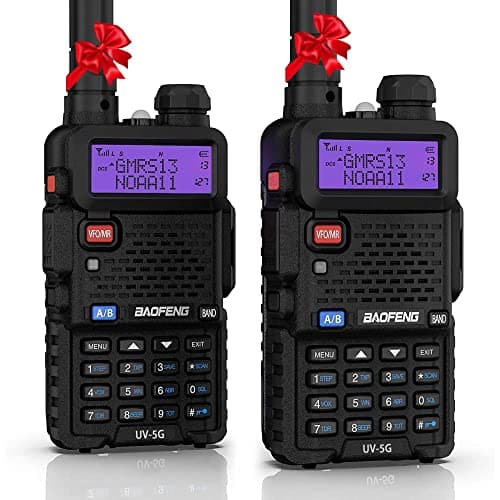
This is also where the most common and most expensive mistake lives: buying a cheap programmable VHF/UHF handheld and using it on GMRS. A radio certified for the amateur service is not a GMRS radio, whatever frequencies it will tune to. BTECH publishes a plain-language guide to which of its radios is certified for which service (BTECH radio service guide), and our is a Baofeng legal on GMRS page works through the whole trap.
What to buy
Our picks for this job
Two GMRS radios and the honest VHF route
GMRS first, because it is UHF and licensed with a form rather than an exam. If you actually want to choose your band, the third pick is an amateur radio and needs an exam - it is not a GMRS radio.
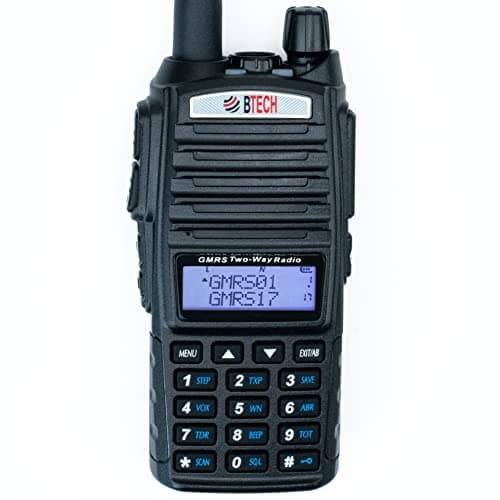
Best budget GMRS for repeater users
BTECH GMRS-V2 (single radio)
Needs a GMRS license. UHF, 5 W, repeater capable, SMA-female antenna jack; BTECH publishes 1 to 5+ miles simplex and 15 to 50+ miles through a repeater.
Check price · Amazon#ad · Price as of November 2, 2026 · How we make money for the link to BTECH GMRS-V2 (single radio)
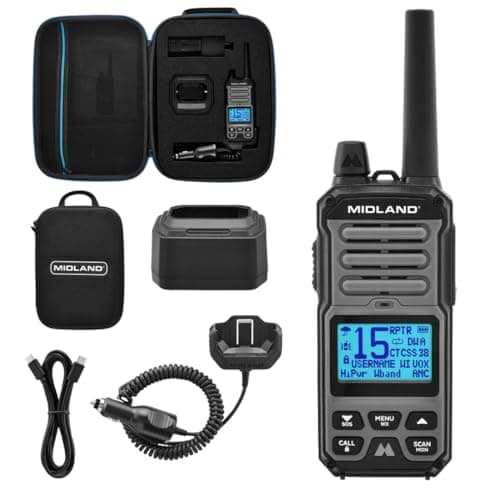
Best Midland handheld for wet weather
Midland GXT67 PRO (single radio)
Needs a GMRS license. UHF, 5 W, IP67, eight repeater channels with split tones and NOAA alerts. Midland's figure is up to about 5 miles depending on terrain.
$219.99Amazon#ad · Price as of November 2, 2026 · How we make money for the link to Midland GXT67 PRO (single radio)
- YaesuNo image
Best beginner ham radio from a major maker
Yaesu FT-4XR (single radio)
Needs a ham license (Technician or above), not a GMRS license. A dual-band VHF/UHF amateur handheld: the legitimate way to use 2 m VHF as well as 70 cm UHF.
Check price · Amazon#ad · Price as of November 2, 2026 · How we make money for the link to Yaesu FT-4XR (single radio)
Which should you choose?
Choose GMRS if you want the best general answer. It is UHF, which suits houses, yards, vehicles and mixed terrain; it allows up to 50 W, repeaters and real antennas; the license is a form and a fee covering your whole immediate family; and the radio and accessory market is enormous. For almost every reader of this site - a property, a convoy, a hunting party, a family - this is the correct choice, and the band question never needs answering.
Choose a VHF service if your land is genuinely flat and open and you are prepared to accept the constraints: MURS if you want no license and will live with five channels at 2 W and no repeaters, or a Part 90 business license if this is a commercial operation and you want the band chosen for your site.
Choose amateur radio if the band choice itself is the point. An exam buys you access to both VHF and UHF, far more power, and an enormous repeater network - but it is a license for the individual, not the family, so it does not replace GMRS for household use. See GMRS vs ham radio and best ham radio for beginners.
How we scored this
Every pick here is backed by the paperwork
Every pick is labeled Researched: we read each maker's published specs, manuals and range tables, check the license rules against the FCC, and score every radio on a public rubric out of 10. Every figure links to where it came from, and every range number is labeled “advertised” so you can see the difference between the box and the terrain.
Scores are our editorial judgment on that documented evidence. Commissions never set a score or decide a pick. The rubric and its weights are published.
What changed
- Published.
Questions
Frequently asked
Is GMRS VHF or UHF?
Is VHF or UHF better for range?
Can I use a VHF radio on GMRS?
Why are VHF antennas so much bigger?
What is the license-free VHF option?
Receipts
Sources
- FCC: General Mobile Radio Service (GMRS) page (checked 2026-10-11)
- FCC: Amateur Radio Service page (checked 2026-10-11)
- 47 CFR 95.1763, GMRS channels (via Cornell LII, checked 2026-10-11)
- 47 CFR 95.1767, GMRS transmitting power limits (via Cornell LII, checked 2026-10-11)
- 47 CFR 95.1705, GMRS eligibility (via Cornell LII, checked 2026-10-11)
- 47 CFR 95.1761, GMRS transmitter certification and no modification (via Cornell LII, checked 2026-10-11)
- 47 CFR 95.2763, the five MURS VHF channels (via Cornell LII, checked 2026-10-11)
- 47 CFR 97.301, amateur service frequency bands (via Cornell LII, checked 2026-10-11)
- 47 CFR 97.7, amateur station control operator required (via Cornell LII, checked 2026-10-11)
- NIST: measurements in support of public safety communications, attenuation and variability (checked 2026-10-11)
- BTECH: radio service guide (checked 2026-10-11)
- BTECH: GMRS-V2 product page (checked 2026-10-11)
- Midland: GXT67 PRO product page (checked 2026-10-11)
Specs and range figures come from each maker's own pages and manuals, linked on every product, and license, power and channel rules come from the FCC and 47 CFR Part 95. Range numbers are the maker's advertised claims and are labeled that way, so you can tell the box number from the terrain number. Prices come live from Amazon with the time we checked. Read the full method.