Not legal advice. This page summarizes FCC rules (47 CFR Part 95) from the official sources linked in the text. Rules and fees checked . The FCC sets its fees annually and can change its rules, so confirm the current version on fcc.gov before you rely on it.

Most people who find this site are on GMRS, and GMRS is genuinely enough for most of what they want: one license, no exam, the whole immediate family covered (47 CFR 95.1705). This page is for the reader who has hit the edges of that and wants to know what the next step costs in effort.
The short answer is: one evening of study for most people, a modest fee, and a different kind of radio hobby on the other side.
Why bother, if you already have GMRS
GMRS gives you 22 channels and 8 repeater pairs in one UHF band, a family license and simple equipment. An amateur license gives you bands rather than channels, far more power, the right to build and modify equipment, satellites, digital modes, and a far larger repeater network.
What it does not give you is a family license. Each operator needs their own amateur license, where one GMRS license covers the holder's whole immediate family. For a household that simply wants everyone to talk, GMRS is still the better answer — which we set out at length in GMRS vs ham radio.
What the Technician exam actually is
The entry-level US amateur license is the Technician class. The exam is 35 multiple-choice questions, and you need 26 correct to pass. There is no Morse code requirement and no practical element.
The part that surprises people: the questions are published in advance. The whole pool — every question and every answer option — is public, maintained on a fixed revision cycle (ARRL: question pools). Your exam is drawn from it. Free practice-test sites drill the current pool, and a few evenings of that is how most people prepare.
Content is a mix of regulations, operating practice, basic electronics and safety. The FCC's own overview of the service is at fcc.gov, and the ARRL maintains the practical guide at Getting Licensed.
The steps, in order
- Get an FCC Registration Number (FRN). Register in the FCC's CORES system first. You need the FRN to sit the exam, and doing it in advance avoids a delay afterwards.
- Study the current question pool. Free practice tests that drill the live pool are the most efficient route; most people need a few evenings.
- Find a session. Exams are run by Volunteer Examiners, in person and increasingly online. The ARRL keeps a session finder.
- Sit the exam. 35 questions, 26 to pass. If you pass, the examiners file the result.
- Pay the FCC application fee when prompted. The current amount is on the FCC's fee schedule.
- Wait for your call sign to appear in the FCC license database — usually days, not weeks. You may not transmit until it is there.
What it costs
Two separate payments, and they are commonly confused. The Volunteer Examiner team charges a modest fee for running the session, set by the coordinating organization. The FCC charges a separate application fee for the license itself, listed on its published fee schedule. Both are current on those pages — we do not quote the amounts here because fee schedules change and a stale number is worse than none.
The license term is ten years and renewal does not require re-examination.
What the license actually unlocks
A Technician gets all amateur privileges above 30 MHz — which is the entire VHF/UHF world where handhelds, local repeaters, satellites and digital voice live — plus limited HF privileges. The frequency allocations are set out in 47 CFR 97.301, and the class structure in 47 CFR 97.501.
In practice, for someone arriving from GMRS, that means:
- The 2 m and 70 cm bands, and the large repeater network on them, much of it linked.
- More power than GMRS permits, and the right to use whatever antenna you build.
- Digital modes and satellites, including working amateur satellites with a handheld.
- Emergency communications groups such as ARES and SKYWARN, which is how many people actually use the license.
The rules that catch new operators
- No business use, and no broadcasting. Amateur radio prohibits communications for hire and one-way broadcasts to the general public (47 CFR 97.113). This is the single biggest difference from GMRS in day-to-day use.
- No encryption. Messages may not be obscured in meaning.
- Identify with your call sign. Regularly, and at the end of an exchange.
- Your license covers you, not your family. Each operator needs their own — unlike GMRS.
- A ham radio is not an FRS or GMRS radio. Transmitting on those services requires equipment certified for them, which is a trap a cheap dual-band handheld walks you straight into — see which Baofengs are actually legal.
Your first radio
Buy the radio before or after the exam, as you prefer — just do not transmit on it until the call sign is granted. An inexpensive dual-band handheld is the standard first purchase, and the ranked comparison is in best ham radios for beginners.
Our picks for this job
Entry handhelds for a new Technician
All three are amateur radios: legal to transmit on once your license is granted, and not legal on FRS or GMRS at all.
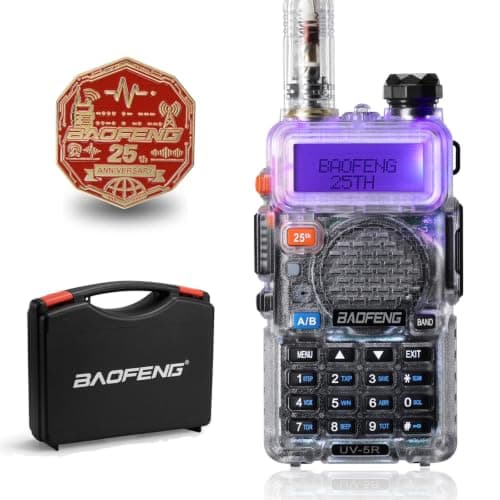
Best first radio after you pass the Technician exam
Baofeng UV-5R (25th Anniversary Edition)
The cheapest way to have a working 2 m / 70 cm handheld on exam day. Expect to read a menu and to program it with software.
$29.99Amazon#ad · Price as of November 6, 2026 · How we make money for the link to Baofeng UV-5R (25th Anniversary Edition)
Best budget ham handheld with real support
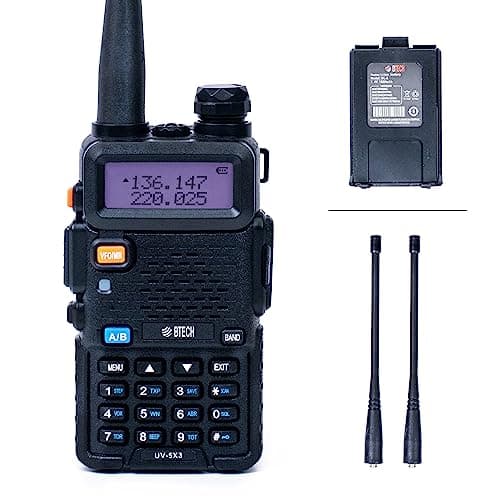
BTECH UV-5X3 Tri-Band (single radio)
A tri-band step up with better documentation and US support, while staying in the same price neighborhood.
$44.89Amazon#ad · Price as of November 6, 2026 · How we make money for the link to BTECH UV-5X3 Tri-Band (single radio)
Best way to actually try digital
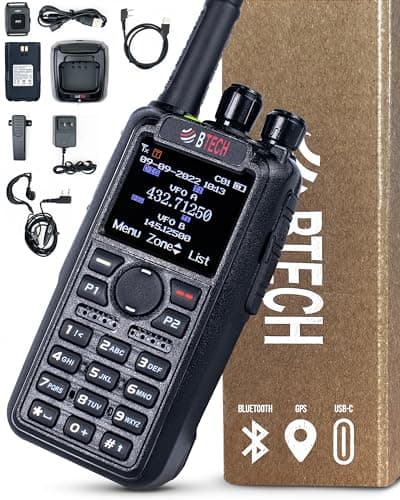
BTECH DMR-6X2 PRO (single radio)
For the new operator who already knows they want digital: DMR plus analog, at a serious price.
$249.89Amazon#ad · Price as of November 6, 2026 · How we make money for the link to BTECH DMR-6X2 PRO (single radio)
How we scored this
Every pick here is backed by the paperwork
Every pick is labeled Researched: we read each maker's published specs, manuals and range tables, check the license rules against the FCC, and score every radio on a public rubric out of 10. Every figure links to where it came from, and every range number is labeled “advertised” so you can see the difference between the box and the terrain.
Scores are our editorial judgment on that documented evidence. Commissions never set a score or decide a pick. The rubric and its weights are published.
What changed
- Published.
Questions
Frequently asked
How hard is the ham radio Technician exam?
How much does a ham radio license cost?
Can I use my ham radio on GMRS or FRS channels?
Does a ham license cover my family like GMRS does?
What can a Technician license actually do?
Receipts
Sources
- FCC: Amateur Radio Service (checked 2026-11-05)
- FCC: personal service and amateur application fees (checked 2026-11-05)
- ARRL: Getting Licensed (checked 2026-11-05)
- ARRL: find an amateur radio license exam session (checked 2026-11-05)
- ARRL: question pools (checked 2026-11-05)
- 47 CFR 97.301, amateur frequency allocations (via Cornell LII, checked 2026-11-05)
- 47 CFR 97.501, amateur operator license classes (via Cornell LII, checked 2026-11-05)
- 47 CFR 97.113, prohibited amateur transmissions (via Cornell LII, checked 2026-11-05)
- 47 CFR 95.1705, GMRS licensee and immediate family (via Cornell LII, checked 2026-11-05)
Specs and range figures come from each maker's own pages and manuals, linked on every product, and license, power and channel rules come from the FCC and 47 CFR Part 95. Range numbers are the maker's advertised claims and are labeled that way, so you can tell the box number from the terrain number. Prices come live from Amazon with the time we checked. Read the full method.