Not legal advice. This page summarizes FCC rules (47 CFR Part 95) from the official sources linked in the text. Rules and fees checked . The FCC sets its fees annually and can change its rules, so confirm the current version on fcc.gov before you rely on it.

Choosing a walkie talkie is easy once you stop comparing the wrong number. The headline on every box is an advertised range figure - 16 miles, 28 miles, 36 miles - and it is the least informative specification in the category, because the radios are all capped at the same transmit power by federal rule. What actually separates a good purchase from a bad one is the license it needs, the battery it runs on, and whether it is light enough that somebody keeps it clipped on.
Work through the five decisions below in order. By the end you will have narrowed the entire market to two or three radios.
1. Start with the license question
The practical rule: buy FRS if the radios will be handed to people outside your household - friends' children, a camp cabin, a work crew, event staff - because a GMRS license does not cover them. Buy GMRS if the radios stay in one family and you need distance, a better antenna or a repeater. Full comparison on GMRS vs FRS; the license-free shortlist is on radios that need no license.
2. Decide your real range need
Not the range you would like - the distance you actually need to cover, and what is between the two radios. UHF at these frequencies travels close to line of sight, so obstructions matter far more than watts.
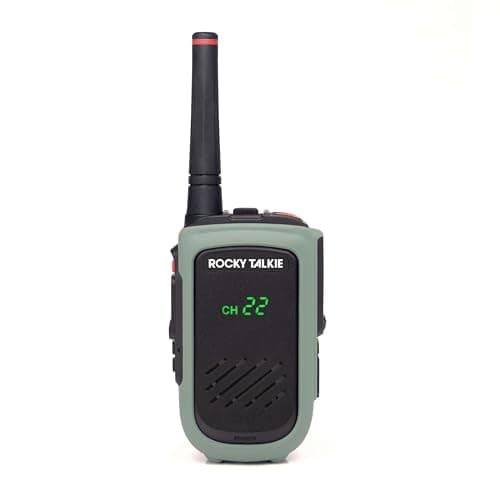
The FCC's own consumer guide puts FRS at "up to two miles on the 2 watt channels, depending on conditions" ( FCC personal radio services guide). Makers that publish honest figures agree: Midland says its GXT line "averages 1/2-2 miles in normal conditions" against a 36-mile box claim, Rocky Talkie publishes 1 to 5 miles in mountains and 0.5 to 3 in forest, and Motorola footnotes its 35-mile headline down to "up to 2 miles" in a neighborhood.
Map that against your situation:
- A house, a campsite, a park, a festival, a worksite: any FRS radio will do. Buy on battery and weight.
- A few hundred acres, or hilly ground: GMRS at 5 W with a removable antenna starts to earn its license.
- Several miles, or over ridges: you need a repeater or a vehicle-mounted radio, not a bigger handheld. See handheld vs mobile range.
If you want the mechanism rather than the conclusion, how far walkie talkies reach and how to increase walkie talkie range cover it.
3. Battery is the spec people regret
More complaints about walkie talkies come down to batteries than to anything else, and the fix is a decision rather than a product. There are three arrangements:
- A rechargeable pack plus an alkaline fallback. The best of the three for most buyers. The Midland X-Talkers and the Motorola T470 all take a pack or AA/AAA cells, so a dead radio is fixable anywhere that sells batteries. Motorola publishes up to 28 hours on three AA cells for the T470.
- A sealed or replaceable Li-ion only. Longer runtime and USB charging, but no roadside fix. Rocky Talkie rates its replaceable pack at 3 to 5 days, which makes this workable; a radio with a sealed pack and no spare does not.
- Alkaline only. Cheapest, and fine for occasional use, but budget two spare sets per radio.
Also look for a desktop charger if the radios live in one place. A dock is the only charging system that reliably survives a family or a crew, because it gives the radio a home.
4. Weight, water and a headset jack
Three smaller decisions that decide whether the radio gets used:
Weight. Under about five ounces for an adult, under four for a child. This single number predicts whether a radio is on a belt or in a drawer, and it is rarely in the headline specs.
Water rating. Read it literally. "Water resistant" with no number means nothing testable. JIS4 or IPX4 means splashing water. IP67 means submersible to 1 m for 30 minutes. Most family radios are splash-level at best, which is fine - just carry a zip bag. Note too that several makers say an accessory plugged into the jack voids the rating.
A headset jack. The cheapest upgrade in the category, and the one that makes a radio usable on a hunting stand, in a festival crowd, on a security post or anywhere a speaker would be rude. Check it exists: some budget radios, including the Midland X-Talker T10, have none. Connectors are not interchangeable - see earpieces and headsets.
Weather alerts are worth having if you are rural or outdoors a lot: NOAA Weather Radio broadcasts warnings continuously (NOAA Weather Radio), and a radio that interrupts for them is genuinely useful.
The three specs to ignore
- Advertised range. Produced under ideal conditions - mountain top to valley, or over open water - and legally constrained to the same power for every radio in the service. A 36-mile radio and a 16-mile radio perform about the same in your neighborhood.
- Channel count above 22. FRS and GMRS have 22 standard channels. Radios advertising 36, 50 or 99 are counting preset privacy-code combinations or user memories, not extra frequencies. What matters is that your radios share the 22 standard channels with everybody else's.
- "Privacy codes". They do not make anything private - they control what your radio unmutes for. Anyone on your channel with any compatible radio hears you. Useful for cutting out other people's traffic, useless for confidentiality. See privacy codes.
What to buy
Four radios that each answer one version of the question above. Any of them is a defensible first purchase; which one depends on the answers you just gave.
Our picks for this job
One radio per answer
FRS first unless you need the distance. All four publish the specs that matter - battery, weight, water rating and a headset jack - rather than only a mileage claim.
Best license-free Midland for hikes
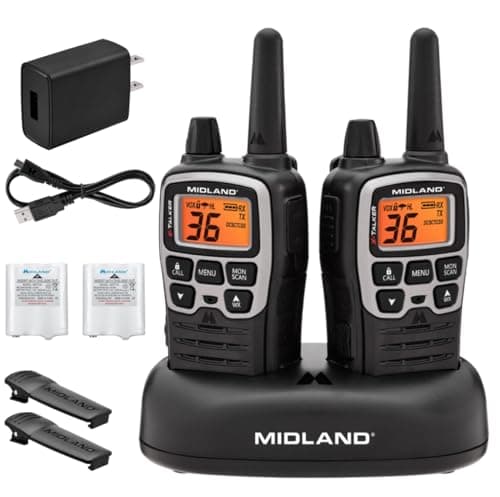
Midland X-Talker T71VP3 (2-pack)
No license. 36 channels, 121 codes, silent operation, eVOX, rechargeable packs plus a three-AA fallback, a desktop charger and a three-year warranty. The default family pick.
$89.99Amazon#ad · Price as of November 2, 2026 · How we make money for the link to Midland X-Talker T71VP3 (2-pack)
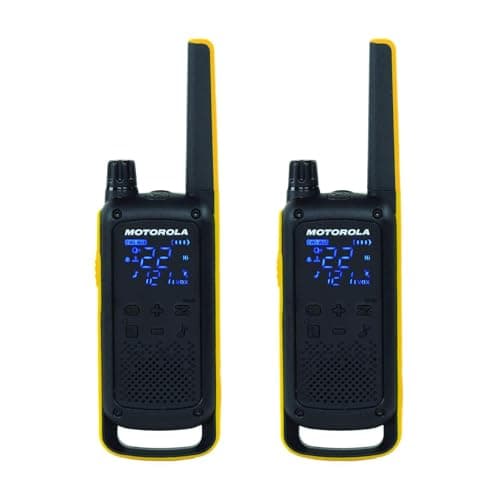
Best Motorola for storm kits
Motorola Talkabout T470 (2-pack)
No license. IPX4, up to 12 hours on the pack or 28 hours on three AA cells, NOAA alerts, a flashlight, VibraCall and a 2.5 mm headset jack. The best battery story here.
$89.99Amazon#ad · Price as of November 2, 2026 · How we make money for the link to Motorola Talkabout T470 (2-pack)
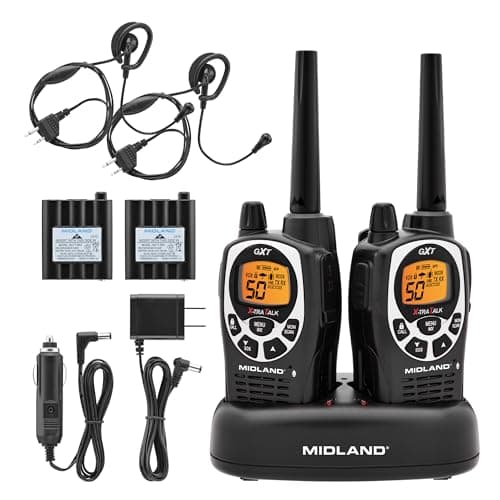
Best simple GMRS pair for families
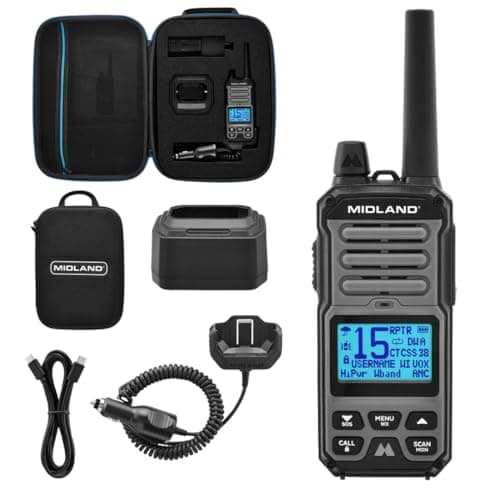
Midland GXT1000VP4 (2-pack)
Needs a GMRS license. High/medium/low power, 142 privacy codes, NOAA weather alerts, whisper mode, and AA fallback. Midland's own typical figure is half a mile to two miles.
$89.99Amazon#ad · Price as of November 2, 2026 · How we make money for the link to Midland GXT1000VP4 (2-pack)
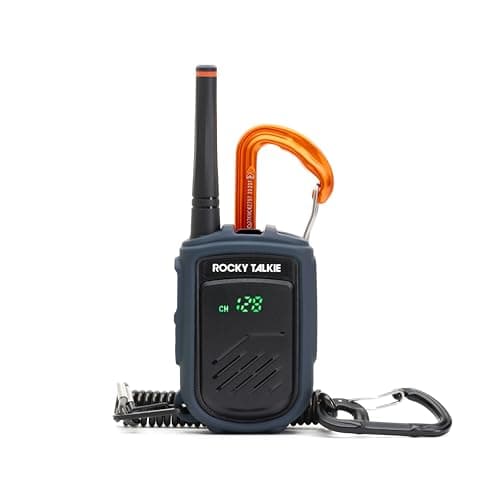
Best for climbers and ski tourers
Rocky Talkie Mountain Radio (single radio)
No license. IP56, shatterproof screen, replaceable Li-ion rated 3 to 5 days, channel lock, climbing carabiner, K1 headset jack - and published terrain range figures instead of a box number.
$120.00Amazon#ad · Price as of November 2, 2026 · How we make money for the link to Rocky Talkie Mountain Radio (single radio)
Fuller lists by situation: best walkie talkies overall, for families, under $50, and GMRS handhelds if you went that way.
What each price tier buys
We never print live prices - every buy link shows the current price on Amazon - but the tiers behave predictably, and knowing the pattern stops you overpaying for a feature you do not need.
- Budget. 22 channels, alkaline cells, no water rating, often no headset jack. Fine for a back garden, a park or a one-off event. This is also where toy radios live, and where published specifications get thin.
- Mid-price. The sweet spot for most buyers: rechargeable packs plus alkaline fallback, a desktop charger, NOAA weather alerts, silent operation or vibrate, a headset jack, and a stated splash rating. Every radio in the picks above sits here or just above.
- Premium. What you pay for is durability and honesty: a real IP67 rating, a battery measured in days, a replaceable pack, a published terrain range figure, a multi-year warranty. Not more range - the power cap is the same.
- High-end. GPS, texting between radios, or a 50 W vehicle radio. A different product, bought for a specific job rather than as a better walkie talkie.
Are walkie talkies worth it?
Worth it when the thing you need is instant, one-to-many communication that needs no network: a campsite, a festival, a worksite, a convoy, a hunting party, a property, a power cut. A radio does that better than a phone can, and keeps doing it when the cell site is congested or absent.
Not worth it as a phone substitute. They are not private, they do not reach 911, they do not know where anyone is, and over any real distance they stop working. If you want the full argument against the obvious alternative, that is walkie talkies vs phone apps, and talking without cell service covers the off-grid case honestly.
The buying checklist
- License: FRS if radios leave the household, GMRS if they stay in the family and you need distance.
- Range: plan for half a mile to two miles on FRS, more only with GMRS, a better antenna or a repeater.
- Battery: a rechargeable pack and an AA or AAA fallback, ideally with a desktop charger.
- Weight: under five ounces for an adult, under four for a child.
- Water: a stated rating - IPX4 or JIS4 for splash, IP67 for submersion. Treat "water resistant" with no number as none.
- Headset jack: confirm it exists, and buy the earpiece your radio's maker lists.
- Pack size: one radio per person who might walk away, from one maker so chargers and cells interchange.
- Ignore: the mileage claim, the channel count above 22, and the word "privacy".
How we scored this
Every pick here is backed by the paperwork
Every pick is labeled Researched: we read each maker's published specs, manuals and range tables, check the license rules against the FCC, and score every radio on a public rubric out of 10. Every figure links to where it came from, and every range number is labeled “advertised” so you can see the difference between the box and the terrain.
Scores are our editorial judgment on that documented evidence. Commissions never set a score or decide a pick. The rubric and its weights are published.
What changed
- Published.
Questions
Frequently asked
What should I look for when buying walkie talkies?
How many miles do walkie talkies really reach?
Is it worth paying more for a walkie talkie?
Do I need a license for walkie talkies?
Does a higher channel count mean a better radio?
Receipts
Sources
- FCC: Family Radio Service (FRS) page (checked 2026-10-11)
- FCC: General Mobile Radio Service (GMRS) page (checked 2026-10-11)
- FCC: Personal Radio Services consumer guide (checked 2026-10-11)
- 47 CFR 95.531, FRS channel power limits (via Cornell LII, checked 2026-10-11)
- 47 CFR 95.1705, GMRS eligibility (via Cornell LII, checked 2026-10-11)
- 47 CFR 95.1767, GMRS transmitting power limits (via Cornell LII, checked 2026-10-11)
- Midland: X-Talker T71VP3 product page (checked 2026-10-11)
- Midland: GXT1000VP4 product page and range FAQ (checked 2026-10-11)
- Motorola: Talkabout T470 series product page (checked 2026-10-11)
- Rocky Talkie: Mountain Radio product page (checked 2026-10-11)
- NOAA / NWS: NOAA Weather Radio All Hazards (checked 2026-10-11)
Specs and range figures come from each maker's own pages and manuals, linked on every product, and license, power and channel rules come from the FCC and 47 CFR Part 95. Range numbers are the maker's advertised claims and are labeled that way, so you can tell the box number from the terrain number. Prices come live from Amazon with the time we checked. Read the full method.