Not legal advice. This page summarizes FCC rules (47 CFR Part 95) from the official sources linked in the text. Rules and fees checked . The FCC sets its fees annually and can change its rules, so confirm the current version on fcc.gov before you rely on it.
The contenders
Side by side
 Stock photo
Best no-license radio between cars
Motorola Talkabout T802 (2-pack)
License-free FRS with USB-C charging and NOAA alerts. Its TALKABOUT phone app sends texts and locations to other T800 radios over the radio itself, so it works with no cell service. Motorola's neighborhood figure is up to 2 miles.
Check price · Amazon#ad · Price set by Amazon · How we make money for the link to Motorola Talkabout T802 (2-pack)
 Stock photo
Best for app-style texting with no bars
BTECH GMRS-PRO (single radio)
Rated at 5 W with repeater support and IP67. BTECH says it sends short texts and GPS coordinates to other GMRS-PRO radios with no cellular service required. Sold singly; needs a GMRS license.
Check price · Amazon#ad · Price set by Amazon · How we make money for the link to BTECH GMRS-PRO (single radio)
 Stock photo
Best for the lead car
Midland MXT275 MicroMobile (15 W)
15 W from a 12V plug, a magnet roof antenna in the box and every control on the mic: the fix when the lead car keeps losing the others where no app can help. Needs a GMRS license.
Check price · Amazon#ad · Price set by Amazon · How we make money for the link to Midland MXT275 MicroMobile (15 W)
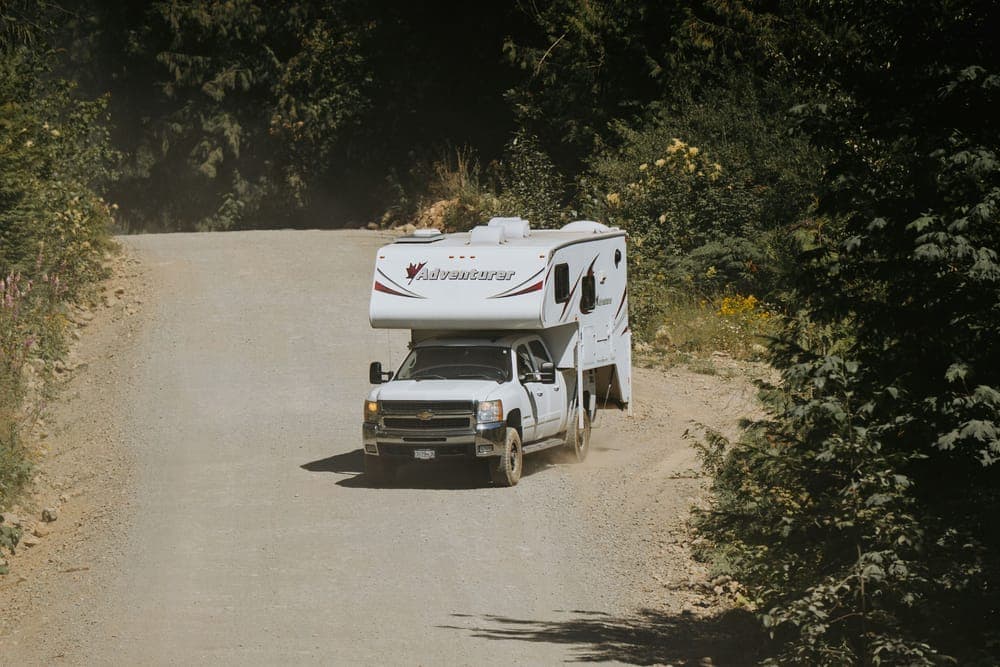
The plan sounds easy: everybody downloads a walkie-talkie app, and the three cars stay in touch all the way to the lake. It works fine on the interstate. Then the road climbs into a pass or drops into a canyon, the second car loses its bars, and the app goes quiet right when someone needs to say "we missed the turn." Here's how radios and apps compare in a moving car. If your question is whether radios work at all without service, start with our guide to walkie-talkies without cell service.
Radios vs apps at a glance
| On the road | Walkie-talkies (FRS and GMRS) | Walkie-talkie apps (Zello, Voxer) |
|---|---|---|
| Needs cell service or Wi-Fi? | No. Radio to radio, no towers. | Yes, on both phones. Zello says it "will not work" without Wi-Fi or cellular. |
| How far it reaches | Terrain decides. The FCC expects up to two miles for FRS on its 2 W channels, and one to twenty-five miles for GMRS. | Any distance, as long as both phones have data |
| Passes, desert, park roads | Works if the other car is within radio range | Drops out when either phone loses data |
| Cost model | Buy the radios once, no service plan. GMRS adds the FCC license fee. | Runs on phones and data plans you already have |
| License | FRS: none. GMRS: an FCC license that covers immediate family. | None |
| Battery | The radio's own battery, or car power for a mobile radio | Shares the phone battery you also need for maps and calls |
| Who's in the group | Everyone on the same channel and privacy code, with no sign-up | Everyone who installs the same app and joins the same group |
| Privacy | Anyone tuned to your channel can hear you | Travels over the internet through the app's service; its privacy policy applies |
| Missed a call? | It's gone unless someone repeats it | Voxer records messages so you can play them back |
How each one moves your voice
A walkie-talkie turns your voice into a radio signal and sends it straight to every radio on the same channel. There's no tower, no carrier and no account in the middle. That's why a dead zone for your phone is just another stretch of road to a radio. What limits a radio is distance and terrain, and our explainer on how walkie-talkies work covers why.
An app works the other way around. Press the button and your voice leaves your phone, crosses the internet and comes back down to the other phone. Zello's help center is blunt about it: "To use Zello, your device must have an adequate WiFi or cellular connection," and "If your device is not connected to the internet via WiFi or cellular connection, Zello will not work" ( Zello: connection requirements). Voxer says it "works over any cellular data network (2G, 3G, 4G, EDGE, LTE) and over WiFi" (Voxer FAQ). So an app has two weak links, your connection and the other car's, and distance doesn't matter to it at all.
If you were counting on the Apple Watch, note two things. Apple says both people need to "be able to make and receive FaceTime audio calls," and that away from the iPhone the watch uses "a cellular or Wi-Fi connection." And it's going away: "With watchOS 27, Walkie-Talkie has been discontinued" ( Apple Support, published September 17, 2026). I wouldn't build a trip plan around it.
Where apps drop out on a road trip
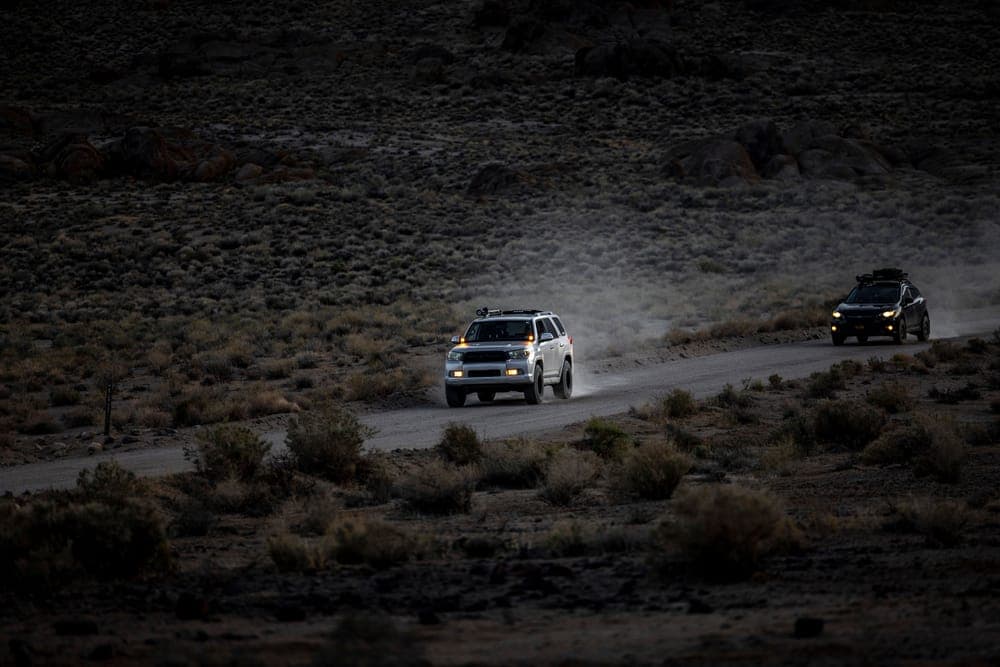
Road trips go right where coverage thins out: mountain passes, long desert two-lanes, canyon roads and big parks. Death Valley is the extreme case. The National Park Service says "Cell phones do not work in most areas of Death Valley National Park" and "There is no cell phone service along most park roads" (NPS: Death Valley directions). On a road like that, an app can't carry a word between two cars a quarter-mile apart. A pair of license-free radios can.
Coverage edges are the sneaky part. The lead car can hold one bar while the car behind it, a mile back and down in a dip, has none, and the app only works when both phones are connected.
Bad days make it worse. Ready.gov warns that "Mobile networks can become overwhelmed during emergencies, making it hard to make and get phone calls" (Ready.gov: Get Tech Ready). A wildfire detour or a storm that sends everyone to their phones at once hits the app, because it rides the same network. A radio pair doesn't share that problem. Before you leave, check your carrier's coverage map for the route and assume the gaps are real.
Where apps honestly win
Apps aren't a bad idea. They're the right tool for a different job, and on some trips they beat any radio you can buy:
- The cars start far apart. One family leaves from Denver, the other from Dallas, and you meet at the campground. No walkie-talkie covers that. An app does, as long as both phones have data.
- Someone splits off for hours. One car drives 30 miles into town for groceries while the other sets up camp. Radios lose each other long before that. An app doesn't care.
- Someone at home wants updates. Grandma back home can join an app group. She can't hear your radio from three states away.
- You want a record. Voxer says "everything is also simultaneously recorded so you and the recipient(s) can play back any message later" (Voxer FAQ). A radio call you missed is simply gone.
- There's nothing to buy. Everybody already carries a phone, and no license is involved.
On an interstate with steady coverage the whole way, an app does the job. A radio there is insurance in case the route surprises you.
Range: box numbers vs what the FCC expects
Radio boxes print big numbers, and they're the maker's advertised best case. Motorola advertises the Talkabout T802 at "up to 35 miles," then footnotes it: "Mountain to valley - up to 35 miles, open water - up to 6 miles, neighborhood - up to 2 miles" ( Motorola T800 page). Midland's advertised chart for its MXT275 mobile reads "50 Miles MAX" with no obstruction, "10-15 Miles IDEAL" with partial obstruction and "5-10 Miles OBSTRUCTED" ( MXT275 spec sheet).
The FCC's own expectations are the better planning numbers. For license-free FRS radios it says "generally less than one-half mile on the 0.5 watt channels and up to two miles on the 2 watt channels, depending on conditions" ( FCC consumer guide). For GMRS, "one to twenty-five miles depending on station class, terrain, and repeater use" (FCC GMRS page).
On a road trip, terrain and height beat wattage: a hill or a deep road cut between the cars matters more than the watts on the box. Plan on handhelds keeping cars together within a mile or two. Past that, you want a mobile radio with its antenna on the roof, or a GMRS repeater near the highway. Our convoy radio guide covers spacing, so the tail car stays inside radio reach instead of drifting out of it.
License, cost and battery
An app needs no license at all, which is a real point in its favor for a group of friends. Radios split in two. FRS radios are license-free and good for cars that stay close. GMRS radios reach farther and need a GMRS license, and one license covers the whole family across every car. It doesn't cover friends; their car runs FRS radios or gets its own license. Mixed groups still work, because all 22 FRS channels are shared with GMRS (FCC FRS page).
On cost, the app rides the phone and data plan you already pay for. Radios are a one-time purchase with no monthly bill, plus the FCC fee for GMRS. On battery, the app shares the phone with your navigation and the call you might need to make, while a radio has its own battery. Either way, take Ready.gov's advice: "Keep a portable phone charger in your car at all times" ( Ready.gov).
Cellular radios and satellite texting: the in-betweens
Cellular push-to-talk radios look like walkie-talkies but work like apps. Motorola says of its TLK 110 that "push-to-talk (PTT) communications take place over an extended LTE network via WAVE PTX, so you communicate nationwide" (Motorola TLK 110 page). Nationwide means wherever there's LTE, so on a road trip it drops out in the same places your phone does. It's a business tool, not a fix for dead zones.
Satellite texting is the newer option. Apple says that "With iPhone 14 or later (all models), you can send iMessages or SMS messages via satellite when you're off the grid," in the United States, Canada, Mexico and Japan. The catches are in Apple's own words: "you need to be outside with a clear view of the sky and horizon," a message "might take 30 seconds to send" in ideal conditions, "over a minute" under light or medium foliage, and you might not connect at all "under heavy foliage or if you're surrounded by other obstructions" (Apple: Messages via satellite). That's fine for "we're stopped at the ranger station." It's useless for "left turn, now." Treat it as the link to the outside world, not the link between cars.
Can an app talk to a real walkie-talkie?
Not directly. Your phone has no FRS or GMRS transmitter, so an app by itself can't reach a walkie-talkie. There are two ways around that, and only one makes sense in a car.
Radios that pair with a phone app. Here the radio does the carrying and the phone is just the screen and keyboard. Motorola says that "Once connected via Bluetooth, The TALKABOUT app uses the T800 as a modem to send messages, locations and more over the radio frequencies to your fellow T800 users" (Motorola T800 page). BTECH says its GMRS-PRO can "Send short text messages and share GPS coordinates with other GMRS-PRO users, no cellular service required" (BTECH GMRS-PRO page). That's the app experience without the towers, but messages only go to the same model, so every car needs matching radios. Our comparison of radios with GPS and texting weighs these against plain voice radios.
Bridging an app to a radio. Zello offers a Bridge that "connects traditional two-way radios with Zello's powerful push-to-talk (PTT) solution." It runs through a gateway: USB gateways need "direct USB connection to a PC," and radio-over-IP gateways deliver audio "via an internet connection" ( Zello: Using Zello Bridge). That's a home-base project, not something you set up in a minivan. If you're tempted to do it on GMRS, read the rules first: the FCC says GMRS repeaters "may not be linked via the internet" ( FCC GMRS page), and 47 CFR 95.1733 lists "Messages which are both conveyed by a wireline control link and transmitted by a GMRS station" among prohibited uses (47 CFR 95.1733).
Three radios that beat an app between cars
Motorola Talkabout T802 (2-pack): the no-license answer. This is the closest thing to a walkie-talkie app that works with no service. It's FRS, charges over USB-C and has NOAA alerts, and with the TALKABOUT app the cars can swap texts and locations over the radio. The antenna is built in, as on every FRS radio, and Motorola's neighborhood figure is up to 2 miles. Buy it for a mix of family and friends. Skip it if the route crosses mountains where the cars will spread out.
BTECH GMRS-PRO: app-style texting with more reach. BTECH rates it at 1, 3 or 5 W, with repeater support, IP67 and USB-C charging, and it sends short texts and GPS coordinates to other GMRS-PRO radios with no cell service. It's sold singly, so buy one per car, and it needs a GMRS license. BTECH's page also says "The antenna is not removable," so there's no path to a roof antenna (BTECH). Skip it if the other cars already carry other brands and you want to text them.
Midland MXT275 MicroMobile: the fix for the lead car. When the lead car keeps losing the others, a mobile with its antenna on the roof is the upgrade. The MXT275 is a 15 W GMRS mobile that plugs into a 12V socket, includes a magnetic roof antenna and puts every control on the mic (Midland MXT275 page). Per Midland's manual, "channels 1 through 7 cannot be removed from the Low transmit power setting," so run your group on 15 to 22 (MXT275 manual). It needs a GMRS license, and Midland states no water rating, so keep it inside a closed car.
Want the full ranking, including GMRS handheld pairs that charge from car power? See our best walkie-talkies for road trips. For bigger in-car radios, our best GMRS mobile radios ranks the options.
Who should use which (and the use-both setup)
- Two or three cars on one route through mountains, desert or parks: radios. It's the job apps are worst at.
- Friends' cars, nobody wants a license: FRS radios like the T802.
- A family whose cars end up a mile or more apart: GMRS on one family license, plus a mobile in the lead car for long empty stretches.
- Cars starting from different cities: an app and ordinary phone calls. No radio covers that.
- A convoy of four or more on forest roads: radios, with roles, standard calls and spacing from the convoy radio guide. If someone brings a CB, GMRS vs CB radio explains why it won't hear your radios.
For most trips, the best answer is both. Here's the setup I'd use:
- One radio channel for car to car. Pick one from 15 to 22 and set the same privacy code on every radio, or none on all of them. Test in the driveway before the first merge.
- One app group as the long-distance backup, for when a car falls out of radio range while everyone still has data, and for the person back home.
- A fallback rule. If the radio goes quiet, try the app. If both are quiet, drive to the next planned stop and wait there. Write the stops down before you leave.
- Power for both. Phones on car chargers, radios topped up over USB-C at every stop.
More road-trip guides, from mobile installs to overlanding setups, are on the road trips hub.
Using either one while driving
An app lives on a phone, and phone laws are strict. The Governors Highway Safety Association's state-law page (updated October 2025) says 33 states, D.C. and several territories "prohibit all drivers from using handheld cellphones while driving," and that 49 states, D.C. and several territories "ban text messaging for all drivers" ( GHSA: distracted driving laws). That page doesn't address two-way radios either way, so I won't tell you a radio is fine where a phone isn't. Check the law in your state and the states on your route.
The simple fix works for both: the passenger runs the radio or the app, and a solo driver pulls over to talk.
In detail
The contenders, in full
Stock photoBest no-license radio between cars
Motorola Talkabout T802 (2-pack)
License-free FRS with USB-C charging and NOAA alerts. Its TALKABOUT phone app sends texts and locations to other T800 radios over the radio itself, so it works with no cell service. Motorola's neighborhood figure is up to 2 miles.
Published specsResearched · not tested by us
How the 6.1 score breaks down
- Real-world reach (30%)
- 4
- Ease of use (20%)
- 8
- Toughness & weather (15%)
- 5
- Power & battery (15%)
- 6
- Field features (10%)
- 9
- Value (10%)
- 7
What the specs support
- Off-grid texting and location sharing between T800 radios through the phone app, with no license and no cell service
- NOAA alerts, emergency button, flashlight and hands-free VOX in one radio
- USB-C charging
Where it falls short
- Motorola doesn't publish the transmit power, and the antenna is fixed like every FRS radio
- Motorola lists the weather rating as IP54 in one place and IPX4 in another; treat it as splash-resistant only
- The messaging and location features only work with other T800-series radios running the app
Skip this if…
…Skip it if you need to reach someone over a ridge or across miles of timber: app features don't add range, and a GMRS radio with more power will reach farther.
#ad · Price set by Amazon · How we make money for the link to Motorola Talkabout T802 (2-pack)
Stock photoBest for app-style texting with no bars
BTECH GMRS-PRO (single radio)
Rated at 5 W with repeater support and IP67. BTECH says it sends short texts and GPS coordinates to other GMRS-PRO radios with no cellular service required. Sold singly; needs a GMRS license.
Published specsResearched · not tested by us
How the 7.3 score breaks down
- Real-world reach (30%)
- 7
- Ease of use (20%)
- 6
- Toughness & weather (15%)
- 9
- Power & battery (15%)
- 7
- Field features (10%)
- 9
- Value (10%)
- 7
What the specs support
- Off-grid texting and GPS location sharing between GMRS-PRO radios
- IP67 submersible build with USB-C charging
- Phone-app programming, no cable or CHIRP needed
- Rated at 5 W with repeater support
Where it falls short
- Texting and location sharing only work with other GMRS-PRO units
- Fixed antenna: BTECH says "the antenna is not removable," so no upgrade to a longer whip or roof antenna
- BTECH doesn't state a battery runtime
- Sold as a single radio
Skip this if…
…Skip it if your group already carries Midland or Cobra radios and you want to text them: messages and GPS positions only go to other GMRS-PRO units.
#ad · Price set by Amazon · How we make money for the link to BTECH GMRS-PRO (single radio)
Stock photoBest for the lead car
Midland MXT275 MicroMobile (15 W)
15 W from a 12V plug, a magnet roof antenna in the box and every control on the mic: the fix when the lead car keeps losing the others where no app can help. Needs a GMRS license.
Published specsResearched · not tested by us
How the 6.9 score breaks down
- Real-world reach (30%)
- 8
- Ease of use (20%)
- 7
- Toughness & weather (15%)
- 4
- Power & battery (15%)
- 8
- Field features (10%)
- 6
- Value (10%)
- 7
What the specs support
- Plugs into a 12V socket, with no hardwiring needed
- Hideaway body and control mic keep the dash clear
- Repeater capable, and the SO-239 jack takes an upgraded antenna
Where it falls short
- Midland states no IP or water rating
- No PA or intercom jack listed, unlike the MXT115P PRO
- Channels 1-7 stay on low power (manual)
Skip this if…
…Skip it if the radio goes in an open-cab tractor or UTV that sees rain and dust: Midland states no water rating for the MXT275, while the MXT115P PRO at the same 15 W is IP67.
#ad · Price set by Amazon · How we make money for the link to Midland MXT275 MicroMobile (15 W)
How we scored this
Radios we claim to have lab-tested: 0
Plenty of radio sites say they range-tested everything they list. We haven't, and we say so. Every pick here is labeled Researched: we read each maker's published specs, manuals and range tables, check the license rules against the FCC, and score every radio on a public rubric. Every figure links to where it came from, and every range number is labeled “advertised.”
Scores are editorial judgments from that documented research, not test results. Commissions never set a score or decide a pick. The rubric and its weights are published.
What changed
- Published.
Questions
Frequently asked
Is there a walkie talkie app that works with real walkie talkies?
Do walkie-talkie apps work without cell service?
Is a walkie-talkie app good enough for a road trip?
Does the Apple Watch Walkie-Talkie work without cell service?
How far do walkie-talkies reach between cars?
Do I need a license to use walkie-talkies on a road trip?
Receipts
Sources
- Zello Support: Connection requirements (checked 2026-09-22)
- Zello Support: Using Zello Bridge (checked 2026-09-22)
- Voxer: FAQ (checked 2026-09-22)
- Apple Support: Use Walkie-Talkie on your Apple Watch (published 2026-09-17; checked 2026-09-22)
- Apple Support: About Messages via satellite (checked 2026-09-22)
- Motorola Solutions: WAVE PTX TLK 110 product page (checked 2026-09-22)
- Motorola Solutions: TALKABOUT T800 series product page (checked 2026-09-22)
- BTECH: GMRS-PRO product page (checked 2026-09-22)
- Midland: MXT275 product page (checked 2026-09-22)
- Midland: MXT275 spec sheet PDF (checked 2026-09-22)
- Midland: MXT275 owner's manual PDF (checked 2026-09-22)
- National Park Service: Death Valley directions and cell service (checked 2026-09-22)
- Ready.gov: Get Tech Ready (checked 2026-09-22)
- FCC: Family Radio Service (FRS) page (checked 2026-09-22)
- FCC: General Mobile Radio Service (GMRS) page (checked 2026-09-22)
- FCC consumer guide: Personal Radio Services (checked 2026-09-22)
- FCC: Personal service and amateur application fees (checked 2026-09-22)
- 47 CFR 95.1733, prohibited GMRS uses, via Cornell LII (checked 2026-09-22)
- GHSA: Distracted driving state laws (updated October 2025; checked 2026-09-22)
We haven't tested the radios on this page and we don't pretend to. Specs and range figures come from each maker's own pages and manuals (linked on every product), and license, power and channel rules come from the FCC and 47 CFR Part 95. Range numbers are the maker's advertised claims and are labeled that way. Prices are set by Amazon and change often, so we don't print them. Where a figure isn't published, we say so. Read the full method.