Not legal advice. This page summarizes FCC rules (47 CFR Part 95) from the official sources linked in the text. Rules and fees checked . The FCC sets its fees annually and can change its rules, so confirm the current version on fcc.gov before you rely on it.
Top pick
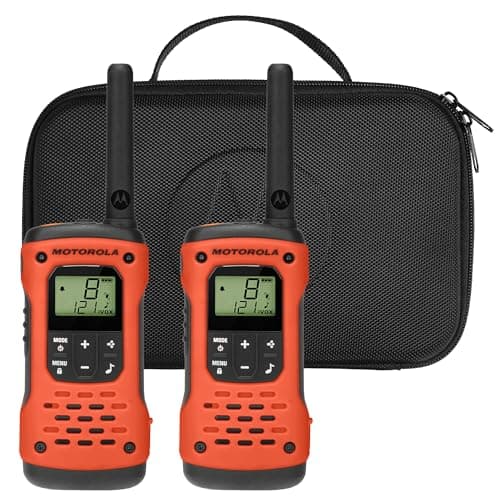
Best straight swap: license-free, no fees
Motorola Talkabout T605 H2O (2-pack)
Two radios in the box, no license, no SIM and no renewal date. IP67, floats face up, and runs on three AA cells when the pack dies.
#ad · Price as of November 19, 2026 · How we make money for the link to Motorola Talkabout T605 H2O (2-pack)
Quick picks
The picks at a glance
| # | Product | Best for | Score | Price |
|---|---|---|---|---|
| 1 | Motorola Talkabout T605 H2O (2-pack) Two radios in the box, no license, no SIM and no renewal date. IP67, floats face up, and runs on three AA cells when the pack dies. | Best straight swap: license-free, no feesNo licenseMid-price | 9.2/10Researched | $89.73Amazon #ad · Disclosure |
| 2 | 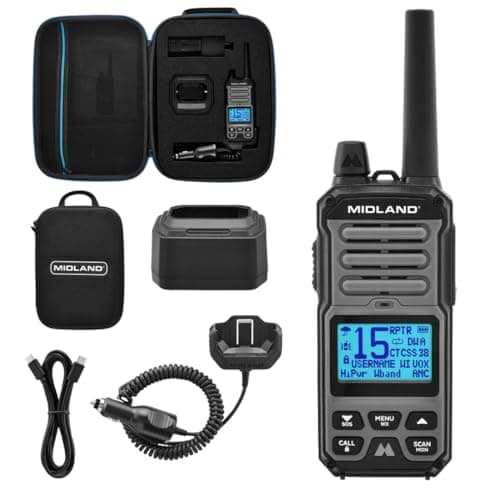 Midland GXT67 PRO (single radio) IP67, a stated 5 W and eight repeater channels, so it works where no carrier does. Needs a GMRS license, and it is sold one radio at a time. | Best if you wanted reach without a networkGMRS licensePremium | 9.3/10Researched | $219.99Amazon #ad · Disclosure |
| 3 | 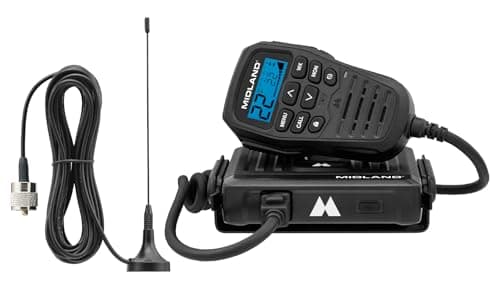 Midland MXT275 MicroMobile (15 W) A 15 W vehicle radio on a roof antenna covers a property or a convoy in a way no handheld or handset does. No water rating, and channels 1-7 stay on low power. | Best if coverage was the whole pointGMRS licensePremium | 9.2/10Researched | $199.99Amazon #ad · Disclosure |
| 4 | 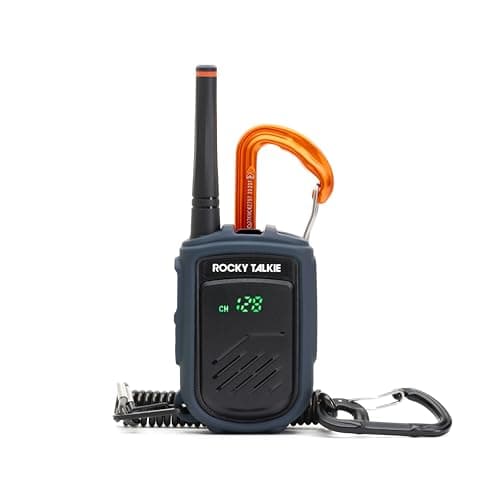 Rocky Talkie Mountain Radio (single radio) Switch it on and talk: license-free, a channel lock, a climbing-rated carabiner and a replaceable battery rated for days. Sold singly, and IP56 rather than submersible. | Best for the no-setup experienceNo licenseMid-price | 9.1/10Researched | $120.00Amazon #ad · Disclosure |
| 5 | 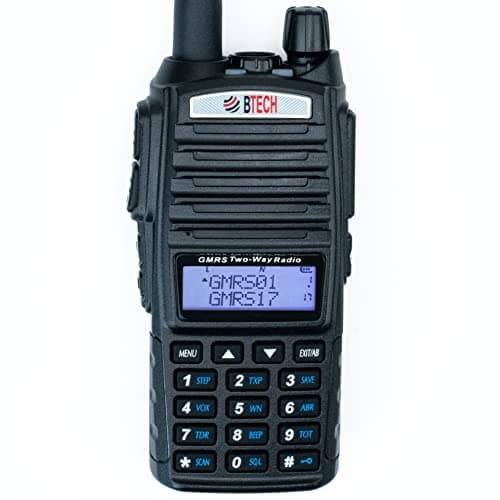 BTECH GMRS-V2 (single radio) A stated 5 W, repeater support and a removable antenna for a fraction of an LTE handset. It is a menu radio, and IP54 only. | Budget pick: cheapest route off a subscriptionGMRS licenseBudget | 9.1/10Researched | Check price · Amazon #ad · Disclosure |
#ad · Prices come live from Amazon, last checked November 19, 2026. Scores are ours, built from published specs, manuals and FCC rules. Photos come from each product's Amazon listing; a radio we can't show a real photo of is left blank rather than illustrated. Tap a row for the full write-up.
Rapid Radios sells something genuinely different from the radios on the rest of this site, and it is worth being precise about what it is before replacing it. Its handsets are push-to-talk devices that ride cellular data networks, not Part 95 radios. Each one ships with what the company calls a "proprietary multi-carrier IoT SIM card pre-installed, fully activated", so it hops to whichever carrier is strongest rather than being tied to one. Because it is cellular, Rapid Radios states plainly that "No FCC license is required", and inside coverage the distance between two handsets does not matter (Rapid Radios FAQ). That is a real product with a real use case.
The terms, in the company's own words as of 2026-11-09: no monthly fees, with the first year of service included in the purchase, after which "renewing your SIM service is just $50 annually per radio", or $40 per radio on auto-pay. Returns run 30 days and the warranty is 12 months. The current RAD1 listing describes an IPX6 body with "5+ Day Battery Life" of standby, a Wi-Fi backup mode, and prices well into the hundreds per radio before the multi-packs (RAD1 product page, catalog, both read 2026-11-09).
So the honest framing is not "this is bad". It is: you are buying a cellular subscription device at a radio price. Whether that is the right trade depends entirely on which of its promises you were actually buying, which is how this page is organized. The underlying technology comparison lives on LTE walkie-talkies vs GMRS; this page is about what to put in the cart instead.
What Rapid Radios is known for
- Nationwide range inside coverage. The company describes "nationwide LTE coverage across the United States" and markets the G1 as a nationwide push-to-talk walkie-talkie with no monthly fees (rapidradios.com). Two handsets in different states talk as easily as two in the same yard.
- No license, no channels, no codes. Nothing to apply for and no channel plan to agree on, because there is no radio spectrum involved.
- Multi-carrier failover. One SIM, several networks, so a weak carrier is not automatically a dead handset.
- A phone-like battery story. Up to five days of standard use, with a removable battery.
Everything on that list is a real advantage over a two-way radio — as long as there is coverage at both ends. That condition is the whole hinge.
Why people look for an alternative
Three reasons come up, and they lead to three different purchases:
- The recurring cost. "No monthly fees" is accurate, and there is still an annual renewal per radio after year one. For a family of four handsets, that is a yearly line item forever. A GMRS license, by contrast, is $35 per the FCC's fee table (checked September 2026) and covers you and your immediate family for ten years (FCC fee table, 47 CFR 95.1705). FRS radios cost nothing at all to license (FCC: FRS).
- Coverage where they actually use radios. A hunting lease, a canyon, a ski area, a campground, the middle of a national forest. A cellular handset is exactly as good as the bars at both ends, which is why the company itself points buyers at a coverage map before they order.
- The outage case. People buy radios for the day the network has a bad day. A device that needs a carrier is in the same boat as the phone it is meant to back up — worked through on do walkie-talkies work if the grid goes down?
How we picked
- Zero recurring cost, or a ten-year one. Every pick is either license-free FRS or GMRS, where the only fee is the FCC application.
- Works with no network at all. Radio to radio, no tower, no SIM, no account.
- Matched to one of the three reasons above rather than ranked on a single spec, because "alternative" means different things to the family, the rancher and the skier.
- Currently purchasable. Each pick returned a live Amazon price on our 2026-11-09 price refresh, which is how availability was checked before featuring it. Our method is on how we rank.
The picks in detail
1. Motorola Talkabout T605 H2O — the closest straight swap
If you wanted "two radios, no paperwork, nothing to renew", this is it. It is FRS, so it is licensed by rule — no application, no fee, no call sign, and anyone may pick one up (FCC: Family Radio Service). Motorola rates it IP67, says it floats face up with the included NiMH pack, and switches on a red and white flashlight when it hits water. It runs on the pack or three AA alkalines, which Motorola rates at up to 23 hours against 9 for the pack (T605 datasheet). It ships as a two-radio kit with a case, four batteries, two earpieces and chargers (T600 series page).
Good to know: Motorola does not publish the transmit power anywhere, so you are trusting an unstated figure inside the FRS ceiling of 2 W on the main channels (47 CFR 95.567). The advertised "up to 35 miles" is a mountain-to-valley number; Motorola's own footnote says up to 2 miles in a neighborhood. Headset use is specified for dry conditions only. And FRS is for personal communication, not running a business (47 CFR 95.531).
2. Midland GXT67 PRO — if what you wanted was reach without a network
The pick for the lease, the ridge and the rainstorm. Midland publishes IP67 waterproof and dustproof, a stated 5 W with high, medium and low settings, 8 GMRS repeater channels with split tones, NOAA weather alerts, VOX and a 2500 mAh pack that charges over USB-C PD, with a vehicle adapter in the box (GXT67 PRO page). Repeater access is the part that matters here: a repeater on high ground does for a handheld what a cell tower does for a phone, without anybody's subscription (GMRS repeaters).
Good to know: it needs a GMRS license, which covers you and your immediate family rather than a crew of friends. It is sold as a single radio, so a pair means buying two. Midland's own FAQ says the battery compartment is factory sealed and the antenna cannot be removed, and its battery-life figures conflict — 16 hours on the spec sheet against "up to 4 days" on the product page (GXT67 FAQs). The full spec sheet is in our Midland GXT67 PRO review.
3. Midland MXT275 MicroMobile — if coverage was the whole point
This is the answer almost nobody considers, and it is the one that changes the outcome. If what you really wanted was "I can reach anyone on the place from anywhere on the place", a 15 W vehicle radio on a roof antenna does that in a way no handheld and no handset does. Midland publishes 15 W with high and low settings, the 8 split-tone repeater channels, a 2.1 dB magnetic antenna and mount in the box, an SO-239 jack for a better antenna later, NOAA weather alerts, and a 12 V plug rather than a wiring job. Its own dated range figures are the honest kind: "50 Miles MAX" with no obstruction, 10-15 miles ideal with partial obstruction, 5-10 miles obstructed.
Good to know: Midland states no water rating for the MXT275, so an open-cab UTV or tractor is the wrong home for it. Channels 1-7 are locked to low power by the manual. And it is a vehicle radio: it does not walk out into the field with you, which is why most people end up with a mobile and a handheld. The whole pattern is laid out in how to cover your property with radios and handheld vs mobile range.
4. Rocky Talkie Mountain Radio — for the no-setup experience
Part of what people like about an LTE handset is that there is nothing to learn. This is the radio that gets closest to that. It is FRS at 2 W, so no license and no fee; Rocky Talkie publishes IP56 (splashproof and snowproof, explicitly not submersible), a shatterproof screen, a climbing-rated Trango Quantum carabiner with a metal-reinforced back-up leash, a replaceable 1550 mAh pack on USB-C rated at 3-5 days, 6.1 oz, and a channel lock so a knock cannot move the group off channel (Mountain Radio page, read 2026-11-09). It is also the only maker here that publishes range by terrain rather than one box number: 35+ miles line of sight, 1 to 5 miles in mountains, 0.5 to 3 in forest and hills, up to 1 mile in a city.
Good to know: it is sold one radio at a time, so a pair is a premium purchase. IP56 is not submersion. There is no NOAA weather channel and no VOX. If you like the idea but not the price, our Rocky Talkie alternatives page ranks the cheaper ways to get most of it.
5. BTECH GMRS-V2 — the budget pick
The cheapest honest way off a subscription, and the budget pick of the five. BTECH publishes 0.5 W / 5 W selectable, repeater compatibility, an SMA-female antenna connector, a Kenwood K1 two-pin accessory jack, USB-C alongside a desktop charger, and up to 18 hours of normal use (GMRS-V2 page). BTECH is also one of the few makers that states what you should expect: 1 to 5+ miles simplex, 15 to 50+ miles through a repeater.
Good to know: it is a keypad-and-menu radio with 200 programmable memories, which is the opposite of the plug-and-play experience you may be leaving. IP54 is splash resistance only. It needs the GMRS license, and it is a single radio. If price is the driver, the whole band is ranked on best GMRS radios under $100.
The published specs side by side
When to keep the LTE radio instead
Three situations where none of the picks above is an upgrade, and we would rather say so than sell you one:
- Your two ends are far apart and both have coverage. Grandparents in another state, a driver on a long haul, two job sites across a metro area. Radio physics does not do this; a network does.
- You need it to work with zero teaching. If the people holding the other handset will never learn a channel and a privacy code, a device with no channels at all has a genuine advantage. The nearest radio equivalents are the Rocky Talkie and the T605 above.
- You are coordinating a crew that is not family. A GMRS license covers the holder and their immediate family, not coworkers, so a crew either buys FRS or needs its own licenses. An LTE handset has no such constraint, and neither does license-free FRS.
The running-cost question, done honestly
This is the comparison people come looking for, so here it is without a spreadsheet. On the radio side, the recurring cost is either nothing (FRS: the T605 and the Rocky Talkie) or one $35 FCC application every ten years for a whole household (GMRS: the GXT67 PRO, the MXT275 and the GMRS-V2). On the LTE side, the published renewal is $50 per radio per year, or $40 on auto-pay, after the included first year.
Multiply by the number of handsets and by the number of years you expect to keep them, and the gap is obvious enough that nobody needs our arithmetic. The point is not that one is cheap and the other expensive — it is that you are renting coverage, and a radio is a thing you own. If you will use the coverage, rent it. If you are buying radios for the lease, the lake and the storm, buy the thing you own. Live prices for each pick come from our dated Amazon feed, which is also how we check a pick is still purchasable.
Three traps when you switch
- Expecting a 5 W handheld to behave like a tower. It will not. Height and a repeater are what buy distance, not watts — watts explained has the honest numbers, and range claims explained covers the mile figures on the box.
- Buying licensed radios for an unlicensed group. Check who will actually hold the radios before you buy GMRS. If it is a crew, buy FRS from best walkie-talkies without a license.
- Replacing one device with one radio. A radio needs a radio on the other end. Budget for the pair, which is why the two-radio kits on this page look better value than their sticker suggests.
If the real requirement is "talk where there is no cell service at all", that case has its own page: walkie-talkies that work without cell service.
In detail
The picks, in full
Rank 01
Best straight swap: license-free, no fees
Motorola Talkabout T605 H2O (2-pack)
Two radios in the box, no license, no SIM and no renewal date. IP67, floats face up, and runs on three AA cells when the pack dies.
Published specsResearched · every figure sourced
How it scores on each criterion
- Real-world reach (30%)
- 8.4
- Ease of use (20%)
- 9.7
- Toughness & weather (15%)
- 9.8
- Power & battery (15%)
- 9.3
- Field features (10%)
- 9.7
- Value (10%)
- 9.7
Why we recommend it
- IP67 and it floats face up, with a flashlight that switches on when it hits the water
- Runs on the NiMH pack or three AA batteries, so a dead pack isn't the end of the day
- The T605 pack adds a case, spare batteries and earpieces
Good to know
Skip it if you need to talk between boats or trucks miles apart: IP67 keeps it alive in the lake, but a fixed-antenna FRS radio won't cover that distance.
#ad · Price as of November 19, 2026 · How we make money for the link to Motorola Talkabout T605 H2O (2-pack)
Rank 02
Best if you wanted reach without a network
Midland GXT67 PRO (single radio)
IP67, a stated 5 W and eight repeater channels, so it works where no carrier does. Needs a GMRS license, and it is sold one radio at a time.
Published specsResearched · every figure sourced
How it scores on each criterion
- Real-world reach (30%)
- 9.3
- Ease of use (20%)
- 9.3
- Toughness & weather (15%)
- 9.8
- Power & battery (15%)
- 9.3
- Field features (10%)
- 9.3
- Value (10%)
- 8.4
Why we recommend it
- IP67 waterproof and dustproof, where the GXT1000 and GXT3000 are splash-rated JIS4
- Rated at 5 W with 8 repeater channels and split tones
- USB-C (PD) and 12 V vehicle charging in the box
Good to know
Skip it if you want to carry a spare battery or fit a longer antenna for the far side of the property: the battery is sealed and the antenna doesn't come off.
#ad · Price as of November 19, 2026 · How we make money for the link to Midland GXT67 PRO (single radio)
Rank 03
Best if coverage was the whole point
Midland MXT275 MicroMobile (15 W)
A 15 W vehicle radio on a roof antenna covers a property or a convoy in a way no handheld or handset does. No water rating, and channels 1-7 stay on low power.
Published specsResearched · every figure sourced
How it scores on each criterion
- Real-world reach (30%)
- 9.7
- Ease of use (20%)
- 9.3
- Toughness & weather (15%)
- 8.4
- Power & battery (15%)
- 9.7
- Field features (10%)
- 8.9
- Value (10%)
- 9.3
Why we recommend it
- Plugs into a 12V socket, with no hardwiring needed
- Hideaway body and control mic keep the dash clear
- Repeater capable, and the SO-239 jack takes an upgraded antenna
Good to know
Skip it if the radio goes in an open-cab tractor or UTV that sees rain and dust: Midland states no water rating for the MXT275, while the MXT115P PRO at the same 15 W is IP67.
#ad · Price as of November 19, 2026 · How we make money for the link to Midland MXT275 MicroMobile (15 W)
Rank 04
Best for the no-setup experience
Rocky Talkie Mountain Radio (single radio)
Switch it on and talk: license-free, a channel lock, a climbing-rated carabiner and a replaceable battery rated for days. Sold singly, and IP56 rather than submersible.
Published specsResearched · every figure sourced
How it scores on each criterion
- Real-world reach (30%)
- 8.4
- Ease of use (20%)
- 9.8
- Toughness & weather (15%)
- 9.7
- Power & battery (15%)
- 9.7
- Field features (10%)
- 8.4
- Value (10%)
- 8.9
Why we recommend it
- Publishes honest terrain figures (1 to 5 miles in mountains), not just a box number
- IP56, shatterproof screen and a real climbing carabiner with a leash
- Replaceable Li-ion rated for 3 to 5 days, with USB-C
- Channel lock keeps a group from drifting off channel
Good to know
Skip it if you need to reach a partner several ridges away or hit a repeater: at 2 W FRS with a fixed antenna, the GMRS Expedition Radio is the Rocky Talkie for that.
#ad · Price as of November 19, 2026 · How we make money for the link to Rocky Talkie Mountain Radio (single radio)
Rank 05
Budget pick: cheapest route off a subscription
BTECH GMRS-V2 (single radio)
A stated 5 W, repeater support and a removable antenna for a fraction of an LTE handset. It is a menu radio, and IP54 only.
Published specsResearched · every figure sourced
How it scores on each criterion
- Real-world reach (30%)
- 9.3
- Ease of use (20%)
- 8.9
- Toughness & weather (15%)
- 8.4
- Power & battery (15%)
- 9.3
- Field features (10%)
- 9.3
- Value (10%)
- 9.8
Why we recommend it
- SMA antenna connector and repeater support at the budget tier
- USB-C charging plus a desktop charger, with up to 18 hours claimed
- BTECH publishes a realistic simplex figure (1 to 5+ miles typical)
Good to know
Skip it if the radio is for a child or a non-technical user: it's a keypad-and-menu radio with 200 programmable memories, not a push-and-talk family unit.
#ad · Price as of November 19, 2026 · How we make money for the link to BTECH GMRS-V2 (single radio)
What to look for in a no-subscription alternative
- Decide who holds the other radio. Family means GMRS is on the table. A crew of friends or coworkers means license-free FRS.
- Be honest about the distance. Within a few miles, a radio wins on cost and independence. Across a state, it cannot compete at all.
- Count radios, not devices. Two-radio kits change the comparison completely.
- Check the water rating against where it lives. IP67 for boats and rain; IP54 or IP56 is splash resistance.
- Prefer a replaceable battery or an AA fallback. It is the difference between a five-dollar fix and a new radio in three seasons.
- If reach is the point, price a vehicle radio. A mobile on a roof antenna beats any handheld upgrade you can buy.
- Agree the channel and code before you need them. This is the one bit of setup a cellular handset saves you, and it takes five minutes: privacy codes explained.
The bottom line
Our recommendation
Best straight swap: license-free, no fees
Motorola Talkabout T605 H2O
Two radios in the box, no license, no SIM and no renewal date. IP67, floats face up, and runs on three AA cells when the pack dies.
#ad · Price as of November 19, 2026 · How we make money for the link to Motorola Talkabout T605 H2O (2-pack)
Runner-up · Best if you wanted reach without a network
Midland GXT67 PRO
IP67, a stated 5 W and eight repeater channels, so it works where no carrier does. Needs a GMRS license, and it is sold one radio at a time.
#ad · Price as of November 19, 2026 · How we make money for the link to Midland GXT67 PRO (single radio)
Brands: want your product tested? For Brands.
How we scored this
Every pick here is backed by the paperwork
Every pick is labeled Researched: we read each maker's published specs, manuals and range tables, check the license rules against the FCC, and score every radio on a public rubric out of 10. Every figure links to where it came from, and every range number is labeled “advertised” so you can see the difference between the box and the terrain.
Scores are our editorial judgment on that documented evidence. Commissions never set a score or decide a pick. The rubric and its weights are published.
What changed
- Published.
Questions
Frequently asked
What is the best Rapid Radios alternative?
Does Rapid Radios really have no monthly fee?
Can a GMRS radio replace an LTE walkie-talkie?
Do any of these alternatives work without cell service?
Is a license-free radio enough, or should I get GMRS?
What about a push-to-talk app instead?
Receipts
Sources
- Rapid Radios FAQ: no FCC license, multi-carrier IoT SIM, nationwide LTE coverage, first year included and $50/$40 annual renewal per radio, 5-day battery, 30-day returns, 12-month warranty (read 2026-11-09)
- Rapid Radios: home page, nationwide LTE and no-monthly-fee positioning (read 2026-11-09)
- Rapid Radios: RAD1 product page, IPX6, 5+ day battery, included first year of service (read 2026-11-09)
- Rapid Radios: full catalog, current device and accessory listings (read 2026-11-09)
- Motorola Solutions: TALKABOUT T600 H2O series page, IP67, flotation and range footnote (checked 2026-09-22)
- Motorola Solutions: T605 H2O datasheet PDF, battery figures (checked 2026-09-22)
- Midland: GXT67 PRO product page, 5 W, IP67 and repeater channels (checked 2026-11-02)
- Midland: GXT67 FAQs, sealed battery and non-removable antenna (checked 2026-09-22)
- Rocky Talkie: Mountain Radio product page, price, specs and stock check (read 2026-11-09)
- BTECH: GMRS-V2 product page, power, repeater support and antenna connector (checked 2026-09-22)
- FCC: Family Radio Service (FRS) page (checked 2026-11-09)
- FCC: personal service and amateur application fees, $35 GMRS application (checked September 2026)
- 47 CFR 95.531, permissible FRS communications (via Cornell LII, checked 2026-11-09)
- 47 CFR 95.567, FRS transmit power limits (via Cornell LII, checked 2026-11-09)
- 47 CFR 95.1705, GMRS licensee and immediate family members (via Cornell LII, checked 2026-11-09)
Specs and range figures come from each maker's own pages and manuals, linked on every product, and license, power and channel rules come from the FCC and 47 CFR Part 95. Range numbers are the maker's advertised claims and are labeled that way, so you can tell the box number from the terrain number. Prices come live from Amazon with the time we checked. Read the full method.