Not legal advice. This page summarizes FCC rules (47 CFR Part 95) from the official sources linked in the text. Rules and fees checked . The FCC sets its fees annually and can change its rules, so confirm the current version on fcc.gov before you rely on it.

Most people find this radio the same way: they want a Midland that can get rained on, discover that the GXT1000 and GXT3000 are only splash-rated, and land on the GXT67 PRO. That is the right instinct. The GXT67 PRO is the only handheld in the GXT line Midland rates for submersion, and it is the company's answer to the Rocky Talkies and Wouxuns that took the premium end of the shelf.
This review is built entirely from what Midland publishes — the product page, the PDF spec sheet, the owner's manual and the GXT67 support FAQ — plus the FCC rules the radio has to live inside. We do not test radios, and the method is on how we rank. In this case that is more than enough, because the two most important things about the GXT67 PRO are written in Midland's own support article, and they are not on the box.
What the GXT67 PRO is
A single-radio, keypad-and-display GMRS handheld, rated IP67 waterproof and dustproof, with high, medium and low power settings topping out at 5 W. It carries up to 99 channels — the 22 standard GMRS and FRS channels, 28 preset privacy-code channels and up to 49 user-defined — plus 8 GMRS repeater channels with split tones, 142 privacy codes, NOAA weather alerts, four-level VOX, channel scan, Dual Watch Pro, microphone noise canceling, an SOS siren, a vibrate alert and whisper talk (Midland's GXT67 PRO page). Midland's own store showed it in stock on the day we read it.
It charges from a USB-C (PD compatible) desktop charger or a vehicle power adapter, both in the box, onto an internal 7.4 V 2500 mAh Li-ion pack (GXT67 owner's manual). Note the words "single radio": unlike the VP4 kits, this one is sold one at a time, so a pair is two purchases.
The published specs
The headline figures, all from Midland unless noted: 5 W with three power levels; IP67; up to 99 channels including 8 repeater channels with split tones; 142 privacy codes; a 7.4 V 2500 mAh internal Li-ion pack; USB-C PD and 12 V vehicle charging; NOAA weather alert radio; VOX with four sensitivity levels; and Midland's terrain figure of "at 5 Watts, this radio can easily reach up to 5 miles, depending on the terrain". The full table, with every figure linked to the page it came from, is in the product card on this page.
Two of those deserve the emphasis Midland does not give them. Split tones on the repeater channels matter if there is a GMRS repeater near you, because many repeaters use a different input and output tone and a radio without split-tone support simply cannot key them. And USB-C Power Delivery means the charger in your truck or your laptop bag works, which is not true of the Micro-USB radios still being sold at this price.
The catch: nothing on this radio comes off
Here is the part that decides whether this is the right buy, and it is in Midland's support FAQ rather than its marketing. Two separate answers, both plain:
- The battery compartment is factory sealed and the pack is not customer-replaceable.
- On the antenna: "The design of this radio does not allow it to be removed" (GXT67 FAQs).
Both are consequences of the IP67 rating — every seam you can open is a seam that can leak, and sealing the battery and bonding the antenna is the cheap way to get a submersible handheld to market. It is a defensible engineering trade. It is also the reason this radio is a five-year purchase rather than a ten-year one, because the lithium pack will age out long before the radio does and there is no legitimate way to change it.
The fixed antenna has a second cost. On a GMRS radio, a removable antenna is allowed, and it is the single cheapest upgrade to reach: a longer whip on a handheld does more for distance than a jump in wattage does. The GXT67 PRO forecloses that path. If you break the antenna — in a door frame, under a seat, in a tailgate — you have bought a new radio. Our GMRS antenna guide covers what you would otherwise be able to fit, and how to increase walkie-talkie range explains why height and antenna beat watts.
The battery figures do not agree, and Midland prints both
Midland publishes two different runtime numbers for this radio. The GXT67 PRO spec sheet and the support FAQ both say "16-hour battery life". The product page says "up to 4 days". Those are not the same claim by any reading.
The reconciliation is almost certainly duty cycle: 16 hours is a working figure with real transmitting, and "up to 4 days" is a standby or very-light-use figure. Midland does not say which, anywhere we can find, so the honest position is to plan on the smaller number. Sixteen hours on a 2500 mAh pack is a legitimate full day on a lease or a job site, and it is roughly what the physics suggests; four days of real use from this pack is not.
Because you cannot swap the pack, the plan has to be a charger rather than a spare. The vehicle adapter in the box is the useful part here: on a long day, the radio charges in the truck between sits. If a spare battery is the thing you want, this is the wrong radio — see walkie-talkie battery life for what the published hour figures across the category actually mean.
Range, in Midland's own words
Midland deserves credit here. Instead of a 36-mile box number, the GXT67 PRO page says: "At 5 Watts, this radio can easily reach up to 5 miles, depending on the terrain." That is a usable figure and it is in the right neighborhood for a 5 W handheld with a short fixed antenna.
What 5 W buys over the 2 W of a license-free FRS radio is real but modest: perhaps a mile or two more across open ground, and more usefully a better chance of punching through timber or getting into a repeater. What it does not do is double anything. Terrain, antenna height and whether you have line of sight decide the outcome, which is the argument laid out in walkie-talkie watts explained and GMRS radio range.
The repeater channels are the sleeper feature for distance. A GMRS repeater on high ground turns a handheld-to-handheld conversation into handheld-to-tower-to-handheld, which is how people cover a county with a 5 W radio. Whether that helps you depends entirely on whether a repeater exists near you and whether its owner permits use — both covered in GMRS repeaters.
The license it requires, and what that costs
This is a GMRS radio and Midland says so: "You must be licensed prior to operating the radio" (GXT67 FAQs). A GMRS license is an individual FCC license. There is no exam, it runs ten years, and the fee is set on the FCC's own fee schedule (FCC application fees, FCC: GMRS).
Two rules matter for how you can actually use it. The license covers the holder and their immediate family — spouse, children, grandchildren, stepchildren, parents, grandparents, siblings, aunts, uncles, nieces, nephews and in-laws (47 CFR 95.1705). It does not cover coworkers, a hunting party of friends or a volunteer crew. And you must identify with your call sign (47 CFR 95.1751), on channels limited to the GMRS frequencies in the rules (47 CFR 95.1763).
If the radios are going to be handed around a crew, buy license-free FRS instead; Midland explains its own two services in FRS and GMRS 101, and our side is in GMRS vs FRS and do you need a GMRS license?
Who should buy it
Buy it if you are licensed, you want one radio that survives weather and dust without babying, and either there is a GMRS repeater near you or you want the 5 W and the NOAA alerts for a property, a lease or a job site. It is the right radio for a truck console, a tractor cab, a duck blind or a pack where rain is a certainty and a dunk is possible.
Skip it if any of these is true: you want to carry a spare battery; you want to fit a longer antenna later; you need several radios for people who are not your immediate family; or you expect to keep the same radios for a decade. Each of those is a hard no on this model, not a preference.
The alternatives, and what each one fixes
Three radios answer the GXT67 PRO's weaknesses, each at a different price:
Our picks for this job
If the GXT67 PRO is not the one
Each of these fixes something the GXT67 PRO cannot: a replaceable battery and a removable antenna, a pair in one box with an AA fallback, or the same 5 W for a fraction of the money.
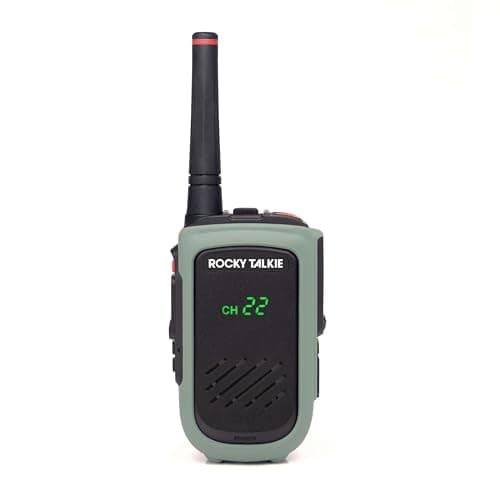
Best rugged GMRS for backcountry trips
Rocky Talkie Expedition Radio (single radio)
The upgrade. Also IP67 and repeater capable, but with a replaceable pack and a removable SMA antenna with two whips in the box — the two things the Midland seals shut. Costs more per radio and ships singly.
$195.00Amazon#ad · Price as of November 2, 2026 · How we make money for the link to Rocky Talkie Expedition Radio (single radio)
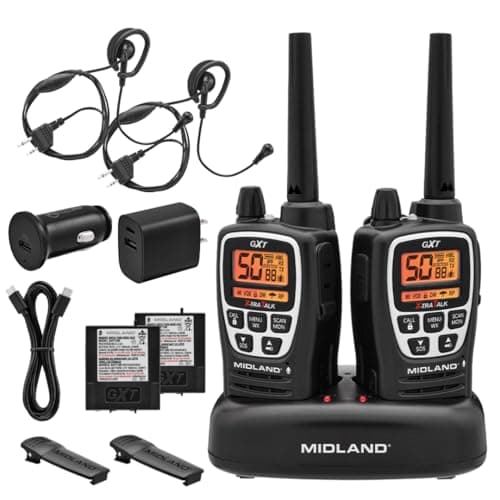
Best Midland pair with repeater access
Midland GXT3000VP4 (2-pack)
The sideways move. Two radios in one box, 8 repeater channels, a Li-ion pack with a 3 AA fallback and a flashlight — but only a JIS4 splash rating, and Midland does not state the wattage.
$159.99Amazon#ad · Price as of November 2, 2026 · How we make money for the link to Midland GXT3000VP4 (2-pack)
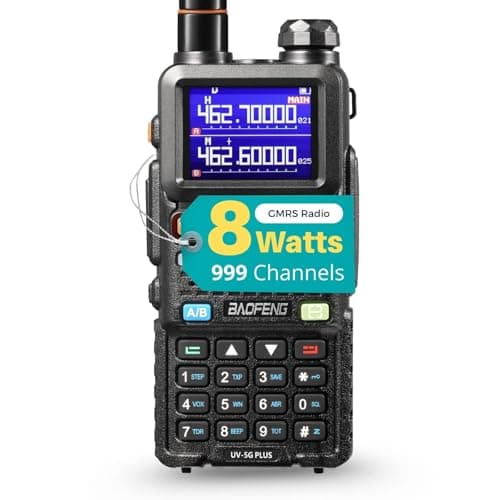
Best cheap GMRS radio with USB-C
Baofeng UV-5G Plus GMRS (single radio)
The cheap route to 5 W: Baofeng states "Real 5W Power Output", a 2500 mAh pack, USB-C and a removable SMA-female antenna, for a fraction of the Midland. No IP rating published, and the menu is a project.
$36.99Amazon#ad · Price as of November 2, 2026 · How we make money for the link to Baofeng UV-5G Plus GMRS (single radio)
If you want this radio's sealing in a Midland pair rather than a single, there is no such product today: the GXT3000VP4 and GXT1000VP4 are both JIS4, and Midland notes the JIS4 rating is "not met with an accessory plugged in". The whole Midland line is sorted by job in best Midland walkie-talkies, and the brand-level argument is in Midland vs Baofeng.
The verdict
The GXT67 PRO is a good radio that Midland has described accurately and marketed loosely. The sealing is genuine, the 5 W figure is stated rather than hidden, the repeater support with split tones is more than most radios at this price offer, and the range claim is unusually honest for the category. Those are real reasons to buy it.
The reservations are structural rather than fixable. A sealed battery and a bonded antenna mean the two parts that wear out cannot be serviced, and the runtime figures Midland publishes disagree with each other by a factor of six. Go in knowing that, and it is the right radio for a licensed operator who wants one tough handheld and will replace it when the battery is done. Expecting a ten-year radio is the only way to be disappointed by it.
In detail
The radio, in full
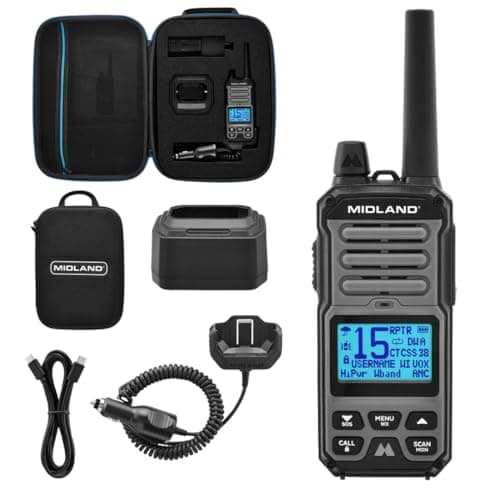
Best Midland handheld for wet weather
Midland GXT67 PRO (single radio)
The IP67 radio in Midland's GXT line: rated at 5 W and repeater capable, with an honest 'up to 5 miles depending on terrain'; it's sold as a single radio with a sealed battery and a fixed antenna, so you'll need two and can't fit a longer antenna.
Published specsResearched · every figure sourced
How the 7.1 score breaks down
- Real-world reach (30%)
- 7
- Ease of use (20%)
- 7
- Toughness & weather (15%)
- 9
- Power & battery (15%)
- 7
- Field features (10%)
- 7
- Value (10%)
- 5
What the specs support
- IP67 waterproof and dustproof, where the GXT1000 and GXT3000 are splash-rated JIS4
- Rated at 5 W with 8 repeater channels and split tones
- USB-C (PD) and 12 V vehicle charging in the box
Where it falls short
- Sold as a single radio, so a pair means buying two
- Fixed antenna and a factory-sealed battery you can't swap in the field
- Midland's battery-life figures conflict (16 hours vs up to 4 days)
Skip this if…
…Skip it if you want to carry a spare battery or fit a longer antenna for the far side of the property: the battery is sealed and the antenna doesn't come off.
#ad · Price as of November 2, 2026 · How we make money for the link to Midland GXT67 PRO (single radio)
How we scored this
Every pick here is backed by the paperwork
Every pick is labeled Researched: we read each maker's published specs, manuals and range tables, check the license rules against the FCC, and score every radio on a public rubric out of 10. Every figure links to where it came from, and every range number is labeled “advertised” so you can see the difference between the box and the terrain.
Scores are our editorial judgment on that documented evidence. Commissions never set a score or decide a pick. The rubric and its weights are published.
What changed
- Published.
Questions
Frequently asked
Is the Midland GXT67 PRO worth it?
Can you replace the GXT67 PRO battery?
How far does the Midland GXT67 PRO reach?
Do you need a license for the Midland GXT67 PRO?
GXT67 PRO or GXT3000: which should I get?
Does the GXT67 PRO work with a repeater?
Is the GXT67 PRO antenna removable?
Receipts
Sources
- Midland: GXT67 PRO product page and in-stock check (checked 2026-11-02)
- Midland: GXT67 FAQs, sealed battery, fixed antenna and the license requirement (checked 2026-09-22)
- Midland: GXT67 PRO spec sheet PDF, the 16-hour battery figure (checked 2026-09-22)
- Midland: GXT67 owner's manual PDF, battery and charging (checked 2026-09-22)
- Midland: GXT3000VP4 product page, JIS4 rating (checked 2026-09-22)
- Midland: GXT1000VP4 product page (checked 2026-09-22)
- Midland support: FRS and GMRS 101 (checked 2026-09-22)
- Rocky Talkie: Expedition Radio product page and in-stock check (checked 2026-11-02)
- Baofeng: UV-5G Plus 5 W GMRS product page (checked 2026-09-26)
- FCC: General Mobile Radio Service (GMRS) page (checked 2026-11-02)
- FCC: personal service and amateur application fees (checked 2026-11-02)
- 47 CFR 95.1705, GMRS licensee and immediate family members (via Cornell LII, checked 2026-11-02)
- 47 CFR 95.1731, GMRS permissible communications (via Cornell LII, checked 2026-11-02)
- 47 CFR 95.1751, GMRS station identification (via Cornell LII, checked 2026-11-02)
- 47 CFR 95.1763, GMRS channel and frequency rules (via Cornell LII, checked 2026-11-02)
Specs and range figures come from each maker's own pages and manuals, linked on every product, and license, power and channel rules come from the FCC and 47 CFR Part 95. Range numbers are the maker's advertised claims and are labeled that way, so you can tell the box number from the terrain number. Prices come live from Amazon with the time we checked. Read the full method.