Not legal advice. This page summarizes FCC rules (47 CFR Part 95) from the official sources linked in the text. Rules and fees checked . The FCC sets its fees annually and can change its rules, so confirm the current version on fcc.gov before you rely on it.
Every cell call you make goes through a tower, a backhaul link and a carrier network, all of which run on electricity and all of which have a finite amount of backup. A walkie-talkie goes from your hand to the other person's hand. That is the whole architecture, and it is why radios belong in an outage kit.
Why they keep working
FRS and GMRS are direct, radio-to-radio services on 462-467 MHz. There is no network to register with, no subscription, no data, and nothing in the path that needs power except the two radios (FCC: Family Radio Service). FRS needs no license at all and is capped at 2 watts on the main channels (47 CFR 95.567); GMRS needs one license that covers your whole immediate family (47 CFR 95.1705).
What you get, realistically, is the FCC's "up to two miles, depending on conditions" for FRS (FCC personal radio services guide), which is the scale of a neighborhood — and in an outage that is exactly the scale that matters. The longer version of this is in walkie-talkies without cell service.
What actually fails in an outage
- Your charger. Nearly every modern radio charges from mains or USB. Day one is fine, day three is not.
- Rechargeable packs that have been sitting. A pack stored for a year is not at the capacity the datasheet quotes. Alkaline cells in a sealed pack keep far better.
- Repeaters. If your plan depends on a GMRS repeater, remember it is someone else's equipment on someone else's power. Treat repeater range as a bonus, not a baseline.
- The habit. Radios nobody has used since last summer come out of the drawer on the wrong channel with nobody agreeing on when to listen.
Notice that three of those four are about batteries and habits, not hardware. That is where the planning effort belongs.
The kit that survives a week
- Radios with AA or AAA fallback, and a sealed box of alkaline cells to match. Motorola states up to 28 hours on three AA alkalines for the T470 against 12 on its NiMH pack (T470 datasheet) — that ratio is the whole argument.
- A 12 V charging path: a car USB adapter, or a small power station. A vehicle is a generator you already own.
- A NOAA weather receiver, built into a radio or standalone.
- A written card in the kit with the channel, the privacy code and the check-in times.
- One radio per household member who might be away, plus a spare.
- A paper list of phone numbers and addresses, because the radios do not replace those.
Our picks for this job
Four radios for an outage kit
Chosen for the things that matter when the power is off: battery fallback, weather alerts, long storage life and - for the house - a 12 V base station.
Best Motorola for storm kits
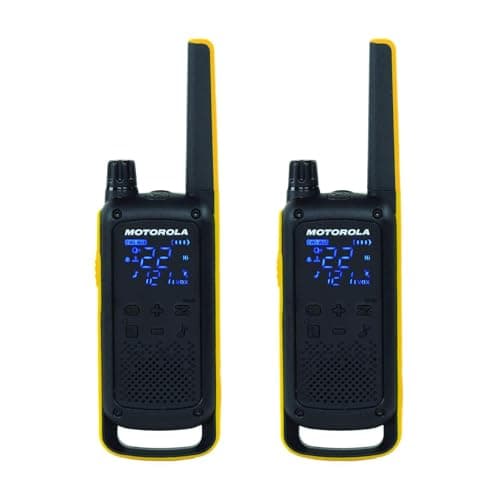
Motorola Talkabout T470 (2-pack)
The storm-kit default: NOAA weather channels and alerts, an emergency button, a flashlight, and a published 28 hours on three AA alkalines.
$89.99Amazon#ad · Price as of November 2, 2026 · How we make money for the link to Motorola Talkabout T470 (2-pack)
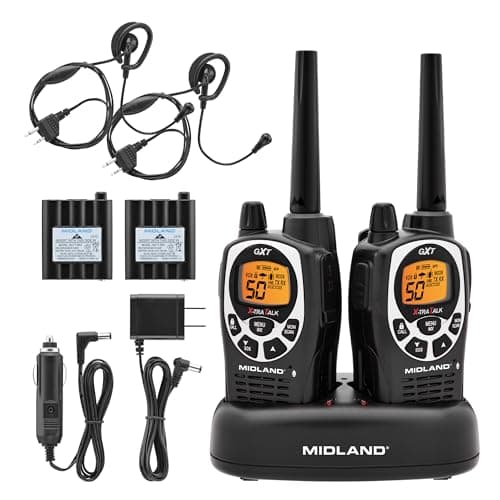
Best simple GMRS pair for families
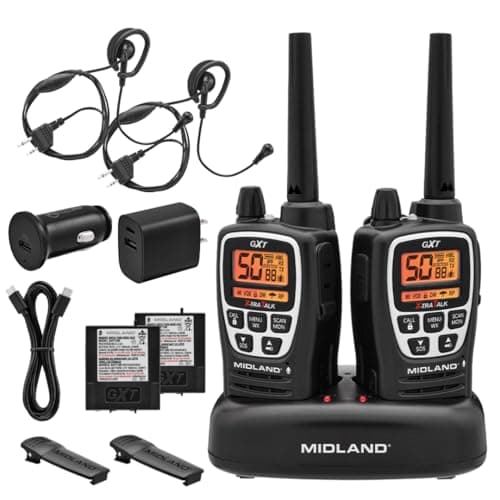
Midland GXT1000VP4 (2-pack)
The GMRS family pair with a 4 AA fallback behind the rechargeable packs, NOAA alerts and an SOS siren. Needs the family license.
$89.99Amazon#ad · Price as of November 2, 2026 · How we make money for the link to Midland GXT1000VP4 (2-pack)
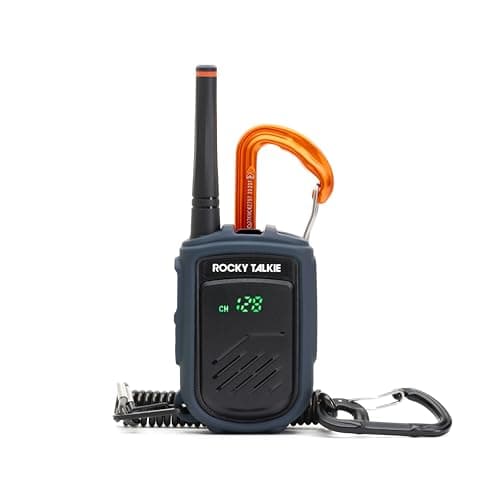
Best for climbers and ski tourers
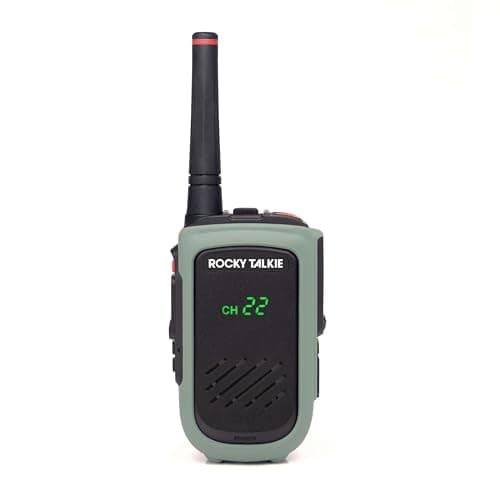
Rocky Talkie Mountain Radio (single radio)
License-free, IP56 and a replaceable Li-ion pack Rocky Talkie rates at 3 to 5 days, so you can carry spare batteries rather than hunt for an outlet.
$120.00Amazon#ad · Price as of November 2, 2026 · How we make money for the link to Rocky Talkie Mountain Radio (single radio)
- BTECHNo image
Best 50 W for a home or shop base
BTECH GMRS-50V2 (50 W mobile/base)
The house end of the plan: a 50 W base-capable radio that runs from a 12 V supply, so a battery and an antenna on the roof keep the household on the air.
Check price · Amazon#ad · Price as of November 2, 2026 · How we make money for the link to BTECH GMRS-50V2 (50 W mobile/base)
The plan matters more than the radio
An outage kit with four radios and no agreement is four radios nobody switches on at the same time. Three decisions, written down:
- One channel and one privacy code, taped to every radio. Matching both is the entire compatibility story (and codes are not privacy).
- Scheduled listening, not constant monitoring. On the hour for five minutes saves enormous battery and means nobody is calling into a dead radio.
- A fallback point. If radio contact fails, where does the family meet and by when? That answer should not depend on any technology.
Our family emergency communication plan turns that into a one-page document you can print, and best GMRS radios for preppers covers the heavier end of the same kit.
What radios will not do
They will not reach 911. No consumer FRS or GMRS channel is monitored by emergency services, and there is no "emergency channel" that summons help — the SOS siren on a radio is a noise-maker for someone within earshot, not an alert to anyone official. They also will not reach the next county: outside of a repeater, a handheld is a neighborhood tool.
And they do not keep working if nobody charged them. That is the honest failure mode of every radio in every emergency kit, and the cheapest insurance against it is a sealed box of alkaline batteries that lives with the radios and gets replaced when you change the smoke-alarm batteries.
How we scored this
Every pick here is backed by the paperwork
Every pick is labeled Researched: we read each maker's published specs, manuals and range tables, check the license rules against the FCC, and score every radio on a public rubric out of 10. Every figure links to where it came from, and every range number is labeled “advertised” so you can see the difference between the box and the terrain.
Scores are our editorial judgment on that documented evidence. Commissions never set a score or decide a pick. The rubric and its weights are published.
What changed
- Published.
Questions
Frequently asked
Do walkie-talkies work without power or cell service?
How far will walkie-talkies reach in an outage?
Are alkaline batteries better than rechargeables for an emergency kit?
Can I call 911 on a walkie-talkie?
Will GMRS repeaters work if the grid is down?
Receipts
Sources
- FCC: Family Radio Service (FRS) page (checked 2026-10-17)
- FCC: personal radio services guide, FRS distance (checked 2026-10-17)
- 47 CFR 95.567, FRS power limits per channel (via Cornell LII, checked 2026-10-17)
- 47 CFR 95.1705, GMRS eligibility: individuals and family (via Cornell LII, checked 2026-10-17)
- NWS: NOAA Weather Radio All Hazards (checked 2026-10-17)
- Ready.gov: alerts and warnings, including NOAA Weather Radio and IPAWS (checked 2026-10-17)
- Motorola Solutions: TALKABOUT T470 series page (checked 2026-09-22)
- Motorola Solutions: T470 datasheet PDF, AA runtime (checked 2026-09-22)
- Midland: GXT1000VP4 product page (checked 2026-09-22)
- Rocky Talkie: Mountain Radio product page (checked 2026-09-22)
- BTECH: GMRS-50V2 product page (checked 2026-09-22)
Specs and range figures come from each maker's own pages and manuals, linked on every product, and license, power and channel rules come from the FCC and 47 CFR Part 95. Range numbers are the maker's advertised claims and are labeled that way, so you can tell the box number from the terrain number. Prices come live from Amazon with the time we checked. Read the full method.