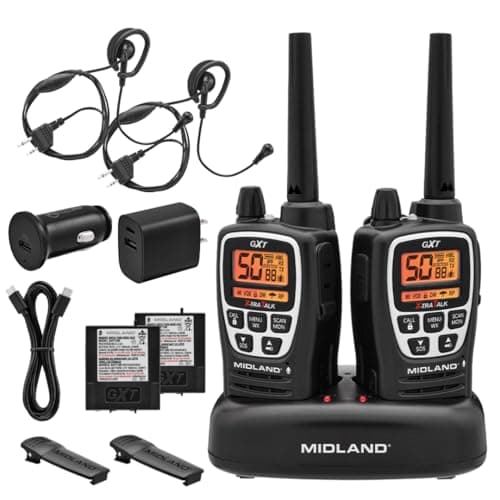
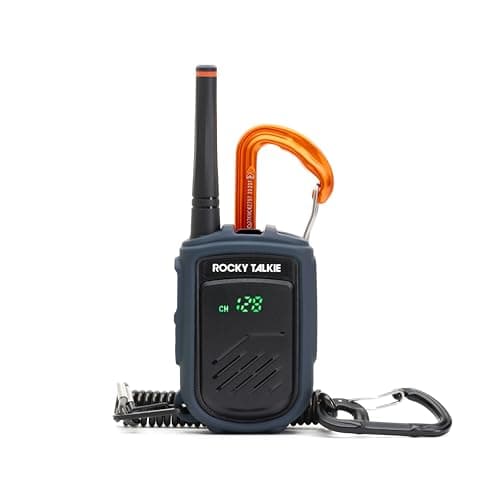
Not legal advice. This page summarizes FCC rules (47 CFR Part 95) from the official sources linked in the text. Rules and fees checked . The FCC sets its fees annually and can change its rules, so confirm the current version on fcc.gov before you rely on it.
Quick picks
The picks at a glance
| # | Product | Best for | Score | Price |
|---|---|---|---|---|
| 1 | 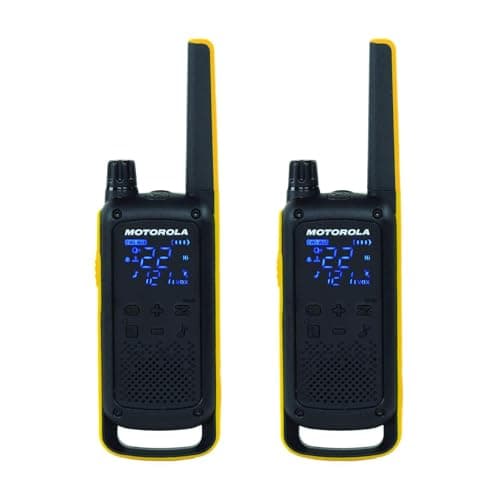 Motorola Talkabout T470 (2-pack) NOAA weather alerts, an emergency button, a flashlight and a stated 28 hours on three AA batteries. License-free, so every household on the street can legally use one. | Best neighborhood watch radioNo licenseMid-price | 6.1/10Researched | $89.99Amazon #ad · Disclosure |
| 2 | 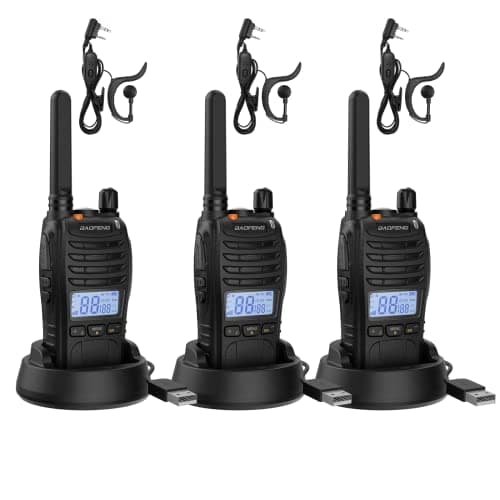 Baofeng BF-88ST Pro FRS (multi-pack) Sold in twos, threes or fours with a headset per radio, and Baofeng publishes a clear 2 W plus 12 NOAA channels. The cheapest honest way to hand out a lot of radios. | Best for equipping a whole blockNo licenseBudget | 6.1/10Researched | $41.99Amazon #ad · Disclosure |
| 3 | 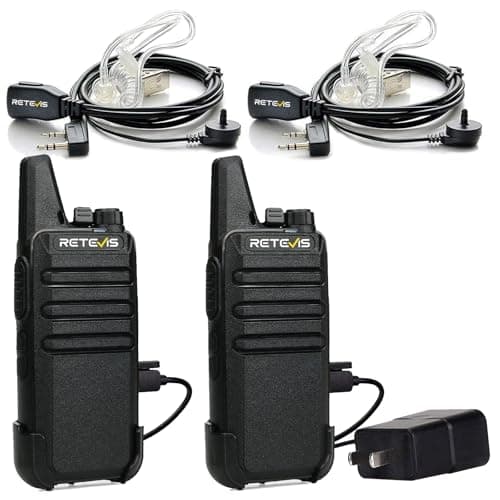 Retevis RT22 (2-pack) Screenless, pre-paired out of the box and 4 oz, with Retevis' own honest 0.5 to 2 miles. Nothing to misconfigure, which is the point when a radio gets used twice a year. | Best for handing to a volunteerNo licenseBudget | 5.5/10Researched | $29.98Amazon #ad · Disclosure |
| 4 | 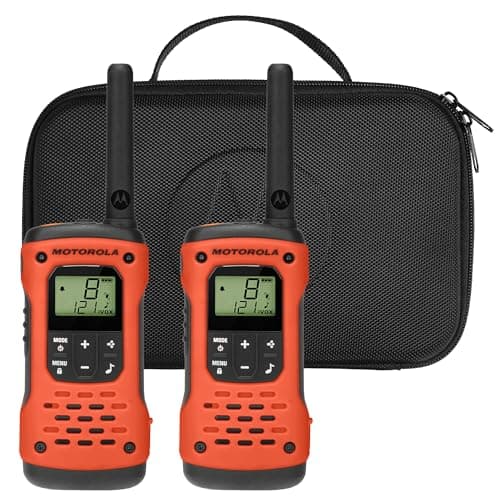 Motorola Talkabout T605 H2O (2-pack) IP67, floats face up on the included pack, and the flashlight turns itself on in water. The radio for a street that floods or a watch that works in weather. | Best for storm and flood watchNo licenseMid-price | 6.8/10Researched | $116.99Amazon #ad · Disclosure |
| 5 | 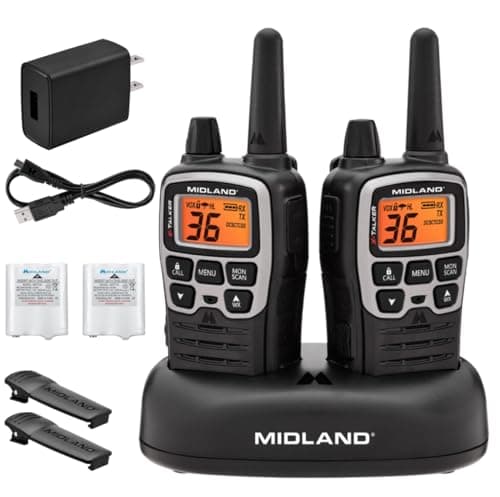 Midland X-Talker T71VP3 (2-pack) Weather Scan, silent operation and eVOX, with 1000 mAh packs or three AA cells. Midland's own runtime figure is about 5 hours on high power, so carry the AAs. | Best with Weather Scan and AA backupNo licenseMid-price | 5.7/10Researched | $89.99Amazon #ad · Disclosure |
| 6 | 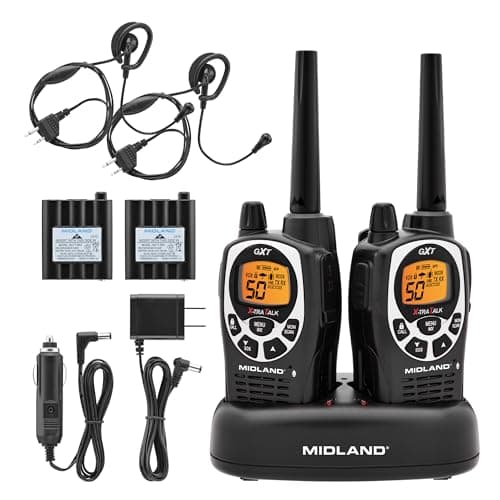 Midland GXT1000VP4 (2-pack) A GMRS pair with NOAA alerts and an AA fallback. Read the licensing callout first: a GMRS license covers your family, not the neighbors. | Best if one household runs the netGMRS licenseMid-price | 6.1/10Researched | $89.99Amazon #ad · Disclosure |
#ad · Prices come live from Amazon, last checked November 2, 2026. Scores are ours, built from published specs, manuals and FCC rules. Photos come from each product's Amazon listing; a radio we can't show a real photo of is left blank rather than illustrated. Tap a row for the full write-up.
A neighborhood watch, a storm phone tree, an HOA event crew and a block that loses cell service in every outage all want the same thing: a handful of radios, in a handful of houses, that work when nobody has planned anything. It is a genuinely good use for walkie-talkies — and it is the one buying decision on this site where the cheap license-free radios are not the compromise answer. They are the correct answer, for a legal reason most roundups skip entirely.
Everything here is chosen and scored from published specs, manuals and the FCC rules; this site does not test radios, and the method is on how we rank.
Start with the licensing rule, not the radio
GMRS radios are more capable: more power, repeater channels, sometimes a removable antenna. For a family on a farm, that is the right buy. For a street, it falls apart, and here is the exact sentence that decides it.
So a GMRS watch group means every participating household buying its own license. FRS, by contrast, is licensed by rule: no application, no fee, no call sign, anybody in any house can pick up the radio and talk (FCC: Family Radio Service). The trade is power — FRS is capped at 2 W on the main channels and 0.5 W on channels 8 to 14 (47 CFR 95.567) — and a permanently attached antenna. Across a few blocks, that is usually enough. GMRS vs FRS has the full comparison.
There is one more rule worth knowing before you plan a "watch channel": FRS is a two-way service. One-way transmissions are prohibited except for emergency messages, traveler assistance, and voice pages or brief equipment tests (47 CFR 95.531(b), 47 CFR 95.533). Calling a neighbor is fine; using the channel as a public-address system for the subdivision is not.
What matters on a block watch
- License-free operation. If a radio needs a license, it cannot be the radio you hand to a neighbor. That single constraint sets the whole list.
- It has to work for someone who uses it twice a year. A watch radio sits in a drawer for months. Screenless controls, channel lock and pre-paired units beat features nobody will remember.
- NOAA weather alerts. Most block groups mobilize for weather, not crime. A radio that can receive NOAA Weather Radio broadcasts (NWS: NOAA Weather Radio) is doing the job before anyone transmits.
- Batteries you can buy at the corner store. An AA fallback matters more here than anywhere else, because the day you need these is the day nothing has been charged.
- Enough radios, cheaply. Coverage on a street comes from having a radio in more houses, not from a better radio in one. Multi-packs beat flagships.
- Honest range figures. Houses, walls and parked cars are hard on UHF; published figures that admit it are worth more than a 35-mile box.
The picks in detail
1. Motorola Talkabout T470 — the one to start with
The T470 is the best all-round fit for a watch group because of what it does when nobody is talking: NOAA weather channels with alerts, an emergency button, an LED flashlight, VibraCall and iVOX/VOX hands-free, on a 2-pack rather than a single radio (T470 series page). Motorola publishes up to 12 hours on the 800 mAh NiMH pack and up to 28 hours on three AA alkalines (T470 datasheet), which is exactly the figure that matters for a radio living in a kitchen drawer. It is FRS, so no license and no call sign.
Motorola is also unusually specific about range: "up to 35 miles" is mountain-to-valley, with up to 6 miles over open water and up to 2 miles in a neighborhood on the same page. That last number is the one to plan your street around.
Cons: IPX4 is splash protection only, so it handles rain but not a storm drain; charging is Micro-USB, not USB-C; and Motorola does not publish the transmit power.
2. Baofeng BF-88ST Pro — the way to equip a whole block
If the plan is "a radio in twelve houses", this is the pick, because it is sold as a 2-pack, 3-pack or 4-pack with a radio, a battery, a belt clip, a lanyard, a headset and a desktop USB charger in each slot (BF-88ST Pro page). Baofeng states a flat "2W (FRS)", which is the clearest power figure the company publishes on any of its license-free radios, plus 22 FRS channels and 12 NOAA weather channels with alert scanning, dual watch, two emergency alarm modes and a flashlight. Its advertised range is "up to 3 miles" — modest, and therefore believable.
Cons: the antenna is built into the shell, so there is no upgrade path at all; no water or dust rating is published, which is a real gap for a radio that may be used in a storm; and dual watch and the alarms are menu features on a radio with very few buttons, so most people will never find them.
3. Retevis RT22 — the one to hand a volunteer
There is a specific failure mode on a block watch: someone picks up a radio for the first time in eight months, nudges a channel knob, and spends the evening talking to nobody. The RT22 is designed around that problem — no screen, a knob and a couple of buttons, and the pair ships set to the same channel and code (Retevis RT22 page). It states 2 W, a 1000 mAh Li-ion with USB-C, VOX, an emergency alarm and 113 g, and Retevis publishes an honest "0.5 to 2 miles".
Cons: 16 channels means it cannot reach every FRS channel a neighbor's 22-channel radio might be sitting on, so the group has to standardize on a channel the RT22 has; there is no NOAA weather receiver; and the water resistance is described only as handling droplets and rain.
4. Motorola Talkabout T605 H2O — for a street that floods
If your block group exists because of hurricanes, flash flooding or ice storms, buy the waterproof one. The T605 is IP67 — Motorola describes surviving submersion to one meter for 30 minutes — it floats face up on the included NiMH pack, and its flashlight is water-activated (T600 H2O series page). It carries 11 NOAA weather channels with alerts, an emergency alert button, and runs up to 9 hours on the pack or up to 23 hours on three AAs (T605 datasheet). The pack includes a case, four NiMH cells and two earpieces.
Cons: the waterproofing buys survival rather than reach, so it is no better at distance than the T470; Motorola notes it may not float with some AA batteries; and headset use is specified for dry conditions only.
5. Midland X-Talker T71VP3 — weather scan and AA backup
Midland's top license-free X-Talker is the alternative to the T470 if you want Weather Scan, silent operation and nine-level eVOX hands-free, with larger 1000 mAh packs and a full charging kit in the box (T71VP3 page). It runs on three AA cells when the packs are flat, and it works with any other FRS or GMRS radio on the shared FRS channels — useful when half the street already owns something.
Cons: Midland's own runtime figure is "around 5 hours at 90-5-5 when being used on Hi power", which is short; it is listed only as "water resistant" with no IP rating; and the "up to 38 miles" on the box has nothing to do with a residential street.
6. Midland GXT1000VP4 — the GMRS option, with the catch
It is on the list because one scenario is real: a single household that holds a GMRS license and wants more reach for its own family — the parents, the kids, the grandparents down the block — while the wider watch stays on FRS. The GXT1000VP4 is the best-known simple GMRS pair: 50 channels, 142 privacy codes, NOAA weather alerts with weather scan, an SOS siren, e-VOX, and NiMH packs with a 4 AA fallback (GXT1000VP4 page). Midland publishes "the GXT averages 1/2-2 miles in normal conditions", which is refreshingly plain.
Cons: the licensing problem above is the big one — the neighbors cannot legally transmit on it outside an emergency; there are no repeater channels; JIS4 is splash only and is lost with an accessory plugged in; and charging is a 12-hour desktop cradle.
The published specs side by side
How far these actually reach on a street
Residential ground is harder on UHF than open country, and the reason is not distance — it is the houses. Signals at 462 MHz lose energy passing through walls, and the loss depends on what the wall is made of; NIST has published measurements of exactly this effect across construction materials (NIST: electromagnetic signal attenuation in construction materials). Brick, stucco over wire lath, foil-faced sheathing and a basement are all worse than drywall and siding.
The practical upshot, using the makers' own published figures rather than box numbers: expect a handheld to reach somewhere between half a mile and two miles across a built-up neighborhood, and less if either person is indoors or below grade. Motorola's own footnote says up to 2 miles in a neighborhood; Retevis says 0.5 to 2 miles; Midland says half a mile to 2 miles in normal conditions. Three makers, three similar answers — that agreement is more useful than any single claim. Our table of every maker's terrain figures collects them, and radios for concrete buildings covers the indoor case if your street has mid-rises.
How to run the net so it works on the night it matters
- Pick one channel and one privacy code, and write them on the radios. A label maker is the most underrated piece of watch equipment. Remember that a privacy code does not make you private — it just mutes other traffic (what privacy codes really do), and anyone with a scanner can hear you.
- Avoid channels 8 to 14. They are limited to 0.5 W by rule, so they reach noticeably less far — see the channel list.
- Set a check-in time. A two-minute radio check on the first Sunday of the month finds dead batteries, wrong channels and radios that someone's kid reprogrammed. A watch group that never tests has a drawer of props.
- Agree who calls 911. One person calls, so dispatch does not get six versions. Everyone else stays off the channel while they do it.
- Keep a written roster offline. Names, addresses and radio assignments on paper, because the scenario you bought radios for is the one where phones are down — see building a family communication plan and what actually works when the grid goes down.
- Sign up for the official alerts too. Radios are for talking to each other; warnings come from NOAA Weather Radio and your county's emergency alert system (Ready.gov: alerts and warnings).
What a watch radio is not
It is not a police radio, and a neighborhood watch is not law enforcement. These radios cannot transmit on public-safety frequencies, they are not encrypted, nobody at a dispatch center is listening, and anyone nearby with a cheap scanner or an identical radio can hear every word. Treat the channel as a conversation held on a front lawn: fine for "there is a car idling outside number 14, is that yours?", wrong for addresses, names, plate numbers and anything you would not shout.
If what you actually need is radios for paid staff, a patrol contractor or a venue, the rules change — a business cannot hold a GMRS license (FCC: General Mobile Radio Service), so read radios for security teams and two-way radios for business instead. And if someone has pitched you a subscription radio that works "anywhere in the country", read LTE walkie-talkies vs GMRS before you buy one for an outage.
Used for what it is — a free, instant, infrastructure-free way for a dozen households to talk to each other — a drawer full of inexpensive FRS radios is one of the better preparedness purchases a street can make. Buy the cheap ones, buy more of them, label them, and test them once a month.
In detail
The picks, in full
Rank 01
Best neighborhood watch radio
Motorola Talkabout T470 (2-pack)
NOAA weather alerts, an emergency button, a flashlight and a stated 28 hours on three AA batteries. License-free, so every household on the street can legally use one.
Published specsResearched · every figure sourced
How the 6.1 score breaks down
- Real-world reach (30%)
- 4
- Ease of use (20%)
- 8
- Toughness & weather (15%)
- 5
- Power & battery (15%)
- 7
- Field features (10%)
- 8
- Value (10%)
- 7
What the specs support
- AA fallback with a stated 28 hours, which suits an emergency kit
- NOAA alerts, flashlight and emergency button included
- Hands-free iVOX/VOX and a standard 2.5 mm headset jack
Where it falls short
- Micro-USB charging, not USB-C
- IPX4 is splash protection only; don't drop it in water
- Motorola doesn't publish the transmit power
Skip this if…
…Skip it if it will get wet often: IPX4 handles rain, not a creek crossing or a canoe, so the IP67 T605 is the Motorola to buy.
#ad · Price as of November 2, 2026 · How we make money for the link to Motorola Talkabout T470 (2-pack)
Rank 02
Best for equipping a whole block
Baofeng BF-88ST Pro FRS (multi-pack)
Sold in twos, threes or fours with a headset per radio, and Baofeng publishes a clear 2 W plus 12 NOAA channels. The cheapest honest way to hand out a lot of radios.
Published specsResearched · every figure sourced
How the 6.1 score breaks down
- Real-world reach (30%)
- 5
- Ease of use (20%)
- 8
- Toughness & weather (15%)
- 3
- Power & battery (15%)
- 7
- Field features (10%)
- 7
- Value (10%)
- 8
What the specs support
- A clear 2 W figure, where the cheaper GT-18 page contradicts itself
- 12 NOAA weather channels with alert scanning
- Two, three or four radios in one box, each with a headset
Where it falls short
- Fixed antenna, so no upgrade path
- No water or dust rating published
- Dual watch and alarms are menu features on a radio with very few buttons
Skip this if…
…Skip it if you need more than about a mile in timber: this is a 2 W FRS radio with a sealed antenna, and no setting changes that.
#ad · Price as of November 2, 2026 · How we make money for the link to Baofeng BF-88ST Pro FRS (multi-pack)
Rank 03
Best for handing to a volunteer
Retevis RT22 (2-pack)
Screenless, pre-paired out of the box and 4 oz, with Retevis' own honest 0.5 to 2 miles. Nothing to misconfigure, which is the point when a radio gets used twice a year.
Published specsResearched · every figure sourced
How the 5.5 score breaks down
- Real-world reach (30%)
- 4.5
- Ease of use (20%)
- 8
- Toughness & weather (15%)
- 3
- Power & battery (15%)
- 6
- Field features (10%)
- 4
- Value (10%)
- 8
What the specs support
- States 2 W and a realistic 0.5 to 2 mile range
- USB-C Li-ion and very light
- Pre-paired out of the box; no screen to confuse anyone
Where it falls short
- Only 16 channels, so it can't reach every FRS channel another family's radio might use
- No weather channel, and only light water resistance
Skip this if…
…Skip it if you need NOAA alerts or will match channels with other brands' 22-channel radios: it has 16 channels and no weather receiver.
#ad · Price as of November 2, 2026 · How we make money for the link to Retevis RT22 (2-pack)
Rank 04
Best for storm and flood watch
Motorola Talkabout T605 H2O (2-pack)
IP67, floats face up on the included pack, and the flashlight turns itself on in water. The radio for a street that floods or a watch that works in weather.
Published specsResearched · every figure sourced
How the 6.8 score breaks down
- Real-world reach (30%)
- 4
- Ease of use (20%)
- 8
- Toughness & weather (15%)
- 9
- Power & battery (15%)
- 7
- Field features (10%)
- 8
- Value (10%)
- 8
What the specs support
- IP67 and it floats face up, with a flashlight that switches on when it hits the water
- Runs on the NiMH pack or three AA batteries, so a dead pack isn't the end of the day
- The T605 pack adds a case, spare batteries and earpieces
Where it falls short
- Motorola doesn't publish the transmit power; reach is ordinary FRS
- It may not float with some AA batteries, per Motorola
- Headset use is for dry conditions only
Skip this if…
…Skip it if you need to talk between boats or trucks miles apart: IP67 keeps it alive in the lake, but a fixed-antenna FRS radio won't cover that distance.
#ad · Price as of November 2, 2026 · How we make money for the link to Motorola Talkabout T605 H2O (2-pack)
Rank 05
Best with Weather Scan and AA backup
Midland X-Talker T71VP3 (2-pack)
Weather Scan, silent operation and eVOX, with 1000 mAh packs or three AA cells. Midland's own runtime figure is about 5 hours on high power, so carry the AAs.
Published specsResearched · every figure sourced
How the 5.7 score breaks down
- Real-world reach (30%)
- 4
- Ease of use (20%)
- 8
- Toughness & weather (15%)
- 4
- Power & battery (15%)
- 6
- Field features (10%)
- 7
- Value (10%)
- 7
What the specs support
- AA fallback plus 1000 mAh packs and a full charging kit
- Weather Scan, silent mode and hands-free eVOX
- Works with any other FRS or GMRS radio on the shared FRS channels
Where it falls short
- Midland's own runtime figure is about 5 hours on high power
- Only "water resistant"; no IP rating
- Transmit power isn't published, and FRS rules still cap what it can do
Skip this if…
…Skip it if you're buying it for the "38 miles": through hills and trees it's still a fixed-antenna FRS radio, and a GMRS radio is the real step up in reach.
#ad · Price as of November 2, 2026 · How we make money for the link to Midland X-Talker T71VP3 (2-pack)
Rank 06
Best if one household runs the net
Midland GXT1000VP4 (2-pack)
A GMRS pair with NOAA alerts and an AA fallback. Read the licensing callout first: a GMRS license covers your family, not the neighbors.
Published specsResearched · every figure sourced
How the 6.1 score breaks down
- Real-world reach (30%)
- 5
- Ease of use (20%)
- 7
- Toughness & weather (15%)
- 5
- Power & battery (15%)
- 7
- Field features (10%)
- 7
- Value (10%)
- 7
What the specs support
- Midland publishes a realistic figure (1/2 to 2 miles in normal conditions), so you know what the pair will really do
- Runs on the included NiMH packs or 4 AA batteries, so a dead pack doesn't end the day
- NOAA weather alerts, SOS siren and e-VOX hands-free are built in
Where it falls short
- No repeater channels, and Midland doesn't state the transmit power
- JIS4 is splash protection only, and it's lost when a headset is plugged in
- Slow desktop charging (12 hours) with no USB port
Skip this if…
…Skip it if you need to reach across a ridge or hit a local repeater: there are no repeater channels, and Midland itself says to expect 1/2 to 2 miles in normal conditions.
#ad · Price as of November 2, 2026 · How we make money for the link to Midland GXT1000VP4 (2-pack)
What to look for in a neighborhood watch radio
- FRS, not GMRS. Licensed by rule means every household can use it legally. This is the first filter, not the last.
- 22 standard FRS channels, so the group can standardize on one channel that every radio in every house can actually reach.
- NOAA weather channels with alert. Most watch groups activate for weather.
- An AA fallback or a long-life pack. The useful figure is the AA runtime, because that is the battery you can still buy during an outage.
- Controls a non-radio person cannot break. Channel lock, few buttons, or no screen at all.
- A multi-pack. Six cheap radios in six houses beat two good radios in one.
- Some weather sealing. At minimum a splash rating; IP67 if your block's emergencies involve water.
How we scored this
Every pick here is backed by the paperwork
Every pick is labeled Researched: we read each maker's published specs, manuals and range tables, check the license rules against the FCC, and score every radio on a public rubric out of 10. Every figure links to where it came from, and every range number is labeled “advertised” so you can see the difference between the box and the terrain.
Scores are our editorial judgment on that documented evidence. Commissions never set a score or decide a pick. The rubric and its weights are published.
What changed
- Published.
Questions
Frequently asked
Do we need a license for neighborhood watch radios?
Can my neighbors use my GMRS license?
How far will a walkie-talkie reach across a neighborhood?
How many radios does a block watch need?
Can we use the watch channel to make announcements?
Are these radios private?
Receipts
Sources
- 47 CFR 95.1705, GMRS licensee and the enumerated immediate family members (via Cornell LII, checked 2026-10-19)
- 47 CFR 95.531, permissible FRS uses including one-way communications (via Cornell LII, checked 2026-10-19)
- 47 CFR 95.533, prohibited FRS uses (via Cornell LII, checked 2026-10-19)
- 47 CFR 95.567, FRS transmit power limits (via Cornell LII, checked 2026-10-19)
- FCC: Family Radio Service (FRS) page (checked 2026-10-19)
- FCC: General Mobile Radio Service (GMRS) page (checked 2026-10-19)
- Motorola Solutions: TALKABOUT T470 series page (checked 2026-09-22)
- Motorola Solutions: T470 datasheet PDF, battery runtimes (checked 2026-09-22)
- Motorola Solutions: TALKABOUT T600 H2O series page (checked 2026-09-22)
- Motorola Solutions: T605 H2O datasheet PDF (checked 2026-09-22)
- Baofeng: BF-88ST Pro product page, 2 W FRS and 12 NOAA channels (checked 2026-09-29)
- Retevis: RT22 product page, 2 W and 0.5-2 miles (checked 2026-09-22)
- Midland: T71VP3 X-Talker product page (checked 2026-09-22)
- Midland: GXT1000VP4 product page (checked 2026-09-22)
- NIST: electromagnetic signal attenuation in construction materials (checked 2026-10-19)
- National Weather Service: NOAA Weather Radio All Hazards (checked 2026-10-19)
- Ready.gov: alerts and warnings (checked 2026-10-19)
Specs and range figures come from each maker's own pages and manuals, linked on every product, and license, power and channel rules come from the FCC and 47 CFR Part 95. Range numbers are the maker's advertised claims and are labeled that way, so you can tell the box number from the terrain number. Prices come live from Amazon with the time we checked. Read the full method.