Not legal advice. This page summarizes FCC rules (47 CFR Part 95) from the official sources linked in the text. Rules and fees checked . The FCC sets its fees annually and can change its rules, so confirm the current version on fcc.gov before you rely on it.
Quick picks
The picks at a glance
| # | Product | Best for | Score | Price |
|---|---|---|---|---|
| 1 | 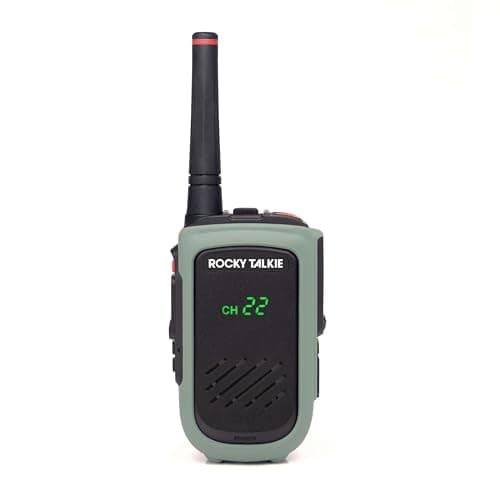 Rocky Talkie Expedition Radio (single radio) The only pick here that publishes a forest number (0.5 to 5 miles in forest and hills) AND takes a longer antenna. A GMRS license and two purchases, because it is sold singly. | Best radio for timberGMRS licensePremium | 7.9/10Researched | $195.00Amazon #ad · Disclosure |
| 2 | 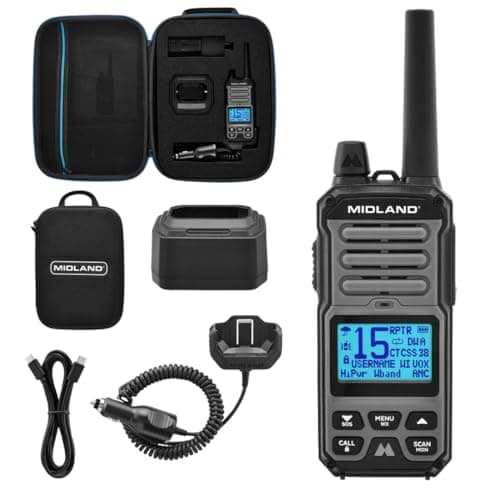 Midland GXT67 PRO (single radio) IP67 instead of splash-rated, which matters when every branch you pass is loaded with water. Rated 5 W with repeater channels, but the antenna does not come off. | Best for wet woodsGMRS licensePremium | 7.1/10Researched | $219.99Amazon #ad · Disclosure |
| 3 | 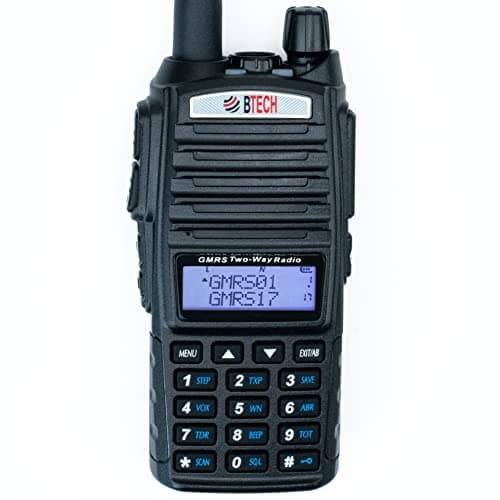 BTECH GMRS-V2 (single radio) The cheapest way to get an SMA antenna jack and repeater channels. Menu-driven, so it suits someone willing to learn a radio, not a kid in a deer stand. | Best budget pick for the canopyGMRS licenseBudget | 6.7/10Researched | Check price · Amazon #ad · Disclosure |
| 4 | 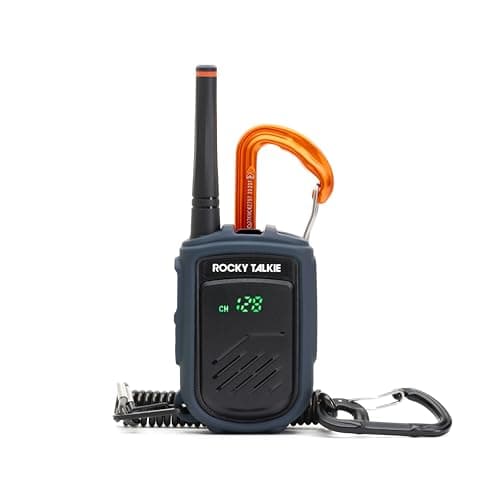 Rocky Talkie Mountain Radio (single radio) Publishes 0.5 to 3 miles in forest and hills, which is the most honest FRS figure on this page. Fixed antenna and 2 W, so it is the short end of the woods. | Best without a licenseNo licenseMid-price | 6.7/10Researched | $120.00Amazon #ad · Disclosure |
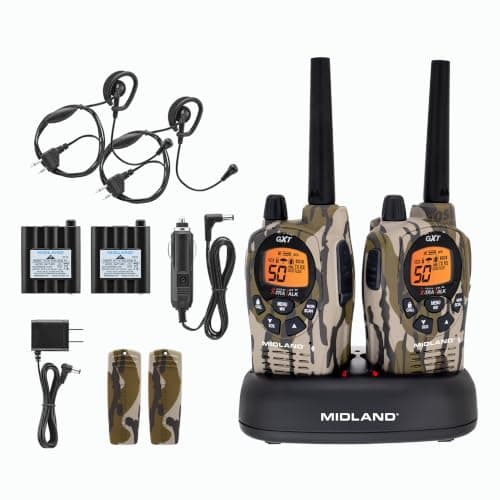
| 5 | 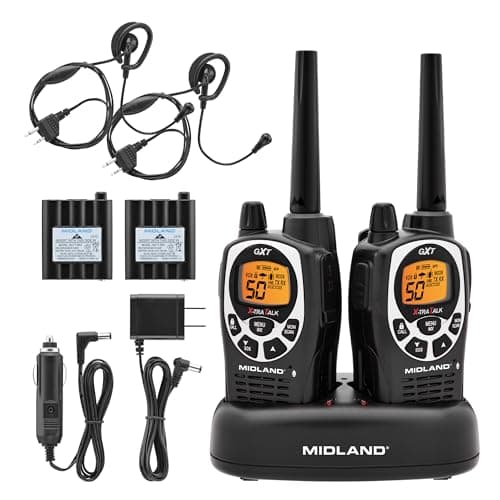 Midland GXT1000VP4 (2-pack) Two radios in one box with an AA fallback and NOAA alerts. Midland's own figure is half a mile to two miles in normal conditions, and there are no repeater channels. | Best simple pair for a small woodlotGMRS licenseMid-price | 6.1/10Researched | $89.99Amazon #ad · Disclosure |
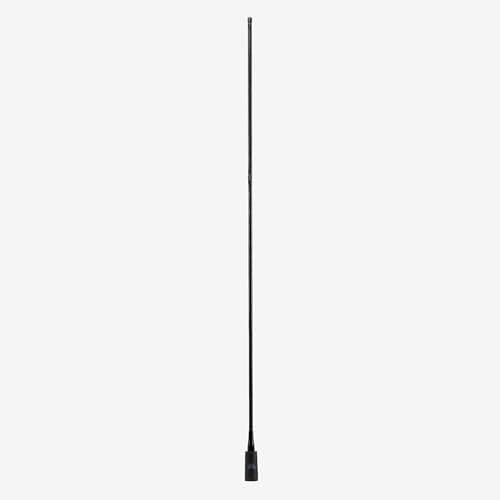
| 6 | 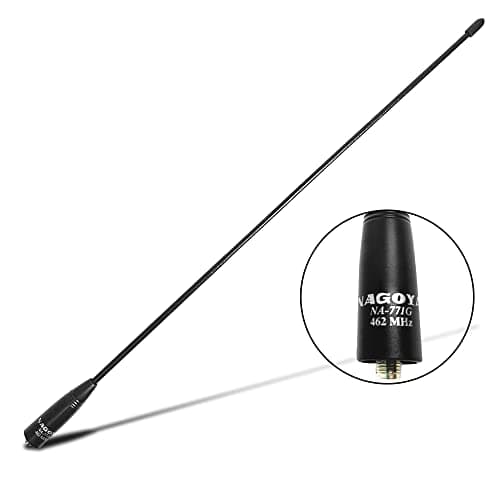 Nagoya NA-771G GMRS Whip (SMA-female) A 15.6-inch half-wave GMRS whip for SMA-female radios like the GMRS-V2. The single cheapest thing you can change about your signal under a canopy. | Best cheap upgrade in the woodsAccessoryBudget | 7.3/10Researched | $20.98Amazon #ad · Disclosure |
#ad · Prices come live from Amazon, last checked November 2, 2026. Scores are ours, built from published specs, manuals and FCC rules. Photos come from each product's Amazon listing; a radio we can't show a real photo of is left blank rather than illustrated. Tap a row for the full write-up.

A hunting party, a crew clearing trails, a family on a wooded campground loop and two people walking a timbered property all hit the same wall: radios that talked a mile across a pasture go quiet at 400 yards once there are leaves in between. Nothing is broken. Trees are simply the one obstacle that neither power settings nor privacy codes nor a different brand fixes.
This page ranks the handful of radios whose makers publish a forest-specific range figure, because in timber that is the only number worth comparing. Everything on it is chosen and scored from published specs, manuals and the FCC rules — this site does not test radios, and the method is on how we rank.
Why trees are different
Walkie-talkies use UHF, up around 462 MHz. At those frequencies a signal does not bend around an obstacle well; it either gets through it or it does not. A hill blocks you outright and you know it. A forest is worse in a sneakier way: it attenuates. Every trunk, branch and wet leaf between the two antennas takes a slice of the signal, and the slices add up over distance, so the radio does not cut off at a line — it fades over a few hundred yards until it is unusable.
This is a real, separately modeled propagation effect, not folklore. The ITU maintains an entire recommendation on it, titled Attenuation in vegetation (P.833-10, approved September 2021). Two practical consequences follow, and they are the reason this page exists:
- Leaf-on is worse than leaf-off. Water in foliage is what absorbs the signal, so the same stand of hardwoods that works in February can be a problem in July, and a soaking rain is worse than a dry day.
- Conifers in summer and winter are about the same. A pine plantation or a cedar swamp does not drop its needles, so you do not get a winter reprieve.
What matters in the woods
- A maker who publishes a forest figure. Two companies on this page do. "Up to 36 miles" tells you nothing about a cedar swamp; "0.5 to 5 miles in forest and hills" tells you what to plan around.
- A removable antenna. This is the biggest controllable variable in timber. FRS radios are not allowed one at all — the FCC requires an FRS unit's antenna to be permanently attached (47 CFR 95.587) — which is one of the strongest arguments for GMRS on wooded ground.
- Repeater channels. A GMRS repeater sits at what the FCC rules describe as "a favorable antenna location (typically high above the surrounding terrain)" (47 CFR 95.303), which is exactly above the canopy. If your area has one, it is the one jump that genuinely beats trees.
- Weather sealing you can trust. Woods are wet. Brush, dew and rain off branches soak a radio on a belt all day, so an IP rating beats "water resistant".
- Power, but last. FRS is capped at 2 W on the main channels (47 CFR 95.567); GMRS handhelds commonly run 5 W under the limits at 47 CFR 95.1767. That is a real step up, but a smaller one than antenna height. Walkie-talkie watts explained has the arithmetic.
The picks in detail
1. Rocky Talkie Expedition Radio — the one to buy for timber
It wins here on two things nothing else on the page has together. First, the maker publishes a terrain table rather than a headline: line of sight 35+ miles, mountains 2 to 8 miles, forest and hills 0.5 to 5 miles, rivers 0.5 to 3 miles, city up to 1.5 miles (Expedition Radio page). Second, the antenna comes off: it is a removable SMA-male connector and both a 7.5 cm stubby and a 17 cm whip are in the box, so you can trade snag resistance for reach when the group spreads out.
The rest is built for long days away from power: 5 W, eight GMRS repeater channels, IP67 to a stated meter of submersion, a replaceable 1800 mAh Li-ion rated at 4 to 6 days, NOAA weather monitoring, and 9.1 oz.
Cons: it needs a GMRS license before you transmit; it is sold as a single radio, so a pair is the most expensive way to equip two people on this page; and the maker lists no VOX hands-free and no flashlight, both of which a hunter walking in before dawn may miss.
2. Midland GXT67 PRO — the one for wet woods
Timber is a wet environment even when it is not raining, and this is the radio on the page built for that: IP67 waterproof and dustproof with the accessory jack cover tightened, where Midland's own GXT1000 and GXT3000 are splash-rated JIS4 (GXT67 PRO page). It is rated 5 W with high, medium and low settings, carries eight GMRS repeater channels with split tones, charges over USB-C or 12 V, and monitors NOAA weather alerts.
Midland also publishes an unusually honest figure for a mass-market brand: "At 5 Watts, this radio can easily reach up to 5 miles, depending on the terrain" (GXT67 FAQs). In timber, read "depending on the terrain" as the whole sentence.
Cons: the antenna is fixed — Midland says plainly that "the design of this radio does not allow it to be removed" — so the biggest woods upgrade is closed off; the battery is factory sealed, so no spare; Midland's own battery-life figures conflict (16 hours on the spec sheet against "up to 4 days" on the product page); and it is sold singly.
3. BTECH GMRS-V2 — the budget way into an antenna jack
If the canopy is your problem and the budget is tight, this is the pick, because it is the cheapest radio here with an SMA-female antenna connector and repeater support. BTECH rates it 0.5 W / 5 W selectable, with 200 programmable memories covering GMRS, NOAA and scanner channels, USB-C plus a desktop charger, and "up to 18 hours normal usage" (BTECH GMRS-V2 page). BTECH publishes a sane simplex figure too — 1 to 5+ miles typical line of sight, 15 to 50+ miles through repeaters, both advertised.
Cons: it is a menu-and-keypad radio, usually programmed through CHIRP, which is the wrong tool to hand a ten-year-old or a volunteer who will use it twice a year; the IP54 splash rating is the weakest sealing on this page, and woods are wet; and you will want the antenna below, which is another purchase.
4. Rocky Talkie Mountain Radio — the best woods radio with no license
Not everyone wants a license, and this is the FRS radio to buy if you do not. It is the only license-free radio here whose maker publishes a forest number: 0.5 to 3 miles in forest and hills, against 1 to 5 miles in mountains and 35+ line of sight (Mountain Radio page). It is 2 W, IP56, has a shatterproof screen, a climbing-rated carabiner and a metal-reinforced leash, a replaceable 1550 mAh Li-ion rated 3 to 5 days, and channel lock so a group cannot drift off channel.
FRS also means anyone can use it: no license, no call sign, nothing to file (FCC: Family Radio Service).
Cons: 2 W and a 7.5 cm fixed antenna is the short end of the woods, and no setting changes that; it is sold as a single radio; and there is no NOAA weather channel and no VOX.
5. Midland GXT1000VP4 — the simple pair for a small woodlot
For a 40-acre woodlot, a wooded campground loop or two people working within sight of the same two-track, a simple pair in one box is the right answer, and this is the best-known one. Fifty channels, 142 privacy codes, NOAA weather alerts with weather scan, e-VOX hands-free, an SOS siren, and NiMH packs with a 4 AA fallback so a dead battery does not end the day (GXT1000VP4 page).
Credit where it is due: Midland publishes "the GXT averages 1/2-2 miles in normal conditions" against the 36 miles on the box. Under a canopy, plan on the low end of that.
Cons: no repeater channels, so the one fix that beats timber is unavailable; Midland does not state the wattage; JIS4 is splash protection only and is lost with an accessory plugged in; and charging is a 12-hour desktop cradle with no USB port.
6. Nagoya NA-771G — the cheapest change you can make
If you already own a GMRS handheld with a removable SMA-female antenna — the GMRS-V2 above is the obvious case — this half-wave whip is the least expensive upgrade on the page. Nagoya lists 3 dBi, half-wave, omni-directional, single-band GMRS tuning centered at 462 MHz with an optimal 462-468 MHz transmit range, 15.6 inches and 1.13 oz (Nagoya NA-771G page). Swapping a stubby for a half-wave does more in timber than any menu setting.
Cons: SMA-female only, so it will not fit the Rocky Talkie Expedition's SMA-male jack and will not fit any FRS radio at all; Nagoya's own page lists two lengths (15.6 in and 15.3 in); and a 15-inch flexible whip catches brush and pack straps all day, which is a real annoyance on a wooded trail.
The published specs side by side
What the makers themselves say about forest
Two of the six publish a forest-specific figure. Both are worth quoting, because they are the only numbers on this page that were written with trees in mind:
- Rocky Talkie Expedition (5 W GMRS, removable antenna): forest and hills 0.5 to 5 miles.
- Rocky Talkie Mountain (2 W FRS, fixed antenna): forest and hills 0.5 to 3 miles.
That gap — the same company, the same terrain description, 3 miles against 5 — is the clearest published statement anywhere of what GMRS plus a removable antenna buys you under a canopy. It is also a useful reality check: the top of the GMRS figure is five miles in forest, not fifteen, and the bottom of both is half a mile. Plan for the bottom. Our full table of every maker's terrain figures puts these next to everything else we have found, and walkie-talkie range claims explained covers how the box number is generated in the first place.
The three fixes that actually work in timber
- Get above the canopy, or at least out from under it. Height beats everything. A ridge, a log landing, a field edge, a gate, the roof of a truck — moving 30 feet uphill or stepping into a clearing routinely does more than any gear change. On a wooded property the practical version of this is picking fixed check-in spots that are already high or open, and agreeing on them before anyone walks in.
- Put a longer antenna on a radio that allows one. Half-wave whip over stubby, on a GMRS radio. On an FRS radio this option does not legally exist (47 CFR 95.587), which is the honest reason GMRS is the service for wooded ground. Our GMRS antenna picks cover handheld, vehicle and base options.
- Use a repeater if your area has one. A machine on a tower or hilltop re-sends your signal from above the trees, which is why BTECH can publish 15 to 50+ miles through repeaters against 1 to 5+ simplex. You need a GMRS radio with repeater channels and, usually, the operator's permission — how GMRS repeaters work walks through finding and joining one.
Three mistakes people make in the woods
Buying the bigger box number. A "38-mile" FRS pair is allowed no more power than a "20-mile" pair and cannot take a bigger antenna either. In timber the two perform identically.
Blaming the radio for a channel problem. Before deciding a radio is weak, confirm both units are on the same channel and the same privacy code. A mismatched code sounds exactly like being out of range — see what privacy codes really do.
Never walking the ground. The only number that matters is the one you get on your own property. Before the day it counts, walk the place with two radios and check in from every stand, gate and landing that matters. If the dead spots fall where you need to talk, you will know whether the answer is height, a longer antenna, a repeater or a radio in the truck — covering a property with radios works through it step by step.
In detail
The picks, in full
Rank 01
Best radio for timber
Rocky Talkie Expedition Radio (single radio)
The only pick here that publishes a forest number (0.5 to 5 miles in forest and hills) AND takes a longer antenna. A GMRS license and two purchases, because it is sold singly.
Published specsResearched · every figure sourced
| Service / license | GMRS (FRS compatible); GMRS license required, US use only |
|---|---|
| Transmit power | 5 W |
| Channels | 22 channels, 121 privacy codes (CTCSS and DCS); channel lock, high/low power, scan, dual channel watch |
| Repeater and antenna | Repeater capable (8 GMRS repeater channels); removable SMA-male antenna, 7.5 cm and 17 cm antennas included |
| Water rating | IP67 (1 meter submersion) |
| Battery | Replaceable 7.4 V 1800 mAh Li-ion, USB-C; "4–6 days" per chargeAdvertised |
| Weather and weight | NOAA weather channels and emergency alert monitoring; 9.1 oz |
| Advertised range | "max range of over 35 miles, with 2–8 miles more typical in backcountry terrain"Advertised |
| Maker's terrain figures | Line-of-sight 35+ miles; mountains 2 to 8 miles; forest/hills 0.5 to 5 miles; rivers 0.5 to 3 miles; city up to 1.5 milesAdvertised |
How the 7.9 score breaks down
- Real-world reach (30%)
- 8
- Ease of use (20%)
- 8
- Toughness & weather (15%)
- 9
- Power & battery (15%)
- 8
- Field features (10%)
- 7
- Value (10%)
- 6
What the specs support
- Removable SMA antenna with short and long options, plus 8 repeater channels
- IP67 with a replaceable Li-ion battery and USB-C, rated for 4-6 days
- The maker publishes terrain-by-terrain range, not just a box number
- Channel lock and a simple 22-channel layout
Where it falls short
- Sold as a single radio, so a pair lands firmly in the premium tier
- No VOX hands-free or flashlight listed by the maker
Skip this if…
…Skip it if you don't want a GMRS license: it's a GMRS radio, and Rocky Talkie's license-free Mountain Radio (FRS, 2 W) covers most trail use.
#ad · Price as of November 2, 2026 · How we make money for the link to Rocky Talkie Expedition Radio (single radio)
Rank 02
Best for wet woods
Midland GXT67 PRO (single radio)
IP67 instead of splash-rated, which matters when every branch you pass is loaded with water. Rated 5 W with repeater channels, but the antenna does not come off.
Published specsResearched · every figure sourced
How the 7.1 score breaks down
- Real-world reach (30%)
- 7
- Ease of use (20%)
- 7
- Toughness & weather (15%)
- 9
- Power & battery (15%)
- 7
- Field features (10%)
- 7
- Value (10%)
- 5
What the specs support
- IP67 waterproof and dustproof, where the GXT1000 and GXT3000 are splash-rated JIS4
- Rated at 5 W with 8 repeater channels and split tones
- USB-C (PD) and 12 V vehicle charging in the box
Where it falls short
- Sold as a single radio, so a pair means buying two
- Fixed antenna and a factory-sealed battery you can't swap in the field
- Midland's battery-life figures conflict (16 hours vs up to 4 days)
Skip this if…
…Skip it if you want to carry a spare battery or fit a longer antenna for the far side of the property: the battery is sealed and the antenna doesn't come off.
#ad · Price as of November 2, 2026 · How we make money for the link to Midland GXT67 PRO (single radio)
Rank 03
Best budget pick for the canopy
BTECH GMRS-V2 (single radio)
The cheapest way to get an SMA antenna jack and repeater channels. Menu-driven, so it suits someone willing to learn a radio, not a kid in a deer stand.
Published specsResearched · every figure sourced
How the 6.7 score breaks down
- Real-world reach (30%)
- 7
- Ease of use (20%)
- 6
- Toughness & weather (15%)
- 5
- Power & battery (15%)
- 7
- Field features (10%)
- 7
- Value (10%)
- 9
What the specs support
- SMA antenna connector and repeater support at the budget tier
- USB-C charging plus a desktop charger, with up to 18 hours claimed
- BTECH publishes a realistic simplex figure (1 to 5+ miles typical)
Where it falls short
- Custom channels mean CHIRP or the keypad menu
- IP54 splash rating only
Skip this if…
…Skip it if the radio is for a child or a non-technical user: it's a keypad-and-menu radio with 200 programmable memories, not a push-and-talk family unit.
#ad · Price as of November 2, 2026 · How we make money for the link to BTECH GMRS-V2 (single radio)
Rank 04
Best without a license
Rocky Talkie Mountain Radio (single radio)
Publishes 0.5 to 3 miles in forest and hills, which is the most honest FRS figure on this page. Fixed antenna and 2 W, so it is the short end of the woods.
Published specsResearched · every figure sourced
How the 6.7 score breaks down
- Real-world reach (30%)
- 5
- Ease of use (20%)
- 9
- Toughness & weather (15%)
- 8
- Power & battery (15%)
- 8
- Field features (10%)
- 4
- Value (10%)
- 6
What the specs support
- Publishes honest terrain figures (1 to 5 miles in mountains), not just a box number
- IP56, shatterproof screen and a real climbing carabiner with a leash
- Replaceable Li-ion rated for 3 to 5 days, with USB-C
- Channel lock keeps a group from drifting off channel
Where it falls short
- Sold as a single radio, so a pair costs twice the listed tier
- No NOAA weather channel or VOX
- Fixed antenna and FRS power limit its reach like any FRS radio
Skip this if…
…Skip it if you need to reach a partner several ridges away or hit a repeater: at 2 W FRS with a fixed antenna, the GMRS Expedition Radio is the Rocky Talkie for that.
#ad · Price as of November 2, 2026 · How we make money for the link to Rocky Talkie Mountain Radio (single radio)
Rank 05
Best simple pair for a small woodlot
Midland GXT1000VP4 (2-pack)
Two radios in one box with an AA fallback and NOAA alerts. Midland's own figure is half a mile to two miles in normal conditions, and there are no repeater channels.
Published specsResearched · every figure sourced
How the 6.1 score breaks down
- Real-world reach (30%)
- 5
- Ease of use (20%)
- 7
- Toughness & weather (15%)
- 5
- Power & battery (15%)
- 7
- Field features (10%)
- 7
- Value (10%)
- 7
What the specs support
- Midland publishes a realistic figure (1/2 to 2 miles in normal conditions), so you know what the pair will really do
- Runs on the included NiMH packs or 4 AA batteries, so a dead pack doesn't end the day
- NOAA weather alerts, SOS siren and e-VOX hands-free are built in
Where it falls short
- No repeater channels, and Midland doesn't state the transmit power
- JIS4 is splash protection only, and it's lost when a headset is plugged in
- Slow desktop charging (12 hours) with no USB port
Skip this if…
…Skip it if you need to reach across a ridge or hit a local repeater: there are no repeater channels, and Midland itself says to expect 1/2 to 2 miles in normal conditions.
#ad · Price as of November 2, 2026 · How we make money for the link to Midland GXT1000VP4 (2-pack)
Rank 06
Best cheap upgrade in the woods
Nagoya NA-771G GMRS Whip (SMA-female)
A 15.6-inch half-wave GMRS whip for SMA-female radios like the GMRS-V2. The single cheapest thing you can change about your signal under a canopy.
Published specsResearched · every figure sourced
How the 7.3 score breaks down
- Gain & height for the job (30%)
- 6
- Fit & connector match (25%)
- 8
- Build & weather (20%)
- 6
- Install burden (15%)
- 9
- Value (10%)
- 9
What the specs support
- Single-band GMRS tuning (462-468 MHz), not a dual-band ham antenna
- A half-wave radiator at 1.13 oz, so it adds length without much weight on the antenna jack
- Screws on in seconds; nothing to program
Where it falls short
- SMA-female only: it will not mate with radios that use SMA-male antennas, such as the Rocky Talkie Expedition Radio
- Nagoya's own page lists two lengths (15.6 in and 15.3 in)
- A long flexible whip catches on packs and brush more than a stubby
Skip this if…
…Skip it if your radio is FRS (the FCC requires FRS antennas to be built in) or takes SMA-male antennas like the Rocky Talkie Expedition: it only fits GMRS handhelds with a removable SMA-female antenna.
#ad · Price as of November 2, 2026 · How we make money for the link to Nagoya NA-771G GMRS Whip (SMA-female)
What to look for in a radio for wooded ground
- A published forest or terrain figure. If the maker will only give you a single best-case mileage, you are being sold a number, not a radio.
- A removable antenna, which means GMRS. FRS antennas must be permanently attached, so the upgrade path only exists on the licensed service.
- Repeater channels, even if you do not have a repeater yet. They cost nothing to have and they are the only genuine answer to a canopy.
- An IP rating, not "water resistant". Wet brush all day is harder on a radio than a rain shower.
- A battery you can swap, or an AA fallback, because a woodlot day is long and there is no outlet.
- Channel lock and simple controls if anyone in the group is not a radio person. A radio nobody can operate under a canopy is worse than a cheaper one everybody can.
- Enough radios. Most of the strongest picks here are sold singly. Price the pair, not the radio.
How we scored this
Every pick here is backed by the paperwork
Every pick is labeled Researched: we read each maker's published specs, manuals and range tables, check the license rules against the FCC, and score every radio on a public rubric out of 10. Every figure links to where it came from, and every range number is labeled “advertised” so you can see the difference between the box and the terrain.
Scores are our editorial judgment on that documented evidence. Commissions never set a score or decide a pick. The rubric and its weights are published.
What changed
- Published.
Questions
Frequently asked
How far do walkie-talkies reach in the woods?
Do trees really block walkie-talkie signals?
Is GMRS worth it just for wooded property?
Will a longer antenna help under a canopy?
Does more power fix tree cover?
What about a radio in the truck instead?
Receipts
Sources
- ITU-R Recommendation P.833, Attenuation in vegetation (P.833-10, checked 2026-10-19)
- Rocky Talkie: Expedition Radio product page and terrain figures (checked 2026-09-22)
- Rocky Talkie: Mountain Radio product page and terrain figures (checked 2026-09-22)
- Midland: GXT67 PRO product page (checked 2026-09-22)
- Midland: GXT67 FAQs, 5 W and the fixed antenna (checked 2026-09-22)
- Midland: GXT1000VP4 product page, 1/2-2 miles in normal conditions (checked 2026-09-22)
- BTECH: GMRS-V2 product page, simplex and repeater figures (checked 2026-09-21)
- Nagoya / BTECH: NA-771G GMRS whip product page (checked 2026-09-21)
- FCC: Family Radio Service (FRS) page (checked 2026-10-19)
- 47 CFR 95.567, FRS transmit power limits (via Cornell LII, checked 2026-10-19)
- 47 CFR 95.587, FRS antenna must be permanently attached (via Cornell LII, checked 2026-10-19)
- 47 CFR 95.303, definition of a repeater station (via Cornell LII, checked 2026-10-19)
- 47 CFR 95.1705, GMRS licensee and immediate family members (via Cornell LII, checked 2026-10-19)
- 47 CFR 95.1767, GMRS transmit power limits (via Cornell LII, checked 2026-10-19)
Specs and range figures come from each maker's own pages and manuals, linked on every product, and license, power and channel rules come from the FCC and 47 CFR Part 95. Range numbers are the maker's advertised claims and are labeled that way, so you can tell the box number from the terrain number. Prices come live from Amazon with the time we checked. Read the full method.