Not legal advice. This page summarizes FCC rules (47 CFR Part 95) from the official sources linked in the text. Rules and fees checked . The FCC sets its fees annually and can change its rules, so confirm the current version on fcc.gov before you rely on it.

If you have searched for a long-range walkie-talkie lately, you have been advertised a device that promises something no FRS or GMRS radio can: talk to your group anywhere in the country, with no license, straight out of the box. These are sold as walkie-talkies, they look like walkie-talkies, and they are not using radio the way the rest of this site means it. They are using the cell network.
That is not a scam and it is not a gimmick — for some buyers it is genuinely the better product. But the thing it is good at and the thing most people on this site are shopping for are nearly opposites, so it is worth being precise.
What an LTE walkie-talkie actually is
The category name in the industry is push-to-talk over cellular, or PoC. The device contains a cellular modem and a SIM; when you press the button, your voice goes out as compressed data over a mobile network to a server, which relays it to everyone else in your group. There is no direct radio link between the two handsets at all.
Rapid Radios, the brand most heavily advertised to US consumers, describes its own product in exactly those terms: it operates on "Push-to-Talk over Cellular (PoC) technology" using "IoT SIM cards that seamlessly access all major cellular carriers", it states that no FCC license is needed because the devices "operate over secure, encrypted cellular data networks", and on cost it says there are no monthly fees because "the first 12 months of nationwide LTE service are completely included with your radio purchase", with an annual renewal after that (Rapid Radios FAQ, read 2026-10-19). Tellingly, the same FAQ tells buyers to check the FCC National Broadband Map to confirm coverage at a specific location.
That last detail is the whole story in one sentence. A PoC radio's range is not a property of the radio. It is a property of somebody else's tower network, at your address.
The honest side-by-side
- What it needs to work. LTE: a usable cell signal at both ends, plus an active paid subscription. GMRS/FRS: two charged radios, and nothing else in the world.
- Range. LTE: effectively unlimited inside coverage — across a city, across a state, across the country. GMRS/FRS: line of sight and terrain, realistically half a mile to about five miles for handhelds by the makers' own terrain figures, farther through a repeater.
- Range where there is no coverage. LTE: zero. GMRS/FRS: unchanged, because there was never anything to lose.
- Ongoing cost. LTE: a recurring service fee per device, forever. GMRS/FRS: none for FRS; one FCC application fee every ten years for GMRS.
- Licensing. LTE: none. FRS: none, licensed by rule (FCC: Family Radio Service). GMRS: one individual license covering the licensee and immediate family (47 CFR 95.1705).
- Who else can hear you. LTE: traffic rides an encrypted carrier data network, so casual eavesdropping with a scanner is not the risk model. GMRS/FRS: anyone within range on the same channel, always — privacy codes mute, they do not encrypt.
- Group size and dispatch. LTE: software talk groups, GPS tracking, dispatch consoles, dozens of users. GMRS/FRS: one channel, everyone hears everyone.
- Who you can talk to outside your group. LTE: only devices on the same service and plan. GMRS/FRS: any other FRS or GMRS radio of any brand on the shared channels — including the stranger up the trail who needs help.
- Battery. LTE: a smartphone-class radio with a modem running constantly. GMRS/FRS: days on a charge for the better handhelds, and some run on AA cells.
When LTE is genuinely the right buy
These are real cases, and in them a cell-based handset beats every radio on this site:
- A crew spread across a metro area. Landscaping trucks, a towing operation, delivery drivers, event staff across a downtown. No repeater will cover that, and the whole working area has coverage anyway.
- Talking between cities. A dispatcher and a driver two hundred miles apart. GMRS cannot do this at all: the FCC bars GMRS repeaters from being linked over the internet to cover a wide area.
- Nobody will manage a license or a channel plan. Hand someone a PoC radio and it works, in their accent, with their group, with no paperwork. For a business that genuinely matters, since a business cannot hold a GMRS license at all — see two-way radios for business.
- You want it to be private. If the conversation is about customers, money or staff, a channel anyone can tune to is the wrong medium.
- You want GPS on a map. Fleet location is a software feature on these, and a very expensive or nonexistent one on consumer radios.
Where LTE fails, specifically
Notice what every scenario above has in common: it happens where people live and work, which is where towers are. Now the other list — and this one is most of why this site exists:
- The hunting lease, the national forest, the canyon, the back pasture. The exact places people buy radios because the phones already failed there. A PoC radio fails in the same spot, for the same reason.
- Underground and deep inside structures. A parking garage, a basement, a mine tour, a stadium concourse when 40,000 phones are competing for the same cell. Cellular degrades in all of them, and a direct radio-to-radio link often does not.
- On the water, away from shore. Coverage over open water is inconsistent and nobody guarantees it.
- Abroad, or on a cruise ship. A domestic plan and an IoT SIM are not the same as international roaming.
- When the subscription lapses. This is the failure mode people do not price in. An FRS radio in a drawer works in five years. A PoC radio in a drawer works in five years only if someone kept paying and the company is still trading.
The outage question
A lot of people shopping for radios are really shopping for a plan for when things break: a hurricane, an ice storm, a wildfire evacuation, a multi-day power cut. This is where the two technologies diverge most sharply, and it is worth being blunt about it without overclaiming.
A PoC radio depends on the same cell sites your phone does. If those sites lose power past their battery reserve, or their backhaul is cut, the handset has nothing to connect to — and the device offers no fallback mode, because there is no direct radio path between units. A GMRS or FRS radio has no infrastructure to lose: two handsets talk to each other whether the grid is up or not. That is the single strongest argument for keeping real radios in a kit, and do walkie-talkies work if the grid goes down works through what that does and does not buy you.
The honest caveat in the other direction: during a long outage, a direct radio link only reaches as far as it ever did. It will connect your street or your property, not your relatives across the state. Neither device solves that; a satellite messenger is a different purchase entirely.
What to check before buying either
If you are considering a cell-based radio:
- Coverage at your actual locations, on the FCC map, before you order.
- The total cost over five years, per device, including the renewal, not just the box price.
- What happens with no signal. Ask directly. If there is no direct device-to-device mode, accept that no-signal means no communication.
- Whether the handsets are locked to that service. A device that only talks to its own brand cannot talk to any radio anyone else owns.
- Return window and warranty, so a coverage surprise at the cabin is recoverable.
If you are considering a GMRS or FRS radio instead, the questions are different:
- Is a license acceptable? GMRS needs one; FRS does not. GMRS buys more power — FRS is capped at 2 W on the main channels (47 CFR 95.567), while GMRS handhelds commonly run 5 W under the limits at 47 CFR 95.1767. Our GMRS vs FRS guide and is GMRS worth it? cover the trade.
- Is there a repeater near you? A GMRS repeater sits at what the rules call "a favorable antenna location (typically high above the surrounding terrain)" (47 CFR 95.303) and is the one thing that stretches a handheld to wide-area coverage without a subscription — see how GMRS repeaters work.
- Does the maker publish a terrain figure? The brands that do are the ones to trust. Compare them in how far can walkie-talkies reach.
The no-subscription radios to compare against
These are the radios we would put beside a cell-based handset for someone who needs communication where coverage is doubtful. Every one works with no network, no account and no recurring fee, and all four are chosen from published specs and FCC rules rather than testing — the rubric is on how we rank.
Our picks for this job
What to buy for this
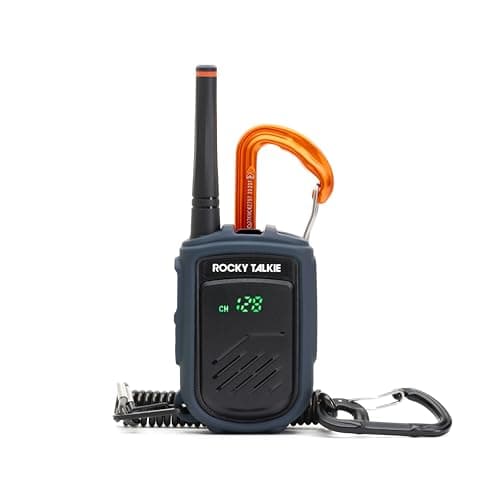
Best for climbers and ski tourers
Rocky Talkie Mountain Radio (single radio)
A rugged license-free radio built for climbers and skiers: 2 W FRS, IP56, a replaceable Li-ion that lasts days in the cold, and a climbing-rated carabiner, with Rocky Talkie's own figure of 1 to 5 miles in mountains.
$120.00Amazon#ad · Price as of November 2, 2026 · How we make money for the link to Rocky Talkie Mountain Radio (single radio)
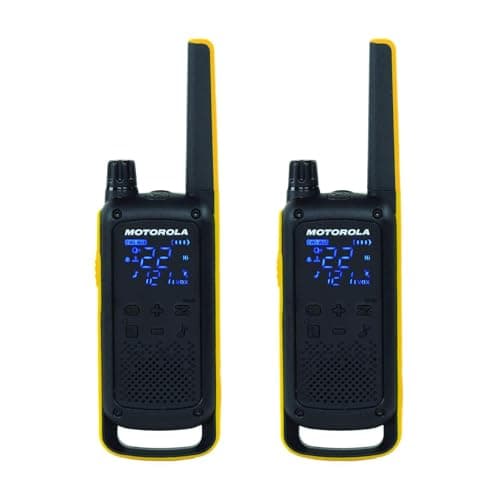
Best Motorola for storm kits
Motorola Talkabout T470 (2-pack)
A solid, splash-resistant family FRS pair with NOAA alerts, a flashlight and AA backup; it suits camping and storm kits, not long-distance talk.
$89.99Amazon#ad · Price as of November 2, 2026 · How we make money for the link to Motorola Talkabout T470 (2-pack)
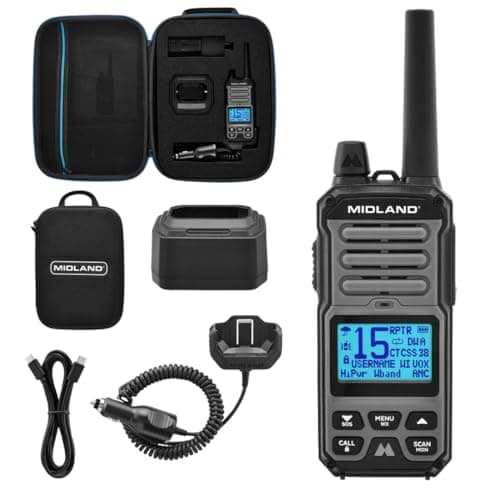
Best Midland handheld for wet weather
Midland GXT67 PRO (single radio)
The IP67 radio in Midland's GXT line: rated at 5 W and repeater capable, with an honest 'up to 5 miles depending on terrain'; it's sold as a single radio with a sealed battery and a fixed antenna, so you'll need two and can't fit a longer antenna.
$219.99Amazon#ad · Price as of November 2, 2026 · How we make money for the link to Midland GXT67 PRO (single radio)
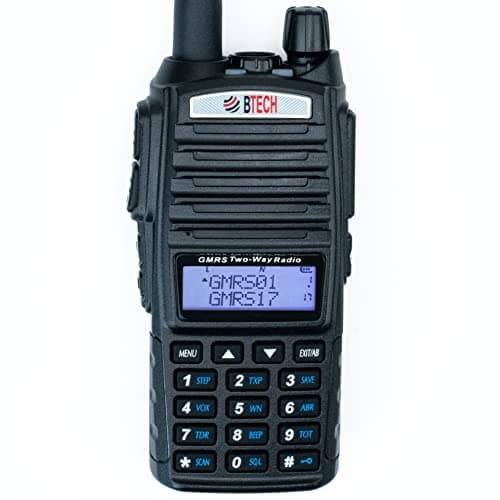
Best budget GMRS for repeater users
BTECH GMRS-V2 (single radio)
A low-cost GMRS handheld rated at 5 W with an SMA antenna connector, repeater support, USB-C and up to 18 hours of battery; it's programmed by keypad menu or CHIRP, so it suits someone willing to learn a menu, not a kid.
Check price · Amazon#ad · Price as of November 2, 2026 · How we make money for the link to BTECH GMRS-V2 (single radio)
Two of them need no license at all. The Rocky Talkie Mountain Radio is the one to buy if you want honesty about range on the box: the maker publishes 1 to 5 miles in mountains and 0.5 to 3 miles in forest and hills (Mountain Radio page), which is a far more useful number than "nationwide". The Motorola T470 is the cheap, sensible pair for a household, with NOAA weather alerts and a stated 28 hours on AA batteries (T470 series page).
The other two are GMRS, for reaching farther without a tower. The Midland GXT67 PRO is IP67 and rated 5 W, with Midland's own "up to 5 miles, depending on the terrain" ( GXT67 FAQs), and the BTECH GMRS-V2 is the budget route to repeater channels and a removable antenna, with BTECH publishing 1 to 5+ miles simplex against 15 to 50+ miles through repeaters (GMRS-V2 page).
The answer is often both
These are not really competitors; they fail in opposite places, which is an argument for owning one of each if your life straddles both. A contractor whose crews work across a city and who hunts on the weekend has two different problems and should buy two different things.
If you want one rule of thumb: buy the network-free radio for the place where you were worried, and the network radio for the place where you were merely inconvenienced. People shop for radios because a phone let them down somewhere specific. Whatever that somewhere is, check it on the coverage map first. Everything else follows from the answer.
If the somewhere was simply "no bars at the campground", start with walkie-talkies without cell service. If it was a wooded property, see radios for wooded areas. If it was your street in a storm, see radios for a neighborhood watch.
How we scored this
Every pick here is backed by the paperwork
Every pick is labeled Researched: we read each maker's published specs, manuals and range tables, check the license rules against the FCC, and score every radio on a public rubric out of 10. Every figure links to where it came from, and every range number is labeled “advertised” so you can see the difference between the box and the terrain.
Scores are our editorial judgment on that documented evidence. Commissions never set a score or decide a pick. The rubric and its weights are published.
What changed
- Published.
Questions
Frequently asked
Do LTE walkie-talkies need a cell signal?
Do LTE walkie-talkies have a monthly fee?
Is an LTE walkie-talkie better than GMRS for long range?
Will an LTE walkie-talkie work in a power outage or hurricane?
Do LTE walkie-talkies need an FCC license?
Can an LTE walkie-talkie talk to a normal walkie-talkie?
Receipts
Sources
- Rapid Radios FAQ: push-to-talk over cellular, IoT SIM cards, no license, 12 months of service included and annual renewal, FCC map recommendation (read 2026-10-19)
- FCC National Broadband Map (checked 2026-10-19)
- FCC: Personal Radio Services, keeping in touch (checked 2026-10-19)
- FCC: Family Radio Service (FRS) page (checked 2026-10-19)
- 47 CFR 95.567, FRS transmit power limits (via Cornell LII, checked 2026-10-19)
- 47 CFR 95.1767, GMRS transmit power limits (via Cornell LII, checked 2026-10-19)
- 47 CFR 95.1705, GMRS licensee and immediate family members (via Cornell LII, checked 2026-10-19)
- 47 CFR 95.303, definition of a repeater station (via Cornell LII, checked 2026-10-19)
- Rocky Talkie: Mountain Radio product page and terrain figures (checked 2026-09-22)
- Motorola Solutions: TALKABOUT T470 series page (checked 2026-09-22)
- Midland: GXT67 FAQs, 5 W and the 5-mile figure (checked 2026-09-22)
- BTECH: GMRS-V2 product page, simplex and repeater figures (checked 2026-09-21)
Specs and range figures come from each maker's own pages and manuals, linked on every product, and license, power and channel rules come from the FCC and 47 CFR Part 95. Range numbers are the maker's advertised claims and are labeled that way, so you can tell the box number from the terrain number. Prices come live from Amazon with the time we checked. Read the full method.