Not legal advice. This page summarizes FCC rules (47 CFR Part 95) from the official sources linked in the text. Rules and fees checked . The FCC sets its fees annually and can change its rules, so confirm the current version on fcc.gov before you rely on it.
Quick picks
The picks at a glance
| # | Product | Best for | Score | Price |
|---|---|---|---|---|
| 1 | 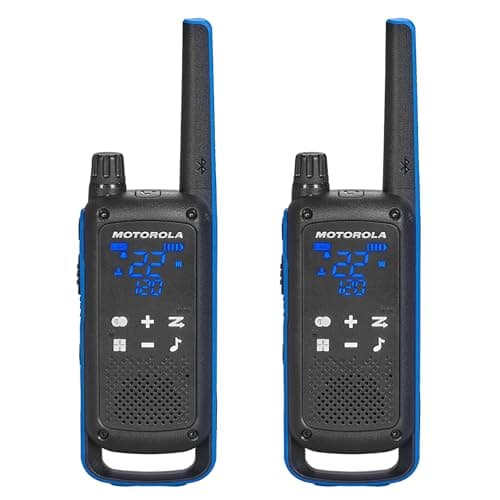 Motorola Talkabout T802 (2-pack) Pairs to the TALKABOUT app over Bluetooth for off-grid group messages and location sharing with what3words. Text beats voice when the stage is louder than you are. | Best for a group that splits upNo licenseMid-price | 6.1/10Researched | $109.99Amazon #ad · Disclosure |
| 2 | 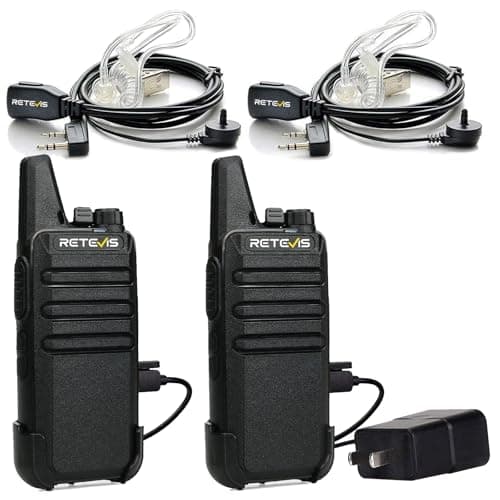 Retevis RT22 (2-pack) 113 g, screenless, channel-locked, USB-C, pre-paired out of the box, with an honest 0.5 to 2 mile published range. Nothing to go wrong at 2am. | Best pocket radioNo licenseBudget | 5.5/10Researched | $29.98Amazon #ad · Disclosure |
| 3 | 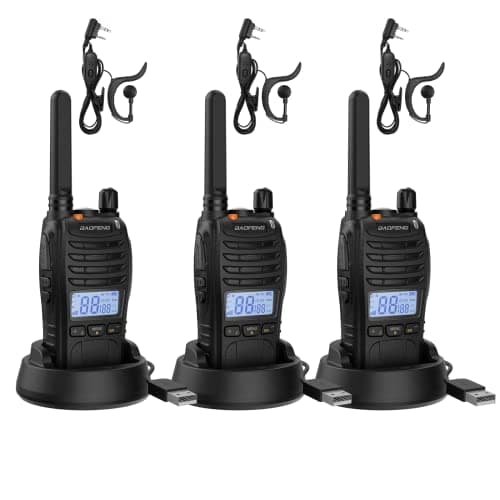 Baofeng BF-88ST Pro FRS (multi-pack) A full 2 W on FRS plus 12 NOAA weather channels, sold in packs of two, three or four, with a headset, clip, lanyard and USB charger with every radio. | Best for a big groupNo licenseBudget | 6.1/10Researched | $41.99Amazon #ad · Disclosure |
| 4 | 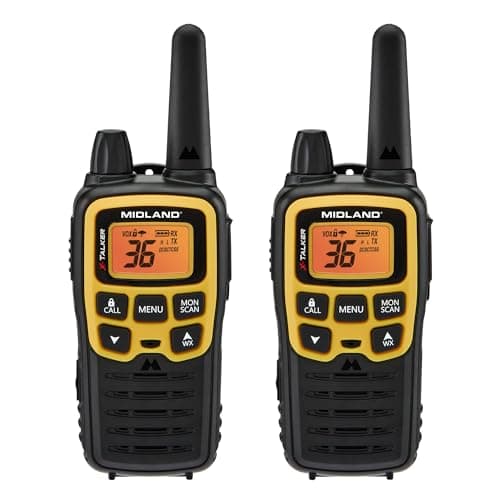 Midland X-Talker T61VP3 (2-pack) Two 700 mAh packs plus a three-AAA fallback, hi/lo power to stretch the charge, NOAA Weather Scan, and a headphone jack. Midland publishes a 6.6 hour runtime figure on high power. | Best battery planNo licenseMid-price | 5.6/10Researched | $79.99Amazon #ad · Disclosure |
| 5 | 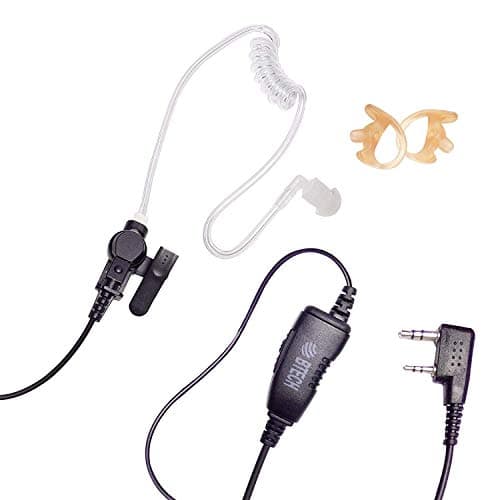 BTECH QHM07 Surveillance Earpiece and Microphone Kit A locking clear-tube surveillance earpiece with an in-line PTT and mic, on the K1 two-pin plug the Retevis and Baofeng radios here use. The accessory that makes a radio usable near a stage. | Best earpiece for a loud fieldAccessoryBudget | 7.3/10Researched | $16.25Amazon #ad · Disclosure |
#ad · Prices come live from Amazon, last checked November 2, 2026. Scores are ours, built from published specs, manuals and FCC rules. Photos come from each product's Amazon listing; a radio we can't show a real photo of is left blank rather than illustrated. Tap a row for the full write-up.
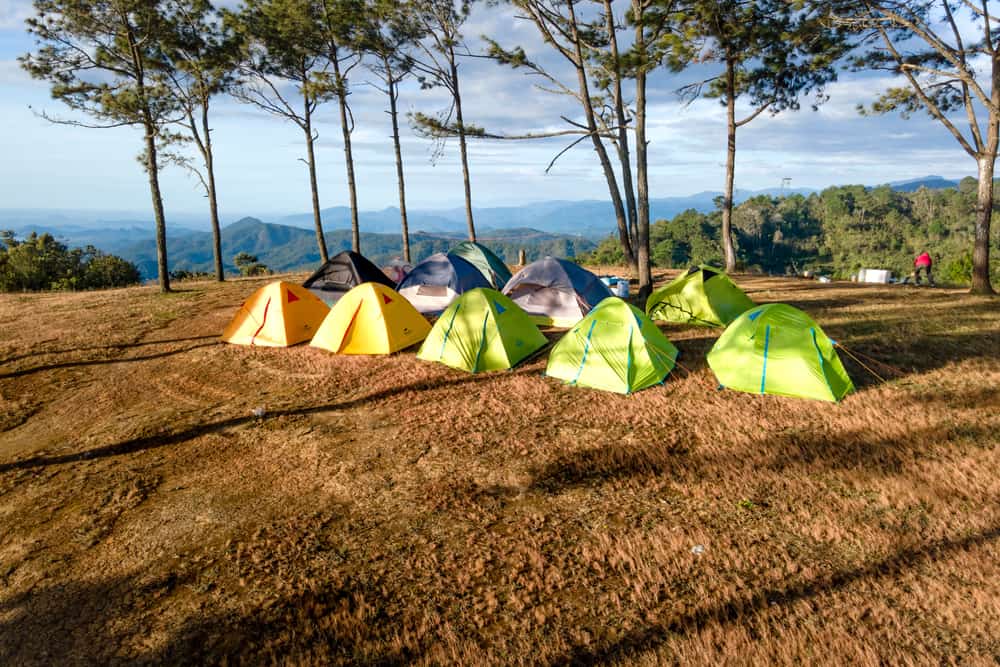
Festivals are the clearest case for a walkie talkie that exists. Tens of thousands of people arrive at one field with one or two cell sites between them, the network degrades to nothing by the first headline set, and the group chat everybody planned around stops delivering. A radio does not share any of that infrastructure: two FRS radios on the same channel talk to each other whether or not a single bar of signal exists anywhere on site.
The catch is that a festival is also a hostile radio environment - a crowd of bodies, metal structures, and a wall of sound that makes a speaker useless. So the picks below are chosen on three things: battery life over a long weekend, a way of communicating that survives the noise, and simplicity at 2am.
Why radios beat phones at a festival
Not better - different, and in this specific environment the difference lands in the radio's favor on three counts:
- No network to congest. Radio-to-radio needs no tower, no data and no account. It is the one thing on site that is not oversubscribed.
- One press reaches everybody. "We are moving to the main stage" goes to the whole group at once, without anybody having to open an app or hear a notification.
- Battery you control. A radio with AAA cells or a spare pack is independent of the charging tent queue, and a radio in standby draws a fraction of what a phone hunting for signal does.
Phones still win for anything that needs a map, a ticket or an emergency call. Carry both - our walkie talkies vs phone apps page works through where each one breaks.
What range you get in a crowd
How we picked
Radios are scored on our published rubric - real-world reach, ease of use, toughness and weather, power and battery, field features and value - and the earpiece on connector fit, hearing and mic in the field, comfort and quiet use, durability and value. The method is on how we rank radios, and every figure comes from the maker's own published specification. These are research picks, not test results.
For festivals we weighted power and battery hardest, then ease of use at night and in a hurry, and gave explicit credit for any way of communicating that does not require being heard over a stage.
The picks in detail
1. Motorola Talkabout T802: the one with off-grid texting
Twenty-two channels and 121 privacy codes, NOAA weather alerts, an emergency alert button, a built-in flashlight, iVOX and VOX hands-free, NiMH rechargeable batteries with USB-C charging, and support for Bluetooth 5.2 audio accessories. The feature that puts it first here is the Bluetooth link to Motorola's TALKABOUT app: off-grid group messaging, location sharing using what3words, and push-to-talk from the phone (Motorola T802/T803 datasheet, Motorola T800 series page). Motorola's documents give it IP54 on the product page and datasheet and IPX4 on the lineup page; read it conservatively as splash-resistant.
Text messaging over the radio link is genuinely the right answer to a festival. Standing forty feet from a PA stack, nobody can hear a radio speaker and nobody can hear you reply - but a short typed message and a what3words location arrive perfectly. That capability, with no network involved, is the single most useful feature on this page.
Buy it if your group splits up and needs to find each other in a crowd. Skip it if you want the simplest possible radio: this is the most feature-heavy pick here, and the app is another thing to set up before you travel.
2. Retevis RT22: the pocket radio
Two watts, 16 channels with CTCSS and DCS codes, a channel lock, no screen, a 1000 mAh Li-ion with USB-C charging and 12 to 24 hours of stated standby, VOX, an emergency alarm, 113 g with the battery, and pairs that arrive already set to the same channel and code. Retevis publishes a flat 0.5 to 2 mile figure and calls the radio "only life-water-resistant" (Retevis RT22 page).
At 113 g this genuinely disappears into a pocket, and the absence of a screen is a feature at a festival: no glow in a dark field, no menu to wander into, and nothing anybody can reconfigure at 2am. It takes the K1 earpiece below, which turns it into a usable radio near a stage. The 16-channel count is the trade - it cannot reach the upper channels on a friend's 22-channel radio.
Buy it if you want a radio you will actually carry all weekend. Skip it if you need NOAA weather alerts, or have to share channels with 22-channel consumer radios.
3. Baofeng BF-88ST Pro: for a big crew
A full 2 W on FRS, 22 FRS channels plus 12 NOAA weather channels, 50 CTCSS tones and 105 DCS codes, dual watch, VOX, two emergency alarm modes, a non-removable antenna, and - the reason it is here - a headset, belt clip, lanyard and USB charger with every radio, in packs of two, three or four (Baofeng BF-88ST Pro page). Baofeng advertises up to 3 miles.
Festivals are group purchases, and this is the cheapest way to put a radio and an earpiece in six or eight hands. Because the headsets are in the box, the crew is equipped for the noise without a second order - which is exactly the step most groups skip and then regret on Friday night. Baofeng publishes no water rating, so a wet weekend needs a zip bag.
Buy it if headcount is the problem and everyone needs an earpiece. Skip it if the forecast is bad or you want an AA fallback: neither is on offer.
4. Midland X-Talker T61VP3: the battery plan
Thirty-six channels as listed and 121 privacy codes, hi/lo power settings, two 700 mAh rechargeable packs plus a three-AAA fallback with a Micro-USB charge jack and a desktop charger, weather alert radio with Weather Scan, five call alerts, eVOX at nine levels, a backlit display, a headphone jack, "water resistant" with no IP rating, and 5 oz per radio. Midland publishes a runtime figure of "6.6 hours at 90-5-5 when being used on Hi power" (Midland T61VP3 page).
That published runtime is unusually honest and it is why this radio earns its place: 6.6 hours on high is one festival day, which tells you plainly that you need the low-power setting, the spare pack and the AAA fallback — all three of which it has. Low power is also the right setting on site, where you are rarely more than a few hundred yards apart.
Buy it if you want a documented battery plan and a hi/lo switch to stretch it. Skip it if weight matters: it is 5 oz against the Retevis's 4.
5. BTECH QHM07: the earpiece that makes any of this work
A K1 two-pin surveillance earpiece with a clear acoustic coil tube that rotates and locks in rather than relying on friction, an in-line PTT and microphone on stainless clips, and an in-ear insert plus left and right open-ear earmolds in the box. BTECH publishes the electricals: mic sensitivity -42 dB +/- 3 dB at 300 ohm, speaker 114 dB +/- 5 dB at 200 ohm (BTECH QHM07 page).
This is the accessory nobody buys and everybody needs. Near a stage, an earpiece is the only way to hear a call at all, and a collar-mounted mic is the only way to be heard. The locking tube matters over a weekend, because a friction-fit coil works loose and ends up dangling. It fits the Retevis and the Baofeng picks here and other Kenwood-style K1 radios; BTECH markets it as noise-canceling without publishing a figure, so treat that as marketing.
Buy it if your radios have a K1 jack. Skip it if they are Midland or Motorola Talkabout - different plugs, and our earpieces and headsets page maps those.
The published specs side by side
In detail
The picks, in full
Rank 01
Best for a group that splits up
Motorola Talkabout T802 (2-pack)
Pairs to the TALKABOUT app over Bluetooth for off-grid group messages and location sharing with what3words. Text beats voice when the stage is louder than you are.
Published specsResearched · every figure sourced
How the 6.1 score breaks down
- Real-world reach (30%)
- 4
- Ease of use (20%)
- 8
- Toughness & weather (15%)
- 5
- Power & battery (15%)
- 6
- Field features (10%)
- 9
- Value (10%)
- 7
What the specs support
- Off-grid texting and location sharing between T800 radios through the phone app, with no license and no cell service
- NOAA alerts, emergency button, flashlight and hands-free VOX in one radio
- USB-C charging
Where it falls short
- Motorola doesn't publish the transmit power, and the antenna is fixed like every FRS radio
- Motorola lists the weather rating as IP54 in one place and IPX4 in another; treat it as splash-resistant only
- The messaging and location features only work with other T800-series radios running the app
Skip this if…
…Skip it if you need to reach someone over a ridge or across miles of timber: app features don't add range, and a GMRS radio with more power will reach farther.
#ad · Price as of November 2, 2026 · How we make money for the link to Motorola Talkabout T802 (2-pack)
Rank 02
Best pocket radio
Retevis RT22 (2-pack)
113 g, screenless, channel-locked, USB-C, pre-paired out of the box, with an honest 0.5 to 2 mile published range. Nothing to go wrong at 2am.
Published specsResearched · every figure sourced
How the 5.5 score breaks down
- Real-world reach (30%)
- 4.5
- Ease of use (20%)
- 8
- Toughness & weather (15%)
- 3
- Power & battery (15%)
- 6
- Field features (10%)
- 4
- Value (10%)
- 8
What the specs support
- States 2 W and a realistic 0.5 to 2 mile range
- USB-C Li-ion and very light
- Pre-paired out of the box; no screen to confuse anyone
Where it falls short
- Only 16 channels, so it can't reach every FRS channel another family's radio might use
- No weather channel, and only light water resistance
Skip this if…
…Skip it if you need NOAA alerts or will match channels with other brands' 22-channel radios: it has 16 channels and no weather receiver.
#ad · Price as of November 2, 2026 · How we make money for the link to Retevis RT22 (2-pack)
Rank 03
Best for a big group
Baofeng BF-88ST Pro FRS (multi-pack)
A full 2 W on FRS plus 12 NOAA weather channels, sold in packs of two, three or four, with a headset, clip, lanyard and USB charger with every radio.
Published specsResearched · every figure sourced
How the 6.1 score breaks down
- Real-world reach (30%)
- 5
- Ease of use (20%)
- 8
- Toughness & weather (15%)
- 3
- Power & battery (15%)
- 7
- Field features (10%)
- 7
- Value (10%)
- 8
What the specs support
- A clear 2 W figure, where the cheaper GT-18 page contradicts itself
- 12 NOAA weather channels with alert scanning
- Two, three or four radios in one box, each with a headset
Where it falls short
- Fixed antenna, so no upgrade path
- No water or dust rating published
- Dual watch and alarms are menu features on a radio with very few buttons
Skip this if…
…Skip it if you need more than about a mile in timber: this is a 2 W FRS radio with a sealed antenna, and no setting changes that.
#ad · Price as of November 2, 2026 · How we make money for the link to Baofeng BF-88ST Pro FRS (multi-pack)
Rank 04
Best battery plan
Midland X-Talker T61VP3 (2-pack)
Two 700 mAh packs plus a three-AAA fallback, hi/lo power to stretch the charge, NOAA Weather Scan, and a headphone jack. Midland publishes a 6.6 hour runtime figure on high power.
Published specsResearched · every figure sourced
How the 5.6 score breaks down
- Real-world reach (30%)
- 4
- Ease of use (20%)
- 8
- Toughness & weather (15%)
- 4
- Power & battery (15%)
- 6
- Field features (10%)
- 7
- Value (10%)
- 6
What the specs support
- Hi/Lo power lets you save battery at short range
- Weather Scan, call alerts and nine-level eVOX
- Headset jack and desktop charger included
Where it falls short
- Midland's own runtime figure is 6.6 hours on high power
- Only "water resistant"; no IP rating
- Midland doesn't publish the transmit power
Skip this if…
…Skip it if you need a full day on high power from one charge: Midland's own figure is 6.6 hours, so pack AAA spares or pick a radio with a bigger battery.
#ad · Price as of November 2, 2026 · How we make money for the link to Midland X-Talker T61VP3 (2-pack)
Rank 05
Best earpiece for a loud field
BTECH QHM07 Surveillance Earpiece and Microphone Kit
A locking clear-tube surveillance earpiece with an in-line PTT and mic, on the K1 two-pin plug the Retevis and Baofeng radios here use. The accessory that makes a radio usable near a stage.
Published specsResearched · every figure sourced
How the 7.3 score breaks down
- Connector fit (30%)
- 8
- Hearing & mic in the field (25%)
- 6
- Comfort & quiet use (20%)
- 8
- Durability (15%)
- 6
- Value (10%)
- 9
What the specs support
- K1 two-pin plug for the BTECH GMRS-V2, FRS-A1 and other Kenwood-style radios
- Coil tube locks in rather than relying on friction; stainless strain-relief clips
- Includes an in-ear earbud and left/right open-ear earmolds
Where it falls short
- Noise canceling is in the product name, but BTECH publishes no noise-reduction figure
- No weather rating or warranty length stated
- Not on BTECH's fit list for its own GMRS-PRO
Skip this if…
…Skip it if your radio has no Kenwood-style K1 two-pin jack (Midland, Motorola Talkabout, Rocky Talkie Expedition) or is a BTECH GMRS-PRO: BTECH lists it only for K1 radios.
#ad · Price as of November 2, 2026 · How we make money for the link to BTECH QHM07 Surveillance Earpiece and Microphone Kit
The festival channel and battery plan
At a festival the plan matters more than the radio, because tens of thousands of people are sharing 22 channels and a week of battery life does not exist.
- Agree a channel and a privacy code before you travel, plus two backups. Write all three on tape inside each battery door. FRS channels at a big event are busy, and "go to 17-5" needs to be a plan rather than a negotiation.
- Expect to share. A privacy code stops your radio unmuting for other people's traffic; it does not give you the channel. If your first choice is swamped, move - that is what the backups are for.
- Run low power on site. You are a few hundred yards apart. Low power roughly doubles what Midland's 6.6 hour high-power figure gives you.
- One spare pack or two spare cell sets per radio, and charge overnight from a power bank. Treat the on-site charging tent as a bonus, never a plan.
- Earpiece in, speaker off, near the stages. Non-negotiable if you want the radio to work where it matters most.
- Agree a physical meeting point and a time, because somewhere on a big site the radios will not reach. A flag, a food stall, the top of a specific path.
- Keep traffic short. Press, pause, one sentence, release. Long transmissions eat battery and block a shared channel for everyone else on it.
What to look for
- A battery plan, not a battery claim. A spare pack, an AA or AAA fallback, or a documented runtime and a low-power setting. Ideally all of them.
- A headset jack, or earpieces in the box. The difference between a radio that works at a festival and one that does not.
- Twenty-two standard FRS channels if anyone outside your group might need to reach you.
- A channel lock, so nothing drifts overnight or in a pocket.
- Light and pocketable. Four to five ounces. A radio in a tent is not a radio.
- Off-grid messaging if your group splits often - currently the T802's app link is the way to get it on a license-free radio.
- A zip bag for rain. Only one radio here publishes any water rating at all, and it is splash-level.
How we scored this
Every pick here is backed by the paperwork
Every pick is labeled Researched: we read each maker's published specs, manuals and range tables, check the license rules against the FCC, and score every radio on a public rubric out of 10. Every figure links to where it came from, and every range number is labeled “advertised” so you can see the difference between the box and the terrain.
Scores are our editorial judgment on that documented evidence. Commissions never set a score or decide a pick. The rubric and its weights are published.
What changed
- Published.
Questions
Frequently asked
Do walkie talkies work at festivals?
What is the best walkie talkie for a festival?
Do festival walkie talkies need a license?
How do you hear a walkie talkie near a loud stage?
What channel should a festival group use?
Receipts
Sources
- Motorola: Talkabout T800 series product page (checked 2026-10-11)
- Motorola: T802/T803 TALKABOUT datasheet (checked 2026-10-11)
- Retevis: RT22 product page (checked 2026-10-11)
- Baofeng: BF-88ST Pro FRS/PMR product page (checked 2026-10-11)
- Midland: X-Talker T61VP3 product page (checked 2026-10-11)
- BTECH: QHM07 surveillance earpiece product page (checked 2026-10-11)
- FCC: Family Radio Service (FRS) page (checked 2026-10-11)
- FCC: Personal Radio Services consumer guide (checked 2026-10-11)
- 47 CFR 95.531, FRS channel power limits (via Cornell LII, checked 2026-10-11)
Specs and range figures come from each maker's own pages and manuals, linked on every product, and license, power and channel rules come from the FCC and 47 CFR Part 95. Range numbers are the maker's advertised claims and are labeled that way, so you can tell the box number from the terrain number. Prices come live from Amazon with the time we checked. Read the full method.