Not legal advice. This page summarizes FCC rules (47 CFR Part 95) from the official sources linked in the text. Rules and fees checked . The FCC sets its fees annually and can change its rules, so confirm the current version on fcc.gov before you rely on it.
Quick picks
The picks at a glance
| # | Product | Best for | Score | Price |
|---|---|---|---|---|
| 1 |  Rocky Talkie Mountain Radio (single radio) License-free, IP56, and a replaceable battery Rocky Talkie rates at 3 to 5 days, so a weekend never needs an outlet. Its own forest figure is 0.5 to 3 miles. | Best for campingNo licenseMid-price | 6.7/10Researched | Check price · Amazon #ad · Disclosure |
| 2 | Midland X-Talker T71VP3 (2-pack) A two-pack with NOAA Weather Scan and a 3 x AA fallback, so a dead pack at a site with no power is a five-minute fix. Midland's own runtime on high is about 5 hours. | Best license-free pair for a campsiteNo licenseMid-price | 5.7/10Researched | Check price · Amazon #ad · Disclosure |
| 3 | Motorola Talkabout T605 H2O (2-pack) IP67, floats face up on the included NiMH pack, and the flashlight switches on in water. Up to 23 hours on three AAs by Motorola's datasheet. | Best for rain, lakes and canoe campsNo licenseMid-price | 6.8/10Researched | Check price · Amazon #ad · Disclosure |
| 4 |  Midland GXT1000VP4 (2-pack) More power and NOAA alerts for sprawling state-park loops, and Midland is refreshingly blunt: it says the GXT averages half a mile to 2 miles in normal conditions. | Best GMRS pair for a big campground (license)GMRS licenseMid-price | 6.1/10Researched | Check price · Amazon #ad · Disclosure |
| 5 | Rocky Talkie Expedition Radio (single radio) 5 W GMRS, a removable antenna, repeater channels and IP67, with a 4 to 6 day battery. Rocky Talkie's forest figure is 0.5 to 5 miles. Sold one at a time. | Best for dispersed and backcountry camps (license)GMRS licensePremium | 7.9/10Researched | Check price · Amazon #ad · Disclosure |
| 6 | Baofeng GT-18 (3-pack) Three license-free radios with NOAA and a flashlight for very little. Baofeng claims only 3 miles, lists no water rating, and rates it down to 32 degrees F. | Best cheap three-pack for a group campNo licenseBudget | 5.3/10Researched | Check price · Amazon #ad · Disclosure |
#ad · Prices are set by Amazon and change often, so we don't print them. Scores are ours, built from published specs, manuals and FCC rules, not hands-on tests. Photos are illustrative stock. Tap a row for the full write-up.
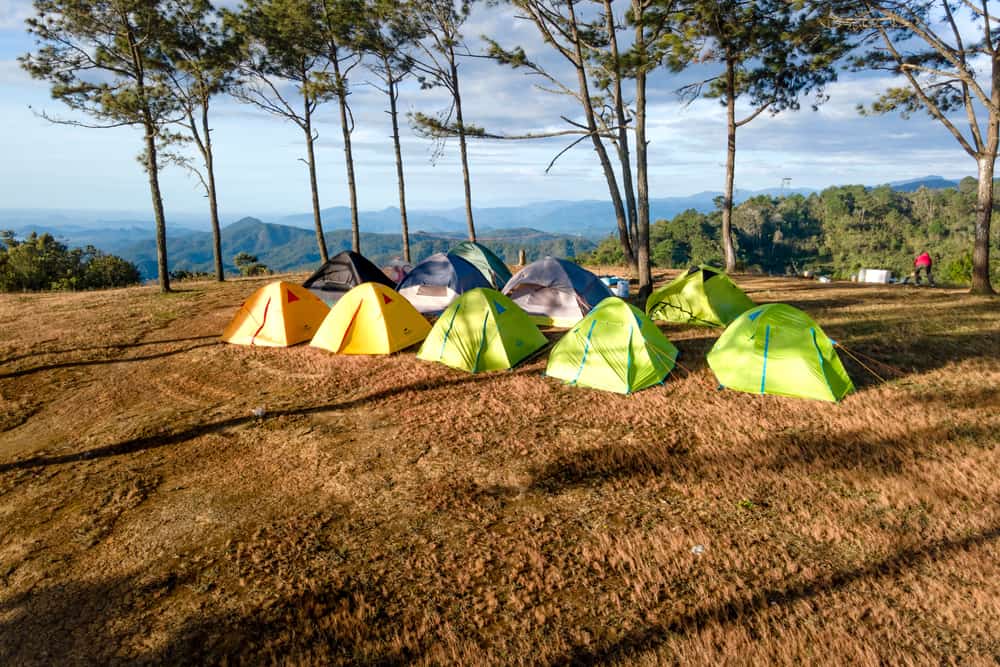
Camping is the use case walkie-talkies were made for. Somebody walks to the bathhouse, somebody takes the kids to the creek, somebody drives out for ice, and the bars on your phone go from two to none the moment you turn off the highway. The distances are usually small: a campground loop, a trailhead half a mile back, the far end of a dispersed site. That is good news, because small distances are exactly what a license-free radio does well.
What matters at camp isn't the mileage number on the box. It's whether the radio still works Sunday morning after nobody charged anything since Friday, whether it survives an afternoon of rain, and whether it can hear a National Weather Service warning before the sky goes green. Those three things drove this list.
How we picked
We scored every radio on our published rubric (real-world reach, ease of use, toughness, power and battery, field features and value) from the makers' own product pages, spec sheets, manuals and datasheets, plus FCC rules; the method is on how we rank radios. These are research picks from published specs, not a season of camping trips, and every figure below is linked to the page it came from.
For camping we weighted four things harder than usual. Battery you can plan around, because campsites don't have outlets: a multi-day rating, a replaceable pack, USB charging off a power bank, or a plain AA fallback. Rain and dust, because the radio lives on a picnic table. NOAA weather alerts, because a camper is the person least likely to hear a warning any other way. And simple operation, because half the people holding one will be kids or in-laws who have never used a radio. Availability was checked on each maker's own store on 2026-09-24; everything here was in stock and sold as a current model on that date. These picks sit in our kids, camp and family hub.
What actually reaches at camp
Four of the six radios here are FRS, which the FCC caps at 2 watts on channels 1 to 7 and 15 to 22, and 0.5 watts on channels 8 to 14 (FCC FRS page). The FCC's own consumer guide tells you what that buys: FRS radios reach "up to two miles on the 2 watt channels, depending on conditions" ( FCC personal radio services guide). Trees, wet foliage and a ridge between you and the trailhead all cut into that. Here is what each maker says, side by side:
| Radio | Maker's figure for woods and hills | Maker's best-case figure |
|---|---|---|
| Rocky Talkie Mountain Radio (FRS) | Forest/hills: 0.5 to 3 miles; mountains: 1 to 5 miles | Line of sight: 35+ miles |
| Rocky Talkie Expedition Radio (GMRS) | Forest/hills: 0.5 to 5 miles; rivers: 0.5 to 3 miles | Line of sight: 35+ miles |
| Midland GXT1000VP4 (GMRS) | Midland's FAQ: "The GXT averages 1/2-2 miles in normal conditions" | "Up to 36 miles" over water or open rural areas |
| Midland X-Talker T71VP3 (FRS) | No terrain figure published | "Up to 38 miles" |
| Motorola Talkabout T605 H2O (FRS) | Neighborhood up to 2 miles; open water up to 6 miles | "Up to 35 miles" mountain to valley |
| Baofeng GT-18 (FRS) | No terrain figure published | "Up to 3 miles" |
Read the middle column, not the right one. Half a mile to two miles through woods is the honest planning number, and it is plenty for a campground. If your camp and your trailhead are farther apart than that, no handheld fixes it; height does. Our guide to how far walkie-talkies reach explains why, and walkie-talkie range claims explained takes apart the box numbers.
Campground or dispersed?
At a developed campground, buy license-free FRS and stop thinking about it. Loop roads, bathhouses and a camp store are all inside a mile, everyone in the group can legally key up regardless of age, and the radios cost a fraction of the GMRS ones. The Rocky Talkie Mountain Radio, the Midland T71VP3 pair and the Motorola T605 all land here.
Dispersed camping changes the math. You're a mile down a forest road, the group splits between camp and a fishing spot, and there is no signal for anyone to fall back on. That's where GMRS earns its license: more power, and on the Expedition Radio a removable antenna and repeater access. The FCC requires an individual license to operate a GMRS system; it runs ten years, the applicant must be 18 or older (FCC GMRS page), and one license covers the licensee's immediate family, children included (47 CFR 95.1705). For a family that camps every weekend, that is one form for the whole crew. Our GMRS license guide and GMRS vs FRS lay out the trade.
The picks in detail
1. Rocky Talkie Mountain Radio: best for camping
Rocky Talkie built this for climbers and skiers, and the same three features are the ones that matter at a campsite: a replaceable 1550 mAh lithium-ion battery rated for 3 to 5 days, IP56 splash and snow protection, and a climbing-rated carabiner with a metal-reinforced backup leash (Rocky Talkie Mountain Radio page). It's 2 W FRS, so no license, and it charges over USB-C, so a small power bank covers a week. Channel lock is the underrated part: nobody's pocket moves the group off channel.
The catch is real. It's sold one radio at a time, so a pair costs twice the listed tier, and Rocky Talkie lists no NOAA weather channel and no VOX. Buy it if you want one radio that will still be alive on day four and you don't mind buying two. Skip it if you want weather alerts built in or you need to equip four people cheaply.
2. Midland X-Talker T71VP3: best license-free pair for a campsite
If you'd rather open one box and hand someone a radio, this is the pair. Midland gives it 36 channels and 121 privacy codes, hi/lo power, eVOX hands-free, a headphone jack and, importantly for camping, a NOAA Weather Alert radio with Weather Scan (Midland T71VP3 page). It runs on two included 1000 mAh packs or three AA batteries, and the box has a desktop charger, a wall adapter and a Micro-USB cable.
Midland is honest about the downside and so are we: the company's own figure is "around 5 hours at 90-5-5 when being used on Hi power." At a campsite that means running low power around camp and carrying AAs, which is exactly why the AA fallback matters. It's also only "water resistant" with no IP rating, and Midland doesn't publish the transmit power. Buy it if you want two radios, weather alerts and a battery you can fix with a trip to the camp store. Skip it if the radios will be out in real rain.
3. Motorola Talkabout T605 H2O: best for rain, lakes and canoe camps
Camp near water and the ranking changes. The T605 is IP67, rated to survive submersion to 1 meter for 30 minutes, and it floats face up with the included NiMH battery, with a red/white flashlight that switches on when it hits the water (Motorola TALKABOUT T600 series page). Motorola's datasheet gives up to 9 hours on the 800 mAh NiMH pack and up to 23 hours on three AA alkalines, over USB-C charging, with NOAA weather alerts on 11 weather channels, an emergency alert button and dual watch (Motorola T605 datasheet). The 2-pack ships with a carry case, four NiMH batteries and two earpieces.
Motorola doesn't publish the transmit power, reach is ordinary FRS, and the company notes it may not float with some AA batteries and that headset use is for dry conditions only. Buy it if your camping involves canoes, kayaks, a lake shore or a week of forecast rain. Skip it if you camp dry and would rather put the money into battery life.
4. Midland GXT1000VP4: best GMRS pair for a big campground (license)
The GXT1000VP4 is the radio most people picture when they think "camping walkie-talkie," and it is a genuinely good sprawling-state-park pair: 50 channels, 142 privacy codes, high/medium/low power, NOAA weather alerts with weather scan, an SOS siren, whisper mode and eVOX, on rechargeable NiMH packs or four AA batteries (Midland GXT1000VP4 page). It is GMRS, so the FCC license applies, and the whole family is covered by it.
Midland deserves credit for publishing what the box doesn't: its FAQ says "The GXT averages 1/2-2 miles in normal conditions," against the 36 miles on the front of the package. There are no repeater channels, the JIS4 rating is splash protection only and is lost with an accessory plugged in, and the desktop charger takes 12 hours. Buy it if you want a familiar, simple pair with more power and more weather features than FRS gives you. Skip it if you want repeater access or a fast USB top-up.
5. Rocky Talkie Expedition Radio: best for dispersed and backcountry camps (license)
For a camp a long way off pavement, this is the step up. It's 5 W GMRS with a removable SMA antenna (7.5 cm and 17 cm both in the box), 8 GMRS repeater channels, IP67, NOAA weather channels with alert monitoring, and a replaceable 1800 mAh battery Rocky Talkie rates at 4 to 6 days on USB-C (Rocky Talkie Expedition Radio page). Its published forest figure is 0.5 to 5 miles, against 0.5 to 3 for the license-free Mountain Radio: a real improvement, not a marketing one.
It needs a GMRS license, it's sold as a single radio in the premium tier, and Rocky Talkie lists no VOX and no flashlight. Buy it if your group disperses across miles of forest road and someone will hold the license. Skip it if you camp in developed campgrounds, where the Mountain Radio does the same job with no paperwork. Our Rocky Talkie Mountain vs Expedition comparison goes deeper.
6. Baofeng GT-18: best cheap three-pack for a group camp
Two families at one site, or three kids who each want one, and you don't want to spend much: the GT-18 is three license-free FRS radios with 22 FRS channels plus NOAA weather, a backlit LCD, dual push-to-talk buttons, a flashlight, and earpieces and lanyards in the box, on a 1500 mAh Li-ion rated at up to 3 days (Baofeng GT-18 page).
Be clear-eyed about it. Baofeng's own page gives conflicting power figures (a 0.5 W product tag against a 2W/0.5W comparison chart), claims only 3 miles, lists no water rating at all, charges over Micro-USB, and rates the radio for 0 to 40 degrees C (32 to 104 degrees F), which rules out a frosty shoulder-season morning. Buy it if you need three radios for a fair-weather group camp on a small budget. Skip it if the radios will get rained on or see a cold night.
The specs side by side
That's the four radios most campers will choose between; the two GMRS-only outliers (the Expedition Radio and the GT-18 three-pack) are covered on their cards above. The pattern worth noticing: the radio with the best battery has no weather receiver, and the one with the best weather features has the shortest stated runtime on high power. Pick the compromise that matches your trip.
Keeping them alive with no outlet
This is where camping trips actually fail. A radio that died Saturday afternoon is worse than no radio, because people are counting on it. Three workable strategies, all straight off the spec sheets above:
- Multi-day battery plus USB-C. The Mountain Radio (3 to 5 days) and Expedition Radio (4 to 6 days) are both replaceable packs charged over USB-C, so one modest power bank keeps a pair going for a week. Both figures are the maker's.
- AA or AAA fallback. The T71VP3 takes three AAs, the T605 takes three AAs for a stated 23 hours, the GXT1000VP4 takes four. Alkalines are sold at every camp store and gas station in America, and they don't care whether you remembered a cable.
- Low power around camp. Radios with hi/lo settings (the T71VP3, the GXT1000VP4, both Rocky Talkies) cover a campground loop fine on low, and low power is where the runtime figures get much better.
One more habit worth building: turn the radios off at night. Nothing on this list has a standby mode that survives a weekend of being left on with the squelch open.
Weather alerts at a campsite
A tent is the worst place in America to be surprised by a storm. NOAA Weather Radio All Hazards "broadcasts official Weather Service warnings, watches, forecasts and other hazard information 24 hours a day, 7 days a week," from "more than 1000 transmitters, covering all 50 states" and adjacent waters and territories, on seven VHF frequencies between 162.400 and 162.550 MHz (National Weather Service: NOAA Weather Radio). The Weather Service is explicit that it "requires a special radio receiver or scanner capable of picking up the signal."
Four radios here have that receiver built in: the T71VP3 and GXT1000VP4 with Midland's Weather Scan, the T605 with 11 weather channels and alerts, and the Expedition Radio with NOAA channels and emergency alert monitoring. The Mountain Radio does not, which is the single biggest argument against it as a camping radio and the reason many people pair it with a small dedicated weather radio. If severe weather is the main reason you're buying, read best walkie-talkies for emergencies before you choose.
In detail
The picks, in full
Rank 01
Stock photoBest for camping
Rocky Talkie Mountain Radio (single radio)
License-free, IP56, and a replaceable battery Rocky Talkie rates at 3 to 5 days, so a weekend never needs an outlet. Its own forest figure is 0.5 to 3 miles.
Published specsResearched · not tested by us
How the 6.7 score breaks down
- Real-world reach (30%)
- 5
- Ease of use (20%)
- 9
- Toughness & weather (15%)
- 8
- Power & battery (15%)
- 8
- Field features (10%)
- 4
- Value (10%)
- 6
What the specs support
- Publishes honest terrain figures (1 to 5 miles in mountains), not just a box number
- IP56, shatterproof screen and a real climbing carabiner with a leash
- Replaceable Li-ion rated for 3 to 5 days, with USB-C
- Channel lock keeps a group from drifting off channel
Where it falls short
- Sold as a single radio, so a pair costs twice the listed tier
- No NOAA weather channel or VOX
- Fixed antenna and FRS power limit its reach like any FRS radio
Skip this if…
…Skip it if you need to reach a partner several ridges away or hit a repeater: at 2 W FRS with a fixed antenna, the GMRS Expedition Radio is the Rocky Talkie for that.
#ad · Price set by Amazon · How we make money for the link to Rocky Talkie Mountain Radio (single radio)
Rank 02
Stock photoBest license-free pair for a campsite
Midland X-Talker T71VP3 (2-pack)
A two-pack with NOAA Weather Scan and a 3 x AA fallback, so a dead pack at a site with no power is a five-minute fix. Midland's own runtime on high is about 5 hours.
Published specsResearched · not tested by us
How the 5.7 score breaks down
- Real-world reach (30%)
- 4
- Ease of use (20%)
- 8
- Toughness & weather (15%)
- 4
- Power & battery (15%)
- 6
- Field features (10%)
- 7
- Value (10%)
- 7
What the specs support
- AA fallback plus 1000 mAh packs and a full charging kit
- Weather Scan, silent mode and hands-free eVOX
- Works with any other FRS or GMRS radio on the shared FRS channels
Where it falls short
- Midland's own runtime figure is about 5 hours on high power
- Only "water resistant"; no IP rating
- Transmit power isn't published, and FRS rules still cap what it can do
Skip this if…
…Skip it if you're buying it for the "38 miles": through hills and trees it's still a fixed-antenna FRS radio, and a GMRS radio is the real step up in reach.
#ad · Price set by Amazon · How we make money for the link to Midland X-Talker T71VP3 (2-pack)
Rank 03
Stock photoBest for rain, lakes and canoe camps
Motorola Talkabout T605 H2O (2-pack)
IP67, floats face up on the included NiMH pack, and the flashlight switches on in water. Up to 23 hours on three AAs by Motorola's datasheet.
Published specsResearched · not tested by us
How the 6.8 score breaks down
- Real-world reach (30%)
- 4
- Ease of use (20%)
- 8
- Toughness & weather (15%)
- 9
- Power & battery (15%)
- 7
- Field features (10%)
- 8
- Value (10%)
- 8
What the specs support
- IP67 and it floats face up, with a flashlight that switches on when it hits the water
- Runs on the NiMH pack or three AA batteries, so a dead pack isn't the end of the day
- The T605 pack adds a case, spare batteries and earpieces
Where it falls short
- Motorola doesn't publish the transmit power; reach is ordinary FRS
- It may not float with some AA batteries, per Motorola
- Headset use is for dry conditions only
Skip this if…
…Skip it if you need to talk between boats or trucks miles apart: IP67 keeps it alive in the lake, but a fixed-antenna FRS radio won't cover that distance.
#ad · Price set by Amazon · How we make money for the link to Motorola Talkabout T605 H2O (2-pack)
Rank 04
Stock photoBest GMRS pair for a big campground (license)
Midland GXT1000VP4 (2-pack)
More power and NOAA alerts for sprawling state-park loops, and Midland is refreshingly blunt: it says the GXT averages half a mile to 2 miles in normal conditions.
Published specsResearched · not tested by us
How the 6.1 score breaks down
- Real-world reach (30%)
- 5
- Ease of use (20%)
- 7
- Toughness & weather (15%)
- 5
- Power & battery (15%)
- 7
- Field features (10%)
- 7
- Value (10%)
- 7
What the specs support
- Midland publishes a realistic figure (1/2 to 2 miles in normal conditions), so you know what the pair will really do
- Runs on the included NiMH packs or 4 AA batteries, so a dead pack doesn't end the day
- NOAA weather alerts, SOS siren and e-VOX hands-free are built in
Where it falls short
- No repeater channels, and Midland doesn't state the transmit power
- JIS4 is splash protection only, and it's lost when a headset is plugged in
- Slow desktop charging (12 hours) with no USB port
Skip this if…
…Skip it if you need to reach across a ridge or hit a local repeater: there are no repeater channels, and Midland itself says to expect 1/2 to 2 miles in normal conditions.
#ad · Price set by Amazon · How we make money for the link to Midland GXT1000VP4 (2-pack)
Rank 05
Stock photoBest for dispersed and backcountry camps (license)
Rocky Talkie Expedition Radio (single radio)
5 W GMRS, a removable antenna, repeater channels and IP67, with a 4 to 6 day battery. Rocky Talkie's forest figure is 0.5 to 5 miles. Sold one at a time.
Published specsResearched · not tested by us
| Service / license | GMRS (FRS compatible); GMRS license required, US use only |
|---|---|
| Transmit power | 5 W |
| Channels | 22 channels, 121 privacy codes (CTCSS and DCS); channel lock, high/low power, scan, dual channel watch |
| Repeater and antenna | Repeater capable (8 GMRS repeater channels); removable SMA-male antenna, 7.5 cm and 17 cm antennas included |
| Water rating | IP67 (1 meter submersion) |
| Battery | Replaceable 7.4 V 1800 mAh Li-ion, USB-C; "4–6 days" per chargeAdvertised |
| Weather and weight | NOAA weather channels and emergency alert monitoring; 9.1 oz |
| Advertised range | "max range of over 35 miles, with 2–8 miles more typical in backcountry terrain"Advertised |
| Maker's terrain figures | Line-of-sight 35+ miles; mountains 2 to 8 miles; forest/hills 0.5 to 5 miles; rivers 0.5 to 3 miles; city up to 1.5 milesAdvertised |
How the 7.9 score breaks down
- Real-world reach (30%)
- 8
- Ease of use (20%)
- 8
- Toughness & weather (15%)
- 9
- Power & battery (15%)
- 8
- Field features (10%)
- 7
- Value (10%)
- 6
What the specs support
- Removable SMA antenna with short and long options, plus 8 repeater channels
- IP67 with a replaceable Li-ion battery and USB-C, rated for 4-6 days
- The maker publishes terrain-by-terrain range, not just a box number
- Channel lock and a simple 22-channel layout
Where it falls short
- Sold as a single radio, so a pair lands firmly in the premium tier
- No VOX hands-free or flashlight listed by the maker
Skip this if…
…Skip it if you don't want a GMRS license: it's a GMRS radio, and Rocky Talkie's license-free Mountain Radio (FRS, 2 W) covers most trail use.
#ad · Price set by Amazon · How we make money for the link to Rocky Talkie Expedition Radio (single radio)
Rank 06
Stock photoBest cheap three-pack for a group camp
Baofeng GT-18 (3-pack)
Three license-free radios with NOAA and a flashlight for very little. Baofeng claims only 3 miles, lists no water rating, and rates it down to 32 degrees F.
Published specsResearched · not tested by us
How the 5.3 score breaks down
- Real-world reach (30%)
- 3
- Ease of use (20%)
- 8
- Toughness & weather (15%)
- 3
- Power & battery (15%)
- 6
- Field features (10%)
- 6
- Value (10%)
- 8
What the specs support
- Three radios, with earpieces and lanyards, at the budget tier
- NOAA weather and a flashlight
- Modest 3-mile claim instead of an inflated box number
Where it falls short
- Baofeng's own page gives conflicting power figures (0.5 W vs 2W / 0.5W)
- Rated to operate only down to 0 degrees C
- Micro-USB charging and no stated water rating
Skip this if…
…Skip it if you'll use it on a ski hill or a winter hunt: Baofeng rates it for 0 to 40 degrees C, and its power figure is unclear.
#ad · Price set by Amazon · How we make money for the link to Baofeng GT-18 (3-pack)
What to look for in walkie-talkies for camping
- A battery plan, not a battery number. Either a multi-day rating with USB charging, or a plain AA fallback you can buy at the camp store. Ideally both.
- NOAA weather alerts. Free, built into most of these radios, and the one feature you'll be glad of at 2 a.m.
- Rain protection you can name. IP67 (T605, Expedition) or IP56 (Mountain Radio) means something. "Water resistant" with no rating, as on the X-Talkers, means keep it under the awning.
- License-free unless you camp dispersed. FRS covers a campground and anyone may use it. GMRS is for the mile-down-a-forest-road camp, and the license covers your whole immediate family.
- Channel lock or a keypad lock. Radios ride in pockets and get sat on. A locked channel is a group that can still hear each other after lunch.
- Enough radios. Two radios split three ways is the most common camping mistake. Count the people who will actually wander off, then buy that many.
If you're buying for a whole household rather than a trip, our best walkie-talkies for families ranks the multi-packs, and best walkie-talkies without a license covers the no-paperwork options in more depth.
Camping with kids on radios
A campground is the best place there is to hand a kid a radio: the distances are short, the landmarks are obvious, and there is a genuine reason to check in. Three rules make it work. Lock the channel before you hand it over. Write your site number on a piece of tape on the back, so a helpful stranger can walk them home. And teach one sentence: if you can't raise us, go back to the site and wait.
Pick something small with a keypad lock and a belt clip rather than the biggest radio you own, and check the volume is set where they can hear it with a creek running. Our best walkie-talkies for kids ranks radios by age, and walkie-talkie games and lingo for kids turns the practice run into something they'll actually do.
A camp channel plan
- Pick one channel and one privacy code at the trailhead, before anyone splits up. Use a 2-watt channel (1 to 7 or 15 to 22) rather than the low-power 8 to 14 group. Privacy codes only filter what you hear; anyone on the channel can still hear you, as our privacy codes guide explains.
- Agree a backup channel for a holiday weekend when the campground is full and channel 1 sounds like a CB convoy. Our walkie-talkie channels guide covers which ones to try.
- Set check-in times rather than talking constantly: top of the hour, or on arrival at the trailhead. It saves battery and it saves everyone's patience.
- Name a meeting spot that a ten-year-old could find: your site, the bathhouse, the camp store.
- Respect quiet hours. A radio on high volume at a campsite carries farther than your voice does. Turn it down after dark or use an earpiece; our earpieces and headsets guide has options by plug type.
A radio is not a rescue device
How we scored this
Radios we claim to have lab-tested: 0
Plenty of radio sites say they range-tested everything they list. We haven't, and we say so. Every pick here is labeled Researched: we read each maker's published specs, manuals and range tables, check the license rules against the FCC, and score every radio on a public rubric. Every figure links to where it came from, and every range number is labeled “advertised.”
Scores are editorial judgments from that documented research, not test results. Commissions never set a score or decide a pick. The rubric and its weights are published.
What changed
- Published.
Questions
Frequently asked
What are the best walkie-talkies for camping?
Do I need a license for walkie-talkies while camping?
How far will walkie-talkies reach at a campground?
Which camping radios have NOAA weather alerts?
Can walkie-talkies call for help if something goes wrong at camp?
Receipts
Sources
- Rocky Talkie: Mountain Radio product page (checked 2026-09-24)
- Rocky Talkie: Expedition Radio product page (checked 2026-09-24)
- Midland: T71VP3 X-Talker product page (checked 2026-09-24)
- Midland: GXT1000VP4 product page (checked 2026-09-24)
- Motorola Solutions: TALKABOUT T600 H2O series product page (checked 2026-09-22)
- Motorola Solutions: T605 H2O datasheet PDF (checked 2026-09-22)
- Baofeng: GT-18 FRS/PMR 3-pack product page (checked 2026-09-24)
- FCC: Family Radio Service (FRS) page (checked 2026-09-24)
- FCC: General Mobile Radio Service (GMRS) page (checked 2026-09-24)
- FCC: Personal Radio Services consumer guide (checked 2026-09-24)
- Cornell LII: 47 CFR 95.1705 (GMRS licensing, checked 2026-09-24)
- National Weather Service: NOAA Weather Radio All Hazards (checked 2026-09-24)
We haven't tested the radios on this page and we don't pretend to. Specs and range figures come from each maker's own pages and manuals (linked on every product), and license, power and channel rules come from the FCC and 47 CFR Part 95. Range numbers are the maker's advertised claims and are labeled that way. Prices are set by Amazon and change often, so we don't print them. Where a figure isn't published, we say so. Read the full method.