Most kids' walkie-talkies get a big first afternoon, then end up in a drawer. The fix isn't a better radio. It's a reason to press the button. Games give them that, and they sneak in real radio skills along the way: waiting your turn, saying it short, and checking the other person heard you. Those are the same habits that make radios useful on a camping trip, at a ski hill or in a storm.
Before you play: set up in five minutes
- Put every radio on the same channel and the same privacy code. Or turn codes off on all of them. Write the channel on a piece of tape on the back of each radio. Our guide to which walkie-talkie channel to use explains how to pick a quiet one.
- For a backyard game, a low-power channel is plenty. On FRS radios, channels 8 to 14 are limited to 0.5 watt, and the FCC says range there is "generally less than one-half mile" (FCC consumer guide). That's more than a yard needs, and your game carries less far into the neighbors' radios.
- Walk the boundary. Have one kid stand at the farthest spot they're allowed to go and do a radio check. If it works there, that's the edge of the game. If it doesn't, the game shrinks.
- Fresh batteries, and a grown-up radio. A parent on a third radio as "base" runs most of these games, and can call everyone in for dinner.
Eight walkie-talkie games for kids
1. Radio scavenger hunt
Base hides five things and reads one clue at a time over the radio. A team finds the item, radios back "Base, we found the blue cup, over," and base answers "Roger, here's clue two." Two teams on two radios can race. For younger kids, make the clues colors and shapes; for older kids, make them riddles. It works in a house on a rainy day just as well as in a park.
2. Hide and seek with clues
The hider takes a radio. Every minute, the seeker can ask for one clue, and the hider has to answer honestly ("I can see something red" or "I'm higher than the ground"). The hider wins if the seeker runs out of time. It teaches kids to listen closely and to describe where they are, which is exactly the skill you want if one of them ever gets separated at a campground.
3. Spy missions
Everyone gets a code name (Falcon, Tiger, Pickle). Base sends missions: "Falcon, report how many cars are in the driveway." Agents answer in code words you agree on beforehand. A headphone jack makes it feel properly secret: the Midland T31VP has one. Add a rule that agents must say "over" at the end of every message, or the mission fails.
4. Story relay
One kid starts a story with one sentence and says "over." The next kid adds a sentence and passes it on. Keep going until someone ends it with "out." It's the best game for a car ride or a long wait, because the radios work from the back row to the front, and it teaches turn-taking without anyone calling it that.
5. Backyard campout check-ins
Pitch a tent in the yard and keep one radio in the house. Agree on check-in times (8 p.m., 9 p.m., lights out) and a simple script: "House, this is Tent, all good, over." If a check-in is missed, a grown-up walks out. Kids love the independence, and parents get peace of mind. It's also a small practice run for a real family emergency radio plan, which runs on the same idea.
6. Twenty questions over the air
One kid thinks of an animal, a food or a place. Everyone else takes turns asking yes-or-no questions over the radio, and the answer must be "affirmative" or "negative." Twenty questions and it's over. It's the easiest way to make the radio words stick.
7. The telephone relay
Line up three kids with radios, far enough apart that the ends can't shout to each other. Base whispers a message to the first kid, who radios it to the second, who radios it to the third. Compare what comes out the other end. When it gets garbled, teach the fix: "Say again."
8. Weather reporter
Both radios in our picks below have NOAA weather channels. Let a kid tune in, listen to the forecast and radio a "weather report" to the family before a hike or a campout. It's a real skill, too: Ready.gov lists a NOAA Weather Radio with tone alert in its basic emergency supply kit.
Kid-friendly radio lingo
Kids love radio words. A few have official meanings in the FAA's Pilot/Controller Glossary, the reference pilots and air traffic controllers use. Others are just common usage, with no official definition. Here's which is which.
| Say this | It means | Where it comes from |
|---|---|---|
| Over | "My transmission is ended; I expect a response." | FAA glossary |
| Out | "The conversation is ended and no response is expected." | FAA glossary |
| Roger | "I have received all of your last transmission." Not a yes or a no. | FAA glossary |
| Wilco | "I have received your message, understand it, and will comply with it." | FAA glossary |
| Say again | "Used to request a repeat of the last transmission." | FAA glossary |
| Stand by | Wait a few seconds; I'll come back to you. | FAA glossary (paraphrased) |
| Affirmative / Negative | Yes / No | FAA glossary (A, N) |
| Copy / Copy that | I heard you | Common usage, no official definition |
| 10-4 | OK, message received | Common usage from old "10-code" lists; meanings vary |
| Radio check | Can you hear me? | Common usage |
One fun fact to share: by those FAA definitions, "over and out" contradicts itself. "Over" means you expect an answer; "out" means you don't. Kids enjoy catching grown-ups on that one. And for anything that matters, plain words beat codes. "Come back to the tent now" is clearer than any number.
Radio manners: listen first, don't jam
The channels your kids play on are shared with everyone nearby. The FCC says all 22 FRS channels are shared with GMRS (FCC FRS page), and that none of the GMRS channels are assigned for the exclusive use of any system, pointing users to "listen-before-talk" etiquette (FCC GMRS page). That's the first manner to teach. The rest follow from it:
- Listen first. If someone else is talking, wait, or move to another channel.
- Push, pause, then talk. Press the button, wait a beat, then speak, so the first word isn't cut off.
- Say who you're calling, and keep it short. "Tent, this is House" beats a long "Hello? Hello? Are you there?"
- Don't jam the channel. Holding the button down, playing music or making noise blocks everyone else. Federal rules say no one may use a personal radio to "intentionally interfere with the communications of another station" (47 CFR 95.333).
- No bad words, no fake emergencies. The same rule bans "obscene, profane or indecent" language and "a false or deceptive communication." Pretend emergencies are for pretend radios.
- Strangers can hear you. A privacy code only filters what you hear; it doesn't hide what you say. Use code names, not real names and addresses.
- A real emergency means a grown-up and a phone. A walkie-talkie can't call 911.
Older kids who hunt or camp with the family will pick up the field version of these habits in our guide to hunting radio channels and etiquette.
What makes a good radio for games
- Enough radios. Games work best with three or four. A four-pack beats two 2-packs of different models, because every radio has the same buttons.
- Color or stickers. So each kid knows which radio is theirs.
- Call alert and a roger beep. A call alert gets attention without shouting. A roger beep sounds when someone lets go of the button, so the other side knows it's their turn.
- VOX, used carefully. Hands-free talk is fun for a relay, but it can open the channel on background noise. Turn it off for games with lots of shouting.
- Batteries you can keep up with. Rechargeables in the box, or AAA cells you already buy.
- A real FRS radio, not a toy, if games will spread across a park or a campground. Toy sets are built for one house and yard.
Two radios built for kids' games
Our picks for this job
A four-pack for a crowd, a pair for a spy team
Both are license-free FRS radios with weather channels, sized and marketed for kids. Pick the Cobra when you need four radios; pick the Midland when you want rechargeables and a headphone jack.
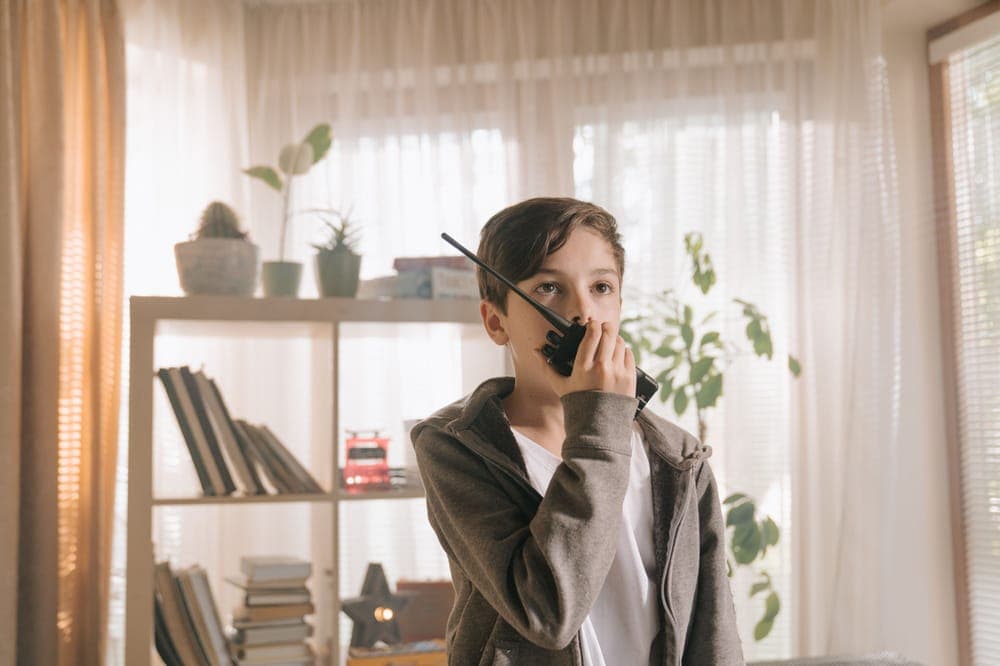 Stock photo
Best four-pack for a group of kids
Cobra RX100-4 (4-pack)
Four color-coded radios with matching belt clips, a call alert, a roger beep, 5-step VOX and 10 NOAA weather channels, per Cobra. Add 12 AAA batteries; none are in the box.
Check price · Amazon#ad · Price set by Amazon · How we make money for the link to Cobra RX100-4 (4-pack)
- Stock photo
Best Midland pick for small hands
Midland X-Talker T31VP (2-pack)
Midland's kids' pick: two rechargeable packs in the box, call alert, eVOX, weather alerts and a headphone jack for spy missions. Only 'water resistant', so keep it out of the sprinkler.
Check price · Amazon#ad · Price set by Amazon · How we make money for the link to Midland X-Talker T31VP (2-pack)
Details come from Cobra's RX100-4 page and Midland's T31VP page and spec sheet. For more options by age, see our best walkie-talkies for kids, or our walkie-talkie gifts for kids if these are going under a tree.
How we scored this
Radios we claim to have lab-tested: 0
Plenty of radio sites say they range-tested everything they list. We haven't, and we say so. Every pick here is labeled Researched: we read each maker's published specs, manuals and range tables, check the license rules against the FCC, and score every radio on a public rubric. Every figure links to where it came from, and every range number is labeled “advertised.”
Scores are editorial judgments from that documented research, not test results. Commissions never set a score or decide a pick. The rubric and its weights are published.
What changed
- Published.
Questions
Frequently asked
What games can you play with walkie talkies?
What do you say when using a walkie-talkie?
What does 10-4 mean on a walkie-talkie?
Why do people say 'over' on walkie-talkies?
What channel should kids use for walkie-talkie games?
Receipts
Sources
- FAA Pilot/Controller Glossary: O (OVER, OUT) (checked 2026-09-22)
- FAA Pilot/Controller Glossary: R (ROGER) (checked 2026-09-22)
- FAA Pilot/Controller Glossary: W (WILCO) (checked 2026-09-22)
- FAA Pilot/Controller Glossary: S (SAY AGAIN, STAND BY) (checked 2026-09-22)
- FAA Pilot/Controller Glossary: A (AFFIRMATIVE) (checked 2026-09-22)
- FAA Pilot/Controller Glossary: N (NEGATIVE) (checked 2026-09-22)
- FCC: General Mobile Radio Service (GMRS) page (checked 2026-09-22)
- FCC: Family Radio Service (FRS) page (checked 2026-09-22)
- FCC consumer guide: Personal Radio Services (checked 2026-09-22)
- 47 CFR 95.333, Personal Radio Service prohibited uses, via Cornell LII (checked 2026-09-22)
- Ready.gov: Build a Kit (checked 2026-09-22)
- Cobra: RX100-4 product page (checked 2026-09-22)
- Midland: T31VP X-Talker product page (checked 2026-09-22)
- Midland: T31VP spec sheet PDF (checked 2026-09-22)
We haven't tested the radios on this page and we don't pretend to. Specs and range figures come from each maker's own pages and manuals (linked on every product), and license, power and channel rules come from the FCC and 47 CFR Part 95. Range numbers are the maker's advertised claims and are labeled that way. Prices are set by Amazon and change often, so we don't print them. Where a figure isn't published, we say so. Read the full method.