Not legal advice. This page summarizes FCC rules (47 CFR Part 95) from the official sources linked in the text. Rules and fees checked . The FCC sets its fees annually and can change its rules, so confirm the current version on fcc.gov before you rely on it.
Quick picks
The picks at a glance
| # | Product | Best for | Score | Price |
|---|---|---|---|---|
| 1 | No photo Midland X-Talker T31VP (2-pack) 3.76 oz, rechargeable packs plus a AAA fallback, NOAA weather channels, a headphone jack and a keypad lock. Midland sells it as its license-free radio for kids and families. | Best all-round camp radioNo licenseBudget | 5.4/10Researched | Check price · Amazon #ad · Disclosure |
| 2 | 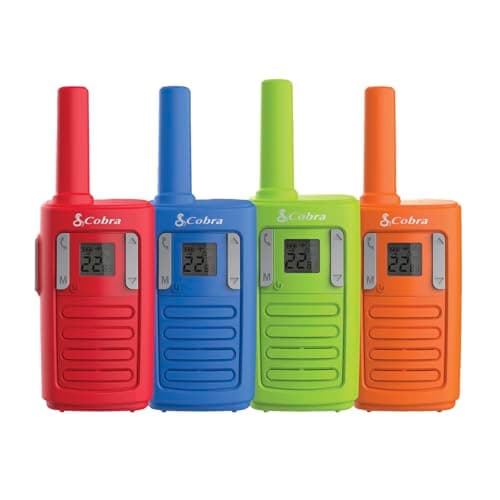 Cobra RX100-4 (4-pack) Four radios in four colors with matching clips, 10 NOAA weather channels and five-step VOX. The colors are the cheapest anti-mix-up feature there is. | Best for a cabin or a patrolNo licenseBudget | 5.2/10Researched | $49.83Amazon #ad · Disclosure |
| 3 | No photo Baofeng GT-18 (3-pack) A 1500 mAh Li-ion that Baofeng rates at up to 3 days per charge, three radios per pack, earpieces and lanyards in the box, and a flashlight on each radio. | Best battery life for a week awayNo licenseBudget | 5.3/10Researched | Check price · Amazon #ad · Disclosure |
| 4 | 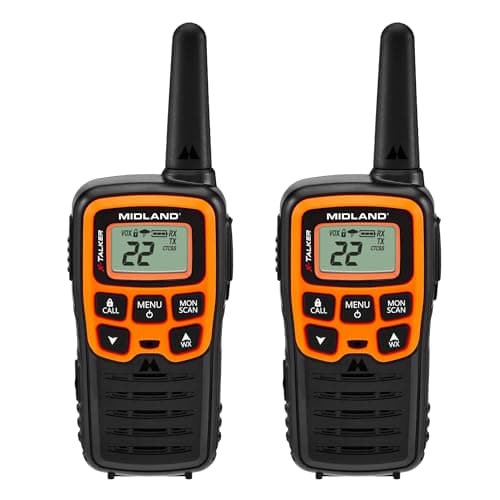 Midland X-Talker T51VP3 (2-pack) NOAA Weather Scan with alert, call alert and eVOX, a rechargeable pack with a desktop charger, and a three-AAA fallback. The grown-up version of the T31. | Best for camp staffNo licenseBudget | 5.6/10Researched | $54.99Amazon #ad · Disclosure |
| 5 | 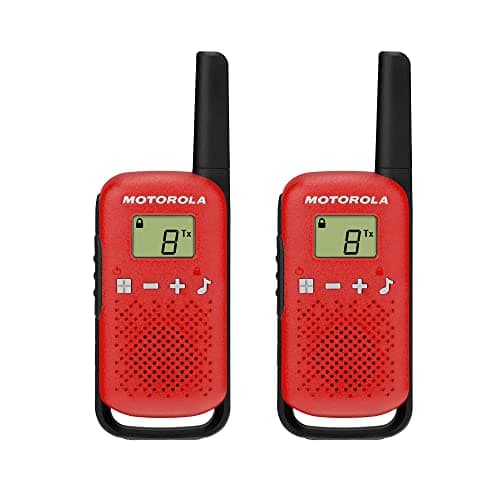 Motorola Talkabout T110 (2-pack) Easy pairing locks the whole group to one channel and code, AAA cells run up to 19 hours, and the personalisation stickers mean each camper can identify their own radio. | Best for the youngest campersNo licenseBudget | 4.9/10Researched | $27.49Amazon #ad · Disclosure |
#ad · Prices come live from Amazon, last checked November 2, 2026. Scores are ours, built from published specs, manuals and FCC rules. Photos come from each product's Amazon listing; a radio we can't show a real photo of is left blank rather than illustrated. Tap a row for the full write-up.

Camp is the harshest realistic test a consumer walkie talkie gets, and almost none of it is about range. A camp radio lives in a duffel, gets dropped on gravel, spends a week away from a reliable power socket, has to be distinguishable from five identical ones, and is operated by somebody who has never used a radio before. A radio that wins on those five counts is the right camp radio even if its box number is the smallest on the shelf.
Every pick here is license-free FRS, because a camp is exactly the situation where a license does not transfer — more on that below. If you are kitting out a family rather than a cabin, start with walkie talkies for families; for camping as a family trip rather than organized camp, see walkie talkies for camping.
What camp does to a radio
Four failure modes account for nearly every radio that comes home dead or useless:
- Flat batteries on day three. A cabin has one outlet and six campers. Either the radio runs on cells you can buy in a camp store, or its charge has to last the week.
- Knocked off channel. One camper presses the wrong button and drops off the group. A keypad lock or easy pairing fixes it; nothing else does.
- Mixed up. Six identical black radios is a lost-property pile by Wednesday. Colors, stickers or tape with a name on it.
- Water. Canoeing, dock duty and afternoon thunderstorms. Most camp radios are only "water resistant" with no published rating, so they need a dry bag rather than a bigger claim.
No license, and why that is the right choice here
How we picked
Every radio is scored on our published rubric: real-world reach, ease of use, toughness and weather, power and battery, field features and value. The method is on how we rank radios, and every figure comes from the maker's own published specification. These are research picks, not test results.
For camp we weighted power and battery, and ease of use, hardest; gave credit for multi-packs, replaceable cells and NOAA weather reception; and discounted advertised range almost entirely. A camp fits inside the FRS envelope by default.
The picks in detail
1. Midland X-Talker T31VP: the all-round camp radio
3.76 oz per radio, 22 channels and 38 privacy codes, two 300 mAh rechargeable packs plus a three-AAA fallback with a Micro-USB "Y" charging cable, 10 NOAA weather channels, call alert, eVOX hands-free, a headphone jack and a keypad lock (Midland T31VP page). Midland calls it its license-free walkie talkie for kids and families; its manual says not to immerse it.
The dual power path is what makes it the default. One Y-cable charges both radios off a single socket or a power bank, and when the packs die on Thursday, three AAA cells from the camp store put the radio back in service. The keypad lock closes off the other big camp failure. It is also small enough that a nine-year-old keeps it clipped on.
Buy it if you want one radio that handles cabins, hikes and a week of fumbling. Skip it if you want a documented water rating — Midland publishes none — or you need more than two radios from one box.
2. Cobra RX100-4: for a cabin or a patrol
Four radios in red, blue, green and orange with color-matched belt clips, 22 FRS channels, 121 privacy codes, channel scan, 10 NOAA weather channels, five-step VOX, call alert and roger beep, on three AAA alkaline cells per radio (Cobra RX100-4 page).
Four colors is a genuinely good camp feature, not a gimmick. A cabin or a scout patrol is the exact group size this pack is built for, and "the blue one" is a sentence that resolves a lost radio in seconds. Alkaline-only power is a real limitation for a long stay — budget two spare sets per radio — but it also means no charger has to travel, and no socket has to be found.
Buy it if you need four radios for one group and no charging logistics. Skip it if you want rechargeable packs, or a headset jack: Cobra lists neither.
3. Baofeng GT-18: the longest battery
Three radios per pack, 22 FRS channels plus NOAA weather, 50 CTCSS tones and 105 DCS codes, channel scan, a 1500 mAh Li-ion with Micro-USB charging that Baofeng rates at "up to 3 days", a backlit LCD, dual PTT buttons, a flashlight, and earpieces and lanyards included with every radio (Baofeng GT-18 page). Note the store's own figures conflict: a product tag says 0.5 W, while the comparison chart on the same page lists 2 W / 0.5 W. Its operating range is given as 0 to 40 degrees C.
That 1500 mAh pack is three times the capacity of the Midland's, and it is why this is the pick for a week with poor charging. The included earpieces matter more at camp than they look: a radio that can be heard quietly is one a counsellor will allow in a cabin after lights-out. Buy the FRS version from the listing, not the European PMR446 one.
Buy it if charging is the hard part of your week and you want three radios plus earpieces. Skip it if you want AA or AAA fallback — there is none — or clear published power figures.
4. Midland X-Talker T51VP3: for camp staff
Twenty-two channels and 38 privacy codes, NOAA Weather Scan with weather alert radio, call alert, eVOX hands-free, an AVP14 rechargeable pack with a desktop charger and Micro-USB cable in the box, and a three-AAA alkaline fallback (Midland T51VP3 page). Midland publishes no water rating, and the T50-series manual says not to immerse it.
The desktop charger is the staff-side feature: a dock in the camp office means radios get put back in a known place and are full every morning, which is the only charging system that survives contact with a camp. The weather alert radio matters more for staff than campers — summer afternoon storms are the main reason a camp schedule changes, and NOAA Weather Radio broadcasts those warnings continuously (NOAA Weather Radio).
Buy it if these are the radios staff carry and charge in one place. Skip it if you want them to be weatherproof, or need more than two per box.
5. Motorola Talkabout T110: for the youngest campers
Twenty-two channels, easy pairing that sets every radio in the group to the same channel and code, an LCD showing channel, code, lock, scan and mute, three AAA alkaline cells rated up to 19 hours, and dual or triple packs with belt clips and personalisation stickers (Motorola Talkabout T110 page). Motorola footnotes its 16-mile claim down to half a mile in a neighborhood.
For a first camp, with campers who have never held a radio, easy pairing plus stickers is close to the whole specification. One adult sets the group up in thirty seconds, every radio matches, and each child has a radio that visibly belongs to them. The triple pack is a useful size for a family sending two siblings.
Buy it if the users are young and the setup has to be foolproof. Skip it if you want rechargeable power or a headset jack: AAA cells only, and none included.
The published specs side by side
In detail
The picks, in full
Rank 01
Best all-round camp radio
Midland X-Talker T31VP (2-pack)
3.76 oz, rechargeable packs plus a AAA fallback, NOAA weather channels, a headphone jack and a keypad lock. Midland sells it as its license-free radio for kids and families.
Published specsResearched · every figure sourced
How the 5.4 score breaks down
- Real-world reach (30%)
- 3
- Ease of use (20%)
- 9
- Toughness & weather (15%)
- 4
- Power & battery (15%)
- 5
- Field features (10%)
- 6
- Value (10%)
- 7
What the specs support
- Marketed by Midland for kids, with a compact body for small hands
- Rechargeable packs included, with AAA batteries as a backup
- Weather alerts, call alert and hands-free eVOX
Where it falls short
- 300 mAh packs are small; Midland publishes no runtime figure
- The manual says not to immerse it in water
Skip this if…
…Skip it if the radios are for adults hiking separate trails: it's sized for backyard and neighborhood play, and the packs are small.
#ad · Price as of November 2, 2026 · How we make money for the link to Midland X-Talker T31VP (2-pack)
Rank 02
Best for a cabin or a patrol
Cobra RX100-4 (4-pack)
Four radios in four colors with matching clips, 10 NOAA weather channels and five-step VOX. The colors are the cheapest anti-mix-up feature there is.
Published specsResearched · every figure sourced
How the 5.2 score breaks down
- Real-world reach (30%)
- 3
- Ease of use (20%)
- 9
- Toughness & weather (15%)
- 3
- Power & battery (15%)
- 4
- Field features (10%)
- 6
- Value (10%)
- 8
What the specs support
- Four radios in four colors, so each kid knows which is theirs
- Real FRS radio with privacy codes, VOX and weather channels
- Cobra markets it as kid-friendly
Where it falls short
- Batteries not included and no rechargeables
- No water rating or flashlight listed
Skip this if…
…Skip it if the radios will live outdoors in the rain or you don't want to buy AAA batteries: Cobra lists no water rating and includes no batteries.
#ad · Price as of November 2, 2026 · How we make money for the link to Cobra RX100-4 (4-pack)
Rank 03
Best battery life for a week away
Baofeng GT-18 (3-pack)
A 1500 mAh Li-ion that Baofeng rates at up to 3 days per charge, three radios per pack, earpieces and lanyards in the box, and a flashlight on each radio.
Published specsResearched · every figure sourced
How the 5.3 score breaks down
- Real-world reach (30%)
- 3
- Ease of use (20%)
- 8
- Toughness & weather (15%)
- 3
- Power & battery (15%)
- 6
- Field features (10%)
- 6
- Value (10%)
- 8
What the specs support
- Three radios, with earpieces and lanyards, at the budget tier
- NOAA weather and a flashlight
- Modest 3-mile claim instead of an inflated box number
Where it falls short
- Baofeng's own page gives conflicting power figures (0.5 W vs 2W / 0.5W)
- Rated to operate only down to 0 degrees C
- Micro-USB charging and no stated water rating
Skip this if…
…Skip it if you'll use it on a ski hill or a winter hunt: Baofeng rates it for 0 to 40 degrees C, and its power figure is unclear.
#ad · Price as of November 2, 2026 · How we make money for the link to Baofeng GT-18 (3-pack)
Rank 04
Best for camp staff
Midland X-Talker T51VP3 (2-pack)
NOAA Weather Scan with alert, call alert and eVOX, a rechargeable pack with a desktop charger, and a three-AAA fallback. The grown-up version of the T31.
Published specsResearched · every figure sourced
How the 5.6 score breaks down
- Real-world reach (30%)
- 4
- Ease of use (20%)
- 8
- Toughness & weather (15%)
- 3
- Power & battery (15%)
- 6
- Field features (10%)
- 6
- Value (10%)
- 8
What the specs support
- NOAA Weather Scan and weather alerts for storms on camping trips
- Rechargeable packs plus a desktop charger, with AAA backup
- License-free and simple enough for the whole family
Where it falls short
- No water rating, and the manual warns against immersion
- No runtime figure published
Skip this if…
…Skip it if it will ride in a kayak or a wet pack: Midland gives it no water rating, so choose an IP67 radio instead.
#ad · Price as of November 2, 2026 · How we make money for the link to Midland X-Talker T51VP3 (2-pack)
Rank 05
Best for the youngest campers
Motorola Talkabout T110 (2-pack)
Easy pairing locks the whole group to one channel and code, AAA cells run up to 19 hours, and the personalisation stickers mean each camper can identify their own radio.
Published specsResearched · every figure sourced
How the 4.9 score breaks down
- Real-world reach (30%)
- 3
- Ease of use (20%)
- 9
- Toughness & weather (15%)
- 3
- Power & battery (15%)
- 5
- Field features (10%)
- 3
- Value (10%)
- 7
What the specs support
- Few buttons and one-step pairing, so a child can run it
- Runs on easy-to-find AAA batteries; stickers help each kid spot their own radio
- Talks to other FRS radios on the same channel and code
Where it falls short
- Batteries are not included and there is no rechargeable option in the box
- No weather rating, NOAA channel or flashlight listed
- Motorola's own neighborhood figure is only up to half a mile
Skip this if…
…Skip it if the kids will be out of sight across a campground or down the block: Motorola's own neighborhood figure is half a mile, and it has no weather rating for rain.
#ad · Price as of November 2, 2026 · How we make money for the link to Motorola Talkabout T110 (2-pack)
Packing and labeling them for camp
- Set the channel and code before the radio is packed, then lock the keypad. Write the setting on tape inside the battery door, so it can be restored by anyone.
- Label every radio with a name, on the body and on the battery door. Camp loses unlabeled gear as a matter of physics. Colored electrical tape doubles as a label and a grip.
- Pack two spare sets of cells per radio if it runs on alkalines, or a power bank and a multi-port cable if it does not. Do not assume a free socket.
- Add a lanyard, and use the belt clip. A radio in a shorts pocket goes in the lake.
- Pack a zip bag or a dry bag. Most camp radios carry no published water rating at all, so the bag is the water rating.
- Agree one channel and one backup for the whole group, and teach the phrase that moves everybody over. FRS channels are shared, and a busy camp will have other radios on them.
- Check the camp's own rules first. Plenty of camps restrict electronics, and a radio may be allowed for staff but not for campers. Ask before you buy five of them.
Our walkie-talkie games and lingo page is worth a read before camp: campers who know how to hold the button and hand over cleanly keep a shared channel usable for everyone else on it.
What to look for
- A battery plan that matches your week. Replaceable AAA cells, a big Li-ion, or a dock in the office. Pick one deliberately.
- A keypad lock or easy pairing. The only real fix for a radio knocked off channel.
- Distinguishable radios. Colors, stickers or tape. Buy the feature or create it yourself.
- NOAA weather channels for whoever is making the call about the afternoon storm.
- Light bodies. Under about five ounces for a child; anything heavier gets abandoned.
- A headset jack or included earpieces if the radio has to be quiet in a cabin.
- The right pack size. Two, three or four radios from one box, all on matching chargers and cells.
How we scored this
Every pick here is backed by the paperwork
Every pick is labeled Researched: we read each maker's published specs, manuals and range tables, check the license rules against the FCC, and score every radio on a public rubric out of 10. Every figure links to where it came from, and every range number is labeled “advertised” so you can see the difference between the box and the terrain.
Scores are our editorial judgment on that documented evidence. Commissions never set a score or decide a pick. The rubric and its weights are published.
What changed
- Published.
Questions
Frequently asked
What are the best walkie talkies for summer camp?
Do walkie talkies need a license for camp use?
How far do camp walkie talkies reach?
Are walkie talkies allowed at summer camp?
How do you stop camp walkie talkies getting mixed up?
Receipts
Sources
- Midland: X-Talker T31VP product page (checked 2026-10-11)
- Midland: X-Talker T51VP3 product page (checked 2026-10-11)
- Cobra: RX100-4 product page (checked 2026-10-11)
- Baofeng: GT-18 FRS product page (checked 2026-10-11)
- Motorola: Talkabout T110 series product page (checked 2026-10-11)
- FCC: Family Radio Service (FRS) page (checked 2026-10-11)
- FCC: Personal Radio Services consumer guide (checked 2026-10-11)
- 47 CFR 95.531, FRS channel power limits (via Cornell LII, checked 2026-10-11)
- NOAA / NWS: NOAA Weather Radio All Hazards (checked 2026-10-11)
Specs and range figures come from each maker's own pages and manuals, linked on every product, and license, power and channel rules come from the FCC and 47 CFR Part 95. Range numbers are the maker's advertised claims and are labeled that way, so you can tell the box number from the terrain number. Prices come live from Amazon with the time we checked. Read the full method.