Not legal advice. This page summarizes FCC rules (47 CFR Part 95) from the official sources linked in the text. Rules and fees checked . The FCC sets its fees annually and can change its rules, so confirm the current version on fcc.gov before you rely on it.
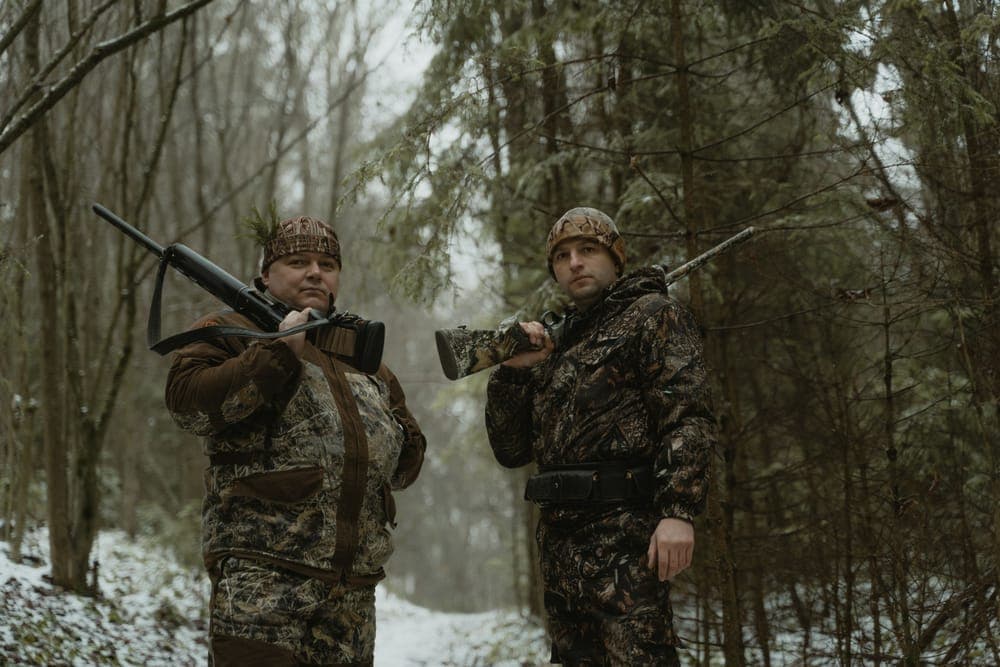
Walkie talkie etiquette isn't about sounding like a pilot. On a hunt, it's about three things: getting the message through the first time, not blowing up the woods with chatter, and making sure that when someone really needs help, the channel is clear. This page covers the lingo, what each phrase actually means, and the habits that make a hunting group's radios work. It's written for adults on a lease or a hunting trip. If you're setting up games for the kids, our walkie-talkie games and lingo for kids page is the one you want, and if you just need to pick a channel, start with our walkie-talkie channel guide.
Walkie-talkie lingo cheat sheet
These are the phrases you'll hear on radios, with what they mean in common use. None of them is required by the FCC. Where a written definition exists, it comes from the FAA's Pilot/Controller Glossary, a published glossary that defines many of the same words. The rest are plain common usage.
| Phrase | What it means | Where the meaning comes from |
|---|---|---|
| Over | "My transmission is ended; I expect a response." | FAA glossary |
| Out | "The conversation is ended and no response is expected." | FAA glossary |
| Copy / copy that | I heard and understood you | Common usage |
| Roger | "I have received all of your last transmission." Not a yes or a no. | FAA glossary |
| Wilco | "I have received your message, understand it, and will comply with it." | FAA glossary |
| Say again | Please repeat your last transmission | FAA glossary |
| Stand by | Wait; I'll come back to you shortly | FAA glossary |
| Go ahead | "Proceed with your message." | FAA glossary |
| Affirmative / negative | Yes / no | FAA glossary |
| 10-4 | Message received, OK | Common usage (a leftover ten-code) |
| Radio check | How do you hear me? | Common usage |
| Loud and clear | I hear you well | Common usage |
Two notes that save arguments at camp. First, "over and out" contradicts itself: by the FAA's definitions, "over" asks for a reply and "out" says none is expected. Nobody on your lease will report you for it, but "out" alone is cleaner. Second, "roger" only means you heard the message. If the question was "Can you help me drag?", answer yes or no.
There are no official walkie-talkie codes
People search for walkie talkie lingo codes expecting an official list. There isn't one for FRS or GMRS users, and the GMRS rules push the other way. 47 CFR 95.1733 bars GMRS stations from sending "coded messages or messages with hidden meanings," with one carve-out: "'10 codes' are permissible" (47 CFR 95.1733). The use the rules permit is "two-way plain language voice communications" with other GMRS stations and FRS units (47 CFR 95.1731).
So "10-4" is fine. But a private code your group invented (say, "blue" meaning "big buck on the north food plot") is exactly the kind of hidden meaning the rule is aimed at, and it's a bad idea anyway: anyone who wasn't at the supper where you made it up won't understand it. The emergency-management world pushes plain words for the same reason. FEMA's NIMS guidance says "it is important that responders and incident managers use common terminology. There simply is little or no room for misunderstanding in an emergency situation" (FEMA NIMS Alert, Dec. 2006). If that's good enough for a disaster response, it's good enough for a deer camp.
Spelling it out: the phonetic alphabet
The "walkie talkie alphabet" people ask about is the ICAO phonetic alphabet. The FAA's Aeronautical Information Manual (section 4-2) says to use it "to spell out groups of letters or difficult words during adverse communications conditions." On a hunt, that means call signs, a road name, or a stand called "B" that keeps getting heard as "D".
| Letters | Words (FAA AIM Table 4-2-7) |
|---|---|
| A to G | Alfa, Bravo, Charlie, Delta, Echo, Foxtrot, Golf |
| H to N | Hotel, India, Juliett, Kilo, Lima, Mike, November |
| O to U | Oscar, Papa, Quebec, Romeo, Sierra, Tango, Uniform |
| V to Z | Victor, Whiskey, Xray, Yankee, Zulu |
Listen before you talk
This is the rule that matters most, and it's the one the FCC itself spells out. On its GMRS page, the FCC says "none of the GMRS channels are assigned for the exclusive use of any system" and asks users to follow "listen-before-talk" etiquette (FCC GMRS page). The general Personal Radio Services rule says the same for every service: channels are shared, and operators "must cooperate in the selection and use of channels in order to avoid interference" (47 CFR 95.359).
In practice: before you call, listen for a few seconds. If someone's talking, wait. Pressing the button over another person doesn't get your message through; the FAA's radio technique section notes that keying up while someone else is talking "will be futile and you will probably jam their receivers causing them to repeat their call" (FAA AIM 4-2-2). The same applies when you switch to the backup channel: pause, listen, then call.
How to make a clean call
- Know what you're going to say before you press the button.
- Press, pause, then talk. The FAA notes that "after pressing the mike button, a slight pause may be necessary to be sure the first word is transmitted" (AIM 4-2-2). Most clipped calls lose the name at the front, which is the part that matters.
- Who you're calling, then who you are. "Creek Stand, this is Camp." That's the same order the FAA uses for an initial call: the station being called, then your identification.
- Say it once, short. FCC rules say operators "must generally limit transmissions to the minimum duration necessary" (47 CFR 95.357). One message per press.
- Let go and wait a few seconds. The other hunter may be climbing, gloved, or pulling out an earpiece.
- Close it. "Copy" or "out" so the channel is clearly free.
And check your pocket. The FAA warns about the "stuck mike": a transmitter keyed by accident that blocks the channel for everyone. A radio jammed against a seat belt or a pack strap does exactly that. Lock the keypad and clip the radio where the button can't get pressed.
Call signs and the GMRS rules
If your group runs GMRS radios, there's one piece of etiquette that is actually a rule. Each GMRS station transmits its call sign "following a single transmission or a series of transmissions" and "at least once every 15 minutes" during a series lasting more than 15 minutes, by voice in English or in Morse code (47 CFR 95.1751). On a lease, the easy habit is to give your call sign at the end of an exchange. Family members using your radios are operating your station under your license (47 CFR 95.1705), and each licensee in the group uses their own call sign. FRS radios are licensed by rule, with no individual license (FCC FRS page), so there's no call sign to give. Our GMRS license guide explains who needs one, and GMRS vs FRS covers the difference.
Quiet protocol on the stand
Deer don't care about the FCC, but they do hear a radio speaker. A hunting group's radio habits should be built around silence:
- Radio silence during the prime hours, apart from the agreed check-ins, a shot, or an emergency. Agree on those hours at supper.
- Earpieces on every stand, so an incoming call is in one ear and nowhere else.
- Vibrate on, tones off. Turn off call tones, key beeps and any end-of-transmission beep.
- Whisper mode if your radio has it. Midland lists "whisper talk" on the GXT67 PRO (product page) and whisper mode on its GXT1000-series radios. If yours has it, use it on the stand.
- VOX only if you've checked it. Voice-operated transmit keys the radio on sound. Wind, rustling clothes or a thermos lid can open the channel without you meaning to, so set it to low sensitivity or use push-to-talk.
- Short calls with a reason. "North Ladder, doe and fawn heading your way." Not a running commentary.
One more thing that isn't etiquette but belongs here: some states restrict using radios to help take or locate game. Montana's rule prohibits two-way communication, radios included, "while in the act of hunting game animals or wolves to aid in the taking or locating of live animals," while exempting use "for the use of safety or other legitimate purposes" ( Mont. Admin. R. 12.6.1010). Check your state's rules before you call deer movement across the lease.
What makes a radio good at quiet protocol is easy to list: vibrate alert, a silent or whisper mode, adjustable VOX, and an earpiece jack. Both radios below have those, one with a GMRS license and one without.
Our picks for this job
Two quiet radios for the stand
One GMRS radio with whisper talk and 4-level VOX, and one license-free camo pair with vibrate alert and 9-level eVOX. Both take an earpiece.
 Stock photo
Best Midland handheld for wet weather
Midland GXT67 PRO (single radio)
Whisper talk, VOX, vibrate alert and IP67 in one radio, rated at 5 W with 8 repeater channels. It's sold singly with a sealed battery, so buy one per hunter. Needs a GMRS license.
Check price · Amazon#ad · Price set by Amazon · How we make money for the link to Midland GXT67 PRO (single radio)
 Stock photo
Best license-free radio for the stand
Midland X-Talker T75VP3 Camo (2-pack)
No license needed (FRS). Mossy Oak camo, vibrate alert, eVOX and a headphone jack, with rechargeable packs or 3 AA batteries. FRS reach is short, so it suits stands within sight of each other.
Check price · Amazon#ad · Price set by Amazon · How we make money for the link to Midland X-Talker T75VP3 Camo (2-pack)
Channel discipline for hunting groups
The etiquette above only works if everyone is on the same channel and code. A few rules keep it that way:
- One hunt channel, one code, one backup, written on a card at camp. For a lease with a camp radio, a channel from 15 to 22 lets a mobile or base run full power; our deer lease radio setup explains why.
- Nobody changes channel alone. A move to the backup gets announced at a check-in, and everyone confirms.
- Lock the keypad once set. A channel knob bumped on the climb is a classic reason a stand "goes dead."
- Put camp chatter somewhere else. If the kids at camp want to talk, give them a different channel so the hunt channel stays clear.
- Remember who else can hear you. A privacy code only filters what you hear. It doesn't stop anyone else on the channel from hearing you, so don't describe a hidden stand's location on the air.
For the full channel list and which channels carry which power, see GMRS channels and frequencies.
Emergencies
Radios are for keeping the group together, not a substitute for 911. If someone is hurt, call 911 first on any phone that can get a call out. It's worth trying even if your own carrier shows no service: FCC rules require wireless carriers to pass 911 calls to an emergency answering point "without respect to their call validation process" ( 47 CFR 9.10), which means a carrier can't turn away a 911 call because you aren't its customer. Where no tower reaches at all, the radio is how you get help moving.
On the radio, keep it plain:
- Say "Emergency, emergency" and who you are. Use plain words. The GMRS rules reserve international distress signals such as "Mayday" for a ship, aircraft or other vehicle in immediate danger (47 CFR 95.1733).
- Say where you are, by stand name or a landmark everyone knows.
- Say what happened and what you need: a vehicle, a person, a call to 911.
- Everyone else stops talking unless they're answering.
If the person who needs to call isn't licensed for GMRS, they can still use your radio: the rule lets a licensee "allow anyone to operate his or her GMRS station if necessary to communicate an emergency message" ( 47 CFR 95.1705). Ready.gov's planning advice applies to a lease as much as a household: know how you'll contact one another and reconnect if separated, and practice the plan (Ready.gov). Our family emergency communication plan goes further.
Etiquette mistakes that cost you
- Talking before the radio is keyed, so the stand name gets clipped off the front.
- First names and "hey, you there?" Stand names tell everyone where the call came from.
- The hot mic in a pocket, broadcasting a truck radio and a conversation to the whole lease.
- Private codes nobody else knows, which confuse your own group and cut against the GMRS rule on hidden meanings.
- Call tones on the stand. An animal call alert is still a noise.
- Skipping the call sign on GMRS at the end of an exchange.
- Changing channel mid-hunt without telling anyone.
Want the radios that make all of this easier? Our best hunting radios ranking weighs vibrate alert, earpiece support and reach, and the rest of the lease and ranch guides are on the hunting and land hub.
How we scored this
Radios we claim to have lab-tested: 0
Plenty of radio sites say they range-tested everything they list. We haven't, and we say so. Every pick here is labeled Researched: we read each maker's published specs, manuals and range tables, check the license rules against the FCC, and score every radio on a public rubric. Every figure links to where it came from, and every range number is labeled “advertised.”
Scores are editorial judgments from that documented research, not test results. Commissions never set a score or decide a pick. The rubric and its weights are published.
Questions
Frequently asked
What does 10-4 mean on a walkie-talkie?
Is it correct to say over and out?
What is the walkie-talkie alphabet?
Are there official walkie-talkie codes?
Do I have to say my call sign on GMRS?
What should I say in an emergency on a walkie-talkie?
Receipts
Sources
- FCC: General Mobile Radio Service (GMRS) page (checked 2026-09-22)
- FCC: Family Radio Service (FRS) page (checked 2026-09-22)
- 47 CFR 95.333, prohibited uses (Cornell LII, checked 2026-09-22)
- 47 CFR 95.357, duration of transmissions (Cornell LII, checked 2026-09-22)
- 47 CFR 95.359, sharing of channels (Cornell LII, checked 2026-09-22)
- 47 CFR 95.1705, who may operate GMRS stations (Cornell LII, checked 2026-09-22)
- 47 CFR 95.1731, permissible GMRS uses (Cornell LII, checked 2026-09-22)
- 47 CFR 95.1733, prohibited GMRS uses (Cornell LII, checked 2026-09-22)
- 47 CFR 95.1751, GMRS station identification (Cornell LII, checked 2026-09-22)
- 47 CFR 9.10, 911 service requirements (Cornell LII, checked 2026-09-22)
- FAA: Pilot/Controller Glossary (checked 2026-09-22)
- FAA: Aeronautical Information Manual, chapter 4 section 2, radio communications (checked 2026-09-22)
- FEMA NIMS Integration Center: NIMS Alert 023-06, NIMS and use of plain language, Dec. 19, 2006 (checked 2026-09-22)
- Ready.gov: Make a Plan (checked 2026-09-22)
- Mont. Admin. R. 12.6.1010, two-way electronic communication while hunting (Cornell LII, checked 2026-09-22)
- Midland: GXT67 PRO product page (checked 2026-09-22)
- Midland: T75VP3 X-Talker camo product page (checked 2026-09-22)
- Midland: T75VP3 spec sheet PDF (checked 2026-09-22)
We haven't tested the radios on this page and we don't pretend to. Specs and range figures come from each maker's own pages and manuals (linked on every product), and license, power and channel rules come from the FCC and 47 CFR Part 95. Range numbers are the maker's advertised claims and are labeled that way. Prices are set by Amazon and change often, so we don't print them. Where a figure isn't published, we say so. Read the full method.