Not legal advice. This page summarizes FCC rules (47 CFR Part 95) from the official sources linked in the text. Rules and fees checked . The FCC sets its fees annually and can change its rules, so confirm the current version on fcc.gov before you rely on it.
Quick picks
The picks at a glance
| # | Product | Best for | Score | Price |
|---|---|---|---|---|
| 1 | 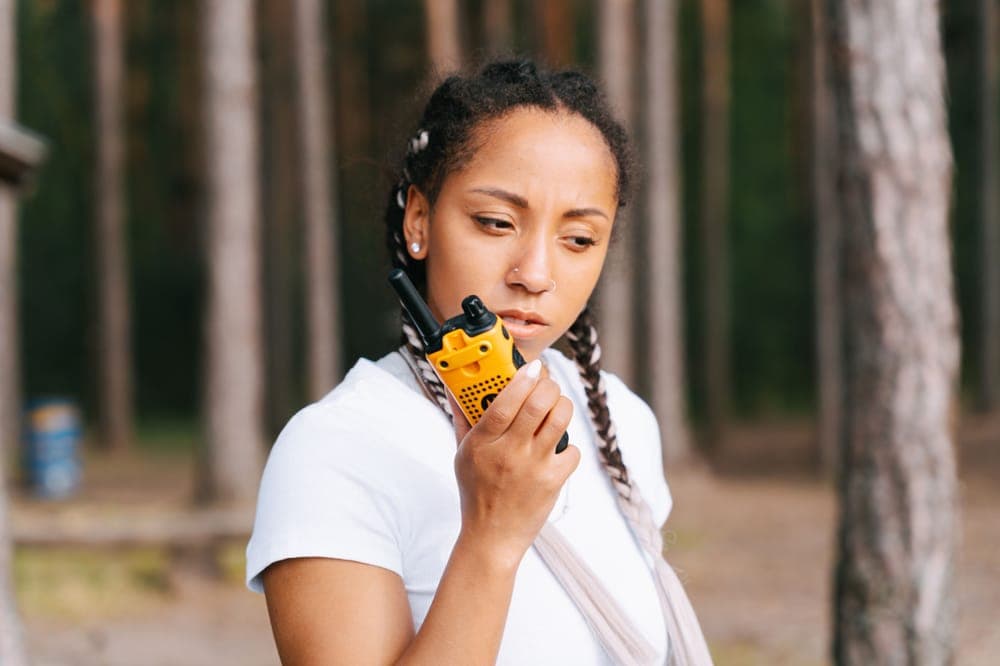 Rocky Talkie Mountain Radio (single radio) License-free, IP56, a climbing-rated carabiner with a backup leash, and a battery Rocky Talkie rates at 3 to 5 days. Its own forest figure is 0.5 to 3 miles. | Best walkie-talkie for hikingNo licenseMid-price | 6.7/10Researched | Check price · Amazon #ad · Disclosure |
| 2 | Midland X-Talker T71VP3 (2-pack) Two radios, NOAA Weather Scan and a 3 x AA fallback, so a flat pack at a trailhead is a five-minute fix rather than the end of the day. | Best pair in one boxNo licenseMid-price | 5.7/10Researched | Check price · Amazon #ad · Disclosure |
| 3 | Motorola Talkabout T605 H2O (2-pack) IP67, floats face up on the supplied NiMH pack and the flashlight switches on in water. Up to 23 hours on three AAs by Motorola's datasheet. | Best for wet trails and water crossingsNo licenseMid-price | 6.8/10Researched | Check price · Amazon #ad · Disclosure |
| 4 | 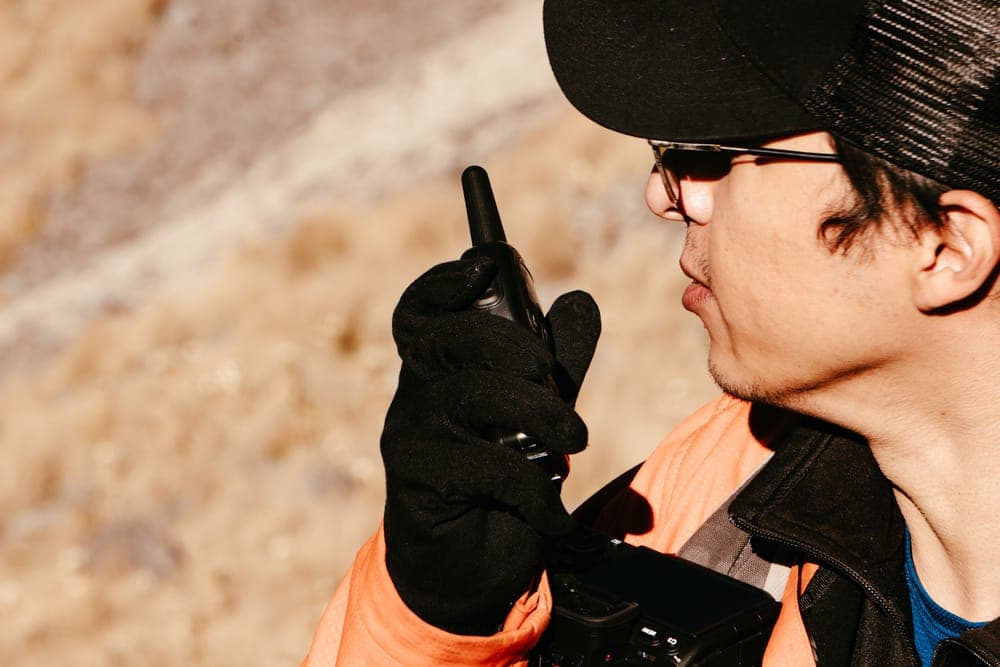 Rocky Talkie Expedition Radio (single radio) 5 W GMRS, IP67, a removable antenna and repeater channels, with a 4 to 6 day battery. Needs a GMRS license, and it is worth it above treeline. | Best for long days in big countryGMRS licensePremium | 7.9/10Researched | Check price · Amazon #ad · Disclosure |
| 5 | Motorola Talkabout T470 (2-pack) IPX4, NOAA alerts, 0.30 lb per radio without batteries, and an AA fallback rated up to 28 hours. The pick if weight and price both matter. | Best light budget pairNo licenseMid-price | 6.1/10Researched | Check price · Amazon #ad · Disclosure |
#ad · Prices are set by Amazon and change often, so we don't print them. Scores are ours, built from published specs, manuals and FCC rules, not hands-on tests. Photos are illustrative stock. Tap a row for the full write-up.

Hiking is where a walkie-talkie earns its place in a pack or fails to. The group splits at a junction, someone drops back on a climb, two people go ahead to the summit and two stop at the lake, and the phone that had two bars at the trailhead has none by mile three. A radio fixes that, but only if it is light enough that you actually brought it.
So this is not the same list as camping, where a radio sits on a picnic table, or the mountains, where terrain and cold dominate. This is ranked on weight, how it attaches, and a day's battery. If you are heading above treeline or into real winter conditions, our best walkie-talkies for mountains is the sharper list, and for basecamp use see best walkie-talkies for camping.
How we picked
Every radio is scored on our published rubric — real-world reach, ease of use, toughness and weather, power and battery, field features and value — from the makers' own product pages, spec sheets, datasheets and manuals, plus the FCC rules. The method is on how we rank radios. These are research picks from published specs, and every figure links to its source.
For hiking specifically we weighted weight and attachment hard, because a radio in the bottom of a pack is useless; weather, because a trail day includes rain; and battery you can finish the day on, with a bonus for an AA fallback. Availability was confirmed on each maker's own store on 2026-09-26. These picks sit in our range and real-world reach hub.
What matters on a trail
How it attaches, more than what it weighs. Eight ounces on a shoulder strap is invisible; eight ounces swinging off a belt clip is annoying by lunchtime, and eight ounces at the bottom of a pack might as well be at home. This is why the Rocky Talkie's carabiner and reinforced leash matter more than its spec sheet does.
Rain, not submersion. Most hiking days that involve water involve drizzle and sweat, not dropping the radio in a river. IP56 handles that. IP67 is for paddlers and creek crossings.
A day, not a week. Any of these will last a day hike. The multi-day figures matter for a thru-hike or a hut trip, and there an AA fallback can beat a bigger lithium pack, because AAs can be carried and swapped in the dark.
Terrain, which decides everything else. A radio that reaches three miles on a ridge will reach a few hundred yards through a wet, dense forest on a switchback. Nothing on this page changes that, and our how far walkie-talkies reach explains why.
The picks in detail
1. Rocky Talkie Mountain Radio: best walkie-talkie for hiking
Built for climbers and ski tourers, which makes it very nearly perfect for hikers. 2 W FRS so there is no license, IP56, USB-C charging, a replaceable 1550 mAh lithium battery that Rocky Talkie rates at 3 to 5 days, channel lock so nobody's pocket moves the group off channel, and a climbing-rated carabiner with a metal-reinforced backup leash (Rocky Talkie Mountain Radio page). Rocky Talkie publishes 0.5 to 3 miles in forest and hills and 1 to 5 miles in mountains, which is honest.
Buy it if you want one radio that clips to a strap and is still alive on Sunday. Skip it if you want NOAA weather alerts, which it does not have, or a pair on a budget — it is sold one radio at a time.
2. Midland X-Talker T71VP3: best pair in one box
Two radios, NOAA Weather Scan, 36 channels with privacy codes, a rechargeable pack and — the part that matters on a multi-day hike — a 3 x AA fallback tray (Midland T71VP3 page). Midland rates about 5 hours on high with the rechargeable pack, so the AAs are not a gimmick, they are the plan for day two.
Buy it if you hike with one other person and want weather alerts. Skip it if you need a real water rating: Midland calls the X-Talkers water resistant without publishing an IP figure.
3. Motorola Talkabout T605 H2O: best for wet trails and water crossings
IP67, it floats face up on the supplied NiMH pack, and the flashlight switches on automatically in water (Motorola TALKABOUT T600 series page; T605 datasheet). Motorola's datasheet gives up to 23 hours on three AAs, and 11 weather channels with alerts.
Motorola also publishes a proper terrain breakdown: up to 2 miles in a neighborhood, up to 6 miles over open water, and the "up to 35 miles" figure only mountain to valley. Buy it if your hiking involves creeks, lakes or reliable rain. Skip it if you are counting grams: it is the bulkiest pair here.
4. Rocky Talkie Expedition Radio: best for long days in big country
The GMRS step up: 5 W, IP67, a removable antenna, repeater channels, the same carabiner-and-leash design and a battery rated at 4 to 6 days (Rocky Talkie Expedition page). Rocky Talkie publishes 0.5 to 5 miles in forest and hills against the Mountain Radio's 0.5 to 3.
That difference is small in trees and large above treeline, where more power and a better antenna genuinely reach further. Buy it if you hike open country, desert or alpine terrain and will take the GMRS license. Skip it if you mostly walk wooded trails: the extra watts are largely absorbed by the trees.
5. Motorola Talkabout T470: best light budget pair
0.30 lb per radio without batteries, IPX4, NOAA weather channels and alerts, an LED flashlight, an emergency button, VibraCall, iVOX and a 2.5 mm headset jack, with 800 mAh NiMH packs rated up to 12 hours or 3 AA alkalines rated up to 28 hours (Motorola TALKABOUT T470 series page).
That AA figure is the best on this page and the reason it is here. Buy it if you want two light radios with weather alerts without spending much. Skip it if you want a real waterproof rating — IPX4 is splash resistance, not immersion.
What actually reaches on a trail
Every maker here publishes a headline figure and, to their credit, most also publish a realistic one. Only the middle column is useful.
| Radio | Maker's terrain figure | Maker's best-case figure |
|---|---|---|
| Rocky Talkie Mountain Radio (2 W FRS) | Forest/hills 0.5 to 3 miles; mountains 1 to 5 miles | Line of sight 35+ miles |
| Rocky Talkie Expedition (5 W GMRS) | Forest/hills 0.5 to 5 miles | Line of sight 35+ miles |
| Motorola Talkabout T605 H2O (FRS) | Neighborhood up to 2 miles; open water up to 6 miles | "Up to 35 miles" mountain to valley |
| Motorola Talkabout T470 (FRS) | Neighborhood up to 2 miles; open water up to 6 miles | "Up to 35 miles" |
| Midland X-Talker T71VP3 (FRS) | No terrain figure published | "Up to 38 miles" |
The FCC's own consumer guide is blunter still: FRS radios reach "up to two miles on the 2 watt channels, depending on conditions" ( FCC personal radio services guide). On a switchbacked trail in wet timber, plan on a few hundred yards to a mile. On a ridge, plan on far more. Height is the variable, not watts — which is also why the group that agrees to call from the top of each climb has a much better day than the group that does not.
In detail
The picks, in full
Rank 01
Stock photoBest walkie-talkie for hiking
Rocky Talkie Mountain Radio (single radio)
License-free, IP56, a climbing-rated carabiner with a backup leash, and a battery Rocky Talkie rates at 3 to 5 days. Its own forest figure is 0.5 to 3 miles.
Published specsResearched · not tested by us
How the 6.7 score breaks down
- Real-world reach (30%)
- 5
- Ease of use (20%)
- 9
- Toughness & weather (15%)
- 8
- Power & battery (15%)
- 8
- Field features (10%)
- 4
- Value (10%)
- 6
What the specs support
- Publishes honest terrain figures (1 to 5 miles in mountains), not just a box number
- IP56, shatterproof screen and a real climbing carabiner with a leash
- Replaceable Li-ion rated for 3 to 5 days, with USB-C
- Channel lock keeps a group from drifting off channel
Where it falls short
- Sold as a single radio, so a pair costs twice the listed tier
- No NOAA weather channel or VOX
- Fixed antenna and FRS power limit its reach like any FRS radio
Skip this if…
…Skip it if you need to reach a partner several ridges away or hit a repeater: at 2 W FRS with a fixed antenna, the GMRS Expedition Radio is the Rocky Talkie for that.
#ad · Price set by Amazon · How we make money for the link to Rocky Talkie Mountain Radio (single radio)
Rank 02
Stock photoBest pair in one box
Midland X-Talker T71VP3 (2-pack)
Two radios, NOAA Weather Scan and a 3 x AA fallback, so a flat pack at a trailhead is a five-minute fix rather than the end of the day.
Published specsResearched · not tested by us
How the 5.7 score breaks down
- Real-world reach (30%)
- 4
- Ease of use (20%)
- 8
- Toughness & weather (15%)
- 4
- Power & battery (15%)
- 6
- Field features (10%)
- 7
- Value (10%)
- 7
What the specs support
- AA fallback plus 1000 mAh packs and a full charging kit
- Weather Scan, silent mode and hands-free eVOX
- Works with any other FRS or GMRS radio on the shared FRS channels
Where it falls short
- Midland's own runtime figure is about 5 hours on high power
- Only "water resistant"; no IP rating
- Transmit power isn't published, and FRS rules still cap what it can do
Skip this if…
…Skip it if you're buying it for the "38 miles": through hills and trees it's still a fixed-antenna FRS radio, and a GMRS radio is the real step up in reach.
#ad · Price set by Amazon · How we make money for the link to Midland X-Talker T71VP3 (2-pack)
Rank 03
Stock photoBest for wet trails and water crossings
Motorola Talkabout T605 H2O (2-pack)
IP67, floats face up on the supplied NiMH pack and the flashlight switches on in water. Up to 23 hours on three AAs by Motorola's datasheet.
Published specsResearched · not tested by us
How the 6.8 score breaks down
- Real-world reach (30%)
- 4
- Ease of use (20%)
- 8
- Toughness & weather (15%)
- 9
- Power & battery (15%)
- 7
- Field features (10%)
- 8
- Value (10%)
- 8
What the specs support
- IP67 and it floats face up, with a flashlight that switches on when it hits the water
- Runs on the NiMH pack or three AA batteries, so a dead pack isn't the end of the day
- The T605 pack adds a case, spare batteries and earpieces
Where it falls short
- Motorola doesn't publish the transmit power; reach is ordinary FRS
- It may not float with some AA batteries, per Motorola
- Headset use is for dry conditions only
Skip this if…
…Skip it if you need to talk between boats or trucks miles apart: IP67 keeps it alive in the lake, but a fixed-antenna FRS radio won't cover that distance.
#ad · Price set by Amazon · How we make money for the link to Motorola Talkabout T605 H2O (2-pack)
Rank 04
Stock photoBest for long days in big country
Rocky Talkie Expedition Radio (single radio)
5 W GMRS, IP67, a removable antenna and repeater channels, with a 4 to 6 day battery. Needs a GMRS license, and it is worth it above treeline.
Published specsResearched · not tested by us
| Service / license | GMRS (FRS compatible); GMRS license required, US use only |
|---|---|
| Transmit power | 5 W |
| Channels | 22 channels, 121 privacy codes (CTCSS and DCS); channel lock, high/low power, scan, dual channel watch |
| Repeater and antenna | Repeater capable (8 GMRS repeater channels); removable SMA-male antenna, 7.5 cm and 17 cm antennas included |
| Water rating | IP67 (1 meter submersion) |
| Battery | Replaceable 7.4 V 1800 mAh Li-ion, USB-C; "4–6 days" per chargeAdvertised |
| Weather and weight | NOAA weather channels and emergency alert monitoring; 9.1 oz |
| Advertised range | "max range of over 35 miles, with 2–8 miles more typical in backcountry terrain"Advertised |
| Maker's terrain figures | Line-of-sight 35+ miles; mountains 2 to 8 miles; forest/hills 0.5 to 5 miles; rivers 0.5 to 3 miles; city up to 1.5 milesAdvertised |
How the 7.9 score breaks down
- Real-world reach (30%)
- 8
- Ease of use (20%)
- 8
- Toughness & weather (15%)
- 9
- Power & battery (15%)
- 8
- Field features (10%)
- 7
- Value (10%)
- 6
What the specs support
- Removable SMA antenna with short and long options, plus 8 repeater channels
- IP67 with a replaceable Li-ion battery and USB-C, rated for 4-6 days
- The maker publishes terrain-by-terrain range, not just a box number
- Channel lock and a simple 22-channel layout
Where it falls short
- Sold as a single radio, so a pair lands firmly in the premium tier
- No VOX hands-free or flashlight listed by the maker
Skip this if…
…Skip it if you don't want a GMRS license: it's a GMRS radio, and Rocky Talkie's license-free Mountain Radio (FRS, 2 W) covers most trail use.
#ad · Price set by Amazon · How we make money for the link to Rocky Talkie Expedition Radio (single radio)
Rank 05
Stock photoBest light budget pair
Motorola Talkabout T470 (2-pack)
IPX4, NOAA alerts, 0.30 lb per radio without batteries, and an AA fallback rated up to 28 hours. The pick if weight and price both matter.
Published specsResearched · not tested by us
How the 6.1 score breaks down
- Real-world reach (30%)
- 4
- Ease of use (20%)
- 8
- Toughness & weather (15%)
- 5
- Power & battery (15%)
- 7
- Field features (10%)
- 8
- Value (10%)
- 7
What the specs support
- AA fallback with a stated 28 hours, which suits an emergency kit
- NOAA alerts, flashlight and emergency button included
- Hands-free iVOX/VOX and a standard 2.5 mm headset jack
Where it falls short
- Micro-USB charging, not USB-C
- IPX4 is splash protection only; don't drop it in water
- Motorola doesn't publish the transmit power
Skip this if…
…Skip it if it will get wet often: IPX4 handles rain, not a creek crossing or a canoe, so the IP67 T605 is the Motorola to buy.
#ad · Price set by Amazon · How we make money for the link to Motorola Talkabout T470 (2-pack)
What to look for in a hiking walkie-talkie
- A carabiner or a strap loop, not just a belt clip. A radio on a shoulder strap gets used. A radio in a lid pocket does not.
- A stated water rating. IP56 covers rain; IP67 covers a dropped radio in a creek. "Water resistant" with no number tells you nothing.
- Channel lock. Packs squash radios. A locked channel keeps a group together.
- A battery plan for the trip length. One day: anything. Several days: a multi-day rating, a spare pack, or AAs.
- NOAA weather alerts if you hike where storms build. The Rocky Talkies do not have them; the Midland and Motorola radios do.
- License-free unless you need the reach. FRS covers a trail group. GMRS earns its license in open country and above treeline — see GMRS vs FRS.
A two-group hiking protocol that works
- Agree the channel and code at the trailhead, with the radios in your hands, and do a test call before you split up. Use a 2 W channel (1 to 7 or 15 to 22), not the low-power 8 to 14 group.
- Radios off, not on, between check-ins. A radio that is off all day and on at the agreed times will outlast a radio that hisses in a pocket for six hours.
- Call from high points. Ridges, saddles, the top of a climb. Calling from inside a gully is the most common reason a group thinks the radios have failed.
- Set check-in times, not constant chatter. Top of each hour, plus at every junction.
- Name a turnaround point and a meeting point. The radio is a convenience; the plan is the safety net.
- Carry an earpiece if the group is big. A radio on full volume in a quiet forest is not popular. Our earpieces and headsets guide has options by plug type.
A radio is not a rescue device
One more practical point. On FRS, anyone may use the radio at any age, so there is no barrier to handing one to a teenager who wants to walk ahead (FCC FRS page; 47 CFR 95.531). On GMRS you need the license, and it covers your immediate family (FCC GMRS page) — which for a family hiking group is usually all you need. See the GMRS license explained.
How we scored this
Radios we claim to have lab-tested: 0
Plenty of radio sites say they range-tested everything they list. We haven't, and we say so. Every pick here is labeled Researched: we read each maker's published specs, manuals and range tables, check the license rules against the FCC, and score every radio on a public rubric. Every figure links to where it came from, and every range number is labeled “advertised.”
Scores are editorial judgments from that documented research, not test results. Commissions never set a score or decide a pick. The rubric and its weights are published.
What changed
- Published.
Questions
Frequently asked
What is the best walkie-talkie for hiking?
How far do walkie-talkies work when hiking?
Do I need a license for walkie-talkies while hiking?
Are walkie-talkies better than phones for hiking?
How heavy is a hiking walkie-talkie?
Receipts
Sources
- Rocky Talkie: Mountain Radio product page (checked 2026-09-26)
- Rocky Talkie: Expedition Radio product page (checked 2026-09-26)
- Midland: T71VP3 X-Talker product page (checked 2026-09-26)
- Motorola Solutions: TALKABOUT T600 H2O series product page (checked 2026-09-26)
- Motorola Solutions: T605 H2O datasheet PDF (checked 2026-09-26)
- Motorola Solutions: TALKABOUT T470 series product page (checked 2026-09-26)
- FCC: Family Radio Service (FRS) page (checked 2026-09-26)
- FCC: General Mobile Radio Service (GMRS) page (checked 2026-09-26)
- FCC: Personal Radio Services consumer guide (checked 2026-09-26)
- Cornell LII: 47 CFR 95.531 (FRS channel power limits, checked 2026-09-26)
We haven't tested the radios on this page and we don't pretend to. Specs and range figures come from each maker's own pages and manuals (linked on every product), and license, power and channel rules come from the FCC and 47 CFR Part 95. Range numbers are the maker's advertised claims and are labeled that way. Prices are set by Amazon and change often, so we don't print them. Where a figure isn't published, we say so. Read the full method.