Not legal advice. This page summarizes FCC rules (47 CFR Part 95) from the official sources linked in the text. Rules and fees checked . The FCC sets its fees annually and can change its rules, so confirm the current version on fcc.gov before you rely on it.
Quick picks
The picks at a glance
| # | Product | Best for | Score | Price |
|---|---|---|---|---|
| 1 | 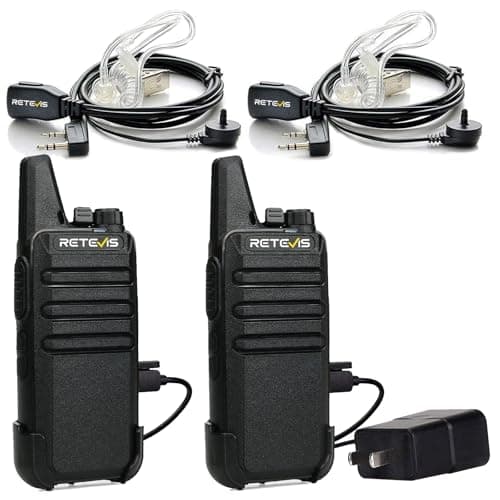 Retevis RT22 (2-pack) The radio you hand to forty volunteers: no screen, channel lock, 2 W FRS, 4 oz and USB-C. Retevis quotes an honest 0.5 to 2 miles, which covers a venue. | Best crew radio overallNo licenseBudget | 5.5/10Researched | $29.98Amazon #ad · Disclosure |
| 2 | 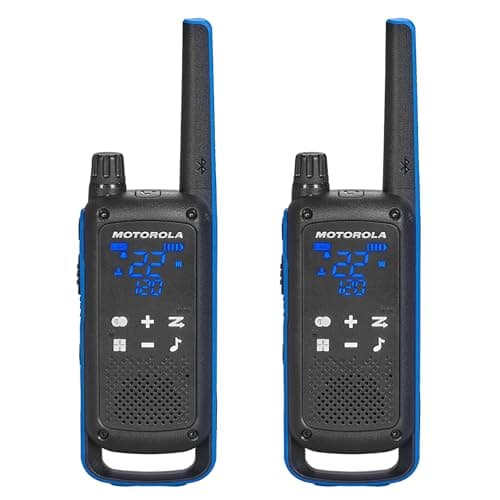 Motorola Talkabout T802 (2-pack) Bluetooth to Motorola's TALKABOUT app passes short messages and location shares between T800-series radios with no cell service. Useful when a site is too loud to talk. | Best for team leadsNo licenseMid-price | 6.1/10Researched | $109.99Amazon #ad · Disclosure |
| 3 | 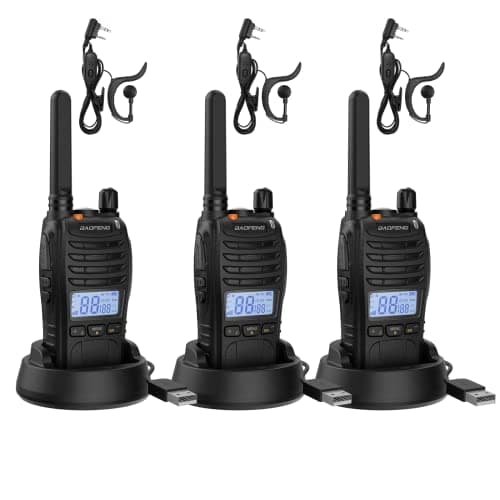 Baofeng BF-88ST Pro FRS (multi-pack) Sold in twos, threes or fours with a headset per radio, at a stated 2 W on FRS. The cheapest way to cover an extra gate or a late crew addition. | Best way to add radios fastNo licenseBudget | 6.1/10Researched | $41.99Amazon #ad · Disclosure |
| 4 | 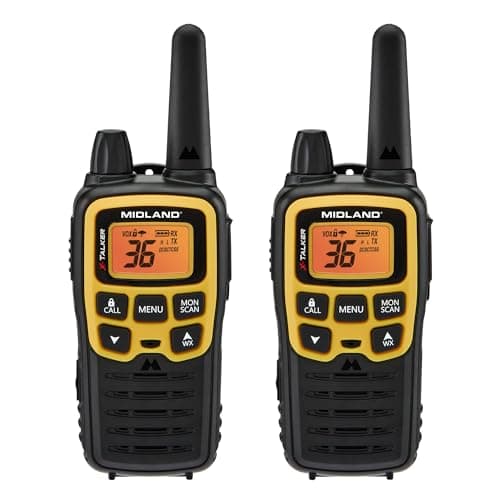 Midland X-Talker T61VP3 (2-pack) The X-Talker with hi/lo power, so a crew working one hall can drop to low and keep the channel clear for everyone else on site. | Best with power settingsNo licenseMid-price | 5.6/10Researched | $79.99Amazon #ad · Disclosure |
| 5 | 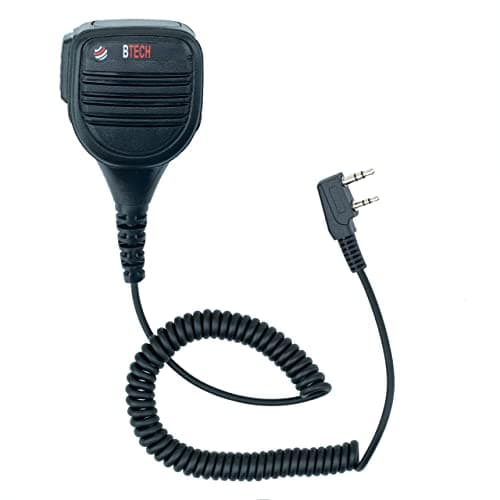 BTECH QHM22 Heavy Duty Speaker Mic A heavy-duty K1 speaker mic that clips high on a shoulder, so the audio is next to your ear instead of on your hip. The right answer outdoors; an earpiece is the right answer in a quiet room. | Best accessory for noiseAccessoryBudget | 6.9/10Researched | $24.89Amazon #ad · Disclosure |
#ad · Prices come live from Amazon, last checked November 2, 2026. Scores are ours, built from published specs, manuals and FCC rules. Photos come from each product's Amazon listing; a radio we can't show a real photo of is left blank rather than illustrated. Tap a row for the full write-up.

Event radio traffic is the opposite of family radio traffic. It is dense, it comes from several teams at once, it happens next to a PA stack, and it runs from a 6 a.m. load-in to a midnight strike. The radios that win are not the ones with the biggest number on the box — they are the ones with a locked channel, a battery that outlasts the day, and audio you can hear with a crowd behind you.
One quick distinction before the picks: this page is for the crew. If you are attending an event and want to find your group in a field of 40,000 people, that is a different purchase — see best walkie-talkies for festivals.
Why event crews buy FRS
The high-power consumer radios are GMRS, and a GMRS license is issued to an individual and covers that person's immediate family (47 CFR 95.1705). A production company, a venue or a volunteer committee cannot hold one. FRS is licensed by rule — no application, no fee — and capped at 2 watts on channels 1-7 and 15-22 and 0.5 watts on 8-14 (47 CFR 95.567, FCC: Family Radio Service). The only thing the FRS rules forbid is one-way broadcasting (47 CFR 95.533), so crew use is fine.
What matters on a show day
Picks come from published maker specifications and the FCC rules; this site does not test radios and our method is on how we rank. Five criteria set the order:
- Audio you can hear in noise. A shoulder-mounted speaker mic beats a louder radio on a belt, every time.
- A battery that covers load-in to strike. Published runtime in hours, or AA fallback.
- Channel lock. Forty borrowed radios will drift off channel unless they cannot.
- Buyable in bulk, cheap to lose. Radios go home in crew bags. Plan on it.
- Something for the leads that the crew radios do not have — text, location, a second channel to monitor.
The picks in detail
1. Retevis RT22 — the crew radio
This is the radio that is already clipped to half the staff at every hotel and conference center in the country: screenless, a channel knob with a lock, 2 W FRS, 16 channels with CTCSS and DCS codes, a 1000 mAh Li-ion with USB-C charging, VOX and 113 grams in the hand (Retevis RT22 product page). Retevis quotes 0.5 to 2 miles and 12 to 24 hours of standby, which is the kind of claim you can plan a day around.
Cons: 16 channels, not 22, so cross-matching with another vendor's radios can run out of room; no NOAA weather receiver; and Retevis describes it as only lightly water resistant, so an outdoor gate team in the rain needs a bag over it.
2. Motorola Talkabout T802 — the lead's radio
The T800-series radios pair over Bluetooth to Motorola's TALKABOUT phone app and pass short text messages and location shares between radios with no cell service involved (T802/T803 datasheet). On a site where the PA makes voice useless, a typed "truck 2 at dock B" gets through. Add NOAA alerts, an emergency button, a flashlight, VOX, Bluetooth audio and USB-C charging.
Cons: the messaging only works between T800-series radios running the app, so it is a two-or-more purchase for leads only; and Motorola publishes IP54 on the datasheet but IPX4 in the lineup highlights (T800 series page), so read it as splash-resistant.
3. Baofeng BF-88ST Pro — the fast way to add radios
When the crew list grows by six on the Thursday before, this is the pack to order: a stated 2 W on FRS, all 22 channels plus 12 NOAA weather channels, dual watch, a headset in the box per radio, sold in twos, threes or fours (Baofeng BF-88ST Pro page). Baofeng states 8 to 12 hours of frequent use.
Cons: a 3-mile advertised figure, a sealed-in antenna and no upgrade path. It is a fill-the-gap radio.
4. Midland X-Talker T61VP3 — the one with power settings
The T61VP3 is the X-Talker that gives you hi and lo power (Midland T61VP3 page), which matters more on a crowded site than extra range does: a team working one hall can run low power and stop stepping on the gate team two hundred yards away. It also brings NOAA Weather Scan, eVOX and 22 channels with 38 codes.
Cons: AAA-based power rather than AA, no IP rating, and Midland does not state the wattage for either setting.
5. BTECH QHM22 speaker mic — the accessory for outdoors
A heavy-duty K1 speaker microphone that clips to a shoulder strap or a lapel puts the audio next to your ear instead of on your hip, which is the single biggest audio improvement available on a noisy site (BTECH QHM22 page). Indoors, in a quiet room or during a performance, swap it for a surveillance earpiece instead.
Cons: K1 Kenwood-style two-pin only — it fits the Retevis and Baofeng picks, and not the Midland or the Motorola. The whole plug matrix is in earpieces and headsets.
The published specs side by side
The channel plan
The thing that fixes event radio is not hardware, it is a written channel plan. FRS gives you 22 channels (47 CFR 95.563) and every radio on a channel hears every other radio on it, so split the teams:
- Channel 1 — command. Leads only. Nobody else transmits here.
- Channel 3 — gates and guest services.
- Channel 5 — stage, production and load-in.
- Channel 7 — vendors and catering.
- Avoid channels 8-14 for anything important: the FCC caps those at 0.5 watts.
Give every radio a label with its channel and privacy code on the back, and print the plan on the crew sheet. Matching channel plus matching code is the entire compatibility story on FRS, which is also why privacy codes are not privacy — here is what they really do.
Kitting out a crew
- One radio per moving role, plus 15% spares. Radios die, walk off and get left in trucks.
- One speaker mic or earpiece per radio. A radio without audio kit is a radio nobody hears.
- A multi-bay charging bank in one locked place, with the radio count written on the case.
- A sign-out sheet. Name against radio number. This is the only thing that gets them back.
- Spare AA or AAA cells for whichever radios take them, because that is your mid-show recovery plan.
Five mistakes that cost a show
- Buying GMRS radios for a company. The license does not exist for organizations. Start over with FRS or a licensed system.
- Putting every team on one channel. Four teams on channel 1 is silence with extra steps.
- Trusting the mileage claim. Those numbers are mountain-top figures; see range claims explained.
- No earpieces or speaker mics. Belt audio loses to a crowd every time.
- Charging overnight on a power strip that someone unplugs. Count the radios on the bank at the end of the night, not in the morning.
In detail
The picks, in full
Rank 01
Best crew radio overall
Retevis RT22 (2-pack)
The radio you hand to forty volunteers: no screen, channel lock, 2 W FRS, 4 oz and USB-C. Retevis quotes an honest 0.5 to 2 miles, which covers a venue.
Published specsResearched · every figure sourced
How the 5.5 score breaks down
- Real-world reach (30%)
- 4.5
- Ease of use (20%)
- 8
- Toughness & weather (15%)
- 3
- Power & battery (15%)
- 6
- Field features (10%)
- 4
- Value (10%)
- 8
What the specs support
- States 2 W and a realistic 0.5 to 2 mile range
- USB-C Li-ion and very light
- Pre-paired out of the box; no screen to confuse anyone
Where it falls short
- Only 16 channels, so it can't reach every FRS channel another family's radio might use
- No weather channel, and only light water resistance
Skip this if…
…Skip it if you need NOAA alerts or will match channels with other brands' 22-channel radios: it has 16 channels and no weather receiver.
#ad · Price as of November 2, 2026 · How we make money for the link to Retevis RT22 (2-pack)
Rank 02
Best for team leads
Motorola Talkabout T802 (2-pack)
Bluetooth to Motorola's TALKABOUT app passes short messages and location shares between T800-series radios with no cell service. Useful when a site is too loud to talk.
Published specsResearched · every figure sourced
How the 6.1 score breaks down
- Real-world reach (30%)
- 4
- Ease of use (20%)
- 8
- Toughness & weather (15%)
- 5
- Power & battery (15%)
- 6
- Field features (10%)
- 9
- Value (10%)
- 7
What the specs support
- Off-grid texting and location sharing between T800 radios through the phone app, with no license and no cell service
- NOAA alerts, emergency button, flashlight and hands-free VOX in one radio
- USB-C charging
Where it falls short
- Motorola doesn't publish the transmit power, and the antenna is fixed like every FRS radio
- Motorola lists the weather rating as IP54 in one place and IPX4 in another; treat it as splash-resistant only
- The messaging and location features only work with other T800-series radios running the app
Skip this if…
…Skip it if you need to reach someone over a ridge or across miles of timber: app features don't add range, and a GMRS radio with more power will reach farther.
#ad · Price as of November 2, 2026 · How we make money for the link to Motorola Talkabout T802 (2-pack)
Rank 03
Best way to add radios fast
Baofeng BF-88ST Pro FRS (multi-pack)
Sold in twos, threes or fours with a headset per radio, at a stated 2 W on FRS. The cheapest way to cover an extra gate or a late crew addition.
Published specsResearched · every figure sourced
How the 6.1 score breaks down
- Real-world reach (30%)
- 5
- Ease of use (20%)
- 8
- Toughness & weather (15%)
- 3
- Power & battery (15%)
- 7
- Field features (10%)
- 7
- Value (10%)
- 8
What the specs support
- A clear 2 W figure, where the cheaper GT-18 page contradicts itself
- 12 NOAA weather channels with alert scanning
- Two, three or four radios in one box, each with a headset
Where it falls short
- Fixed antenna, so no upgrade path
- No water or dust rating published
- Dual watch and alarms are menu features on a radio with very few buttons
Skip this if…
…Skip it if you need more than about a mile in timber: this is a 2 W FRS radio with a sealed antenna, and no setting changes that.
#ad · Price as of November 2, 2026 · How we make money for the link to Baofeng BF-88ST Pro FRS (multi-pack)
Rank 04
Best with power settings
Midland X-Talker T61VP3 (2-pack)
The X-Talker with hi/lo power, so a crew working one hall can drop to low and keep the channel clear for everyone else on site.
Published specsResearched · every figure sourced
How the 5.6 score breaks down
- Real-world reach (30%)
- 4
- Ease of use (20%)
- 8
- Toughness & weather (15%)
- 4
- Power & battery (15%)
- 6
- Field features (10%)
- 7
- Value (10%)
- 6
What the specs support
- Hi/Lo power lets you save battery at short range
- Weather Scan, call alerts and nine-level eVOX
- Headset jack and desktop charger included
Where it falls short
- Midland's own runtime figure is 6.6 hours on high power
- Only "water resistant"; no IP rating
- Midland doesn't publish the transmit power
Skip this if…
…Skip it if you need a full day on high power from one charge: Midland's own figure is 6.6 hours, so pack AAA spares or pick a radio with a bigger battery.
#ad · Price as of November 2, 2026 · How we make money for the link to Midland X-Talker T61VP3 (2-pack)
Rank 05
Best accessory for noise
BTECH QHM22 Heavy Duty Speaker Mic
A heavy-duty K1 speaker mic that clips high on a shoulder, so the audio is next to your ear instead of on your hip. The right answer outdoors; an earpiece is the right answer in a quiet room.
Published specsResearched · every figure sourced
How the 6.9 score breaks down
- Connector fit (30%)
- 8
- Hearing & mic in the field (25%)
- 6
- Comfort & quiet use (20%)
- 5
- Durability (15%)
- 7
- Value (10%)
- 9
What the specs support
- K1 two-pin plug; BTECH lists the GMRS-V1, GMRS-V2 and FRS-A1
- IP54 impact-resistant casing and an 8-position stainless clip
- 3.5 mm jack lets you add a listen-only earpiece for quiet or loud places
Where it falls short
- BTECH does not list its GMRS-PRO, or any Midland or Motorola radio
- IP54 is splash resistance, not waterproof
- No warranty length stated on the page
Skip this if…
…Skip it if you own a Midland, a Motorola Talkabout or a BTECH GMRS-PRO: none is on BTECH's fit list, which covers Kenwood-style K1 two-pin radios.
#ad · Price as of November 2, 2026 · How we make money for the link to BTECH QHM22 Heavy Duty Speaker Mic
What to look for in an event radio
- FRS, not GMRS, unless you are renting a licensed system from a dealer.
- Channel lock, or no display at all.
- A published runtime that covers your longest day, or batteries you can swap.
- A K1 two-pin jack, because the cheap, good speaker mics and earpieces are all K1.
- High and low power settings if several teams share a site.
- Enough radios, plus spares, bought in packs rather than pairs.
And one upgrade worth the money on exactly two radios: app messaging and location sharing for the leads. It is the only feature here that solves a problem volume cannot.
How we scored this
Every pick here is backed by the paperwork
Every pick is labeled Researched: we read each maker's published specs, manuals and range tables, check the license rules against the FCC, and score every radio on a public rubric out of 10. Every figure links to where it came from, and every range number is labeled “advertised” so you can see the difference between the box and the terrain.
Scores are our editorial judgment on that documented evidence. Commissions never set a score or decide a pick. The rubric and its weights are published.
What changed
- Published.
Questions
Frequently asked
What radios do event staff use?
Do event radios need an FCC license?
How many channels do we need for an event?
Speaker mic or earpiece for event crew?
Will walkie-talkies cover a whole festival site?
Can we mix brands across the crew?
Receipts
Sources
- Retevis: RT22 product page (checked 2026-09-29)
- Motorola Solutions: TALKABOUT T800 series product page (checked 2026-09-22)
- Motorola Solutions: T802/T803 datasheet PDF (checked 2026-09-22)
- Baofeng: BF-88ST Pro FRS product page (checked 2026-09-22)
- Midland: X-Talker T61VP3 product page (checked 2026-09-22)
- BTECH: QHM22 heavy duty speaker mic product page (checked 2026-09-22)
- FCC: Family Radio Service (FRS) page (checked 2026-10-17)
- 47 CFR 95.533, permissible FRS uses (via Cornell LII, checked 2026-10-17)
- 47 CFR 95.563, FRS channel frequencies (via Cornell LII, checked 2026-10-17)
- 47 CFR 95.567, FRS power limits per channel (via Cornell LII, checked 2026-10-17)
- 47 CFR 95.1705, GMRS eligibility: individuals and family (via Cornell LII, checked 2026-10-17)
Specs and range figures come from each maker's own pages and manuals, linked on every product, and license, power and channel rules come from the FCC and 47 CFR Part 95. Range numbers are the maker's advertised claims and are labeled that way, so you can tell the box number from the terrain number. Prices come live from Amazon with the time we checked. Read the full method.