Not legal advice. This page summarizes FCC rules (47 CFR Part 95) from the official sources linked in the text. Rules and fees checked . The FCC sets its fees annually and can change its rules, so confirm the current version on fcc.gov before you rely on it.
Quick picks
The picks at a glance
| # | Product | Best for | Score | Price |
|---|---|---|---|---|
| 1 | 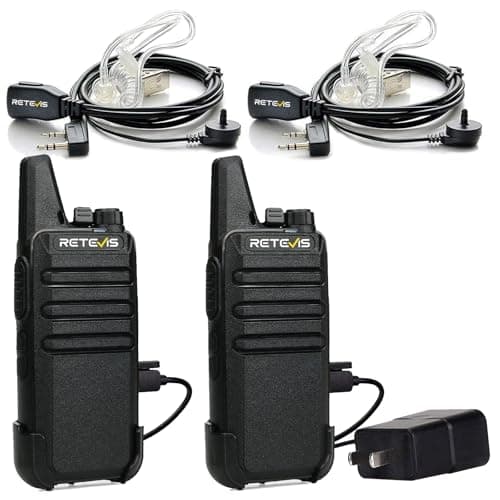 Retevis RT22 (2-pack) A screenless 2 W FRS radio with channel lock: nobody can change the channel by accident, and Retevis itself quotes an honest 0.5 to 2 miles. USB-C Li-ion and 4 oz per radio. | Best school radio overallNo licenseBudget | 5.5/10Researched | $29.98Amazon #ad · Disclosure |
| 2 | 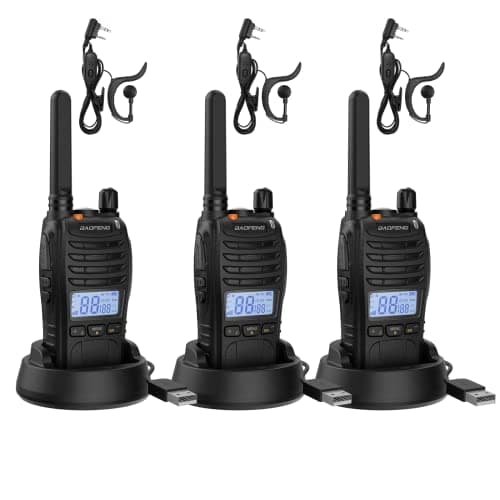 Baofeng BF-88ST Pro FRS (multi-pack) Sold in twos, threes or fours with headsets in the box, at a full stated 2 W on FRS and 12 NOAA weather channels. The cheapest honest way to put radios on every floor. | Best way to issue a dozenNo licenseBudget | 6.1/10Researched | $41.99Amazon #ad · Disclosure |
| 3 | 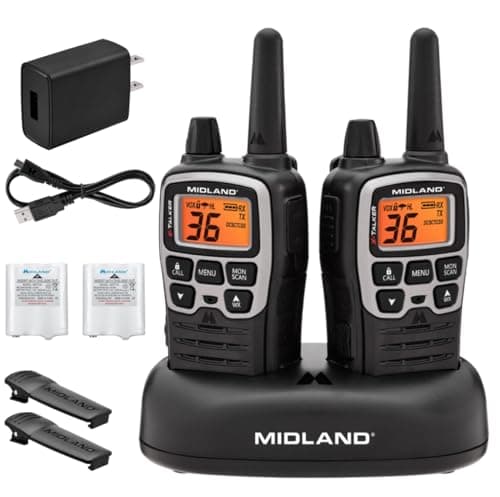 Midland X-Talker T71VP3 (2-pack) Hi/lo power, Weather Scan, a headphone jack and a 3 AA fallback, so a radio on the secretary's desk still works when the chargers are dead. | Best for front-office useNo licenseMid-price | 5.7/10Researched | $89.99Amazon #ad · Disclosure |
| 4 | 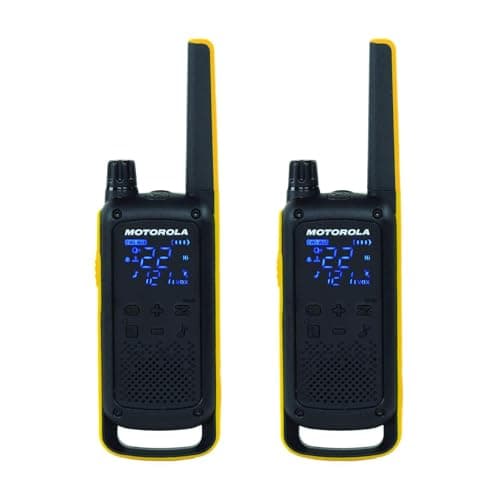 Motorola Talkabout T470 (2-pack) NOAA weather channels and alerts, an emergency button, a flashlight and a stated 28 hours on three AA alkalines. The radio to store, not to carry daily. | Best for the emergency cabinetNo licenseMid-price | 6.1/10Researched | $89.99Amazon #ad · Disclosure |
| 5 | 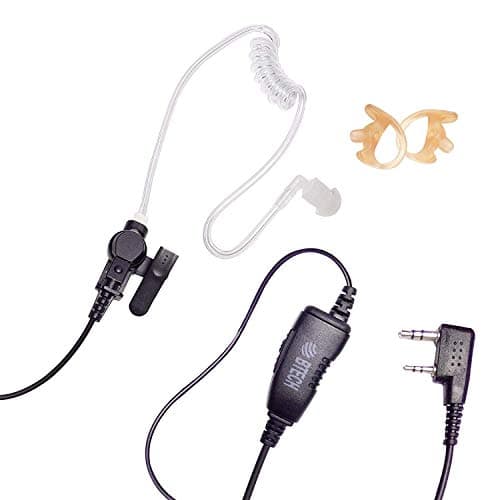 BTECH QHM07 Surveillance Earpiece and Microphone Kit A locking clear-tube surveillance earpiece with an in-line PTT mic, for Kenwood-style K1 radios like the Retevis and Baofeng picks. Keeps radio traffic out of a classroom. | Best accessory for a hallwayAccessoryBudget | 7.3/10Researched | $16.25Amazon #ad · Disclosure |
#ad · Prices come live from Amazon, last checked November 2, 2026. Scores are ours, built from published specs, manuals and FCC rules. Photos come from each product's Amazon listing; a radio we can't show a real photo of is left blank rather than illustrated. Tap a row for the full write-up.

School radio traffic is short, constant and low-drama: a bus is early, a student needs walking to the nurse, the gym door is unlocked, the parent in the office is here for pickup. None of that needs distance. It needs radios that every member of staff can use without training, that stay on the right channel, that survive a drop onto tile, and that the district is actually allowed to own.
That last point knocks out a surprising number of popular radios, so it goes first.
The license problem nobody mentions
The powerful, repeater-capable consumer radios — anything labeled GMRS — require an individual FCC license. Individual is the operative word: the rule grants GMRS licenses to a person, and it covers that person's immediate family members (47 CFR 95.1705). A school, a district or a PTA is not a family and cannot hold one. A principal's personal license does not cover staff.
That leaves two legal options. FRS is licensed by rule: no application, no fee, no call sign, capped by the FCC at 2 watts on channels 1-7 and 15-22 and 0.5 watts on 8-14, with a non-removable antenna (47 CFR 95.567, 47 CFR 95.587, FCC: Family Radio Service). Nothing in the FRS rules restricts it to personal use; the only prohibition is on one-way broadcasting (47 CFR 95.533). Part 90 business licensing is the other option, sold through dealers, and it is what a large district with its own repeater buys (47 CFR 90.35).
How we picked for a campus
Picks come from published specifications, manuals and the FCC rules — this site does not test radios, and our method is on how we rank. For a school, five things decided the order:
- Channel lock or no screen. The single biggest cause of "the radios stopped working" in a school is somebody nudging the channel button. A locked or screenless radio cannot drift.
- A full shift on one charge. Staff radios get charged overnight, not at lunch.
- A headset jack. Open-speaker radio traffic in a classroom is a non-starter, so an earpiece has to be an option from day one.
- Buyable in quantity. Two radios is a trial; eight is a deployment.
- Honest published range. A maker that says "0.5 to 2 miles" is easier to plan around than one that prints 35 miles on the box.
The picks in detail
1. Retevis RT22 — the one to issue by default
The RT22 is the radio you have already seen clipped to a shirt at a hotel desk or a restaurant host stand: no screen, a channel knob, a 2 W FRS transmitter, 16 channels with CTCSS and DCS codes, USB-C charging on a 1000 mAh Li-ion, VOX and 4 ounces in the hand (Retevis RT22 product page). Retevis quotes 0.5 to 2 miles, which is an honest figure and more than a campus needs. The pair ships set to the same channel and code, so a box of them is ready at the start of the day.
Cons: 16 channels means it cannot reach every channel another organization's 22-channel radios might be on, there is no NOAA weather receiver, and it is only lightly water resistant.
2. Baofeng BF-88ST Pro — the way to equip a whole floor
Baofeng's license-free pack is the cheapest way to put a radio in every hand without buying junk: a stated 2 W on FRS, all 22 channels plus 12 NOAA weather channels, dual watch, a sealed-in antenna, and a headset included with each radio, sold as a 2-, 3- or 4-pack (Baofeng BF-88ST Pro page). Baofeng states 8 to 12 hours of frequent use, which covers a school day with room to spare.
Cons: Baofeng advertises only 3 miles, which is fine here but tells you not to buy it for a field trip across town; and the antenna is non-removable, so there is no upgrade path.
3. Midland X-Talker T71VP3 — the office radio
For the front office, the nurse and the principal, the T71VP3 adds things the cheap radios do not have: hi/lo power, NOAA Weather Scan with alerts, silent operation, nine VOX levels, a headphone jack and — the one that matters in a power cut — a three-AA fallback behind the rechargeable packs (Midland T71VP3 page).
Cons: Midland's own runtime figure is about five hours on high power, and there is no IP rating.
4. Motorola Talkabout T470 — the emergency-cabinet radio
Every school has a cabinet with flashlights and a first-aid kit in it, and this is the radio that belongs there: NOAA weather channels and alerts, an emergency button, a flashlight, VibraCall, and a published 28 hours on three AA alkalines against 12 hours on the rechargeable pack (Motorola T470 series page). Alkaline batteries in a drawer outlast a rechargeable pack that has been sitting for a year.
Cons: Micro-USB charging, IPX4 splash rating only, and a 2.5 mm jack that needs a Motorola-pattern earpiece, not the K1 type the other picks use.
5. BTECH QHM07 earpiece — the accessory that makes this work
One accessory decides whether staff actually carry the radio: a surveillance earpiece with a clear acoustic tube that rotates and locks, and an in-line push-to-talk microphone on the lapel (BTECH QHM07 page). It fits Kenwood-style K1 two-pin jacks, which is what the Retevis and Baofeng picks use, and it ships with both earbud and open-ear earmold inserts.
Cons: it is a K1 plug only. It does not fit Midland's dual-pin jack or a Motorola Talkabout, so buy the earpiece that matches the radio — the full matrix is in earpieces and headsets.
The published specs side by side
Why range inside a school is the real limit
Nobody is defeated by distance on a school campus; they are defeated by the building. Concrete, brick, cinder block, steel lockers, tile and elevator shafts all absorb UHF signal, which is why a radio that covers two miles of open field struggles between a basement cafeteria and a third-floor classroom (NIST: electromagnetic signal attenuation in construction materials).
Four rules worth writing down
- One channel, written on the radio. Tape the channel and code on the back of every unit. On FRS, matching channel and matching privacy code is the whole of compatibility.
- No student names on the air. Radio is not private — anyone within range with a scanner or a matching radio can hear it, and privacy codes do not encrypt anything. Our privacy codes guide explains why.
- Plain language, not codes. A substitute teacher cannot decode anything. See walkie-talkie 10 codes for why plain speech wins on a shared channel.
- Charge on a rack, not on desks. Radios that live in a charging bank get charged; radios that live in drawers do not.
In detail
The picks, in full
Rank 01
Best school radio overall
Retevis RT22 (2-pack)
A screenless 2 W FRS radio with channel lock: nobody can change the channel by accident, and Retevis itself quotes an honest 0.5 to 2 miles. USB-C Li-ion and 4 oz per radio.
Published specsResearched · every figure sourced
How the 5.5 score breaks down
- Real-world reach (30%)
- 4.5
- Ease of use (20%)
- 8
- Toughness & weather (15%)
- 3
- Power & battery (15%)
- 6
- Field features (10%)
- 4
- Value (10%)
- 8
What the specs support
- States 2 W and a realistic 0.5 to 2 mile range
- USB-C Li-ion and very light
- Pre-paired out of the box; no screen to confuse anyone
Where it falls short
- Only 16 channels, so it can't reach every FRS channel another family's radio might use
- No weather channel, and only light water resistance
Skip this if…
…Skip it if you need NOAA alerts or will match channels with other brands' 22-channel radios: it has 16 channels and no weather receiver.
#ad · Price as of November 2, 2026 · How we make money for the link to Retevis RT22 (2-pack)
Rank 02
Best way to issue a dozen
Baofeng BF-88ST Pro FRS (multi-pack)
Sold in twos, threes or fours with headsets in the box, at a full stated 2 W on FRS and 12 NOAA weather channels. The cheapest honest way to put radios on every floor.
Published specsResearched · every figure sourced
How the 6.1 score breaks down
- Real-world reach (30%)
- 5
- Ease of use (20%)
- 8
- Toughness & weather (15%)
- 3
- Power & battery (15%)
- 7
- Field features (10%)
- 7
- Value (10%)
- 8
What the specs support
- A clear 2 W figure, where the cheaper GT-18 page contradicts itself
- 12 NOAA weather channels with alert scanning
- Two, three or four radios in one box, each with a headset
Where it falls short
- Fixed antenna, so no upgrade path
- No water or dust rating published
- Dual watch and alarms are menu features on a radio with very few buttons
Skip this if…
…Skip it if you need more than about a mile in timber: this is a 2 W FRS radio with a sealed antenna, and no setting changes that.
#ad · Price as of November 2, 2026 · How we make money for the link to Baofeng BF-88ST Pro FRS (multi-pack)
Rank 03
Best for front-office use
Midland X-Talker T71VP3 (2-pack)
Hi/lo power, Weather Scan, a headphone jack and a 3 AA fallback, so a radio on the secretary's desk still works when the chargers are dead.
Published specsResearched · every figure sourced
How the 5.7 score breaks down
- Real-world reach (30%)
- 4
- Ease of use (20%)
- 8
- Toughness & weather (15%)
- 4
- Power & battery (15%)
- 6
- Field features (10%)
- 7
- Value (10%)
- 7
What the specs support
- AA fallback plus 1000 mAh packs and a full charging kit
- Weather Scan, silent mode and hands-free eVOX
- Works with any other FRS or GMRS radio on the shared FRS channels
Where it falls short
- Midland's own runtime figure is about 5 hours on high power
- Only "water resistant"; no IP rating
- Transmit power isn't published, and FRS rules still cap what it can do
Skip this if…
…Skip it if you're buying it for the "38 miles": through hills and trees it's still a fixed-antenna FRS radio, and a GMRS radio is the real step up in reach.
#ad · Price as of November 2, 2026 · How we make money for the link to Midland X-Talker T71VP3 (2-pack)
Rank 04
Best for the emergency cabinet
Motorola Talkabout T470 (2-pack)
NOAA weather channels and alerts, an emergency button, a flashlight and a stated 28 hours on three AA alkalines. The radio to store, not to carry daily.
Published specsResearched · every figure sourced
How the 6.1 score breaks down
- Real-world reach (30%)
- 4
- Ease of use (20%)
- 8
- Toughness & weather (15%)
- 5
- Power & battery (15%)
- 7
- Field features (10%)
- 8
- Value (10%)
- 7
What the specs support
- AA fallback with a stated 28 hours, which suits an emergency kit
- NOAA alerts, flashlight and emergency button included
- Hands-free iVOX/VOX and a standard 2.5 mm headset jack
Where it falls short
- Micro-USB charging, not USB-C
- IPX4 is splash protection only; don't drop it in water
- Motorola doesn't publish the transmit power
Skip this if…
…Skip it if it will get wet often: IPX4 handles rain, not a creek crossing or a canoe, so the IP67 T605 is the Motorola to buy.
#ad · Price as of November 2, 2026 · How we make money for the link to Motorola Talkabout T470 (2-pack)
Rank 05
Best accessory for a hallway
BTECH QHM07 Surveillance Earpiece and Microphone Kit
A locking clear-tube surveillance earpiece with an in-line PTT mic, for Kenwood-style K1 radios like the Retevis and Baofeng picks. Keeps radio traffic out of a classroom.
Published specsResearched · every figure sourced
How the 7.3 score breaks down
- Connector fit (30%)
- 8
- Hearing & mic in the field (25%)
- 6
- Comfort & quiet use (20%)
- 8
- Durability (15%)
- 6
- Value (10%)
- 9
What the specs support
- K1 two-pin plug for the BTECH GMRS-V2, FRS-A1 and other Kenwood-style radios
- Coil tube locks in rather than relying on friction; stainless strain-relief clips
- Includes an in-ear earbud and left/right open-ear earmolds
Where it falls short
- Noise canceling is in the product name, but BTECH publishes no noise-reduction figure
- No weather rating or warranty length stated
- Not on BTECH's fit list for its own GMRS-PRO
Skip this if…
…Skip it if your radio has no Kenwood-style K1 two-pin jack (Midland, Motorola Talkabout, Rocky Talkie Expedition) or is a BTECH GMRS-PRO: BTECH lists it only for K1 radios.
#ad · Price as of November 2, 2026 · How we make money for the link to BTECH QHM07 Surveillance Earpiece and Microphone Kit
What to look for in a school radio
- FRS on the box. If it says GMRS, the district cannot license it. This is the first filter, not the last.
- Channel lock, or no display at all. Fewer controls means fewer support calls.
- A stated battery life in hours. You need a school day plus a sports event, not a vague "long battery."
- The accessory jack type. K1 two-pin is the most common and the cheapest to accessorize. Midland and Motorola use their own.
- Replaceable or AA-capable packs for the radios that live in an emergency cabinet.
- A count that covers reality. Office, principal, nurse, two hall monitors, cafeteria, gym and a spare is eight radios, not four.
And one thing to ignore: the mileage claim. A campus needs a quarter of a mile through walls, which is a building problem, not a wattage problem.
How we scored this
Every pick here is backed by the paperwork
Every pick is labeled Researched: we read each maker's published specs, manuals and range tables, check the license rules against the FCC, and score every radio on a public rubric out of 10. Every figure links to where it came from, and every range number is labeled “advertised” so you can see the difference between the box and the terrain.
Scores are our editorial judgment on that documented evidence. Commissions never set a score or decide a pick. The rubric and its weights are published.
What changed
- Published.
Questions
Frequently asked
What walkie-talkies do schools use?
Can a school hold a GMRS license?
Do school walkie-talkies need a license?
How many walkie-talkies does a school need?
Will walkie-talkies work across a whole school building?
Can staff radios be overheard?
Receipts
Sources
- Retevis: RT22 product page (checked 2026-09-29)
- Baofeng: BF-88ST Pro FRS product page (checked 2026-09-22)
- Midland: X-Talker T71VP3 product page (checked 2026-09-22)
- Motorola Solutions: TALKABOUT T470 series page (checked 2026-09-22)
- BTECH: QHM07 surveillance earpiece product page (checked 2026-09-22)
- FCC: Family Radio Service (FRS) page (checked 2026-10-17)
- 47 CFR 95.533, permissible FRS uses (via Cornell LII, checked 2026-10-17)
- 47 CFR 95.567, FRS power limits (via Cornell LII, checked 2026-10-17)
- 47 CFR 95.587, FRS non-removable antenna rule (via Cornell LII, checked 2026-10-17)
- 47 CFR 95.1705, GMRS eligibility: individuals and family (via Cornell LII, checked 2026-10-17)
- 47 CFR 90.35, Industrial/Business Pool eligibility (via Cornell LII, checked 2026-10-17)
- NIST: electromagnetic signal attenuation in construction materials (checked 2026-10-17)
Specs and range figures come from each maker's own pages and manuals, linked on every product, and license, power and channel rules come from the FCC and 47 CFR Part 95. Range numbers are the maker's advertised claims and are labeled that way, so you can tell the box number from the terrain number. Prices come live from Amazon with the time we checked. Read the full method.