Not legal advice. This page summarizes FCC rules (47 CFR Part 95) from the official sources linked in the text. Rules and fees checked . The FCC sets its fees annually and can change its rules, so confirm the current version on fcc.gov before you rely on it.

A GMRS call sign is the identifier the FCC assigns to your license, and it is the only thing you are legally obliged to say on the air. It is not something you choose, not something printed on the radio, and not something you can make up: it arrives with the license grant and it belongs to the license, not to the radio or to the person holding it at the time.
If you do not have a license yet, that is the first step - how to get a GMRS license walks through the application. This page is about what happens once it is granted.
What a GMRS call sign is
A short alphanumeric string, assigned automatically on grant. Modern GMRS call signs issued to individuals follow a four-letter, three-digit shape - for example WRAA123 - and recent grants are clustered in the WQ and WR letter ranges. You cannot request a specific one, and there are no vanity call signs in GMRS.
It identifies the license, which is the important part. A GMRS license is granted to an individual at least 18 years old and extends to that person's immediate family (47 CFR 95.1705, FCC GMRS page). So one call sign covers the license holder, their spouse, their children, their parents - and every handheld, mobile and base station they operate. There is no second call sign to apply for when you buy a second radio.
Where to find yours
Your call sign appears on the license document itself, which is issued electronically. If you have lost track of it:
- Sign in to the FCC's licensing system with the FRN and password you used to apply (FCC CORES login). Your licenses, and their call signs, are listed against the FRN.
- If you have forgotten which FRN you used, the FCC's guidance on applying for and managing a license is the starting point (FCC: applying for a new license, FCC ULS GMRS license manager help). An FRN is registered separately from any license (FCC: register a new FRN).
- Or search the public license database by your own name, using the GMRS license search (FCC ULS GMRS license search help). GMRS licenses are public records.
How often you must say it
What that looks like in practice is short and undramatic. A two-minute conversation needs the call sign once, at the end: "All right, see you at the gate. WRAA123." A long convoy drive needs it dropped in roughly every quarter of an hour. You do not need to announce it on every press, and nobody on GMRS expects the formal exchange protocols of amateur radio.
Several radios, one call sign
One license covers a whole immediate family, which raises the obvious question: how does anyone tell which radio is talking? The rule's own answer is the optional unit number after the call sign (47 CFR 95.1751).
So a family might run WRAA123 unit 1 for the base at the house, unit 2 for the truck, unit 3 and unit 4 for the handhelds. Written down inside each radio's battery door, it takes thirty seconds to set up and it makes traffic legible. Day to day most families just use first names on the air and add the call sign when they identify - which is entirely legal, because the call sign is the required part and names are not prohibited.
What you must not do is use somebody else's call sign, or invent one. If a friend outside your immediate family wants to use radios with you, either they get their own license, or they use FRS radios - see GMRS vs FRS.
Looking up somebody else's call sign
Because GMRS licenses are public, you can look up a call sign you have heard on the air. The FCC's GMRS license search is the authoritative source (FCC ULS GMRS license search help). This is routinely used for two legitimate purposes: confirming that a repeater owner holds a current license, and checking your own record before renewal.
It is worth saying what it is not for. Looking up a stranger's home address because you did not like their radio traffic is exactly the behavior that makes people reluctant to use the service. Treat the database as a license check, not a directory of people.
How this differs from a ham call sign
People coming from amateur radio, or heading toward it, should know these are separate systems and separate call signs:
- Different licenses entirely. A ham license requires passing an exam and authorises operation on the amateur bands (47 CFR 97.301). A GMRS license is an application and a fee. Holding one does not give you the other, and a ham call sign is not valid for identifying on GMRS.
- Different scope. A GMRS license covers your immediate family; an amateur license covers only the individual it is issued to.
- Different culture. Amateur radio identification is more frequent and more formal. On GMRS the 15-minute rule is the whole requirement.
Our GMRS vs ham radio page compares the two services properly, and is a Baofeng legal on GMRS covers the certification trap that catches people who buy a ham radio expecting to use it on GMRS.
Radios worth the license
If you are going to hold a license and use a call sign, these are the radios that make the license worth having - all three do something an FRS radio is not allowed to.
Our picks for this job
Three radios that justify the paperwork
All three need the GMRS license your call sign comes with. Each one does something FRS cannot: repeaters, a removable antenna, or 50 watts.
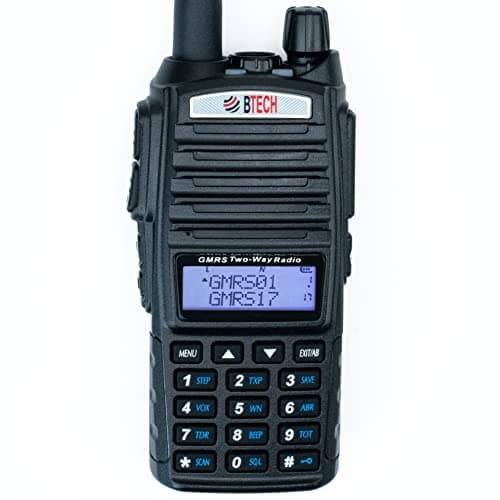
Best budget GMRS for repeater users
BTECH GMRS-V2 (single radio)
5 W, repeater compatible, SMA-female antenna jack and a K1 accessory jack. BTECH publishes 1 to 5+ miles simplex and 15 to 50+ miles through a repeater.
Check price · Amazon#ad · Price as of November 2, 2026 · How we make money for the link to BTECH GMRS-V2 (single radio)
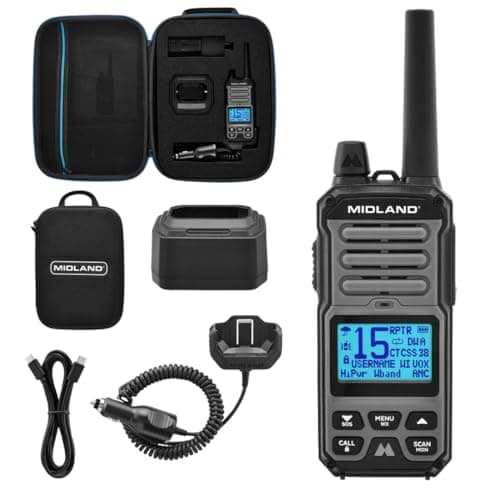
Best Midland handheld for wet weather
Midland GXT67 PRO (single radio)
5 W and IP67, with eight GMRS repeater channels using split tones, NOAA alerts, vibrate and whisper talk. The antenna and battery are both fixed.
$219.99Amazon#ad · Price as of November 2, 2026 · How we make money for the link to Midland GXT67 PRO (single radio)
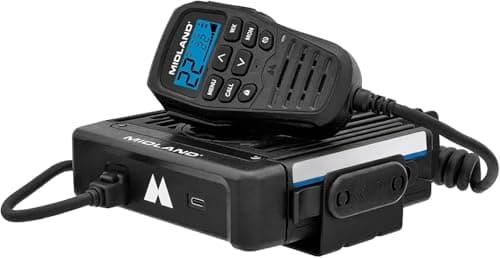
Best 50 W radio for a clean dash
Midland MXT575 MicroMobile (50 W)
50 W in the vehicle or as a base, with 8 repeater channels, a control-mic design and a magnet-mount antenna in the box. Midland publishes a terrain range chart.
$439.99Amazon#ad · Price as of November 2, 2026 · How we make money for the link to Midland MXT575 MicroMobile (50 W)
Common mistakes
- Thinking the radio has a call sign. It does not. The license does, and it covers every radio you own.
- Identifying on every transmission. Unnecessary. End of conversation, plus every 15 minutes in a long one.
- Never identifying at all. This is the actual rule being broken most often, and it is the one thing the FCC asks of you in exchange for the license.
- Using a ham call sign on GMRS. Separate services, separate licenses, separate call signs.
- Letting a non-family member use your radios on your call sign. The license extends to immediate family only.
- Forgetting to renew. A GMRS license has a fixed term; a lapsed license means the call sign is no longer yours to use. Check your record through the FCC license manager (FCC ULS GMRS license manager help).
The practical habits that go with a call sign - listening first, pausing before you speak, keeping transmissions short - are covered on how to use a GMRS radio.
How we scored this
Every pick here is backed by the paperwork
Every pick is labeled Researched: we read each maker's published specs, manuals and range tables, check the license rules against the FCC, and score every radio on a public rubric out of 10. Every figure links to where it came from, and every range number is labeled “advertised” so you can see the difference between the box and the terrain.
Scores are our editorial judgment on that documented evidence. Commissions never set a score or decide a pick. The rubric and its weights are published.
What changed
- Published.
Questions
Frequently asked
What is a GMRS call sign?
How do I find my GMRS call sign?
How often do you have to give your GMRS call sign?
Can my whole family use one GMRS call sign?
Is a ham call sign valid on GMRS?
Receipts
Sources
- FCC: General Mobile Radio Service (GMRS) page (checked 2026-10-11)
- 47 CFR 95.1751, GMRS station identification (via Cornell LII, checked 2026-10-11)
- 47 CFR 95.1705, GMRS eligibility (via Cornell LII, checked 2026-10-11)
- 47 CFR 97.301, amateur service frequency bands (via Cornell LII, checked 2026-10-11)
- FCC: applying for a new license in ULS (checked 2026-10-11)
- FCC: ULS license search help for GMRS (checked 2026-10-11)
- FCC: ULS license manager help for GMRS (checked 2026-10-11)
- FCC: CORES login (checked 2026-10-11)
- FCC: register a new FRN (checked 2026-10-11)
- myGMRS: repeater directory and call-sign registration (checked 2026-10-11)
- BTECH: GMRS-V2 product page (checked 2026-10-11)
- Midland: GXT67 PRO product page (checked 2026-10-11)
- Midland: MXT575 MicroMobile product page (checked 2026-10-11)
Specs and range figures come from each maker's own pages and manuals, linked on every product, and license, power and channel rules come from the FCC and 47 CFR Part 95. Range numbers are the maker's advertised claims and are labeled that way, so you can tell the box number from the terrain number. Prices come live from Amazon with the time we checked. Read the full method.