Not legal advice. This page summarizes FCC rules (47 CFR Part 95) from the official sources linked in the text. Rules and fees checked . The FCC sets its fees annually and can change its rules, so confirm the current version on fcc.gov before you rely on it.
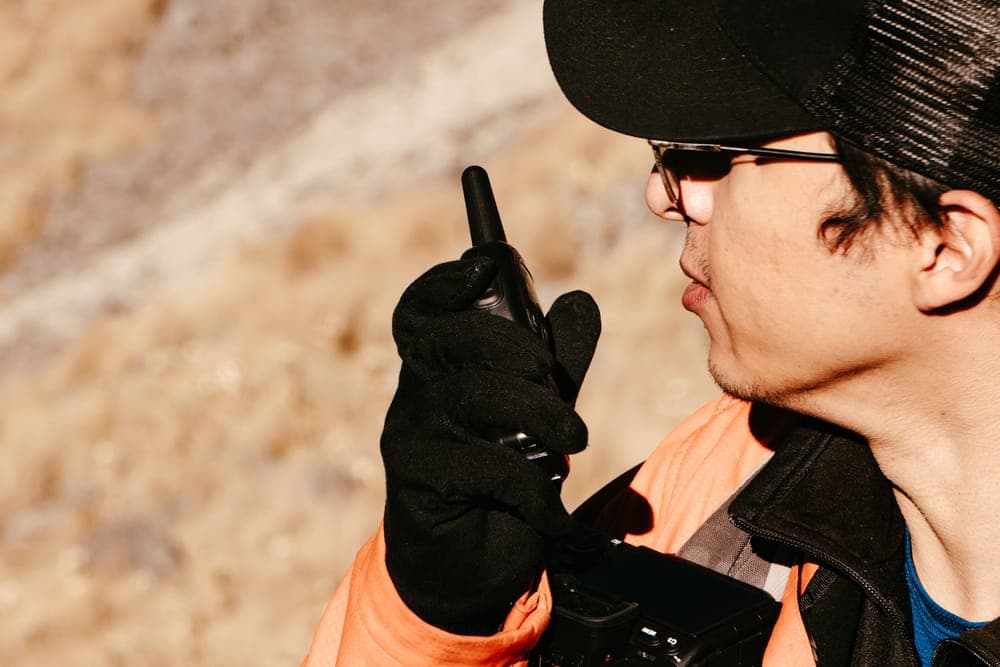
A GMRS radio is simpler than its 200-channel menu suggests. Almost everything you need is three settings - a channel, a privacy code and a power level - plus one legal habit the box never mentions: identifying with your FCC call sign. This page walks through all of it in the order you will actually do it.
Before you transmit: the license
Nine steps to your first conversation
- Charge both radios fully, and fit the antenna properly. On a radio with a removable antenna, finger-tight and square - a loose antenna is the most common cause of poor transmit on a brand new radio.
- Set the same channel on every radio. Channels 1-22 are the standard GMRS and FRS set, so they are what other people's radios share. Channel 20 is widely treated as a travel and calling channel; pick something else for family traffic.
- Set the same privacy code, or none. A CTCSS or DCS code stops your radio unmuting for other groups on your channel. It is a squelch filter, not privacy, and both radios must match or neither hears the other. See privacy codes.
- Listen before you talk. Hold for a few seconds. GMRS channels are shared, and transmitting over someone is both rude and, on a channel in use, a way of being heard by nobody.
- Press, pause, talk, release. Hold the push-to-talk button, wait about half a second for the transmitter to come up, then speak. Most "they did not hear me" problems are the first word being cut off. Release fully when you finish - a held button blocks the whole channel.
- Hold the radio properly. Mic two to three inches from your mouth, speaking across it rather than into it, and keep your hand off the antenna. Antenna vertical, and held away from your body if you can.
- Say who you are. Your FCC call sign, at the end of the exchange and at least every 15 minutes in a long one - see the next section.
- Set power to match the distance. Low power across a campsite, high power across a valley. Details below.
- Check your weather channels. Nearly every GMRS radio receives NOAA Weather Radio broadcasts (NOAA Weather Radio). Find your local station once, and leave the alert function on if the radio has it.
When you have to give your call sign
In practice that means a short, unglamorous habit: finish a conversation with "WRXX123, clear", and drop the call sign in once during anything long. You do not need to say it on every press. Our GMRS call signs page covers what a call sign looks like, where to find yours and how families handle unit numbers.
Power settings, and when to use them
GMRS allows up to 50 W on the main 462 and 467 MHz channels, with lower limits on the shared 467 MHz interstitial channels (47 CFR 95.1767). Handhelds are typically rated at 5 W by their makers, and mobiles up to 50 W. The rules also set channel limits you cannot override: channels 8-14 are the low-power interstitial channels, and GMRS handhelds are limited there.
How to use the switch:
- Low power at close range. Across a campsite, a yard or a worksite. Battery life roughly doubles, and you are not splattering a shared channel across the county.
- High power for distance and obstructions. Across a valley, through timber, to a repeater on a ridge.
- Do not expect power to fix terrain. At these frequencies a hill between two radios is close to absolute. Height beats watts - get above the obstruction, or use a repeater. See how to increase walkie talkie range.
One rule worth knowing before you shop for accessories: GMRS transmitters must be certified and may not be modified, and only an antenna or accessory the maker supplies or authorises keeps the radio inside its certification (47 CFR 95.1761). An external amplifier on a handheld is not a legal upgrade.
Using a GMRS repeater
A repeater sits high up, listens on the 467 MHz repeater inputs and retransmits on the matching 462 MHz outputs, which is how GMRS reaches tens of miles instead of a few. Repeater channels are commonly labeled RPT15 through RPT22 or 23-30 depending on the radio.
Four things you need before it works:
- A repeater-capable radio. Not every GMRS radio has the split-frequency channels - the Midland GXT1000 does not, the BTECH GMRS-V2 and Midland GXT67 PRO do.
- The repeater's output channel and its input tone. Most repeaters require a specific CTCSS or DCS tone on the input to open them. Directories list both: myGMRS and RepeaterBook.
- Permission, where it is asked for. Many GMRS repeaters are privately owned and ask you to request access. That is a courtesy and a community norm, not an FCC rule - but ignoring it is how a newcomer gets a bad reception.
- A longer pause. Repeaters take a moment to come up. Press, wait a full second, then talk, or your first syllable is lost.
Full detail on GMRS repeaters, including how coverage is described and what to expect from a handheld into a hilltop machine.
Radios that make this easy
Our picks for this job
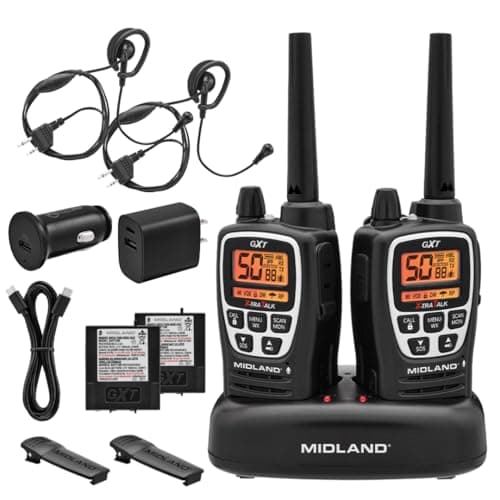
Three GMRS handhelds, by how much setup you want
All three need a GMRS license. The difference is how much menu you deal with and whether repeaters are on the table.
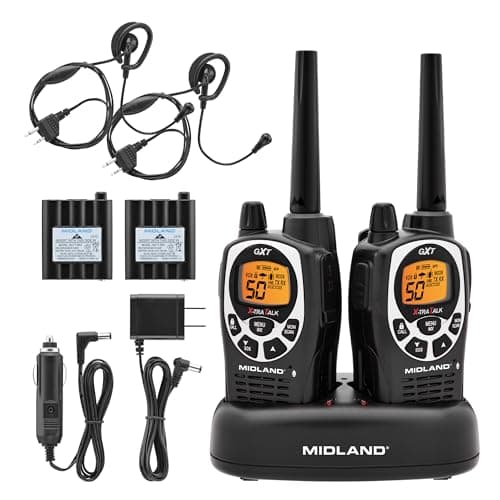
Best simple GMRS pair for families
Midland GXT1000VP4 (2-pack)
Simplest to run: high/medium/low power, 142 privacy codes, NOAA weather alerts, whisper mode, AA fallback. No repeater channels, so it is simplex only.
$89.99Amazon#ad · Price as of November 2, 2026 · How we make money for the link to Midland GXT1000VP4 (2-pack)
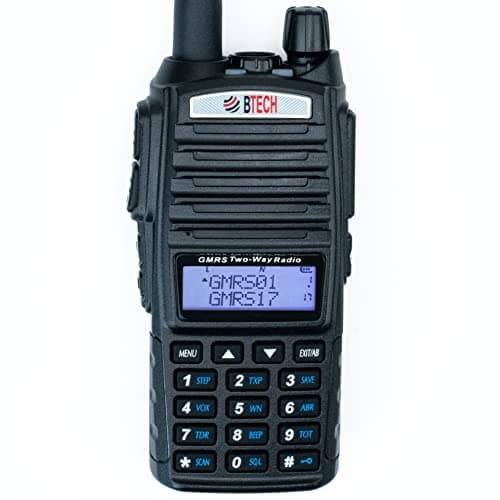
Best budget GMRS for repeater users
BTECH GMRS-V2 (single radio)
Repeater capable at 5 W with an SMA-female antenna jack and a K1 accessory jack; BTECH publishes 1 to 5+ miles simplex and 15 to 50+ miles through a repeater. More menu to learn.
Check price · Amazon#ad · Price as of November 2, 2026 · How we make money for the link to BTECH GMRS-V2 (single radio)
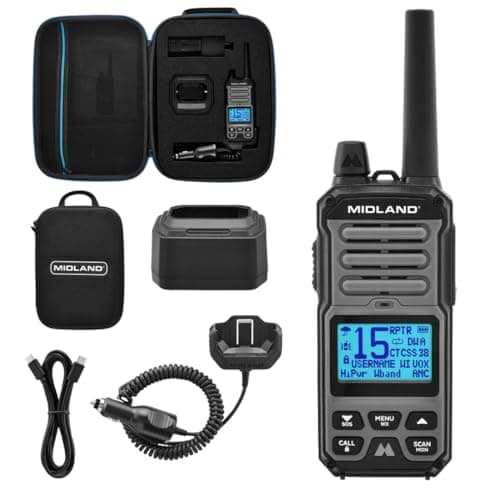
Best Midland handheld for wet weather
Midland GXT67 PRO (single radio)
5 W, IP67, eight GMRS repeater channels with split tones, NOAA alerts, vibrate and whisper talk. Midland's own figure is up to about 5 miles depending on terrain.
$219.99Amazon#ad · Price as of November 2, 2026 · How we make money for the link to Midland GXT67 PRO (single radio)
Etiquette and the rules on content
GMRS is a shared, public service. Two rules in particular shape what you may say and do:
- No obscenity, no false distress calls, no continuous transmission to block a channel, and no using the service for anything unlawful - the prohibited-use rules are set out in 47 CFR 95.1733.
- Share the channel. Keep transmissions short, leave gaps, and give way to anyone who sounds like they have something urgent. The permissible-use rule for GMRS is in 47 CFR 95.1731.
And the practical version, which matters more day to day:
- Nothing you say is private. No addresses, no card numbers, no "we are away until Sunday". Anyone with a radio or a scanner on your channel hears you.
- Short and specific. "Moving to the north gate" beats a conversation. One idea per transmission.
- Hand over cleanly. Finish with the other person's name or "go ahead", so nobody talks over anybody.
When it is not working
- You can hear them but they cannot hear you. Almost always the privacy code: yours is set, theirs is not, or they differ. Set both radios to code 0 and retry.
- Nobody hears your first word. You are talking too soon after pressing. Pause half a second - a full second into a repeater.
- Short range from a brand new radio. Check the antenna is fully seated, and that you are not wrapping a hand around it. Then check you are not on channels 8-14, which are low power by rule.
- Constant noise or chatter. Someone else is on your channel - that is normal. Move, or set a matching privacy code on both radios.
- The repeater never comes up. Wrong input tone, wrong channel, or you are simply not reaching it. Confirm both from the directory listing, then try from higher ground.
- Battery dies in hours. You are on high power at close range. Switch to low.
For what to realistically expect before you start troubleshooting, read GMRS radio range - a lot of apparent faults are the service working exactly as designed.
How we scored this
Every pick here is backed by the paperwork
Every pick is labeled Researched: we read each maker's published specs, manuals and range tables, check the license rules against the FCC, and score every radio on a public rubric out of 10. Every figure links to where it came from, and every range number is labeled “advertised” so you can see the difference between the box and the terrain.
Scores are our editorial judgment on that documented evidence. Commissions never set a score or decide a pick. The rubric and its weights are published.
What changed
- Published.
Questions
Frequently asked
Do you have to say your call sign on GMRS?
How do you set up two GMRS radios to talk to each other?
What channel should I use on a GMRS radio?
Do you need a license to listen to GMRS?
Why can I hear them but they cannot hear me?
Receipts
Sources
- FCC: General Mobile Radio Service (GMRS) page (checked 2026-10-11)
- 47 CFR 95.1705, GMRS eligibility (via Cornell LII, checked 2026-10-11)
- 47 CFR 95.1731, permissible GMRS uses (via Cornell LII, checked 2026-10-11)
- 47 CFR 95.1733, prohibited GMRS uses (via Cornell LII, checked 2026-10-11)
- 47 CFR 95.1749, GMRS network connection (via Cornell LII, checked 2026-10-11)
- 47 CFR 95.1751, GMRS station identification: call sign every 15 minutes (via Cornell LII, checked 2026-10-11)
- 47 CFR 95.1761, GMRS transmitter certification (via Cornell LII, checked 2026-10-11)
- 47 CFR 95.1763, GMRS channels (via Cornell LII, checked 2026-10-11)
- 47 CFR 95.1767, GMRS transmitting power limits (via Cornell LII, checked 2026-10-11)
- Midland: GXT1000VP4 product page (checked 2026-10-11)
- Midland: GXT67 PRO product page (checked 2026-10-11)
- BTECH: GMRS-V2 product page (checked 2026-10-11)
- myGMRS: GMRS repeater directory (checked 2026-10-11)
- RepeaterBook: GMRS repeater directory (checked 2026-10-11)
- NOAA / NWS: NOAA Weather Radio All Hazards (checked 2026-10-11)
Specs and range figures come from each maker's own pages and manuals, linked on every product, and license, power and channel rules come from the FCC and 47 CFR Part 95. Range numbers are the maker's advertised claims and are labeled that way, so you can tell the box number from the terrain number. Prices come live from Amazon with the time we checked. Read the full method.