Not legal advice. This page summarizes FCC rules (47 CFR Part 95) from the official sources linked in the text. Rules and fees checked . The FCC sets its fees annually and can change its rules, so confirm the current version on fcc.gov before you rely on it.

Walk into a marine store and a big-box store on the same afternoon and you will be shown two handheld radios that look nearly identical. One costs three times as much. The difference is not build quality; it is which radio service the thing transmits on, and that decides who can hear you.
The difference in one table
- Marine VHF: 156-162 MHz, part of the maritime service. Reaches other boats, marinas, bridges, lock keepers and the Coast Guard. Channel 16 is monitored. Handhelds are typically 5-6 W; fixed sets 25 W.
- FRS / GMRS walkie-talkie: 462-467 MHz, part of the personal radio services. Reaches other FRS and GMRS radios and nothing else. Nobody official is listening. FRS is capped at 2 W, GMRS handhelds are typically 5 W.
Both are line-of-sight radios with no towers involved, so both work with no cell signal. That is the only thing they genuinely have in common.
What marine VHF is for
Marine VHF exists so vessels can be reached, warned and rescued. The frequency 156.800 MHz — channel 16 — is the international radiotelephone distress, urgency, safety, call and reply frequency for ship, public and private coast stations (47 CFR 80.369). That is the sentence that makes a marine radio a safety device: there is an agreed channel, and people whose job is to answer are on it.
A marine radio also gets you working channels for talking to a marina or a bridge, weather broadcasts, and on DSC-equipped sets a digital distress alert tied to a registered MMSI number. None of that exists on a walkie-talkie.
What walkie-talkies are for
FRS and GMRS radios are for coordinating people you came with. On a boat that is a real list: the person on the bow handling the anchor, the crew in the dinghy going for ice, the driver backing the trailer down the ramp, the kids on the dock, a second boat running alongside, a shore camp.
Doing that on channel 16 would be illegal and rude; doing it on a marine working channel means every boat within ten miles hears your family chatter. A pair of license-free radios keeps it off the air that matters — and costs a fraction of a second VHF handheld.
The license rules, both sides
Marine VHF: a recreational US vessel that is not subject to carriage requirements, does not travel to foreign ports and does not make international calls is a "ship station licensed by rule" and needs no individual FCC station license to use a marine radio in the 156-162 MHz band (47 CFR 80.13). Cross a border or carry required equipment and that changes.
FRS: licensed by rule, no application, no fee, capped at 2 watts on most channels (47 CFR 95.567, FCC: Family Radio Service). GMRS: one individual license, no exam, ten years, covers your immediate family (47 CFR 95.1705, FCC: GMRS), with power limits at 47 CFR 95.1767. Whether that license is worth filing is covered in is GMRS worth it?
Where each one may be used
The marine authorization in 47 CFR 80.13 is for a ship station — a radio aboard a vessel. It is not a general-purpose license to use marine frequencies for whatever you like: a marine handheld is not the radio to take hiking, to a job site or into a campground, and shore-based stations on marine channels are a separate, licensed category.
FRS and GMRS have the opposite shape: they go anywhere in the US, including on the water. There is nothing stopping you using walkie-talkies afloat, which is exactly why they are the right tool for talking inside your own party.
What to look for on a boat radio
- A published submersion rating. IP67 means a stated meter for 30 minutes. "Water resistant" means rain.
- Buoyancy, with the maker's footnote. Floating radios float with specific batteries fitted.
- NOAA weather channels and alerts on the walkie-talkie side, since you will not always have the VHF on.
- A battery you can replace or back up with AAs.
- Clear license status. Some makers' own documents contradict themselves on this; read the manual in the box.
Our picks for this job
Three radios for your own group on the water
None of these replaces a marine VHF. They are the radios to carry alongside one, for talking to the people you came with.
Best waterproof radio for paddlers
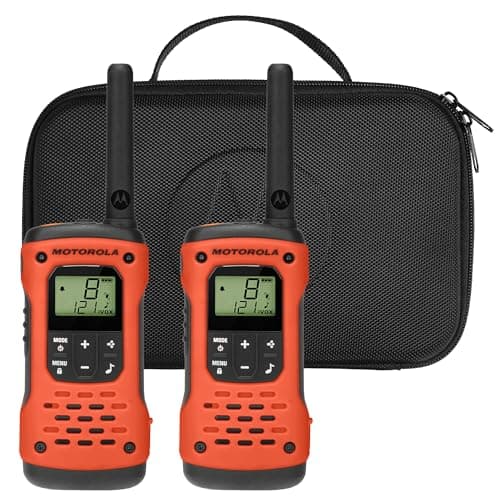
Motorola Talkabout T605 H2O (2-pack)
IP67, floats face up on the included NiMH pack, water-activated flashlight, NOAA alerts and a stated 23 hours on three AA alkalines. License-free, so anyone aboard can use it.
$116.99Amazon#ad · Price as of November 2, 2026 · How we make money for the link to Motorola Talkabout T605 H2O (2-pack)
Best Midland handheld for wet weather
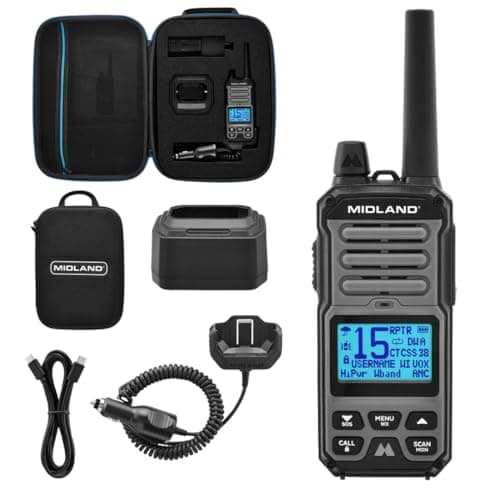
Midland GXT67 PRO (single radio)
The reach option: IP67, a stated 5 W and repeater channels, with Midland's own honest figure of up to about 5 miles depending on terrain. Needs a GMRS license.
$219.99Amazon#ad · Price as of November 2, 2026 · How we make money for the link to Midland GXT67 PRO (single radio)
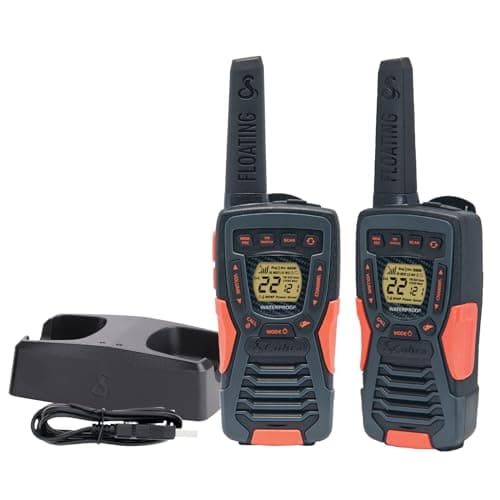
Best floating radio for the boat
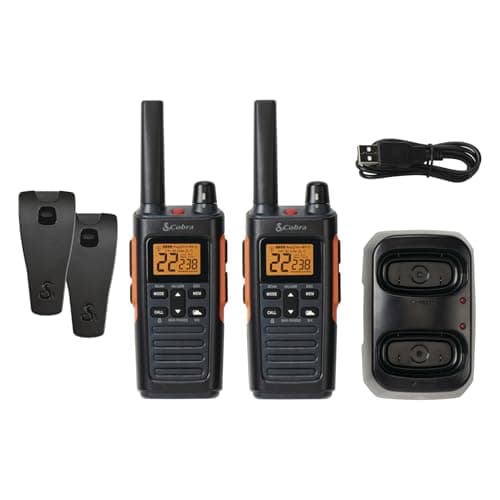
Cobra ACXT1035R FLT (2-pack)
Floats, IP67, 10 NOAA weather channels and a BURP function that clears water out of the speaker. Cobra's own documents disagree on licensing, so check the manual in the box.
$129.95Amazon#ad · Price as of November 2, 2026 · How we make money for the link to Cobra ACXT1035R FLT (2-pack)
Four mistakes boaters make
- Buying walkie-talkies instead of a VHF. They are not substitutes. A boat that goes beyond a lake needs a marine radio.
- Using channel 16 for chatter. It is the distress and calling frequency, not a group channel.
- Taking a marine handheld ashore as a general-purpose radio. The ship-station authorization does not cover that; carry FRS or GMRS for land use.
- Assuming a splash rating is a water rating. On a boat, buy the published IP67 and nothing less — see best waterproof walkie-talkies.
For the full set of radios that survive a boat, including the floating ones, see best walkie-talkies for boating. For the cruise-ship version of this question — where the ship's own rules come into it — see do walkie-talkies work on cruise ships.
How we scored this
Every pick here is backed by the paperwork
Every pick is labeled Researched: we read each maker's published specs, manuals and range tables, check the license rules against the FCC, and score every radio on a public rubric out of 10. Every figure links to where it came from, and every range number is labeled “advertised” so you can see the difference between the box and the terrain.
Scores are our editorial judgment on that documented evidence. Commissions never set a score or decide a pick. The rubric and its weights are published.
What changed
- Published.
Questions
Frequently asked
Can I use a walkie-talkie instead of a marine radio?
Do recreational boaters need an FCC license for VHF?
Can a marine radio talk to a walkie-talkie?
Is it legal to use a marine handheld on land?
Which should I buy first for a small boat?
Receipts
Sources
- 47 CFR 80.13, station license required / ships licensed by rule (via Cornell LII, checked 2026-10-17)
- 47 CFR 80.369, distress, urgency, safety, call and reply frequencies (via Cornell LII, checked 2026-10-17)
- FCC: Family Radio Service (FRS) page (checked 2026-10-17)
- FCC: General Mobile Radio Service (GMRS) page (checked 2026-10-17)
- 47 CFR 95.567, FRS power limits (via Cornell LII, checked 2026-10-17)
- 47 CFR 95.1705, GMRS eligibility (via Cornell LII, checked 2026-10-17)
- 47 CFR 95.1767, GMRS power limits (via Cornell LII, checked 2026-10-17)
- Motorola Solutions: TALKABOUT T600 H2O series page (checked 2026-09-22)
- Motorola Solutions: T605 H2O datasheet PDF (checked 2026-09-22)
- Midland: GXT67 PRO FAQs (checked 2026-09-22)
- Cobra: ACXT1035R FLT product page and manual (checked 2026-09-22)
Specs and range figures come from each maker's own pages and manuals, linked on every product, and license, power and channel rules come from the FCC and 47 CFR Part 95. Range numbers are the maker's advertised claims and are labeled that way, so you can tell the box number from the terrain number. Prices come live from Amazon with the time we checked. Read the full method.