Not legal advice. This page summarizes FCC rules (47 CFR Part 95) from the official sources linked in the text. Rules and fees checked . The FCC sets its fees annually and can change its rules, so confirm the current version on fcc.gov before you rely on it.
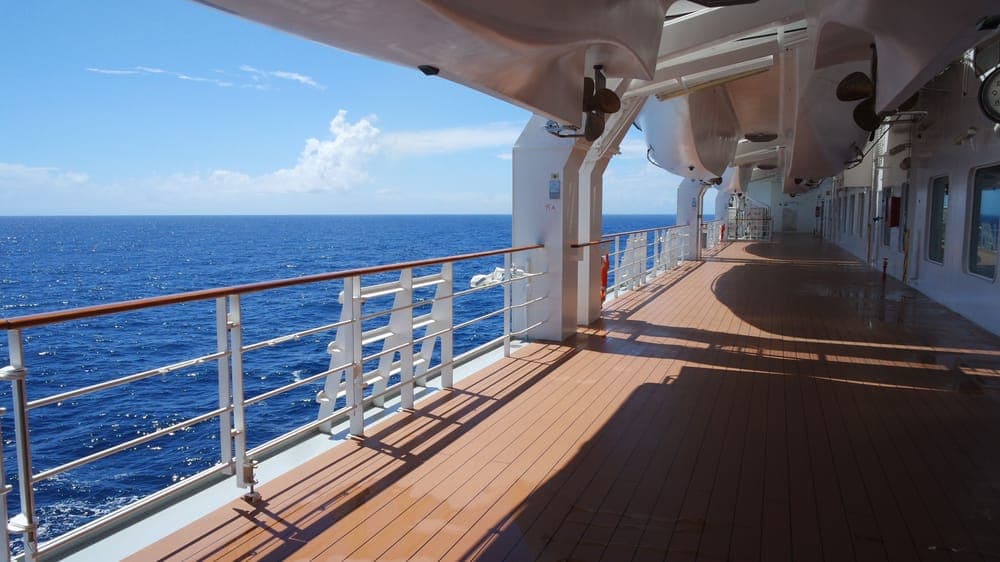
Here's the cruise problem in one picture: one kid is at the pool, another is at the arcade, the grown-ups are at a show, and your phone plan may not work at sea. A pair of license-free radios is the classic fix. It can work well, but a cruise ship is about the hardest place there is for a handheld radio, and some lines don't allow them at all. Check both before you buy.
Will walkie-talkies work on a cruise ship?
No radio maker publishes a cruise-ship range figure, and we don't measure one, so here's the honest version. The FCC expects FRS radios to reach "up to two miles on the 2 watt channels, depending on conditions" ( FCC consumer guide), and Motorola's own fine print for the T605 says "neighborhood up to 2 miles." Those are figures for open air and houses. A ship is decks of steel, so expect less, and expect it to vary by where you stand.
- Where they tend to work: across an open deck, from the pool to the rail, and between spots with a clear view of each other.
- Where they tend to struggle: cabin to cabin on different decks, from deep inside the ship to an outside deck, inside stairwells, and from one end of the ship to the other with several decks and walls in between.
The fix is simple: test on day one. Walk the ship with two radios, find the spots that work, and build your meeting plan around them. Our guide to how far walkie-talkies reach explains the same effect on land.
Why steel decks cut the range
FRS and GMRS radios work around 462 to 467 MHz (FCC FRS page). At those frequencies, a signal gets through wood and drywall far better than through metal, and a ship is built from steel decks and steel bulkheads. Midland's support page puts it generally: radio signal is "affected by things such as obstructions, terrain, weather, material, etc.," and its box figures are for ideal conditions with no obstructions (Midland walkie-talkie FAQ).
More power isn't the answer here. Every license-free FRS radio has the same caps, and at least one line (below) sets a 5-watt limit anyway. What helps is geometry: get to an open deck, move toward the same end of the ship, or pick meeting points where the radios already worked.
What the cruise lines say
Policies change and differ by line, so we only list a line's rule where we read it on the line's own page. All three were checked on September 22, 2026.
| Line | What its page says | What it means for you |
|---|---|---|
| Royal Caribbean | Electrical items such as baby monitors and "HAM radios" are prohibited, with exceptions including "two-way radios (walkie-talkies) limited to a maximum range of ten (10) miles, a power output of five (5) watts, internal voice communication only, and no external antenna" | Allowed within those limits. Royal Caribbean doesn't say whether it goes by the box's advertised range, and many family radios advertise more than 10 miles, so ask before you pack. |
| Norwegian Cruise Line | "Walkie-talkies" appear on its list of items "prohibited on-board vessels," which it says "will be confiscated and not transported aboard" | Leave them at home. |
| Carnival | "All speakers (including Bluetooth, portable, and wireless types) and radios are prohibited and will be held and returned at the end of the cruise," because "public announcements must be heard by all guests and crew" | The page doesn't name walkie-talkies specifically. Ask Carnival whether two-way radios count before you pack a pair. |
Sailing a different line? Look up its current prohibited-items list, or ask the line directly. We don't state any line's policy here that we haven't read on its own page.
FRS, GMRS and the license question
License-free FRS radios are the natural choice for a cruise. In the US, the FCC says FRS is "licensed by rule", so nobody in the family needs a license (FCC FRS page). FRS radios also meet the "no external antenna" idea by design: the rules require the antenna to be "a non-removable integral part" of the radio (47 CFR 95.587).
GMRS radios are a harder fit. They need an FCC GMRS license, many have removable antennas, and the license is a US one. Rocky Talkie says plainly that its GMRS Expedition Radio is "not legal for use outside the US" (Rocky Talkie). Keep in mind that the FCC's rules are US rules; ports of call and foreign waters have their own. If you want a no-license pair for home too, our best walkie-talkies without a license ranking covers the field.
Finding a quiet channel on a crowded ship
A ship with thousands of passengers can have dozens of families on the same 22 FRS channels. Two things help. A privacy code filters out other families' chatter so your radios only open for each other; it doesn't stop anyone on the channel from hearing you. And a radio with preset channel-and-code combinations makes it quick to hop to a quieter one: Cobra's RX680 has 38 of them (Cobra). Pick a main and a backup on day one, write them down, and tell the kids. Our guide to which walkie-talkie channel to use has more on choosing one.
Can walkie-talkies go in checked luggage?
Yes, but carry-on is simpler. TSA's entry for radios says yes for both carry-on and checked bags, and points to the FAA for the battery rules (TSA: Radio). Those rules depend on the battery:
- AA, AAA and NiMH batteries: the FAA allows dry alkaline and dry rechargeable batteries, including "Nickel metal hydride (NiMH)", in both carry-on and checked bags; they "must be protected from damage and short circuit" (FAA: Airline Passengers and Batteries; also TSA: dry batteries).
- Radios with lithium-ion batteries installed: the FAA says devices containing lithium batteries "should be carried in carry-on baggage," and if they go in checked bags they "must be completely powered off and protected to prevent unintentional activation or damage" (FAA: Portable Electronic Devices).
- Spare lithium-ion battery packs: carry-on only. The FAA says spare lithium batteries "must be carried in carry-on baggage only," with terminals protected from short circuit, for example by leaving them in retail packaging or taping the terminals (FAA: Lithium Batteries; also TSA).
My advice: put the radios in your carry-on, switched off, with the keypad lock on if they have one. Nothing about that is complicated, and it keeps the radios out of a baggage handler's way. TSA notes that the final decision at the checkpoint rests with the officer.
Do walkie-talkies have lithium batteries?
Some do, some don't. It depends on the model, so check the spec sheet. A few examples from maker pages:
| Radio | Battery, per the maker | Flying with it |
|---|---|---|
| Motorola T605 H2O | 800 mAh NiMH packs, or 3 AA alkalines (datasheet) | No lithium; carry-on or checked |
| Cobra RX100-4 | 3 AAA alkalines per radio (Cobra) | No lithium; carry-on or checked |
| Cobra RX680 | Rechargeable Li-ion packs (Cobra) | Carry-on preferred; spare packs carry-on only |
| Rocky Talkie Mountain Radio | 1,550 mAh Li-ion, replaceable (Rocky Talkie) | Carry-on preferred; spare packs carry-on only |
The 100 watt-hour limit on lithium-ion batteries won't trouble a handheld radio. The FAA's formula is mAh divided by 1,000, times the voltage. Rocky Talkie lists its Expedition Radio battery at 7.4 V and 1,800 mAh, which works out to about 13 Wh, well under the FAA's 100 Wh line (FAA).
What to look for in a cruise radio
- Your line's rules first. If the line bans them, nothing else matters.
- License-free FRS, with the fixed antenna the rules require.
- A battery you can fly with easily. NiMH or AA radios are the simplest to pack; Li-ion is fine in a carry-on.
- Water resistance for the pool deck. Splash-rated at minimum; IP67 if the kids will be at the pool all day.
- Presets or privacy codes, to get off a crowded channel quickly.
- Earpieces for quiet places, so a call doesn't interrupt the show.
Two radios for the ship
Our picks for this job
A pool-proof pair and a crowded-channel pair
Both are license-free FRS radios with fixed antennas. The Motorola is the one for kids at the pool; the Cobra is the one for hopping off busy channels. Check your line's rules before you buy either.
 Stock photo
Best waterproof radio for paddlers
Motorola Talkabout T605 H2O (2-pack)
IP67, and Motorola says it floats face up with its NiMH pack, so a drop at the pool isn't the end of it. NiMH or AA power keeps airport security simple, and the T605 box adds two earpieces (Motorola says headset use is for dry conditions).
Check price · Amazon#ad · Price set by Amazon · How we make money for the link to Motorola Talkabout T605 H2O (2-pack)
- Stock photo
Best rechargeable pair with presets
Cobra RX680 (2-pack)
38 preset channel/code combinations make it quick to find a quiet channel on a full ship. IP54 and Li-ion packs, per Cobra, so it rides in the carry-on and stays off the pool deck.
Check price · Amazon#ad · Price set by Amazon · How we make money for the link to Cobra RX680 (2-pack)
For more cruise picks, ranked, see our best walkie-talkies for cruise ships. Specs above come from Motorola's T600 H2O page and Cobra's RX680 page.
A simple ship plan for the family
- Test on day one. Walk the ship with two radios and find where they work from the cabin, the pool and the main dining room.
- Pick meeting points the radios reach. A named spot on an open deck is better than "by the elevators."
- Set a main and a backup channel, and tape them to each radio.
- Agree on check-in times for the kids: before a show, at meal times, before port departure.
- Keep the volume low and never talk over announcements. Carnival's reason for its radio rule is that "public announcements must be heard by all guests and crew." Good manners on any line.
- Have a no-radio fallback. If a call goes unanswered, everyone goes to the first meeting point.
How we scored this
Radios we claim to have lab-tested: 0
Plenty of radio sites say they range-tested everything they list. We haven't, and we say so. Every pick here is labeled Researched: we read each maker's published specs, manuals and range tables, check the license rules against the FCC, and score every radio on a public rubric. Every figure links to where it came from, and every range number is labeled “advertised.”
Scores are editorial judgments from that documented research, not test results. Commissions never set a score or decide a pick. The rubric and its weights are published.
What changed
- Published.
Questions
Frequently asked
Do walkie talkies work on cruise ships?
Can walkie talkies go in checked luggage?
Do walkie talkies have lithium batteries?
Are walkie-talkies allowed on Royal Caribbean?
Are walkie-talkies allowed on Norwegian Cruise Line?
Do I need a license to use walkie-talkies on a cruise?
Receipts
Sources
- Royal Caribbean: Prohibited items onboard policy FAQ (checked 2026-09-22)
- Norwegian Cruise Line: What can't I bring onboard FAQ (checked 2026-09-22)
- Carnival Cruise Line: Important information to know before you go (checked 2026-09-22)
- TSA: What Can I Bring? Radio (checked 2026-09-22)
- TSA: Lithium batteries with 100 watt hours or less in a device (checked 2026-09-22)
- TSA: Dry batteries (AA, AAA, C and D) (checked 2026-09-22)
- FAA PackSafe: Portable electronic devices containing batteries (checked 2026-09-22)
- FAA PackSafe: Lithium batteries (checked 2026-09-22)
- FAA: Airline Passengers and Batteries guidance and FAQs (checked 2026-09-22)
- Midland Support: Walkie Talkie FAQs (checked 2026-09-22)
- FCC: Family Radio Service (FRS) page (checked 2026-09-22)
- FCC consumer guide: Personal Radio Services (checked 2026-09-22)
- 47 CFR 95.587, FRS additional requirements (antenna), via Cornell LII (checked 2026-09-22)
- Rocky Talkie: Expedition Radio product page (checked 2026-09-22)
- Rocky Talkie: Mountain Radio product page (checked 2026-09-22)
- Motorola Solutions: TALKABOUT T600 H2O series product page (checked 2026-09-22)
- Motorola Solutions: T605 H2O datasheet PDF (checked 2026-09-22)
- Cobra: RX680 product page (checked 2026-09-22)
- Cobra: RX100-4 product page (checked 2026-09-22)
We haven't tested the radios on this page and we don't pretend to. Specs and range figures come from each maker's own pages and manuals (linked on every product), and license, power and channel rules come from the FCC and 47 CFR Part 95. Range numbers are the maker's advertised claims and are labeled that way. Prices are set by Amazon and change often, so we don't print them. Where a figure isn't published, we say so. Read the full method.