Not legal advice. This page summarizes FCC rules (47 CFR Part 95) from the official sources linked in the text. Rules and fees checked . The FCC sets its fees annually and can change its rules, so confirm the current version on fcc.gov before you rely on it.
Quick picks
The picks at a glance
| # | Product | Best for | Score | Price |
|---|---|---|---|---|
| 1 |  Retevis RT22 (2-pack) Tiny, light, pre-paired out of the box and charged over USB-C, and its maker claims only 0.5 to 2 miles, which is honest for a ship. Only 16 channels and no screen. | Best for cruisesNo licenseBudget | 5.5/10Researched | Check price · Amazon #ad · Disclosure |
| 2 | Cobra RX680 (2-pack) 38 preset channel-and-code combos make it easy to dodge the other families on board, with a stated 2 W high setting, IP54 and Li-ion packs. | Best for finding a quiet channelNo licenseMid-price | 6.3/10Researched | Check price · Amazon #ad · Disclosure |
| 3 | Motorola Talkabout T802 (2-pack) Pairs with a phone app for off-grid group messages between T800 radios, so a teen can text "at the buffet" during a show. Same short FRS reach. | Best for texting between decksNo licenseMid-price | 6.1/10Researched | Check price · Amazon #ad · Disclosure |
| 4 | Motorola Talkabout T470 (2-pack) Runs on three AAs for a stated 28 hours, so there's nothing to charge in the cabin. VibraCall buzzes instead of beeping at dinner or a show. | Best if you'd rather pack AA batteriesNo licenseMid-price | 6.1/10Researched | Check price · Amazon #ad · Disclosure |
| 5 | Baofeng GT-18 (3-pack) Three radios with earpieces and lanyards for very little money, and a modest 3-mile claim. Choose the FRS version, and note its power figures conflict. | Best three-pack for a cruise on a budgetNo licenseBudget | 5.3/10Researched | Check price · Amazon #ad · Disclosure |
#ad · Prices are set by Amazon and change often, so we don't print them. Scores are ours, built from published specs, manuals and FCC rules, not hands-on tests. Photos are illustrative stock. Tap a row for the full write-up.
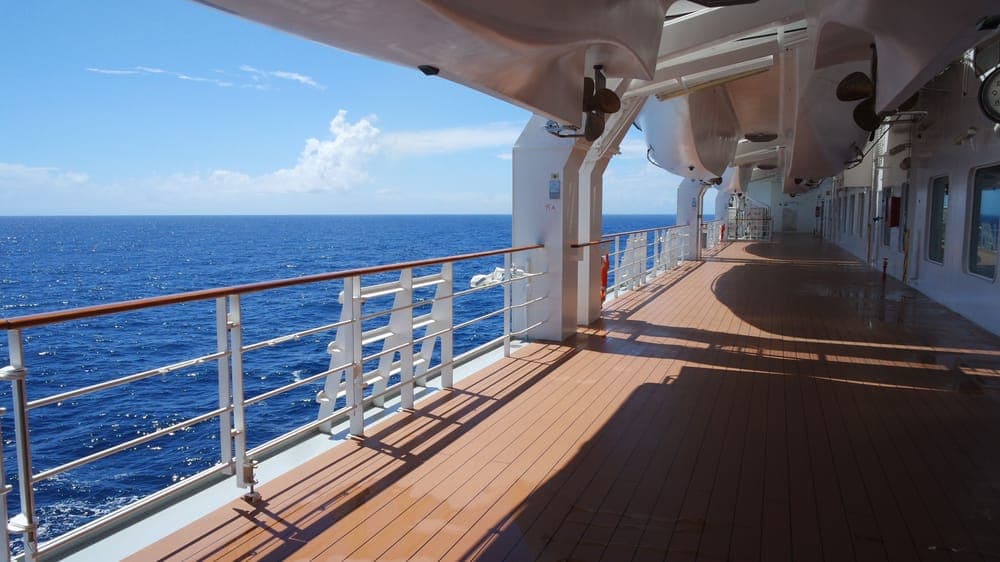
You're at the pool on the top deck. Your 12-year-old is somewhere between the arcade and the pizza place four decks down, and you didn't buy the ship's internet package. That's the job the best walkie-talkies for cruise ships have to do, and they can do it, just less well than the box suggests. A cruise ship is a stack of steel decks and bulkheads, and steel blocks radio signals far better than the walls of a house.
Here's what to expect. On the same deck, and across the open decks, a pair of license-free FRS radios works well. Through several decks of steel, expect broken calls or silence. The answer is a small, simple radio plus a plan (meeting points and check-in times), not a bigger box number. And before any of that, check your cruise line, because some lines don't allow walkie-talkies at all.
How we picked
Every pick is an FRS radio, which needs no license and has the kind of built-in antenna Royal Caribbean's rule asks for. We scored each on our published rubric (real-world reach, ease of use, toughness, power and battery, field features and value) from the makers' pages, manuals and FCC rules; the method is on how we rank radios. These are research picks from published specs, not a sea trial.
For a ship we ranked on what matters on board: small and light enough to live in a pocket for a week, easy to charge in a cabin, easy to move to a quiet channel and privacy code on a ship full of other families, and an honest range claim. That last point is why the #1 pick scores lower than #2 and still wins: on a cruise ship, extra reach on paper buys you nothing, and one line's policy is written in miles. If the whole family is choosing radios for more than one trip, start with the best walkie-talkies for families. These picks also live in our kids, camp and family hub.
Check your cruise line first
Cruise lines set their own rules, and they don't agree. Here's what each line's own page said when we checked on September 22, 2026. Policies change, so read your line's current prohibited-items list before you pack.
| Cruise line | What its own page says (checked 2026-09-22) |
|---|---|
| Royal Caribbean | Allowed, with limits. Its prohibited-items FAQ bans most electrical equipment, then lists as an exception "two-way radios (walkie-talkies) limited to a maximum range of ten (10) miles, a power output of five (5) watts, internal voice communication only, and no external antenna" (Royal Caribbean FAQ). |
| Norwegian Cruise Line | Not allowed. "Walkie-talkies" is on its "What can't I bring onboard?" list, along with ham radios (NCL FAQ). |
| Carnival | Unclear. Its safety information page says "All speakers (including Bluetooth, portable, and wireless types) and radios are prohibited and will be held and returned at the end of the cruise" (Carnival safety information). It doesn't say whether "radios" includes walkie-talkies, and a 2019 Carnival packing article recommends them for families (Carnival packing tips). Ask Carnival before you pack. |
| Disney and other lines | We couldn't load Disney Cruise Line's prohibited-items page when we checked, so we won't guess. For Disney and every other line, check the line's own prohibited-items list. |
One wrinkle in Royal Caribbean's wording: it limits radios to "a maximum range of ten (10) miles," and it doesn't say how it measures that. Most of the FRS and GMRS handhelds we cover advertise 16 to 40 miles on the box. Two picks here don't: Retevis claims 0.5 to 2 miles for the RT22 and Baofeng claims up to 3 miles for the GT-18. If I were sailing Royal Caribbean, I'd pack one of those and still ask the line before sailing. That's my read of their wording, not theirs.
What steel decks do to range
Start from the regulator's own expectation. The FCC says FRS radios reach "generally less than one-half mile on the 0.5 watt channels and up to two miles on the 2 watt channels, depending on conditions" ( FCC consumer guide). That's on land. Motorola's own fine print for its Talkabouts gives "neighborhood up to 2 miles." A ship is a harder place than a neighborhood: the signal has to get through steel decks, bulkheads, machinery and a few thousand people.
In practice that means radios work best on the same deck, along the open decks and outside, and worst between a cabin deep in the ship and the pool on top. No radio on this page fixes that, because every FRS radio lives under the same power rules with a fixed antenna. For the deeper answer, including luggage and batteries, see our guide to whether walkie-talkies work on cruise ships, and for range in general, how far walkie-talkies reach.
The picks in detail
1. Retevis RT22: best for cruises
The RT22 is almost the opposite of a feature-packed radio, and on a ship that's the point. It weighs 113 g (3.99 oz) with its battery, has "no complicated screens or keyboards," and Retevis says the pair ships set to the same frequency and CTCSS code, "so they can work together when out of the box" ( Retevis RT22 page). It's 2 W FRS with no license required, runs on a 1000 mAh lithium-ion battery that charges over USB-C, and Retevis says one Type-C cable charges two radios at once. It has VOX and an emergency alarm.
Retevis rates the battery at "12 to 24 hours of standby time," which is standby, not talk, so charge it every night. It has only 16 channels, so check the manual's channel chart if you'll mix it with other brands, and with no screen you can't see which privacy code you're on. Retevis calls it "only life-water-resistant," so keep it out of the pool. Buy it if you want a small, simple pair you can hand a kid on day one. Skip it if you'll need to change codes often on a crowded ship; the RX680 does that better.
2. Cobra RX680: best for finding a quiet channel
A ship full of families is a ship full of radios. The RX680 handles that better than anything here: on top of 22 FRS channels and 121 privacy codes, it has 38 preset channel-and-code combinations, so moving the family to a quiet combo is one number, not two settings (Cobra RX680 page). Cobra states the power (selectable 0.5 or 2 W), answers "No license is required" on its page, and rates it IP54, meaning it can be used in wet conditions but shouldn't be submerged.
It runs on Li-ion packs rated at up to 18 hours, with a charging dock and Micro-USB cable, and adds NOAA weather channels, an SOS flashlight, VOX and scan. Two trade-offs for a cruise: there's no AA fallback, and its "up to 38-mile range" box claim is exactly the kind of number Royal Caribbean's 10-mile wording could trip over. Buy it if your line allows radios without a range limit and you want easy channel changes. Skip it if you're sailing Royal Caribbean and want to avoid a conversation at security.
3. Motorola Talkabout T802: best for texting between decks
The T802 pairs with Motorola's TALKABOUT phone app over Bluetooth for off-grid group messages, location sharing and push-to-talk from the phone (Motorola T800 page). On a ship, the useful part is messaging: a teen can send "at the buffet" during a show instead of talking. Messages only go to other T800-series radios running the app, and I wouldn't expect location sharing to mean much on a moving ship. It also has NOAA alerts, a flashlight, an emergency button and VOX, and charges its NiMH batteries over USB-C.
The app doesn't add reach: it's still a fixed-antenna FRS radio, and Motorola doesn't publish the transmit power. Motorola lists the weather rating as IP54 in one place and IPX4 in another, so treat it as splash-resistant. Buy it if your family would rather text than talk. Skip it if you want the simplest radio for a young kid.
4. Motorola Talkabout T470: best if you'd rather pack AA batteries
Cabins have limited outlets, and some families would rather not charge anything. The T470 runs on its 800 mAh NiMH pack (up to 12 hours) or three AA batteries (up to 28 hours), so a bag of spare AAs is your whole charging plan. VibraCall buzzes instead of beeping, which suits the dining room and the theater. It has a 2.5 mm headset jack, a flashlight, NOAA alerts, an emergency button and iVOX/VOX, and weighs 0.30 lb per radio without batteries.
It's IPX4, which is splash protection only, charges over Micro-USB rather than USB-C, and carries the same "up to 35 miles" headline (neighborhood up to 2) as the other Talkabouts. Buy it if you want AA power and a silent alert. Skip it if you want the lightest pocket radio; the RT22 is smaller.
5. Baofeng GT-18: best three-pack for a cruise on a budget
Three license-free FRS radios with earpieces and lanyards in the box, a backlit screen, dual push-to-talk buttons, NOAA weather and a flashlight, for very little money. Baofeng claims only "up to 3 miles," which is honest, and a 1500 mAh battery good for "up to 3 days" on Micro-USB. Lanyards help kids keep a radio on them rather than on a deck chair.
Two cautions. Baofeng's own page conflicts on power (0.5 W on one tag, 2 W / 0.5 W on its chart), and the listing also sells a PMR446 version for Europe, so choose the FRS option for a US sailing. Buy it if you need three radios for a week on a budget. Skip it if you want a maker that states its power clearly.
The specs side by side
The range row is the one to read twice. Three of these radios advertise 35 to 38 miles; two advertise 3 miles or less. They all live under the same FRS power limits, and none of them will do more than a few decks of steel allows. The honest claims also happen to be the only ones under Royal Caribbean's 10-mile figure.
Why license-free is the right call at sea
A GMRS radio adds paperwork and a detachable antenna for very little gain inside a steel hull, so every pick here is FRS. Ashore in a foreign port, local rules apply, not the FCC's; Europe, for one, uses a different license-free band called PMR446, which is why Baofeng sells a PMR446 version of the GT-18. I'd keep the radios switched off ashore unless you've checked. For more license-free options, see the best walkie-talkies without a license; for the difference between the two services, GMRS vs FRS; and for the license itself, our GMRS license guide.
In detail
The picks, in full
Rank 01
Stock photoBest for cruises
Retevis RT22 (2-pack)
Tiny, light, pre-paired out of the box and charged over USB-C, and its maker claims only 0.5 to 2 miles, which is honest for a ship. Only 16 channels and no screen.
Published specsResearched · not tested by us
How the 5.5 score breaks down
- Real-world reach (30%)
- 4.5
- Ease of use (20%)
- 8
- Toughness & weather (15%)
- 3
- Power & battery (15%)
- 6
- Field features (10%)
- 4
- Value (10%)
- 8
What the specs support
- States 2 W and a realistic 0.5 to 2 mile range
- USB-C Li-ion and very light
- Pre-paired out of the box; no screen to confuse anyone
Where it falls short
- Only 16 channels, so it can't reach every FRS channel another family's radio might use
- No weather channel, and only light water resistance
Skip this if…
…Skip it if you need NOAA alerts or will match channels with other brands' 22-channel radios: it has 16 channels and no weather receiver.
#ad · Price set by Amazon · How we make money for the link to Retevis RT22 (2-pack)
Rank 02
Stock photoBest for finding a quiet channel
Cobra RX680 (2-pack)
38 preset channel-and-code combos make it easy to dodge the other families on board, with a stated 2 W high setting, IP54 and Li-ion packs.
Published specsResearched · not tested by us
How the 6.3 score breaks down
- Real-world reach (30%)
- 4.5
- Ease of use (20%)
- 8
- Toughness & weather (15%)
- 6
- Power & battery (15%)
- 6
- Field features (10%)
- 8
- Value (10%)
- 7
What the specs support
- Cobra states the power (0.5 or 2 W) and says no license is required
- 38 preset channel/code combos make it simple to find a clear channel
- IP54, NOAA alerts and an SOS flashlight
Where it falls short
- No AA fallback listed; it relies on its Li-ion packs
- Micro-USB charging
Skip this if…
…Skip it if you need to run on store-bought batteries during a long outage: it charges its own Li-ion packs, so an AA radio like the ACXT645 suits that better.
#ad · Price set by Amazon · How we make money for the link to Cobra RX680 (2-pack)
Rank 03
Stock photoBest for texting between decks
Motorola Talkabout T802 (2-pack)
Pairs with a phone app for off-grid group messages between T800 radios, so a teen can text "at the buffet" during a show. Same short FRS reach.
Published specsResearched · not tested by us
How the 6.1 score breaks down
- Real-world reach (30%)
- 4
- Ease of use (20%)
- 8
- Toughness & weather (15%)
- 5
- Power & battery (15%)
- 6
- Field features (10%)
- 9
- Value (10%)
- 7
What the specs support
- Off-grid texting and location sharing between T800 radios through the phone app, with no license and no cell service
- NOAA alerts, emergency button, flashlight and hands-free VOX in one radio
- USB-C charging
Where it falls short
- Motorola doesn't publish the transmit power, and the antenna is fixed like every FRS radio
- Motorola lists the weather rating as IP54 in one place and IPX4 in another; treat it as splash-resistant only
- The messaging and location features only work with other T800-series radios running the app
Skip this if…
…Skip it if you need to reach someone over a ridge or across miles of timber: app features don't add range, and a GMRS radio with more power will reach farther.
#ad · Price set by Amazon · How we make money for the link to Motorola Talkabout T802 (2-pack)
Rank 04
Stock photoBest if you'd rather pack AA batteries
Motorola Talkabout T470 (2-pack)
Runs on three AAs for a stated 28 hours, so there's nothing to charge in the cabin. VibraCall buzzes instead of beeping at dinner or a show.
Published specsResearched · not tested by us
How the 6.1 score breaks down
- Real-world reach (30%)
- 4
- Ease of use (20%)
- 8
- Toughness & weather (15%)
- 5
- Power & battery (15%)
- 7
- Field features (10%)
- 8
- Value (10%)
- 7
What the specs support
- AA fallback with a stated 28 hours, which suits an emergency kit
- NOAA alerts, flashlight and emergency button included
- Hands-free iVOX/VOX and a standard 2.5 mm headset jack
Where it falls short
- Micro-USB charging, not USB-C
- IPX4 is splash protection only; don't drop it in water
- Motorola doesn't publish the transmit power
Skip this if…
…Skip it if it will get wet often: IPX4 handles rain, not a creek crossing or a canoe, so the IP67 T605 is the Motorola to buy.
#ad · Price set by Amazon · How we make money for the link to Motorola Talkabout T470 (2-pack)
Rank 05
Stock photoBest three-pack for a cruise on a budget
Baofeng GT-18 (3-pack)
Three radios with earpieces and lanyards for very little money, and a modest 3-mile claim. Choose the FRS version, and note its power figures conflict.
Published specsResearched · not tested by us
How the 5.3 score breaks down
- Real-world reach (30%)
- 3
- Ease of use (20%)
- 8
- Toughness & weather (15%)
- 3
- Power & battery (15%)
- 6
- Field features (10%)
- 6
- Value (10%)
- 8
What the specs support
- Three radios, with earpieces and lanyards, at the budget tier
- NOAA weather and a flashlight
- Modest 3-mile claim instead of an inflated box number
Where it falls short
- Baofeng's own page gives conflicting power figures (0.5 W vs 2W / 0.5W)
- Rated to operate only down to 0 degrees C
- Micro-USB charging and no stated water rating
Skip this if…
…Skip it if you'll use it on a ski hill or a winter hunt: Baofeng rates it for 0 to 40 degrees C, and its power figure is unclear.
#ad · Price set by Amazon · How we make money for the link to Baofeng GT-18 (3-pack)
What to look for in cruise walkie-talkies
- Pocket size. You'll carry it to dinner, the pool and the show for a week. The RT22 is 3.99 oz with its battery; the T470 is 0.30 lb before batteries.
- Easy cabin charging. Royal Caribbean's list prohibits "extension cords, power strips, multi-plug outlets" but allows "Device and USB chargers marked with a recognized U.S. or European conformity certification" (Royal Caribbean FAQ). A radio that charges from a USB cable, like the RT22 (USB-C) or the GT-18, fits that easily. AA radios like the T470 skip the question entirely.
- Quick channel and code changes. A ship is crowded. Presets like the RX680's 38 combos, or at least a screen that shows the privacy code, make moving to a quiet channel easy. Privacy codes filter what you hear; they don't make the channel private. Our privacy codes guide explains the difference.
- A silent alert. VibraCall on the T470 or a quiet earpiece keeps the radio from beeping through dinner.
- A lanyard or a clip. Radios left on deck chairs walk off. The GT-18 includes lanyards; the others have belt clips.
- An honest range claim. On a ship it's the only range number that means anything, and it may matter at security on at least one line.
A cruise-ship channel plan
- Pick a channel and code at home, on one of the 2-watt FRS channels (1 to 7 or 15 to 22), and a backup for when the first is busy. Our walkie-talkie channels guide helps.
- Name a meeting point on day one, somewhere everyone can find, for when the radios don't reach.
- Set check-in times, like the top of every hour, so a dead battery or a dead zone doesn't turn into a search.
- Keep cabin numbers off the air. Everyone on that channel can hear you, privacy code or not.
- Turn off VOX in noisy places like the pool deck, or the radio will transmit every splash.
- Charge every night, or pack enough AAs for the week.
Mistakes to avoid
- Packing before you check the line's list. Norwegian lists walkie-talkies as prohibited, and Carnival says prohibited radios are held until the end of the cruise.
- Buying for the box number. A 38-mile claim won't get through more steel than a 2-mile one, and it may raise questions.
- Bringing a GMRS radio. More paperwork, a detachable antenna, and no real gain on board.
- Packing a power strip to charge everything. Royal Caribbean's list prohibits them; check your line's rules on chargers.
- Counting on the radios alone. Pair them with meeting points and check-in times. When the steel wins, the plan still works.
How we scored this
Radios we claim to have lab-tested: 0
Plenty of radio sites say they range-tested everything they list. We haven't, and we say so. Every pick here is labeled Researched: we read each maker's published specs, manuals and range tables, check the license rules against the FCC, and score every radio on a public rubric. Every figure links to where it came from, and every range number is labeled “advertised.”
Scores are editorial judgments from that documented research, not test results. Commissions never set a score or decide a pick. The rubric and its weights are published.
What changed
- Published.
Questions
Frequently asked
Are walkie-talkies allowed on cruise ships?
Does Royal Caribbean allow walkie-talkies?
Can you bring walkie-talkies on a Norwegian or Carnival cruise?
Do I need a license to use walkie-talkies on a cruise?
How do you charge walkie-talkies on a cruise ship?
Will walkie-talkies work between decks on a cruise ship?
Receipts
Sources
- Royal Caribbean: What items are prohibited onboard a cruise ship? FAQ (checked 2026-09-22)
- Norwegian Cruise Line: What can't I bring onboard? FAQ (checked 2026-09-22)
- Carnival Cruise Line: Safety information, prohibited items (checked 2026-09-22)
- Carnival: Ultimate cruise packing tips for families, published 2019-06-07 (checked 2026-09-22)
- FCC: Family Radio Service (FRS) page (checked 2026-09-22)
- FCC consumer guide: Personal Radio Services, keeping in touch (checked 2026-09-22)
- Retevis: RT22 product page and FAQ (checked 2026-09-22)
- Cobra: RX680 product page (checked 2026-09-22)
- Cobra: RX680 owner's manual PDF (checked 2026-09-22)
- Motorola Solutions: TALKABOUT T800 series product page (checked 2026-09-22)
- Motorola Solutions: T802/T803 datasheet PDF (checked 2026-09-22)
- Motorola Solutions: TALKABOUT T470 series product page (checked 2026-09-22)
- Motorola Solutions: T470 series datasheet PDF (checked 2026-09-22)
- Baofeng: GT-18 FRS/PMR 3-pack product page (checked 2026-09-22)
- Rocky Talkie: Expedition Radio product page (checked 2026-09-22)
We haven't tested the radios on this page and we don't pretend to. Specs and range figures come from each maker's own pages and manuals (linked on every product), and license, power and channel rules come from the FCC and 47 CFR Part 95. Range numbers are the maker's advertised claims and are labeled that way. Prices are set by Amazon and change often, so we don't print them. Where a figure isn't published, we say so. Read the full method.