Not legal advice. This page summarizes FCC rules (47 CFR Part 95) from the official sources linked in the text. Rules and fees checked . The FCC sets its fees annually and can change its rules, so confirm the current version on fcc.gov before you rely on it.
Quick picks
The picks at a glance
| # | Product | Best for | Score | Price |
|---|---|---|---|---|
| 1 | 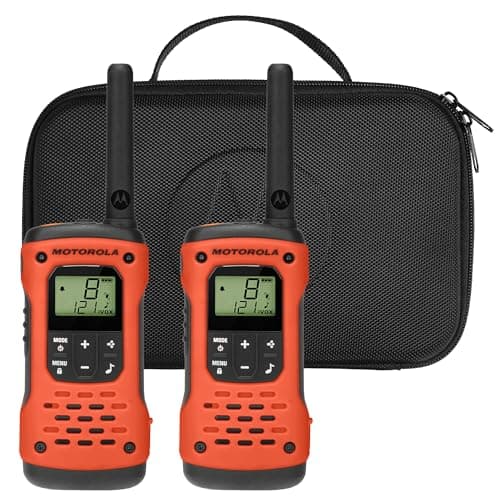 Motorola Talkabout T605 H2O (2-pack) IP67, floats face up on the included NiMH pack, and the flashlight switches itself on when the radio hits the water. License-free, so anyone aboard can use it. | Best boating radio overallNo licenseMid-price | 6.8/10Researched | $116.99Amazon #ad · Disclosure |
| 2 | 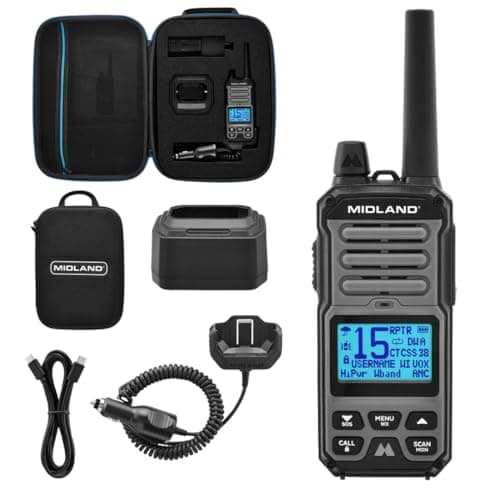 Midland GXT67 PRO (single radio) IP67 with a stated 5 W and repeater channels, plus Midland's own honest figure of up to about 5 miles depending on terrain. Needs a GMRS license and is sold singly. | Best for reach from the waterGMRS licensePremium | 7.1/10Researched | $219.99Amazon #ad · Disclosure |
| 3 | 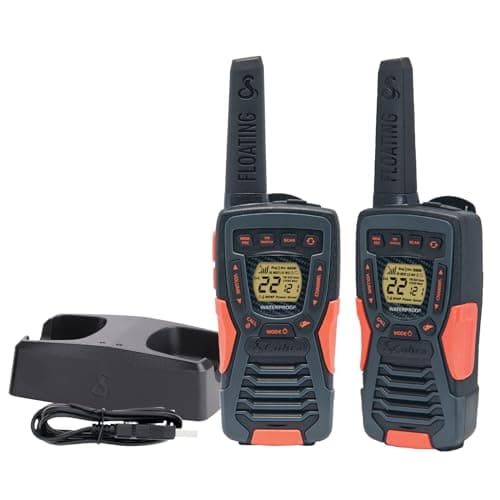 Cobra ACXT1035R FLT (2-pack) IP67 and floats, with 10 NOAA weather channels, a BURP function that clears water from the speaker and AA rechargeables. Cobra's own documents disagree on licensing, so check the manual. | Best floating radio with weather alertsCheck licenseMid-price | 6.7/10Researched | $129.95Amazon #ad · Disclosure |
| 4 | 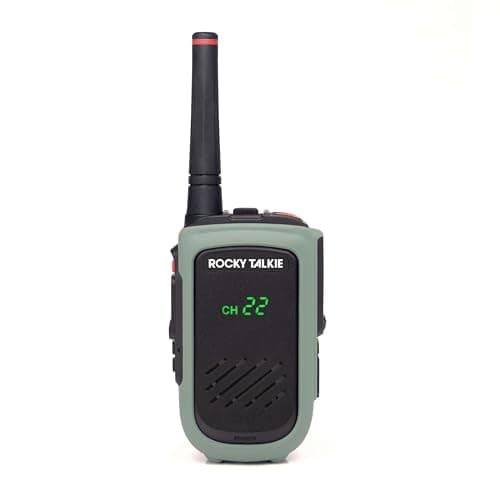 Rocky Talkie Expedition Radio (single radio) IP67, a stated 5 W, a removable antenna with a long whip included and a 4-6 day battery. Rocky Talkie publishes 0.5 to 3 miles on rivers, which is the kind of number worth planning with. | Best for open water crossingsGMRS licensePremium | 7.9/10Researched | $195.00Amazon #ad · Disclosure |
| 5 | 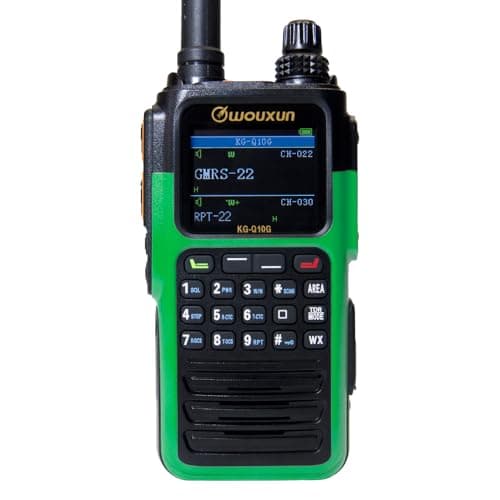 Wouxun KG-Q10G (single radio) IP67 GMRS handheld that displays GPS location data and monitors NOAA alerts, so a tender crew can read out a position. Wouxun's own page conflicts on power output. | Best with a position readoutGMRS licensePremium | 6.8/10Researched | $219.99Amazon #ad · Disclosure |
#ad · Prices come live from Amazon, last checked November 2, 2026. Scores are ours, built from published specs, manuals and FCC rules. Photos come from each product's Amazon listing; a radio we can't show a real photo of is left blank rather than illustrated. Tap a row for the full write-up.

Boats break radios. Salt, spray, a dropped handset and a wet pocket kill more two-way radios than any other environment, and a radio that cannot be rinsed and dropped is not a boating radio no matter what the box says. Only a handful of consumer radios publish a submersion rating, and two of them float.
Before the picks, the question that trips up most buyers: whether you actually want a walkie-talkie at all.
Marine VHF or walkie-talkie?
They are different services doing different jobs. Marine VHF is the boat's radio: it reaches other vessels, bridges, marinas and the Coast Guard, and on a recreational US boat that stays in US waters it needs no individual station license, because such ships are licensed by rule (47 CFR 80.13). Channel 16 — 156.800 MHz — is the international distress, urgency, safety, call and reply frequency (47 CFR 80.369). Nothing on this page replaces that.
A walkie-talkie on FRS or GMRS does the job marine VHF is bad at: chatting inside your own group. The kids on the dock, the person on the bow handling the anchor, the second car at the ramp, a kayak party, the tender crew going for ice. FRS needs no license at all (FCC: Family Radio Service) and GMRS needs one individual license that covers the family (47 CFR 95.1705).
What matters on the water
Picks come from published maker specifications, manuals and the FCC rules — this site does not test radios, and the method is on how we rank. Four things decided the order:
- A published IP rating, and ideally buoyancy. IP67 means a stated meter of submersion for half an hour. "Water resistant" with no number means rain.
- Does it float, and does it float the way you will carry it? Motorola publishes a caveat that its floating radio may not float on some AA batteries, which is exactly the kind of detail that matters at the gunwale.
- Audio that survives a wet speaker. Water in a speaker grille sounds like a dead radio; drain features and loud audio both count.
- NOAA weather alerts. On open water, a weather receiver is not a luxury.
The picks in detail
1. Motorola Talkabout T605 H2O — the one to buy first
The T605 is rated IP67 — Motorola describes it as surviving submersion to one meter for 30 minutes — and it floats face up on the included NiMH pack, with a published note that it may not float on some AA batteries (T600 H2O series page). The flashlight is water-activated. Motorola states up to 9 hours on the pack and up to 23 hours on three AA alkalines (T605 datasheet), and the pack ships with a case, four NiMH cells and two earpieces.
Cons: it is FRS, so the waterproofing buys survival, not distance; Motorola notes headset use is for dry conditions; and it costs more than a splash-rated radio with the same reach.
2. Midland GXT67 PRO — the one that reaches
If you need to talk between boats rather than across a deck, this is the pick: IP67 with the jack cover tightened, a stated 5 watts, eight GMRS repeater channels, USB-C charging and Midland's own honest figure of "up to 5 miles, depending on the terrain" ( Midland GXT67 FAQs).
Cons: a GMRS license is required before you transmit; it is sold as a single radio so a pair costs double; and both the battery and the antenna are fixed (GXT67 PRO page).
3. Cobra ACXT1035R FLT — floating, with weather
IP67, floats, 10 NOAA weather channels with alert, selectable 0.5/1/2 W, a Rewind-Say-Again replay for the transmission you missed over engine noise, a BURP function that vibrates water out of the speaker, and three AA NiMH cells per radio (Cobra ACXT1035R page).
Cons, and this is why it is third: Cobra's own documents disagree about licensing. The product page says nothing, while an older camo-edition manual on the same page prints "FCC LICENSE REQUIRED" and refers to GMRS mode. Read the manual that comes in your box before you transmit.
4. Rocky Talkie Expedition Radio — for crossings and kayak trips
IP67, a stated 5 W, a replaceable 1800 mAh battery good for a published 4 to 6 days, a removable SMA antenna with both a 7.5 cm and a 17 cm whip in the box, and eight repeater channels (Rocky Talkie Expedition page). Rocky Talkie publishes terrain figures instead of a single headline: 0.5 to 3 miles on rivers, up to 1.5 miles in a city, 35+ line of sight.
Cons: GMRS license required, sold singly, and it is the most expensive radio here.
5. Wouxun KG-Q10G — the one that shows a position
An IP67 GMRS handheld with a GPS location readout, NOAA weather mode and alerts, simultaneous dual receive and eight repeater channels (Wouxun KG-Q10G page). Being able to read your own coordinates off the screen is genuinely useful when you are describing where you are.
Cons: Wouxun's page conflicts on transmit power — "up to 6 W" in the highlights against 4 W on UHF high in its own spec table — and its authorized dealer lists the antenna as non-removable.
The published specs side by side
Why range over water is different
Water is the one environment where the big numbers on the box get closer to true. With nothing between two antennas but flat water, UHF signal travels well — Motorola's own footnote to its 35-mile claim gives up to 6 miles over open water against up to 2 miles in a neighborhood. What still limits you is height: both radios are about five feet above the surface, so the horizon arrives sooner than you think.
Which radio for which boat job
- Kids on the dock, deck-to-cabin, ramp and trailer: Motorola T605 H2O, a pair, no license needed.
- Two boats running together, or boat to shore camp: Midland GXT67 PRO or Rocky Talkie Expedition, with the GMRS license.
- Kayak, canoe or paddleboard group: anything IP67 that floats; the T605 and the Cobra FLT are the two that do.
- Anchor watch and weather: a radio with NOAA alerts — the Cobra FLT or the T605, and see best walkie-talkies with NOAA.
- Anything involving other vessels, bridges or the Coast Guard: marine VHF, not this page.
What these radios will not do
They will not reach the Coast Guard. They have no DSC distress button, no MMSI, and nobody ashore monitors FRS or GMRS channels. They are not EPIRBs or PLBs. On a boat going offshore, a walkie-talkie is a convenience layer sitting on top of a VHF radio and, past the VHF horizon, a satellite beacon — never a replacement for either.
Used for what they are good at, though, they solve a daily annoyance that VHF does not: quiet, cheap, license-free chatter inside your own crew, on a radio you can drop in the lake.
In detail
The picks, in full
Rank 01
Best boating radio overall
Motorola Talkabout T605 H2O (2-pack)
IP67, floats face up on the included NiMH pack, and the flashlight switches itself on when the radio hits the water. License-free, so anyone aboard can use it.
Published specsResearched · every figure sourced
How the 6.8 score breaks down
- Real-world reach (30%)
- 4
- Ease of use (20%)
- 8
- Toughness & weather (15%)
- 9
- Power & battery (15%)
- 7
- Field features (10%)
- 8
- Value (10%)
- 8
What the specs support
- IP67 and it floats face up, with a flashlight that switches on when it hits the water
- Runs on the NiMH pack or three AA batteries, so a dead pack isn't the end of the day
- The T605 pack adds a case, spare batteries and earpieces
Where it falls short
- Motorola doesn't publish the transmit power; reach is ordinary FRS
- It may not float with some AA batteries, per Motorola
- Headset use is for dry conditions only
Skip this if…
…Skip it if you need to talk between boats or trucks miles apart: IP67 keeps it alive in the lake, but a fixed-antenna FRS radio won't cover that distance.
#ad · Price as of November 2, 2026 · How we make money for the link to Motorola Talkabout T605 H2O (2-pack)
Rank 02
Best for reach from the water
Midland GXT67 PRO (single radio)
IP67 with a stated 5 W and repeater channels, plus Midland's own honest figure of up to about 5 miles depending on terrain. Needs a GMRS license and is sold singly.
Published specsResearched · every figure sourced
How the 7.1 score breaks down
- Real-world reach (30%)
- 7
- Ease of use (20%)
- 7
- Toughness & weather (15%)
- 9
- Power & battery (15%)
- 7
- Field features (10%)
- 7
- Value (10%)
- 5
What the specs support
- IP67 waterproof and dustproof, where the GXT1000 and GXT3000 are splash-rated JIS4
- Rated at 5 W with 8 repeater channels and split tones
- USB-C (PD) and 12 V vehicle charging in the box
Where it falls short
- Sold as a single radio, so a pair means buying two
- Fixed antenna and a factory-sealed battery you can't swap in the field
- Midland's battery-life figures conflict (16 hours vs up to 4 days)
Skip this if…
…Skip it if you want to carry a spare battery or fit a longer antenna for the far side of the property: the battery is sealed and the antenna doesn't come off.
#ad · Price as of November 2, 2026 · How we make money for the link to Midland GXT67 PRO (single radio)
Rank 03
Best floating radio with weather alerts
Cobra ACXT1035R FLT (2-pack)
IP67 and floats, with 10 NOAA weather channels, a BURP function that clears water from the speaker and AA rechargeables. Cobra's own documents disagree on licensing, so check the manual.
Published specsResearched · every figure sourced
How the 6.7 score breaks down
- Real-world reach (30%)
- 4
- Ease of use (20%)
- 8
- Toughness & weather (15%)
- 9
- Power & battery (15%)
- 7
- Field features (10%)
- 9
- Value (10%)
- 6
What the specs support
- IP67 and it floats, with a feature to clear water from the speaker
- Rewind-Say-Again replays missed messages
- Runs on AA-size NiMH cells
Where it falls short
- Cobra's documents disagree on whether a license is required
- The camo pattern RealTree Max-5 is sold out; Cobra says that pattern won't return
Skip this if…
…Skip it if you want a radio whose license status is settled on paper: Cobra's page is silent and an older manual says a license is required, so a clearly labeled FRS radio avoids the question.
#ad · Price as of November 2, 2026 · How we make money for the link to Cobra ACXT1035R FLT (2-pack)
Rank 04
Best for open water crossings
Rocky Talkie Expedition Radio (single radio)
IP67, a stated 5 W, a removable antenna with a long whip included and a 4-6 day battery. Rocky Talkie publishes 0.5 to 3 miles on rivers, which is the kind of number worth planning with.
Published specsResearched · every figure sourced
| Service / license | GMRS (FRS compatible); GMRS license required, US use only |
|---|---|
| Transmit power | 5 W |
| Channels | 22 channels, 121 privacy codes (CTCSS and DCS); channel lock, high/low power, scan, dual channel watch |
| Repeater and antenna | Repeater capable (8 GMRS repeater channels); removable SMA-male antenna, 7.5 cm and 17 cm antennas included |
| Water rating | IP67 (1 meter submersion) |
| Battery | Replaceable 7.4 V 1800 mAh Li-ion, USB-C; "4–6 days" per chargeAdvertised |
| Weather and weight | NOAA weather channels and emergency alert monitoring; 9.1 oz |
| Advertised range | "max range of over 35 miles, with 2–8 miles more typical in backcountry terrain"Advertised |
| Maker's terrain figures | Line-of-sight 35+ miles; mountains 2 to 8 miles; forest/hills 0.5 to 5 miles; rivers 0.5 to 3 miles; city up to 1.5 milesAdvertised |
How the 7.9 score breaks down
- Real-world reach (30%)
- 8
- Ease of use (20%)
- 8
- Toughness & weather (15%)
- 9
- Power & battery (15%)
- 8
- Field features (10%)
- 7
- Value (10%)
- 6
What the specs support
- Removable SMA antenna with short and long options, plus 8 repeater channels
- IP67 with a replaceable Li-ion battery and USB-C, rated for 4-6 days
- The maker publishes terrain-by-terrain range, not just a box number
- Channel lock and a simple 22-channel layout
Where it falls short
- Sold as a single radio, so a pair lands firmly in the premium tier
- No VOX hands-free or flashlight listed by the maker
Skip this if…
…Skip it if you don't want a GMRS license: it's a GMRS radio, and Rocky Talkie's license-free Mountain Radio (FRS, 2 W) covers most trail use.
#ad · Price as of November 2, 2026 · How we make money for the link to Rocky Talkie Expedition Radio (single radio)
Rank 05
Best with a position readout
Wouxun KG-Q10G (single radio)
IP67 GMRS handheld that displays GPS location data and monitors NOAA alerts, so a tender crew can read out a position. Wouxun's own page conflicts on power output.
Published specsResearched · every figure sourced
How the 6.8 score breaks down
- Real-world reach (30%)
- 6
- Ease of use (20%)
- 6
- Toughness & weather (15%)
- 9
- Power & battery (15%)
- 7
- Field features (10%)
- 9
- Value (10%)
- 5
What the specs support
- IP67 build with USB-C charging
- GPS location display, NOAA alerts and dual receive
- 8 built-in repeater channels
Where it falls short
- Wouxun's page contradicts itself on transmit power (6 W vs 4 W UHF high)
- Non-removable antenna per the dealer, so no antenna upgrade path
- Sold as a single radio at the premium tier
Skip this if…
…Skip it if you want to fit a longer antenna for more reach: its authorized dealer lists the antenna as non-removable.
#ad · Price as of November 2, 2026 · How we make money for the link to Wouxun KG-Q10G (single radio)
What to look for in a boating radio
- A published IP67 rating. Not "waterproof," not IPX4. A number, from the maker.
- Buoyancy, and the conditions for it. Floating radios float with specific batteries fitted — read the footnote.
- NOAA weather channels with alert. The cheapest safety feature on any boat radio.
- A battery you can swap or back up with AAs, because a dead radio on day three of a trip is a brick.
- License status you can prove. FRS for anyone aboard; GMRS if you hold the license. If the maker's own documents disagree, read the manual in the box.
- A float strap or a clip, because the radio that goes over the side has still gone over the side.
How we scored this
Every pick here is backed by the paperwork
Every pick is labeled Researched: we read each maker's published specs, manuals and range tables, check the license rules against the FCC, and score every radio on a public rubric out of 10. Every figure links to where it came from, and every range number is labeled “advertised” so you can see the difference between the box and the terrain.
Scores are our editorial judgment on that documented evidence. Commissions never set a score or decide a pick. The rubric and its weights are published.
What changed
- Published.
Questions
Frequently asked
Can I use a walkie-talkie instead of a marine VHF radio?
Do I need a license for a marine VHF radio on my boat?
Which walkie-talkies actually float?
How far will a walkie-talkie reach over water?
Is GMRS worth it for a boat?
Receipts
Sources
- 47 CFR 80.13, ship stations licensed by rule (via Cornell LII, checked 2026-10-17)
- 47 CFR 80.369, 156.800 MHz distress, urgency, safety and calling (via Cornell LII, checked 2026-10-17)
- Motorola Solutions: TALKABOUT T600 H2O series page (checked 2026-09-22)
- Motorola Solutions: T605 H2O datasheet PDF (checked 2026-09-22)
- Midland: GXT67 PRO product page (checked 2026-09-22)
- Midland: GXT67 PRO FAQs, 5 W and the 5-mile figure (checked 2026-09-22)
- Cobra: ACXT1035R FLT product page and camo-edition manual (checked 2026-09-22)
- Rocky Talkie: Expedition Radio product page (checked 2026-09-22)
- Wouxun: KG-Q10G product page (checked 2026-09-29)
- FCC: Family Radio Service (FRS) page (checked 2026-10-17)
- 47 CFR 95.567, FRS power limits (via Cornell LII, checked 2026-10-17)
- 47 CFR 95.1705, GMRS eligibility (via Cornell LII, checked 2026-10-17)
Specs and range figures come from each maker's own pages and manuals, linked on every product, and license, power and channel rules come from the FCC and 47 CFR Part 95. Range numbers are the maker's advertised claims and are labeled that way, so you can tell the box number from the terrain number. Prices come live from Amazon with the time we checked. Read the full method.