Not legal advice. This page summarizes FCC rules (47 CFR Part 95) from the official sources linked in the text. Rules and fees checked . The FCC sets its fees annually and can change its rules, so confirm the current version on fcc.gov before you rely on it.
Quick picks
The picks at a glance
| # | Product | Best for | Score | Price |
|---|---|---|---|---|
| 1 | 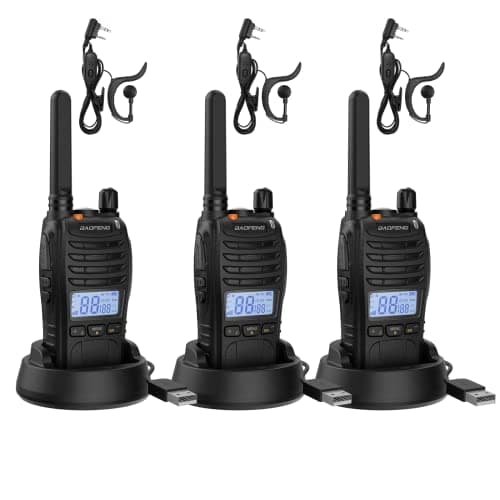 Baofeng BF-88ST Pro FRS (multi-pack) Sold in twos, threes or fours with a headset included per radio, at a stated 2 W on FRS plus 12 NOAA weather channels. The cheapest way to put a radio on every volunteer. | Best way to equip a teamNo licenseBudget | 6.1/10Researched | $41.99Amazon #ad · Disclosure |
| 2 | 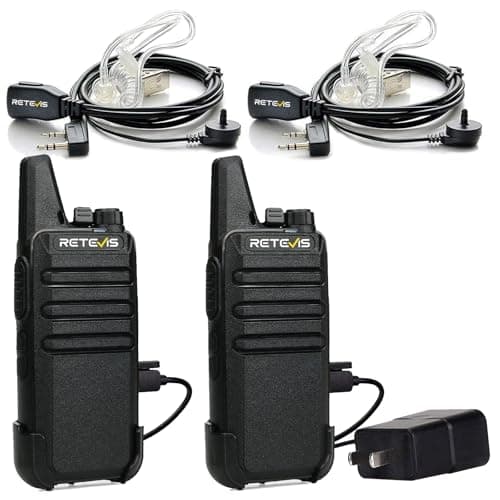 Retevis RT22 (2-pack) No screen, a channel knob and channel lock, so a first-time volunteer cannot change anything. 4 oz, USB-C, and an honest 0.5 to 2 mile figure from Retevis itself. | Best radio to hand to anyoneNo licenseBudget | 5.5/10Researched | $29.98Amazon #ad · Disclosure |
| 3 | 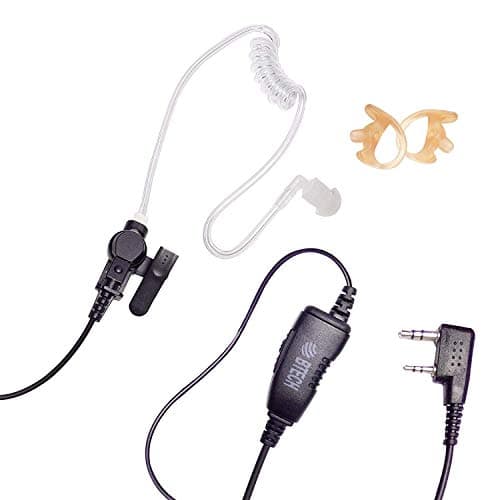 BTECH QHM07 Surveillance Earpiece and Microphone Kit Clear locking coil tube with an in-line PTT mic, for Kenwood-style K1 jacks like the Baofeng and Retevis picks. Earbud and open-ear inserts both in the box. | Best discreet earpieceAccessoryBudget | 7.3/10Researched | $16.25Amazon #ad · Disclosure |
| 4 | 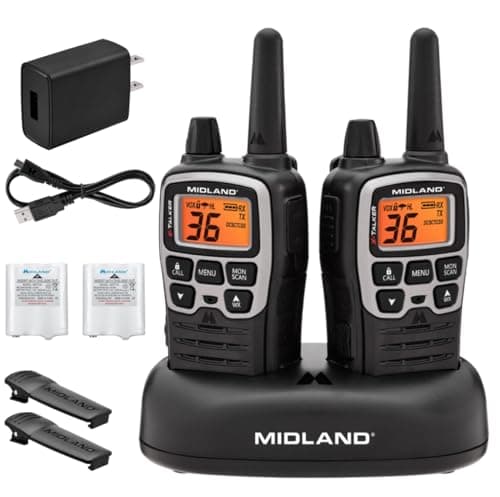 Midland X-Talker T71VP3 (2-pack) Hi/lo power, Weather Scan with alerts, a headphone jack and a 3 AA fallback, so the one radio that must work on a dead-battery morning still does. | Best radio for the team leadNo licenseMid-price | 5.7/10Researched | $89.99Amazon #ad · Disclosure |
| 5 | 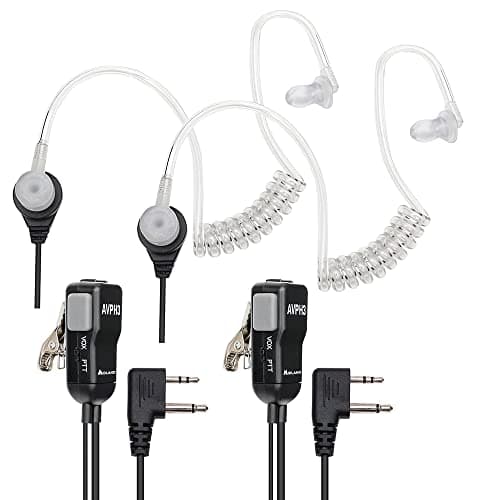 Midland AVPH3 Transparent In-Ear Headset (2-pack) Midland's own transparent in-ear surveillance headsets, sold as a pair, for X-Talker and GXT radios. Buy the earpiece that matches the radio, not the cheapest one. | Best earpiece for Midland radiosAccessoryBudget | 7.1/10Researched | $37.95Amazon #ad · Disclosure |
#ad · Prices come live from Amazon, last checked November 2, 2026. Scores are ours, built from published specs, manuals and FCC rules. Photos come from each product's Amazon listing; a radio we can't show a real photo of is left blank rather than illustrated. Tap a row for the full write-up.

A church safety team has an unusual radio problem. The people carrying the radios are volunteers who rotate weekly, the equipment sits in a cupboard for six days, the coverage area is a parking lot plus a building with thick walls, and nothing about it should look like a police operation to the family walking in the door.
That points at a specific kit: cheap, simple, license-free radios with wired earpieces, one agreed channel, and a written page of plain-language procedure. Here is how to assemble it.
A church cannot license GMRS
The radios with the most power on the shelf are GMRS, and GMRS licenses go to individuals — the rule grants one to a person and covers that person's immediate family (47 CFR 95.1705). A congregation is not a family. A deacon's personal GMRS license does not cover the rest of the team, so a church that buys GMRS radios for volunteers has bought equipment it cannot legally operate.
FRS is the answer and it is a good one: licensed by rule, no application, no fee, no call sign, capped at 2 watts on channels 1-7 and 15-22 (47 CFR 95.567, FCC: Family Radio Service). Nothing in the FRS rules limits it to personal use; the only prohibition is one-way broadcasting (47 CFR 95.533). Very large campuses that want their own repeater are into licensed Part 90 territory, which is a dealer system rather than a purchase (47 CFR 90.35) — see two-way radios for business.
What actually matters on a Sunday
Picks here come from published specifications and the FCC rules, not from testing — our method is on how we rank. For a volunteer safety team, the order was decided by:
- An earpiece that is quiet and stays put. A speaker squawking in a service is the fastest way for a team to be asked to stop using radios.
- Nothing to misconfigure. Volunteers change weekly. A channel knob and a lock beat a menu.
- Charge once, keep a charge. Radios used three hours a week sit on a shelf the rest of the time; Li-ion that holds a week beats a pack that needs charging the night before.
- Enough radios for the whole rotation, which means multi-packs, not pairs.
- Low cost per radio, because these get dropped, left in cars and occasionally taken home by mistake.
The picks in detail
1. Baofeng BF-88ST Pro multi-pack — equip the whole team
Baofeng's license-free pack is the practical answer to "we need six radios": a stated 2 W on FRS, all 22 channels plus 12 NOAA weather channels, dual watch, two emergency alarm modes, a sealed-in antenna, and an earpiece in the box with every radio, sold as a 2-, 3- or 4-pack (Baofeng BF-88ST Pro page). Baofeng states 8 to 12 hours of frequent use on the 1200 mAh pack, which is three Sundays of service time.
Cons: Baofeng's own range claim is 3 miles, the antenna cannot be upgraded, and the included earpiece is basic — the QHM07 below is the upgrade that matters.
2. Retevis RT22 — the radio a new volunteer cannot break
No screen, no menu, a channel knob and channel lock: the RT22 is the radio you hand to someone five minutes before a service. It is 2 W FRS, 16 channels with CTCSS and DCS, 1000 mAh Li-ion with USB-C, VOX, an emergency alarm and 4 ounces (Retevis RT22 product page). Retevis quotes 0.5 to 2 miles, which is honest and covers any normal campus.
Cons: 16 channels rather than 22, no NOAA receiver, and only light water resistance — fine indoors, less fine for a parking team in the rain.
3. BTECH QHM07 earpiece — the part that makes it discreet
A clear acoustic coil tube that rotates and locks into the earpiece, with the push-to-talk microphone on a lapel clip, so the radio stays on a belt under a jacket and the volume stays in one ear (BTECH QHM07 page). It ships with an in-ear insert plus left and right open-ear earmolds, which matters when a volunteer needs to hear the room as well as the radio.
Cons: K1 Kenwood-style two-pin only. It fits the Baofeng and Retevis picks and not a Midland or a Motorola Talkabout.
4. Midland X-Talker T71VP3 — the team lead's radio
One radio on the team should be the dependable one, and this is it: hi/lo power, NOAA Weather Scan with alerts, silent operation, nine levels of eVOX, a headphone jack and a three-AA fallback behind the rechargeable packs (Midland T71VP3 page). On the morning the charging bank was unplugged, AA batteries from the kitchen drawer put it back on the air.
Cons: about five hours on high power by Midland's own figure, and no published IP rating.
5. Midland AVPH3 headsets — the earpiece that fits the Midland
Midland uses its own dual-pin jack, so the K1 earpiece above will not fit the T71VP3. The AVPH3 transparent in-ear surveillance headsets are Midland's own answer, sold as a pair, and they fit the X-Talker and GXT lines (Midland AVPH3 page).
Cons: it is a Midland-only plug, and on the GXT radios Midland notes the water rating is not met with an accessory in the jack. The full plug matrix is in earpieces and headsets.
The published specs side by side
Covering the lot, the lobby and the nursery
The hard parts of a church campus are not far away, they are shielded: a nursery in a basement, a sanctuary with block walls, a fellowship hall behind a steel door, a parking lot on the far side of the building. Concrete, block, brick and steel all absorb UHF signal, which is why a radio good for two miles outdoors can fail across sixty feet of building (NIST: signal attenuation in construction materials).
A protocol a volunteer can remember
- One channel and one privacy code, taped to every radio. On FRS that is the entire compatibility story, and it means a borrowed radio joins the net instantly.
- Plain language only. No codes, no numbers, no jargon a new volunteer has to learn — see walkie-talkie 10 codes for why.
- Names stay off the air. FRS channels are public and privacy codes do not encrypt anything (here is what they actually do). Use positions: "lobby," "lot," "nursery."
- Call, wait, then speak. "Lobby to lot" — pause for the answer — then the message. Everyone talking at once is the most common failure on a shared channel.
- Radios go back on the charger, counted. A missing radio is a radio on someone's kitchen counter.
What a radio is not
A walkie-talkie is a coordination tool. It is not a medical alert, not an alarm system and not a way to reach emergency services: for anything serious, somebody calls 911 on a phone while the radio coordinates the people already on site. Radios also do not reach a repeater or a dispatcher on FRS, by design.
If your team needs encrypted traffic, campus-wide coverage through concrete, or radios that talk to a rented site system, that is a licensed Part 90 conversation with a local dealer, not a consumer purchase. Everything above is for the normal case, which is ten volunteers and a parking lot.
In detail
The picks, in full
Rank 01
Best way to equip a team
Baofeng BF-88ST Pro FRS (multi-pack)
Sold in twos, threes or fours with a headset included per radio, at a stated 2 W on FRS plus 12 NOAA weather channels. The cheapest way to put a radio on every volunteer.
Published specsResearched · every figure sourced
How the 6.1 score breaks down
- Real-world reach (30%)
- 5
- Ease of use (20%)
- 8
- Toughness & weather (15%)
- 3
- Power & battery (15%)
- 7
- Field features (10%)
- 7
- Value (10%)
- 8
What the specs support
- A clear 2 W figure, where the cheaper GT-18 page contradicts itself
- 12 NOAA weather channels with alert scanning
- Two, three or four radios in one box, each with a headset
Where it falls short
- Fixed antenna, so no upgrade path
- No water or dust rating published
- Dual watch and alarms are menu features on a radio with very few buttons
Skip this if…
…Skip it if you need more than about a mile in timber: this is a 2 W FRS radio with a sealed antenna, and no setting changes that.
#ad · Price as of November 2, 2026 · How we make money for the link to Baofeng BF-88ST Pro FRS (multi-pack)
Rank 02
Best radio to hand to anyone
Retevis RT22 (2-pack)
No screen, a channel knob and channel lock, so a first-time volunteer cannot change anything. 4 oz, USB-C, and an honest 0.5 to 2 mile figure from Retevis itself.
Published specsResearched · every figure sourced
How the 5.5 score breaks down
- Real-world reach (30%)
- 4.5
- Ease of use (20%)
- 8
- Toughness & weather (15%)
- 3
- Power & battery (15%)
- 6
- Field features (10%)
- 4
- Value (10%)
- 8
What the specs support
- States 2 W and a realistic 0.5 to 2 mile range
- USB-C Li-ion and very light
- Pre-paired out of the box; no screen to confuse anyone
Where it falls short
- Only 16 channels, so it can't reach every FRS channel another family's radio might use
- No weather channel, and only light water resistance
Skip this if…
…Skip it if you need NOAA alerts or will match channels with other brands' 22-channel radios: it has 16 channels and no weather receiver.
#ad · Price as of November 2, 2026 · How we make money for the link to Retevis RT22 (2-pack)
Rank 03
Best discreet earpiece
BTECH QHM07 Surveillance Earpiece and Microphone Kit
Clear locking coil tube with an in-line PTT mic, for Kenwood-style K1 jacks like the Baofeng and Retevis picks. Earbud and open-ear inserts both in the box.
Published specsResearched · every figure sourced
How the 7.3 score breaks down
- Connector fit (30%)
- 8
- Hearing & mic in the field (25%)
- 6
- Comfort & quiet use (20%)
- 8
- Durability (15%)
- 6
- Value (10%)
- 9
What the specs support
- K1 two-pin plug for the BTECH GMRS-V2, FRS-A1 and other Kenwood-style radios
- Coil tube locks in rather than relying on friction; stainless strain-relief clips
- Includes an in-ear earbud and left/right open-ear earmolds
Where it falls short
- Noise canceling is in the product name, but BTECH publishes no noise-reduction figure
- No weather rating or warranty length stated
- Not on BTECH's fit list for its own GMRS-PRO
Skip this if…
…Skip it if your radio has no Kenwood-style K1 two-pin jack (Midland, Motorola Talkabout, Rocky Talkie Expedition) or is a BTECH GMRS-PRO: BTECH lists it only for K1 radios.
#ad · Price as of November 2, 2026 · How we make money for the link to BTECH QHM07 Surveillance Earpiece and Microphone Kit
Rank 04
Best radio for the team lead
Midland X-Talker T71VP3 (2-pack)
Hi/lo power, Weather Scan with alerts, a headphone jack and a 3 AA fallback, so the one radio that must work on a dead-battery morning still does.
Published specsResearched · every figure sourced
How the 5.7 score breaks down
- Real-world reach (30%)
- 4
- Ease of use (20%)
- 8
- Toughness & weather (15%)
- 4
- Power & battery (15%)
- 6
- Field features (10%)
- 7
- Value (10%)
- 7
What the specs support
- AA fallback plus 1000 mAh packs and a full charging kit
- Weather Scan, silent mode and hands-free eVOX
- Works with any other FRS or GMRS radio on the shared FRS channels
Where it falls short
- Midland's own runtime figure is about 5 hours on high power
- Only "water resistant"; no IP rating
- Transmit power isn't published, and FRS rules still cap what it can do
Skip this if…
…Skip it if you're buying it for the "38 miles": through hills and trees it's still a fixed-antenna FRS radio, and a GMRS radio is the real step up in reach.
#ad · Price as of November 2, 2026 · How we make money for the link to Midland X-Talker T71VP3 (2-pack)
Rank 05
Best earpiece for Midland radios
Midland AVPH3 Transparent In-Ear Headset (2-pack)
Midland's own transparent in-ear surveillance headsets, sold as a pair, for X-Talker and GXT radios. Buy the earpiece that matches the radio, not the cheapest one.
Published specsResearched · every figure sourced
How the 7.1 score breaks down
- Connector fit (30%)
- 8
- Hearing & mic in the field (25%)
- 6
- Comfort & quiet use (20%)
- 8
- Durability (15%)
- 5
- Value (10%)
- 8
What the specs support
- Midland's widest stated fit: every Midland FRS and GMRS radio except the T10
- Push-to-talk or VOX, so you can talk without reaching for the radio
- Two earpieces in the pack, one for each radio of a 2-pack
- Clear tube sits in the ear, keeping calls private and low-profile
Where it falls short
- Midland publishes no cable, weather-rating or warranty details on the page
- Listed for Midland radios only; Midland names no other brand
- Some Midland 2-packs (GXT1000VP4, T290VP4) already ship with a pair of basic headsets
Skip this if…
…Skip it if your radio isn't a Midland, or is the X-Talker T10: Midland lists the AVPH3 only for its own radios, and the T10 has no headset jack at all.
#ad · Price as of November 2, 2026 · How we make money for the link to Midland AVPH3 Transparent In-Ear Headset (2-pack)
What to look for in a team radio
- FRS on the box. If the listing says GMRS, the church cannot license it. First filter.
- A K1 (Kenwood two-pin) jack, because that is where the cheap, good earpieces live.
- Channel lock or no screen so a rotating team cannot drift off channel.
- A stated runtime in hours, not a vague claim. Three hours a week means you want a pack that holds charge for a month.
- Enough radios for the rotation plus two spares. Multi-packs exist for exactly this.
- A charging bank in one place, ideally in a locked cupboard with the radio count on the door.
And ignore the mileage claim entirely: your problem is a block wall sixty feet away, not two miles of open ground.
How we scored this
Every pick here is backed by the paperwork
Every pick is labeled Researched: we read each maker's published specs, manuals and range tables, check the license rules against the FCC, and score every radio on a public rubric out of 10. Every figure links to where it came from, and every range number is labeled “advertised” so you can see the difference between the box and the terrain.
Scores are our editorial judgment on that documented evidence. Commissions never set a score or decide a pick. The rubric and its weights are published.
What changed
- Published.
Questions
Frequently asked
What radios do church security teams use?
Does a church need a license for walkie-talkies?
How many radios does a church safety team need?
Can anyone listen to our church radios?
Will the radios reach the parking lot and the basement nursery?
Should volunteers use earpieces or speakers?
Receipts
Sources
- Baofeng: BF-88ST Pro FRS product page (checked 2026-09-22)
- Retevis: RT22 product page (checked 2026-09-29)
- BTECH: QHM07 surveillance earpiece product page (checked 2026-09-22)
- Midland: X-Talker T71VP3 product page (checked 2026-09-22)
- Midland: AVPH3 transparent surveillance headsets product page (checked 2026-09-22)
- FCC: Family Radio Service (FRS) page (checked 2026-10-17)
- 47 CFR 95.533, permissible FRS uses (via Cornell LII, checked 2026-10-17)
- 47 CFR 95.567, FRS power limits (via Cornell LII, checked 2026-10-17)
- 47 CFR 95.1705, GMRS eligibility: individuals and family (via Cornell LII, checked 2026-10-17)
- 47 CFR 90.35, Industrial/Business Pool eligibility (via Cornell LII, checked 2026-10-17)
- NIST: electromagnetic signal attenuation in construction materials (checked 2026-10-17)
Specs and range figures come from each maker's own pages and manuals, linked on every product, and license, power and channel rules come from the FCC and 47 CFR Part 95. Range numbers are the maker's advertised claims and are labeled that way, so you can tell the box number from the terrain number. Prices come live from Amazon with the time we checked. Read the full method.