Emergency radio shopping goes wrong in a predictable way. The listings advertise features that sound like safety — "emergency alert", "weather band", "SOS" — and bury the one specification that decides whether you will still own the radio in a year. This guide goes in the order that actually matters, and cites the National Weather Service for the facts about the service itself rather than a retailer.
What NOAA Weather Radio actually is
NOAA Weather Radio All Hazards is a government broadcast network run by the National Weather Service. It transmits continuous weather information and, in an emergency, warnings — not only weather, but also the civil and public-safety alerts the "All Hazards" name refers to. The transmitters run on backup power, which is why the broadcast keeps going when the grid does not.
Your radio is a receiver on this network. It is not part of a two-way system, it has no account and no subscription, and there is nothing to set up except the alerting. The NWS maintains its own page on receivers, and it is the right thing to read before any purchase.
The seven frequencies, and why "weather band" is not enough
NWR stations use seven VHF public-service channels, spaced 25 kHz apart: 162.400, 162.425, 162.450, 162.475, 162.500, 162.525 and 162.550 MHz (NWS: NOAA Weather Radio FAQ).
Any radio worth buying receives all seven, because which one serves you depends on your nearest transmitter and you may need a different one if you travel. A listing that says "weather band" without a channel count is being vague for a reason. The specification to look for is simply 7 NOAA channels.
S.A.M.E. codes, and how to set one
This is the feature that decides whether the radio stays switched on. One NWS transmitter covers a wide area, often several counties. Without filtering, your radio alarms for all of them.
S.A.M.E. (Specific Area Message Encoding) is a digital burst at the start of each alert carrying the codes of the counties it applies to. A S.A.M.E. radio compares those codes with the ones you programmed and stays silent if it is not your area. Midland's desktop units hold up to 25 counties, which is far more than a household needs and useful if you cover a commute or a second property.
- Find your county's six-digit code. The NWS publishes the list; it is one lookup for most people, or several if you want neighboring counties too.
- Enter it in the radio's menu following the manual. On the Midland units this is a few button presses.
- Set the alert style. Voice, tone or display-only — the last one is what makes a bedroom radio tolerable.
- Test it. NWS transmitters run a weekly required test, usually midweek. If your radio does not react on test day, something is not programmed.
The Public Alert standard, and its one catch
Public Alert is a real certification, not a marketing badge: the standard is CTA-2009-C, developed by the Consumer Technology Association with the National Weather Service, and only the CTA can authorize use of the mark (NWS: All Hazards logo information).
The catch is worth knowing. A receiver qualifies for the NWR All Hazards logo with either S.A.M.E. or 1050 Hz tone alerting, and tone-only receivers are exempt from section 5 of the standard, which applies only to S.A.M.E. receivers. So a certified radio can still alert for the whole transmitter area. The badge is a floor, not a guarantee of county filtering — look for the letters S.A.M.E.
Power options, compared honestly
- AC with alkaline backup. The right answer for a house. Alkaline cells sit for years and are there when the grid is not. Midland rates the WR120's backup at roughly two days of standby, or about twelve hours of constant full-volume broadcast.
- Rechargeable pack with crank and solar. The right answer for a bag. The trade is self-discharge: a lithium pack left for three years will be flat.
- Alkaline only. The most reliable after long storage and the least useful once the cells are gone. Tape a spare set to the radio.
- Cranking, realistically. Sangean is the only maker in the category that publishes a ratio: about one minute of cranking for roughly five minutes of listening (MMR-88). Treat the crank as insurance that the radio is never fully dead, not as how you run it.
- Charging a phone. Read the mAh. A 2600 mAh pack has real headroom; an 850 mAh pack is sized for its own listening time. Either way expect a partial charge, not a full one.
What to buy for your situation
Our picks for this job
The radios behind this guide
Each of these is ranked in full on the roundups; here is the shortest version of who each one is for.
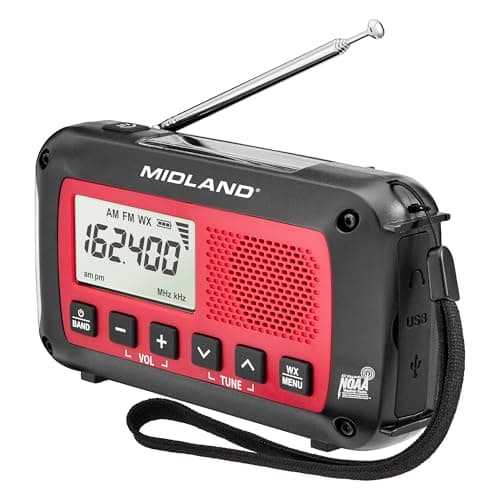
Best crank radio for a go-bag
Midland ER40 Emergency Crank Weather Radio
One radio for a bag: crank, solar and USB on a replaceable 2600 mAh pack, alerting while switched off, and capacity left for a phone. No S.A.M.E.
$59.99Amazon#ad · Price as of November 6, 2026 · How we make money for the link to Midland ER40 Emergency Crank Weather Radio
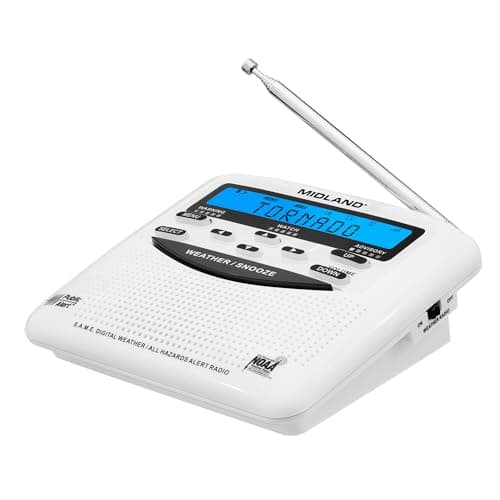
Best NOAA alert radio for the house
Midland WR120B NOAA Weather Alert Radio
One radio for a bedside table: S.A.M.E. for up to 25 counties and AA backup. No AM/FM, no light, no charging.
$45.99Amazon#ad · Price as of November 6, 2026 · How we make money for the link to Midland WR120B NOAA Weather Alert Radio
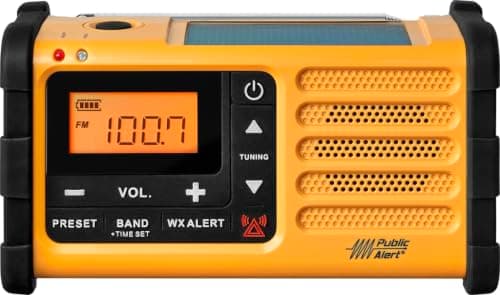
Best built crank radio for the price
Sangean MMR-88 Multi-Powered Emergency Radio
The better-built portable, with all seven NOAA frequencies, a 14-hour stated playtime and the only published crank ratio. No S.A.M.E.
$77.09Amazon#ad · Price as of November 6, 2026 · How we make money for the link to Sangean MMR-88 Multi-Powered Emergency Radio
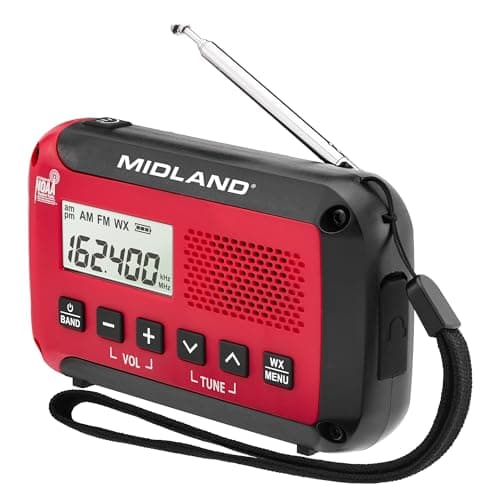
Best pocket emergency radio on AA cells
Midland ER10VP Compact Emergency Alert Radio
The glovebox radio: three AA cells, nothing to keep charged, and it still works after years in storage.
$29.99Amazon#ad · Price as of November 6, 2026 · How we make money for the link to Midland ER10VP Compact Emergency Alert Radio
The half this guide does not cover
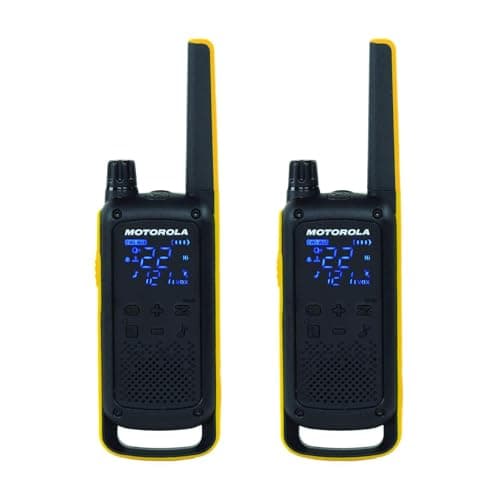
Every radio above is receive-only. None of them can call anyone. A preparedness kit that only receives is half a kit, and the other half is a two-way radio: license-free FRS, which anyone may use with no application and no fee (FCC: Family Radio Service), or GMRS, where one license covers the holder and their immediate family (47 CFR 95.1705).
The build, with a checklist and channel plan, is in the power-outage communication kit. If you want the shorter answer on whether radios work at all when the grid fails, do walkie-talkies work if the grid goes down? is the page for that, and the family emergency communication plan covers who calls whom.
How we scored this
Every pick here is backed by the paperwork
Every pick is labeled Researched: we read each maker's published specs, manuals and range tables, check the license rules against the FCC, and score every radio on a public rubric out of 10. Every figure links to where it came from, and every range number is labeled “advertised” so you can see the difference between the box and the terrain.
Scores are our editorial judgment on that documented evidence. Commissions never set a score or decide a pick. The rubric and its weights are published.
What changed
- Published.
Questions
Frequently asked
What should I look for in an emergency radio?
What are the NOAA weather radio frequencies?
How do I program a S.A.M.E. code?
Is a Public Alert certified radio always S.A.M.E.?
Do I need a license for an emergency radio?
Receipts
Sources
- NWS: NOAA Weather Radio receivers (checked 2026-11-05)
- NWS: NOAA Weather Radio FAQ, the seven NWR frequencies (checked 2026-11-05)
- NWS: NWR All Hazards logo and the CTA-2009-C Public Alert standard (checked 2026-11-05)
- Sangean: MMR-88 product page, crank-to-listening ratio (checked 2026-11-05)
- FCC: Family Radio Service (FRS) page (checked 2026-11-05)
- 47 CFR 95.1705, GMRS licensee and immediate family (via Cornell LII, checked 2026-11-05)
Specs and range figures come from each maker's own pages and manuals, linked on every product, and license, power and channel rules come from the FCC and 47 CFR Part 95. Range numbers are the maker's advertised claims and are labeled that way, so you can tell the box number from the terrain number. Prices come live from Amazon with the time we checked. Read the full method.