Quick picks
The picks at a glance
| # | Product | Best for | Score | Price |
|---|---|---|---|---|
| 1 | 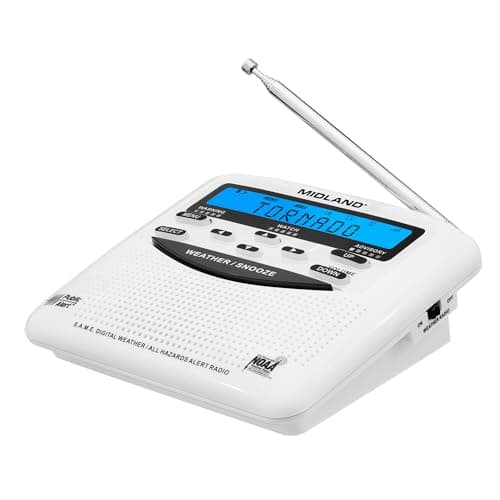 Midland WR120B NOAA Weather Alert Radio S.A.M.E. for up to 25 counties, AA backup and selectable voice, tone or display-only alerting. The cheapest way into alerting that stays quiet for other people's warnings. | Best NOAA alert radio overallNo licenseBudget | 9.0/10Researched | $45.99Amazon #ad · Disclosure |
| 2 | 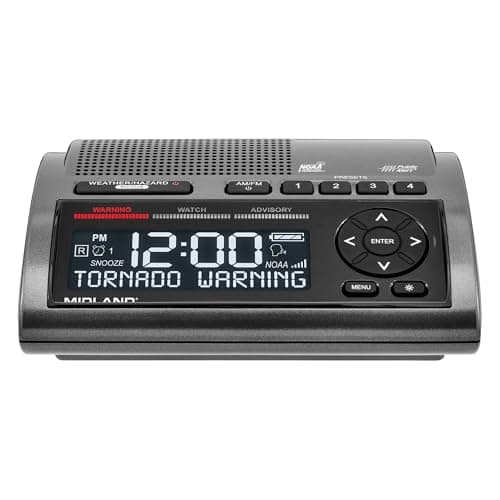 Midland WR400 Deluxe NOAA Weather Radio The same 25-county alerting plus AM/FM presets, a USB charging port, an alarm clock, and an alert jack that drives a strobe or a bed shaker. | Best for AM/FM and accessibilityNo licenseMid-price | 9.1/10Researched | $99.32Amazon #ad · Disclosure |
| 3 | 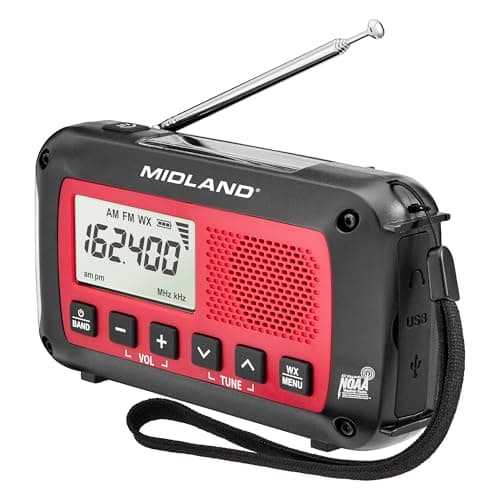 Midland ER40 Emergency Crank Weather Radio No S.A.M.E., but it alerts with siren and flashing light even when switched off, charges three ways and has a 2600 mAh pack with enough left for a phone. | Best portable alternativeNo licenseBudget | 9.7/10Researched | $59.99Amazon #ad · Disclosure |
| 4 | 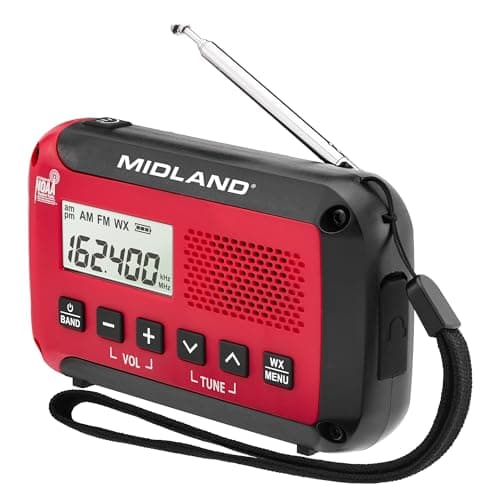 Midland ER10VP Compact Emergency Alert Radio Three AA cells, all seven NOAA channels, audible and visual alerting and an SOS strobe in a five-inch body. Nothing to keep charged. | Best on batteries you already ownNo licenseBudget | 9.0/10Researched | $29.99Amazon #ad · Disclosure |
#ad · Prices come live from Amazon, last checked November 6, 2026. Scores are ours, built from published specs, manuals and FCC rules. Photos come from each product's Amazon listing; a radio we can't show a real photo of is left blank rather than illustrated. Tap a row for the full write-up.

A NOAA weather radio does one job: it sits silent for months and then makes a noise before the weather gets to you. Every one of them receives the same seven National Weather Service frequencies, from 162.400 to 162.550 MHz in 25 kHz steps (NWS: NOAA Weather Radio FAQ). The radios do not differ on what they can hear. They differ on what they do about it.
Which is why this page ranks on alerting first and everything else second. Each pick is scored from the maker's own published figures, each one linked to the document it came from; the method is on how we rank.
What S.A.M.E. actually does, and why it decides the purchase
A single NWS transmitter covers a wide area — often several counties. Without S.A.M.E., your radio alarms for every warning that transmitter sends, including flood warnings for a county an hour away at three in the morning. People do not tolerate that for long. They turn the radio off, and then it is not a weather radio, it is a box.
S.A.M.E. (Specific Area Message Encoding) is a digital code at the start of each alert that names the counties it applies to. Program your county's six-digit code in and the radio ignores everything else. That one feature is the difference between a radio you keep switched on and one you do not, and it is the reason both desktop picks here outrank the portables despite having fewer features.
How we ranked them
- Alerting and NOAA coverage first. Does it do S.A.M.E., how many counties can it hold, and does it alert when the unit is switched off?
- Power, second. A weather radio that dies with the grid has failed at the one moment it exists for. Battery backup, crank, solar, and the maker's own runtime figure.
- What else it does in an outage. AM/FM for local news, a light, a USB port for a phone.
- Build, and then value within the tier.
The picks in detail
1. Midland WR120B — the default
It wins because it does the important thing cheaply. Midland publishes digital S.A.M.E. for up to 25 programmable county locations, selectable voice, tone or display-only alerting, and a 120 V AC supply with 3 x AA battery backup (WR120 product page). Midland's support pages put the backup runtime at about two days in standby on alkaline cells, or about twelve hours of constant full-volume broadcast (and the NWS explains why standby is the number that matters).
Good to know: Midland contradicts itself on this radio in two places. The product page says 60 alerts; the user guide says over 80 alert types. The product page claims a 90 dB siren; Midland's own support pages say 85 dB. Neither gap changes whether the radio works, but you should know the published numbers disagree before you quote them to anyone.
2. Midland WR400 — the one you will actually leave plugged in
Same 25-county S.A.M.E. alerting, 80 programmable alerts, and the additions that turn an alert box into a bedside radio: AM/FM with 6 presets (AM 520-1710 kHz, FM 87.5-108.1 MHz), an alarm clock with snooze, a USB charging port, and 4 x AA backup (WR400 product page).
The feature worth paying for is the one nobody markets: an alert jack that drives a strobe light or a bed shaker. For a deaf or hard-of-hearing household that is not a nice extra, it is the entire product. It is the only radio on this page that has one.
Good to know: Midland's blogs quote this radio's siren at both 85 dB and 25 dB. The 25 dB figure is implausible for an alert siren and looks like a typo, but it is on Midland's own site.
3. Midland ER40 — the portable that alerts while switched off
The pick when the radio has to leave the house. A replaceable 2600 mAh lithium pack charged by micro-USB, hand crank or solar; a high-output LED that cycles low, high and an SOS Morse beacon; and alert behavior that is genuinely well thought out — with weather alert on, it sounds a siren, flashes the flashlight and switches to the current weather channel, and it does this even when the radio is off (ER40 product page).
Good to know: no S.A.M.E., so it alerts on the whole transmitter footprint; Midland's manual states it does not support alkaline or standard batteries at all, so if the pack dies you are cranking; and it will not receive alerts while it is charging another device.
4. Midland ER10VP — the one that runs on what is in the drawer
Three AA alkaline cells, all seven NOAA channels, audible and visual alerting, AM/FM, a headphone jack and an LED with high, low and SOS strobe, in a 5 x 3 x 1.2 in body (ER10VP product page). Midland states it receives broadcasts up to 50 miles from the transmitter, depending on conditions.
Good to know: there is no crank, no solar and no rechargeable pack, and it cannot charge a phone. What it buys you is a radio that stores in a glovebox for three years and still works, because alkaline cells do not self-discharge the way a lithium pack does.
The published specs side by side
The Public Alert mark, and what it is worth
If you want a shortcut past the marketing, look for the Public Alert certification. It is a real standard — CTA-2009-C, developed by the Consumer Technology Association with the National Weather Service — and only the CTA can authorize its use (NWS: All Hazards logo information).
Two details matter. First, only receivers with S.A.M.E. or 1050 Hz tone alerting qualify for the NWR All Hazards logo at all. Second, tone-only receivers are exempt from section 5 of the standard, which applies only to S.A.M.E. receivers — so the logo alone does not tell you a radio does county-level filtering. Check for the words "S.A.M.E." specifically, not just the badge. The NWS keeps its own page on receivers and is the right authority to read before a purchase.
Power is the second decision, and the one people get wrong
A weather radio's whole value is being awake when nothing else is. That makes the power question simple to ask and easy to get wrong:
- AC with alkaline backup (WR120B, WR400) is right for a house. Alkaline cells sit in the radio for years and are there when the grid is not. Change them on a schedule you will remember.
- A rechargeable pack with crank and solar (ER40) is right for a bag. It also means a pack that self-discharges in storage, so it needs topping up a few times a year or it will be flat when you reach for it.
- Alkaline only (ER10VP) is the most reliable long-storage option and the least useful once the batteries are gone. Keep a spare set taped to it.
If the radio also needs to put a charge back into a phone, the capacity figure is the one to read — and most crank radios are sized for listening, not power-banking. Our hand-crank radio roundup goes through that in detail.
What a weather radio cannot do
Every radio on this page is receive-only. It has no transmitter. It will tell you a tornado warning has been issued; it will not tell your family where you are, and it cannot call for help. That is not a flaw — it is the category — but it is the single most common misunderstanding in preparedness shopping.
A kit that actually works has both: a weather radio for the warning, and license-free FRS or licensed GMRS radios for talking to each other when the cell network is congested or down. We walk the whole build, with a checklist, in the power-outage communication kit, and do walkie-talkies work if the grid goes down? answers the question underneath it.
In detail
The picks, in full
Rank 01
Best NOAA alert radio overall
Midland WR120B NOAA Weather Alert Radio
S.A.M.E. for up to 25 counties, AA backup and selectable voice, tone or display-only alerting. The cheapest way into alerting that stays quiet for other people's warnings.
Published specsResearched · every figure sourced
How it scores on each criterion
- Alerting & NOAA coverage (30%)
- 9.8
- Power options & runtime (25%)
- 8.4
- Usefulness in an outage (20%)
- 8.4
- Build & weather (15%)
- 8.4
- Value (10%)
- 9.7
Why we recommend it
- S.A.M.E. for up to 25 counties, so it stays quiet for warnings that are not yours
- AA battery backup keeps it alerting when the grid is down
- Voice, tone or display-only alerting, so it can sit in a bedroom
- The cheapest way into real county-level alerting
Good to know
This is a bedside alerting box, not a go-bag radio: it has no AM/FM, no light and no way to charge a phone, so pair it with a crank radio if you want one unit that does everything.
#ad · Price as of November 6, 2026 · How we make money for the link to Midland WR120B NOAA Weather Alert Radio
Rank 02
Best for AM/FM and accessibility
Midland WR400 Deluxe NOAA Weather Radio
The same 25-county alerting plus AM/FM presets, a USB charging port, an alarm clock, and an alert jack that drives a strobe or a bed shaker.
Published specsResearched · every figure sourced
How it scores on each criterion
- Alerting & NOAA coverage (30%)
- 9.8
- Power options & runtime (25%)
- 8.4
- Usefulness in an outage (20%)
- 8.9
- Build & weather (15%)
- 8.4
- Value (10%)
- 8.9
Why we recommend it
- Same 25-county S.A.M.E. alerting as the WR120, with 80 programmable alerts
- AM/FM with presets means local news when the TV and internet are out
- Alert jack drives a strobe or bed shaker — the accessible option in this category
- USB port tops up a phone from the wall without hunting for a brick
Good to know
Skip the extra over the WR120 if you only want the alert and already have a radio for news: the AM/FM, clock and USB port are what you are paying for, not better alerting.
#ad · Price as of November 6, 2026 · How we make money for the link to Midland WR400 Deluxe NOAA Weather Radio
Rank 03
Best portable alternative
Midland ER40 Emergency Crank Weather Radio
No S.A.M.E., but it alerts with siren and flashing light even when switched off, charges three ways and has a 2600 mAh pack with enough left for a phone.
Published specsResearched · every figure sourced
How it scores on each criterion
- Alerting & NOAA coverage (30%)
- 9.7
- Power options & runtime (25%)
- 9.8
- Usefulness in an outage (20%)
- 9.8
- Build & weather (15%)
- 8.9
- Value (10%)
- 9.3
Why we recommend it
- Charges three ways and the pack is replaceable rather than sealed in
- Alerts with siren and flashing light even when the radio is switched off
- SOS beacon and a real flashlight, so it earns its place in a bag
- 2600 mAh is enough to put a usable charge back in a phone
Good to know
Skip it if you want county-specific alerting: the ER40 alerts on the whole transmitter footprint, so for a bedside radio that only wakes for your county, the S.A.M.E. desktop units are the right buy.
#ad · Price as of November 6, 2026 · How we make money for the link to Midland ER40 Emergency Crank Weather Radio
Rank 04
Best on batteries you already own
Midland ER10VP Compact Emergency Alert Radio
Three AA cells, all seven NOAA channels, audible and visual alerting and an SOS strobe in a five-inch body. Nothing to keep charged.
Published specsResearched · every figure sourced
How it scores on each criterion
- Alerting & NOAA coverage (30%)
- 9.3
- Power options & runtime (25%)
- 8.9
- Usefulness in an outage (20%)
- 8.9
- Build & weather (15%)
- 8.4
- Value (10%)
- 9.7
Why we recommend it
- Runs on AA cells, so it works with the batteries already in the drawer
- All seven NOAA channels and a real alert function at the lowest price here
- Flashlight with an SOS strobe in a 5-inch body
- Nothing to keep charged — it stores for years and still works
Good to know
Skip it if you want one radio to do everything in an outage: it has no crank and no USB output, so it keeps you informed but will not put a charge back in a phone.
#ad · Price as of November 6, 2026 · How we make money for the link to Midland ER10VP Compact Emergency Alert Radio
What to look for in a weather radio
- S.A.M.E., stated by name. Not "alerts", not a Public Alert badge on its own. The words Specific Area Message Encoding, and a county count.
- Battery backup you can replace. AA or AAA cells for a house unit; a replaceable pack for a portable.
- Alerting while switched off. A radio that only alerts when you have left it on is a radio that will be off.
- Selectable alert style. Voice, tone or display-only matters if it lives in a bedroom.
- An external antenna jack if you are far from the transmitter or inside a steel building.
- An alert jack if anyone in the house is deaf or hard of hearing. Only one radio here has one.
- A two-way radio to go with it. The weather radio is half a plan.
How we scored this
Every pick here is backed by the paperwork
Every pick is labeled Researched: we read each maker's published specs, manuals and range tables, check the license rules against the FCC, and score every radio on a public rubric out of 10. Every figure links to where it came from, and every range number is labeled “advertised” so you can see the difference between the box and the terrain.
Scores are our editorial judgment on that documented evidence. Commissions never set a score or decide a pick. The rubric and its weights are published.
What changed
- Published.
Questions
Frequently asked
What is the best NOAA weather radio?
What does S.A.M.E. mean on a weather radio?
Do weather radios work when the power is out?
Can a NOAA weather radio call for help?
What frequencies do NOAA weather radios use?
Is the Public Alert logo the same as S.A.M.E.?
Receipts
Sources
- NWS: NOAA Weather Radio FAQ, the seven NWR frequencies (checked 2026-11-05)
- NWS: NWR All Hazards logo and the CTA-2009-C Public Alert standard (checked 2026-11-05)
- NWS: NOAA Weather Radio receivers (checked 2026-11-05)
- Midland: WR120 NOAA Weather and Emergency Alert Radio page (checked 2026-11-05)
- Midland: WR400 Deluxe NOAA Weather Radio page (checked 2026-11-05)
- Midland: ER40 Emergency Crank Weather Radio page (checked 2026-11-05)
- Midland: ER10VP compact emergency alert radio page (checked 2026-11-05)
Specs and range figures come from each maker's own pages and manuals, linked on every product, and license, power and channel rules come from the FCC and 47 CFR Part 95. Range numbers are the maker's advertised claims and are labeled that way, so you can tell the box number from the terrain number. Prices come live from Amazon with the time we checked. Read the full method.