Quick picks
The picks at a glance
| # | Product | Best for | Score | Price |
|---|---|---|---|---|
| 1 | 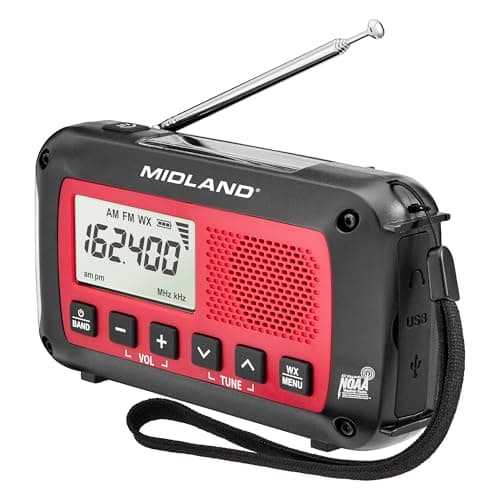 Midland ER40 Emergency Crank Weather Radio A replaceable 2600 mAh pack charged by USB, crank or solar, NOAA alerting that works with the radio switched off, and capacity left over for a phone. | Best crank radio overallNo licenseBudget | 9.7/10Researched | $59.99Amazon #ad · Disclosure |
| 2 | 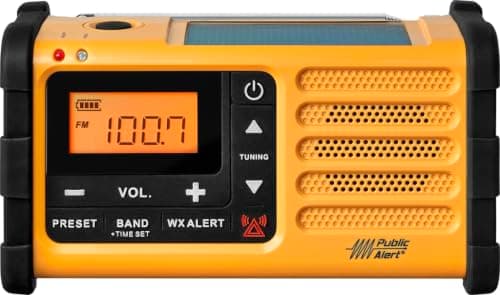 Sangean MMR-88 Multi-Powered Emergency Radio All seven NOAA frequencies, a stated 14-hour playtime, rubber-armored corners and a published crank-to-listening ratio instead of a vague promise. | Best built, most honest figuresNo licenseMid-price | 9.3/10Researched | $77.09Amazon #ad · Disclosure |
| 3 | 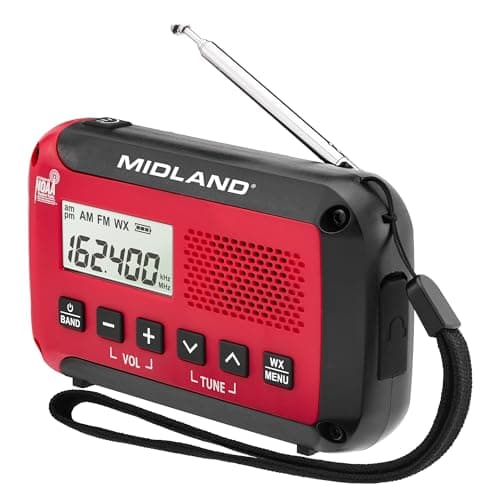 Midland ER10VP Compact Emergency Alert Radio Not a crank radio at all: three AA cells that still work after three years in a glovebox, with all seven NOAA channels and an SOS strobe. | Best for long storageNo licenseBudget | 9.0/10Researched | $29.99Amazon #ad · Disclosure |
#ad · Prices come live from Amazon, last checked November 6, 2026. Scores are ours, built from published specs, manuals and FCC rules. Photos come from each product's Amazon listing; a radio we can't show a real photo of is left blank rather than illustrated. Tap a row for the full write-up.
A hand-crank radio is bought once, put in a closet, and judged years later on a night when nothing else works. That makes it a category where marketing is especially unmoored from the specification, because almost nobody checks.
So this page ranks on the published numbers: pack capacity, stated runtime, the charging paths the maker actually lists, and — where it exists — a figure for how much listening one minute of cranking produces. Everything is linked to the page it came from; the method is on how we rank.
The honest math of cranking
Only one maker on this page will tell you the ratio. Sangean states that one minute of cranking the MMR-88's dynamo gives roughly five minutes of listening (Sangean MMR-88). That is a useful, unflattering, checkable number, and it reframes the whole category: cranking is a way to get a weather bulletin, not a way to live off-grid. Half an hour of radio costs about six minutes of work.
Nobody publishes a figure that makes cranking look like a power source, because it is not one. Treat the crank as the thing that guarantees the radio will never be completely dead, and the battery and solar panel as how it actually runs.
The picks in detail
1. Midland ER40 — the one to put in the bag
It wins on the two things that decide a crank radio: a 2600 mAh lithium pack that is replaceable rather than sealed in, and three charging paths — micro-USB, hand crank and solar (ER40 product page). It is also the only radio here whose alerting behavior is genuinely well designed: with weather alert on it sounds a siren, flashes the flashlight and switches to the current weather channel, and it does that with the radio switched off.
The flashlight cycles low, high and an SOS Morse beacon, and there is AM/FM with a clock and a backlit LCD.
Good to know: Midland's manual states it does not support alkaline or standard batteries at all, so the lithium pack is the only power source; it will not receive alerts while it is charging another device; the port is micro-USB rather than USB-C; and Midland publishes neither a runtime figure nor the flashlight's lumens.
2. Sangean MMR-88 — the better-built radio
Sangean is a radio company rather than a preparedness brand, and it shows in what they publish: an 18350 lithium cell, 3.7 V / 850 mAh, with a stated 14 hours of playtime, all seven NOAA frequencies, 19 presets shared across AM and FM, a 40 mm speaker, a 3.5 mm headphone jack, and dimensions and weight to the millimetre and gram (MMR-88 product page).
The build is the other reason to want it: shock-resistant rubber reinforcement on all four corners, and a triple LED with four patterns including a real SOS. The headphone jack matters more than it sounds — it is how you listen to a bulletin at 2 a.m. without waking a house.
Good to know: Sangean's own weather-radio guide states this model does not carry S.A.M.E. area coding; at 850 mAh there is very little spare capacity for a phone; Sangean publishes no IP water rating at all, only the rubber corners; and the charging port differs by production version, with micro-USB on older units and USB-C on newer ones.
3. Midland ER10VP — the one that survives the closet
Not a crank radio, and that is the point. It takes three AA alkaline cells, receives all seven NOAA channels with audible and visual alerting, and has AM/FM, a headphone jack and an LED with high, low and SOS strobe in a 5 x 3 x 1.2 in body (ER10VP product page). Midland states it receives broadcasts up to 50 miles from the transmitter, depending on conditions.
A lithium pack left in a drawer for three years is usually flat and sometimes dead. Alkaline cells are not, which is why the cheapest radio here is the one most likely to work the first time you reach for it. Keep a spare set taped to the back.
Good to know: no crank, no solar, no USB output, so it cannot charge anything; and Midland's manual for it is titled ER10, so it may not match the current ER10VP exactly.
The published specs side by side
Capacity decides what it can charge, and the gap is large
If you want the radio to double as a power bank, read one number: the pack capacity. The ER40's 2600 mAh is roughly three times the MMR-88's 850 mAh. That is not a marginal difference in a category where people assume every crank radio charges a phone — the Sangean's battery is sized for its own 14 hours of listening, and the Midland's has headroom beyond that.
Even 2600 mAh is less than most modern phone batteries, so plan on a partial charge: enough for a call, some messages and a map, not a full top-up. If keeping phones alive is the actual goal, a dedicated power bank is the right purchase and the radio is the radio.
The storage problem nobody mentions
Every rechargeable emergency radio shares one failure mode: it self-discharges in the closet. A radio bought in 2026 and first reached for in 2029 will be flat, and the crank will get you a bulletin but not much more.
Three habits fix it, none of which need a spec sheet: top the radio up twice a year on the same schedule as smoke-alarm batteries; leave the solar panel facing a window if it lives somewhere with light; and keep one alkaline radio in the kit alongside the rechargeable one, which is exactly why the ER10VP is on this page.
And remember what the category cannot do. Every radio here is receive-only. For talking to anyone, you need FRS or GMRS alongside — the full build is in the power-outage communication kit, and the county-alerting side is in best NOAA weather radios.
In detail
The picks, in full
Rank 01
Best crank radio overall
Midland ER40 Emergency Crank Weather Radio
A replaceable 2600 mAh pack charged by USB, crank or solar, NOAA alerting that works with the radio switched off, and capacity left over for a phone.
Published specsResearched · every figure sourced
How it scores on each criterion
- Alerting & NOAA coverage (30%)
- 9.7
- Power options & runtime (25%)
- 9.8
- Usefulness in an outage (20%)
- 9.8
- Build & weather (15%)
- 8.9
- Value (10%)
- 9.3
Why we recommend it
- Charges three ways and the pack is replaceable rather than sealed in
- Alerts with siren and flashing light even when the radio is switched off
- SOS beacon and a real flashlight, so it earns its place in a bag
- 2600 mAh is enough to put a usable charge back in a phone
Good to know
Skip it if you want county-specific alerting: the ER40 alerts on the whole transmitter footprint, so for a bedside radio that only wakes for your county, the S.A.M.E. desktop units are the right buy.
#ad · Price as of November 6, 2026 · How we make money for the link to Midland ER40 Emergency Crank Weather Radio
Rank 02
Best built, most honest figures
Sangean MMR-88 Multi-Powered Emergency Radio
All seven NOAA frequencies, a stated 14-hour playtime, rubber-armored corners and a published crank-to-listening ratio instead of a vague promise.
Published specsResearched · every figure sourced
How it scores on each criterion
- Alerting & NOAA coverage (30%)
- 9.3
- Power options & runtime (25%)
- 9.7
- Usefulness in an outage (20%)
- 9.3
- Build & weather (15%)
- 8.9
- Value (10%)
- 8.9
Why we recommend it
- Receives all seven NOAA frequencies, not a subset
- Publishes an honest crank-to-listening ratio and a 14-hour playtime figure
- Rubber-armored corners and a headphone jack for quiet listening
- Four-pattern LED including a real SOS
Good to know
Skip it if the radio's job is to charge your phone: at 850 mAh the battery is sized for listening, not for power-banking, and the Midland ER40 carries three times the capacity.
#ad · Price as of November 6, 2026 · How we make money for the link to Sangean MMR-88 Multi-Powered Emergency Radio
Rank 03
Best for long storage
Midland ER10VP Compact Emergency Alert Radio
Not a crank radio at all: three AA cells that still work after three years in a glovebox, with all seven NOAA channels and an SOS strobe.
Published specsResearched · every figure sourced
How it scores on each criterion
- Alerting & NOAA coverage (30%)
- 9.3
- Power options & runtime (25%)
- 8.9
- Usefulness in an outage (20%)
- 8.9
- Build & weather (15%)
- 8.4
- Value (10%)
- 9.7
Why we recommend it
- Runs on AA cells, so it works with the batteries already in the drawer
- All seven NOAA channels and a real alert function at the lowest price here
- Flashlight with an SOS strobe in a 5-inch body
- Nothing to keep charged — it stores for years and still works
Good to know
Skip it if you want one radio to do everything in an outage: it has no crank and no USB output, so it keeps you informed but will not put a charge back in a phone.
#ad · Price as of November 6, 2026 · How we make money for the link to Midland ER10VP Compact Emergency Alert Radio
What to look for in a crank radio
- A published pack capacity. If the maker will not print mAh, assume it is small.
- More than one charging path. USB for the truth, crank for the guarantee, solar for the long outage.
- A replaceable battery. A sealed pack sets the radio's lifespan at the pack's lifespan.
- Alerting with the radio off. Otherwise it only works if someone remembered.
- All seven NOAA channels, not "weather band".
- A light you would actually use, with an SOS pattern.
- An alkaline radio in the kit as well. It is the one that still works after three years in a drawer.
How we scored this
Every pick here is backed by the paperwork
Every pick is labeled Researched: we read each maker's published specs, manuals and range tables, check the license rules against the FCC, and score every radio on a public rubric out of 10. Every figure links to where it came from, and every range number is labeled “advertised” so you can see the difference between the box and the terrain.
Scores are our editorial judgment on that documented evidence. Commissions never set a score or decide a pick. The rubric and its weights are published.
What changed
- Published.
Questions
Frequently asked
What is the best hand-crank emergency radio?
How long do you have to crank an emergency radio?
Can a hand-crank radio charge a phone?
Do crank radios have S.A.M.E. county alerting?
Is a crank radio better than a battery one?
Receipts
Sources
- Midland: ER40 Emergency Crank Weather Radio page (checked 2026-11-05)
- Sangean: MMR-88 multi-powered radio page, crank ratio and battery (checked 2026-11-05)
- Midland: ER10VP compact emergency alert radio page (checked 2026-11-05)
- NWS: NOAA Weather Radio FAQ, the seven NWR frequencies (checked 2026-11-05)
Specs and range figures come from each maker's own pages and manuals, linked on every product, and license, power and channel rules come from the FCC and 47 CFR Part 95. Range numbers are the maker's advertised claims and are labeled that way, so you can tell the box number from the terrain number. Prices come live from Amazon with the time we checked. Read the full method.