Quick picks
The picks at a glance
| # | Product | Best for | Score | Price |
|---|---|---|---|---|
| 1 | 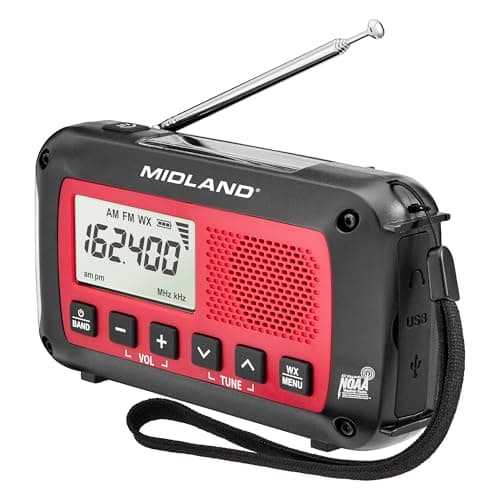 Midland ER40 Emergency Crank Weather Radio Charges by USB, crank or solar on a replaceable 2600 mAh pack, alerts with siren and flashing light while switched off, and has capacity left for a phone. | Best emergency radio overallNo licenseBudget | 9.7/10Researched | $59.99Amazon #ad · Disclosure |
| 2 | 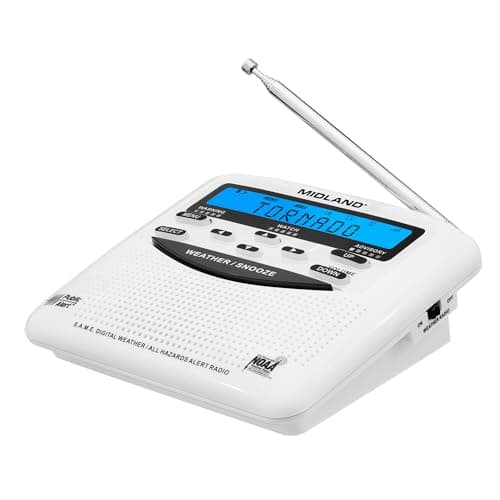 Midland WR120B NOAA Weather Alert Radio S.A.M.E. for up to 25 counties and AA backup, so the siren is only ever your warning. The cheapest radio here that filters by county. | Best for the houseNo licenseBudget | 9.0/10Researched | $45.99Amazon #ad · Disclosure |
| 3 | 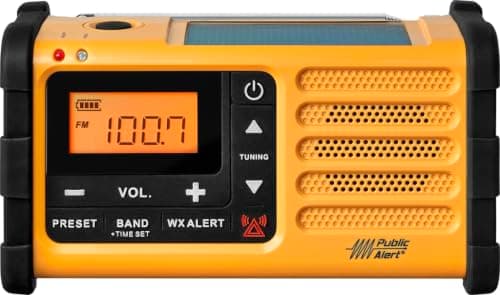 Sangean MMR-88 Multi-Powered Emergency Radio All seven NOAA frequencies, 14 hours stated playtime, armored corners, a headphone jack, and the only published crank-to-listening ratio in the category. | Best built portableNo licenseMid-price | 9.3/10Researched | $77.09Amazon #ad · Disclosure |
| 4 | 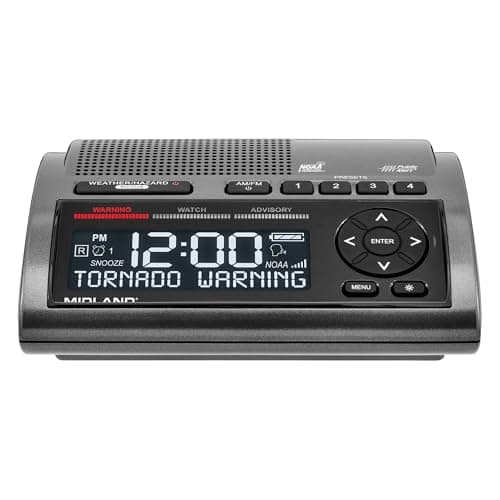 Midland WR400 Deluxe NOAA Weather Radio 25-county S.A.M.E. plus AM/FM presets, a USB port, a clock, and an alert jack that drives a strobe light or a bed shaker. | Best accessible alertingNo licenseMid-price | 9.1/10Researched | $99.32Amazon #ad · Disclosure |
| 5 | 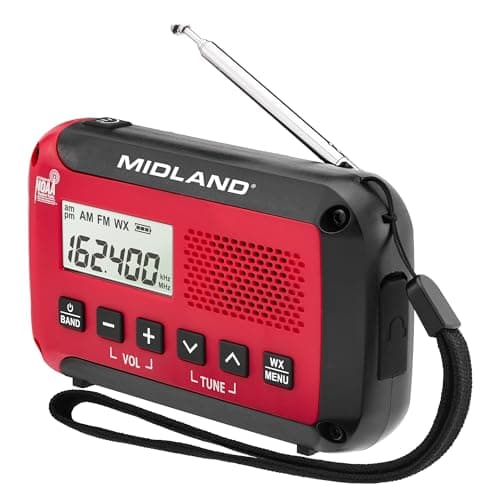 Midland ER10VP Compact Emergency Alert Radio Three AA cells and nothing to keep charged. The radio most likely to work the first time you reach for it after three years. | Best for long storageNo licenseBudget | 9.0/10Researched | $29.99Amazon #ad · Disclosure |
#ad · Prices come live from Amazon, last checked November 6, 2026. Scores are ours, built from published specs, manuals and FCC rules. Photos come from each product's Amazon listing; a radio we can't show a real photo of is left blank rather than illustrated. Tap a row for the full write-up.

"Emergency radio" covers two products that are bought for different reasons and judged on different things. One sits on a nightstand plugged into the wall and exists to make a noise before the weather arrives. The other lives in a bag and exists to still be working on day three. Most buying advice blurs them, which is how people end up with a crank radio that alarms for a flood warning fifty miles away, or a desktop alerter that is useless the moment they leave the house.
This page ranks both, on the figures each maker publishes, every one linked to the document it came from. The method is on how we rank.
The two jobs, and why the answer is usually two radios
- Alerting. A radio that wakes up for a National Weather Service warning. The feature that matters is S.A.M.E. — Specific Area Message Encoding — which lets the radio alarm for your county and ignore everyone else's. Without it, a single transmitter's warnings for several counties all come through your bedroom at 3 a.m., and you will unplug it.
- Surviving. A radio that works when the grid does not: crank, solar, replaceable cells, a light, and ideally enough battery to put something back into a phone.
The two are rarely the same radio, because S.A.M.E. lives on desktop units and crank-and-solar lives on portables. At these prices the honest answer for most households is one of each — and both together still cost less than a single premium handheld two-way radio.
How we ranked them
- Alerting and NOAA coverage (30%). S.A.M.E. or not, how many counties, all seven NWR frequencies or a subset, and whether it alerts with the unit switched off.
- Power options and runtime (25%). Every charging path the maker lists and every runtime figure it publishes.
- Usefulness in an outage (20%). AM/FM for local news, a light, a USB output, and whether it fits in a bag.
- Build and weather (15%), then value within the tier (10%).
The picks in detail
1. Midland ER40 — the one to own if you only own one
A replaceable 2600 mAh lithium pack charged three ways — micro-USB, hand crank and solar — and the best-designed alerting here: siren, flashing flashlight and an automatic switch to the live weather channel, triggered even when the radio is off (ER40 product page). The light cycles low, high and an SOS Morse beacon.
Good to know: Midland's manual states it takes no alkaline or standard batteries at all, so the pack is the only power source; it will not receive alerts while charging another device; the port is micro-USB; and there is no S.A.M.E., so it alerts for the whole transmitter footprint.
2. Midland WR120B — the cheapest radio that filters by county
Digital S.A.M.E. for up to 25 programmable counties, selectable voice, tone or display-only alerting, and 120 V AC with 3 x AA backup (WR120 product page). Midland's support pages put the backup at about two days standby, or about twelve hours of constant full-volume broadcast.
Good to know: Midland's own figures conflict — 60 alerts on the product page against over 80 in the user guide, and a 90 dB siren on the page against 85 dB in support. It has no AM/FM, no light and no way to charge anything.
3. Sangean MMR-88 — the one built like a radio
An 18350 lithium cell, 3.7 V / 850 mAh, with a stated 14 hours of playtime, all seven NOAA frequencies, 19 AM/FM presets, a 40 mm speaker, a 3.5 mm headphone jack, shock-resistant rubber on all four corners, and a four-pattern LED including SOS (MMR-88 product page). Sangean is also the only maker in the category that publishes a crank ratio: about one minute of cranking for roughly five minutes of listening.
Good to know: Sangean's own guide states it has no S.A.M.E.; 850 mAh leaves very little spare for a phone; there is no published IP rating; and the charging port is micro-USB on older units and USB-C on newer ones.
4. Midland WR400 — the accessible bedside unit
The WR120's 25-county S.A.M.E. with 80 programmable alerts, plus AM/FM with 6 presets, an alarm clock with snooze, a USB charging port, 4 x AA backup, an external antenna jack and — the reason it is here — an alert jack for a strobe light or a bed shaker (WR400 product page). For a deaf or hard-of-hearing household that is the whole product.
Good to know: Midland's blogs give the siren as both 85 dB and 25 dB; four AA cells are needed for backup and are not included.
5. Midland ER10VP — the one that survives the closet
Three AA alkaline cells, all seven NOAA channels with audible and visual alerting, AM/FM, a headphone jack and a high/low LED with SOS strobe, in a 5 x 3 x 1.2 in body (ER10VP product page). Midland states reception up to 50 miles from the transmitter, depending on conditions.
Good to know: no crank, no solar, no USB output and no S.A.M.E. What it buys is the one thing rechargeable radios cannot promise — that it still works after three years in a drawer.
The published specs side by side
What none of them can do
Every radio on this page is receive-only. There is no transmitter in any of them. They will tell you a warning has been issued. They will not tell your family you are safe, reach a neighbor, or call for help.
That is worth saying plainly because preparedness marketing rarely does. The kit that actually works pairs a weather radio with two-way radios: license-free FRS, which anyone may use with no application and no fee (FCC: Family Radio Service), or licensed GMRS, where one license covers the holder and their immediate family (47 CFR 95.1705).
Four mistakes that make an emergency radio useless
- Never programming the S.A.M.E. code. A S.A.M.E. radio ships unprogrammed and alerts on everything until you enter your county. Ten minutes, once, or you have bought the expensive version of a radio with no S.A.M.E. at all.
- Letting the lithium pack self-discharge. Top up rechargeable radios twice a year on the same schedule as smoke-alarm batteries.
- Buying one radio for both jobs. The crank radios here have no county filtering and the S.A.M.E. units have no crank. Pick deliberately, or buy both.
- Assuming it can call out. It cannot. See above, and buy a two-way radio as well — walkie-talkies for emergencies covers that side.
The deeper explanation of the bands, the S.A.M.E. codes and the power trade-offs is in the emergency radio buying guide.
In detail
The picks, in full
Rank 01
Best emergency radio overall
Midland ER40 Emergency Crank Weather Radio
Charges by USB, crank or solar on a replaceable 2600 mAh pack, alerts with siren and flashing light while switched off, and has capacity left for a phone.
Published specsResearched · every figure sourced
How it scores on each criterion
- Alerting & NOAA coverage (30%)
- 9.7
- Power options & runtime (25%)
- 9.8
- Usefulness in an outage (20%)
- 9.8
- Build & weather (15%)
- 8.9
- Value (10%)
- 9.3
Why we recommend it
- Charges three ways and the pack is replaceable rather than sealed in
- Alerts with siren and flashing light even when the radio is switched off
- SOS beacon and a real flashlight, so it earns its place in a bag
- 2600 mAh is enough to put a usable charge back in a phone
Good to know
Skip it if you want county-specific alerting: the ER40 alerts on the whole transmitter footprint, so for a bedside radio that only wakes for your county, the S.A.M.E. desktop units are the right buy.
#ad · Price as of November 6, 2026 · How we make money for the link to Midland ER40 Emergency Crank Weather Radio
Rank 02
Best for the house
Midland WR120B NOAA Weather Alert Radio
S.A.M.E. for up to 25 counties and AA backup, so the siren is only ever your warning. The cheapest radio here that filters by county.
Published specsResearched · every figure sourced
How it scores on each criterion
- Alerting & NOAA coverage (30%)
- 9.8
- Power options & runtime (25%)
- 8.4
- Usefulness in an outage (20%)
- 8.4
- Build & weather (15%)
- 8.4
- Value (10%)
- 9.7
Why we recommend it
- S.A.M.E. for up to 25 counties, so it stays quiet for warnings that are not yours
- AA battery backup keeps it alerting when the grid is down
- Voice, tone or display-only alerting, so it can sit in a bedroom
- The cheapest way into real county-level alerting
Good to know
This is a bedside alerting box, not a go-bag radio: it has no AM/FM, no light and no way to charge a phone, so pair it with a crank radio if you want one unit that does everything.
#ad · Price as of November 6, 2026 · How we make money for the link to Midland WR120B NOAA Weather Alert Radio
Rank 03
Best built portable
Sangean MMR-88 Multi-Powered Emergency Radio
All seven NOAA frequencies, 14 hours stated playtime, armored corners, a headphone jack, and the only published crank-to-listening ratio in the category.
Published specsResearched · every figure sourced
How it scores on each criterion
- Alerting & NOAA coverage (30%)
- 9.3
- Power options & runtime (25%)
- 9.7
- Usefulness in an outage (20%)
- 9.3
- Build & weather (15%)
- 8.9
- Value (10%)
- 8.9
Why we recommend it
- Receives all seven NOAA frequencies, not a subset
- Publishes an honest crank-to-listening ratio and a 14-hour playtime figure
- Rubber-armored corners and a headphone jack for quiet listening
- Four-pattern LED including a real SOS
Good to know
Skip it if the radio's job is to charge your phone: at 850 mAh the battery is sized for listening, not for power-banking, and the Midland ER40 carries three times the capacity.
#ad · Price as of November 6, 2026 · How we make money for the link to Sangean MMR-88 Multi-Powered Emergency Radio
Rank 04
Best accessible alerting
Midland WR400 Deluxe NOAA Weather Radio
25-county S.A.M.E. plus AM/FM presets, a USB port, a clock, and an alert jack that drives a strobe light or a bed shaker.
Published specsResearched · every figure sourced
How it scores on each criterion
- Alerting & NOAA coverage (30%)
- 9.8
- Power options & runtime (25%)
- 8.4
- Usefulness in an outage (20%)
- 8.9
- Build & weather (15%)
- 8.4
- Value (10%)
- 8.9
Why we recommend it
- Same 25-county S.A.M.E. alerting as the WR120, with 80 programmable alerts
- AM/FM with presets means local news when the TV and internet are out
- Alert jack drives a strobe or bed shaker — the accessible option in this category
- USB port tops up a phone from the wall without hunting for a brick
Good to know
Skip the extra over the WR120 if you only want the alert and already have a radio for news: the AM/FM, clock and USB port are what you are paying for, not better alerting.
#ad · Price as of November 6, 2026 · How we make money for the link to Midland WR400 Deluxe NOAA Weather Radio
Rank 05
Best for long storage
Midland ER10VP Compact Emergency Alert Radio
Three AA cells and nothing to keep charged. The radio most likely to work the first time you reach for it after three years.
Published specsResearched · every figure sourced
How it scores on each criterion
- Alerting & NOAA coverage (30%)
- 9.3
- Power options & runtime (25%)
- 8.9
- Usefulness in an outage (20%)
- 8.9
- Build & weather (15%)
- 8.4
- Value (10%)
- 9.7
Why we recommend it
- Runs on AA cells, so it works with the batteries already in the drawer
- All seven NOAA channels and a real alert function at the lowest price here
- Flashlight with an SOS strobe in a 5-inch body
- Nothing to keep charged — it stores for years and still works
Good to know
Skip it if you want one radio to do everything in an outage: it has no crank and no USB output, so it keeps you informed but will not put a charge back in a phone.
#ad · Price as of November 6, 2026 · How we make money for the link to Midland ER10VP Compact Emergency Alert Radio
What to look for in an emergency radio
- S.A.M.E. by name if it is for the house, with a county count.
- Alerting with the unit switched off. Otherwise it only works if someone remembered.
- More than one way to power it, and a battery you can replace.
- A published capacity in mAh if you expect it to charge a phone.
- All seven NOAA channels, not a vague "weather band".
- AM/FM, because local news is how you learn what is actually happening.
- A two-way radio alongside it. The weather radio is half a plan.
How we scored this
Every pick here is backed by the paperwork
Every pick is labeled Researched: we read each maker's published specs, manuals and range tables, check the license rules against the FCC, and score every radio on a public rubric out of 10. Every figure links to where it came from, and every range number is labeled “advertised” so you can see the difference between the box and the terrain.
Scores are our editorial judgment on that documented evidence. Commissions never set a score or decide a pick. The rubric and its weights are published.
What changed
- Published.
Questions
Frequently asked
What is the best emergency radio?
Do emergency radios need a license?
Can an emergency radio charge my phone?
What is S.A.M.E. and do I need it?
Is the Public Alert logo enough to go by?
How many NOAA weather frequencies are there?
Receipts
Sources
- NWS: NOAA Weather Radio FAQ, the seven NWR frequencies (checked 2026-11-05)
- NWS: NWR All Hazards logo and the CTA-2009-C Public Alert standard (checked 2026-11-05)
- Midland: ER40 Emergency Crank Weather Radio page (checked 2026-11-05)
- Midland: WR120 NOAA Weather and Emergency Alert Radio page (checked 2026-11-05)
- Midland: WR400 Deluxe NOAA Weather Radio page (checked 2026-11-05)
- Midland: ER10VP compact emergency alert radio page (checked 2026-11-05)
- Sangean: MMR-88 multi-powered radio page (checked 2026-11-05)
- FCC: Family Radio Service (FRS) page (checked 2026-11-05)
- 47 CFR 95.1705, GMRS licensee and immediate family (via Cornell LII, checked 2026-11-05)
Specs and range figures come from each maker's own pages and manuals, linked on every product, and license, power and channel rules come from the FCC and 47 CFR Part 95. Range numbers are the maker's advertised claims and are labeled that way, so you can tell the box number from the terrain number. Prices come live from Amazon with the time we checked. Read the full method.