Quick picks
The picks at a glance
| # | Product | Best for | Score | Price |
|---|---|---|---|---|
| 1 | 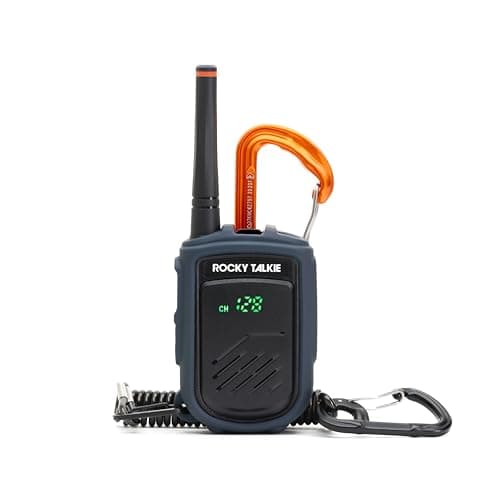 Rocky Talkie Mountain Radio (single radio) A replaceable 1550 mAh Li-ion charged over USB-C, with Rocky Talkie's own figure of 3 to 5 days per charge rather than a number of hours. | Best rechargeable overallNo licenseMid-price | 6.7/10Researched | $120.00Amazon #ad · Disclosure |
| 2 | 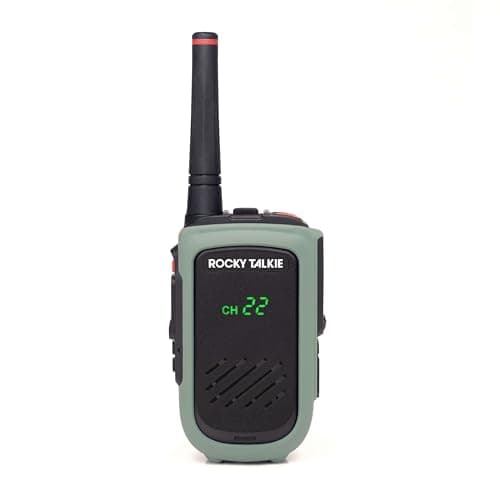 Rocky Talkie Expedition Radio (single radio) The longest published runtime here at 4 to 6 days, on a replaceable 1800 mAh pack, in an IP67 GMRS radio with a removable antenna. | Best for multi-day tripsGMRS licensePremium | 7.9/10Researched | $195.00Amazon #ad · Disclosure |
| 3 | 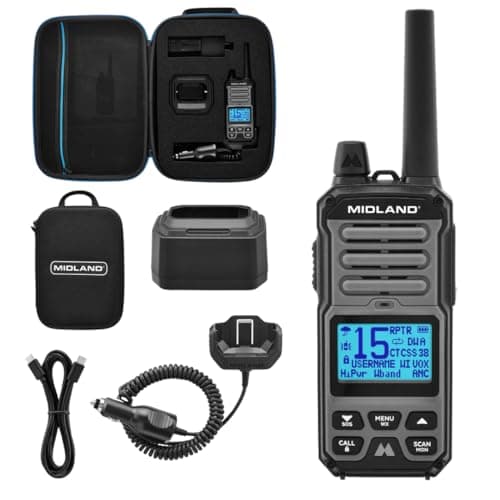 Midland GXT67 PRO (single radio) 2500 mAh charged by USB-C PD or 12 V, inside the only IP67 body in Midland's GXT line. The battery is sealed in, and Midland's own runtime figures disagree. | Best rechargeable GMRS for wet workGMRS licensePremium | 7.1/10Researched | $219.99Amazon #ad · Disclosure |
| 4 | 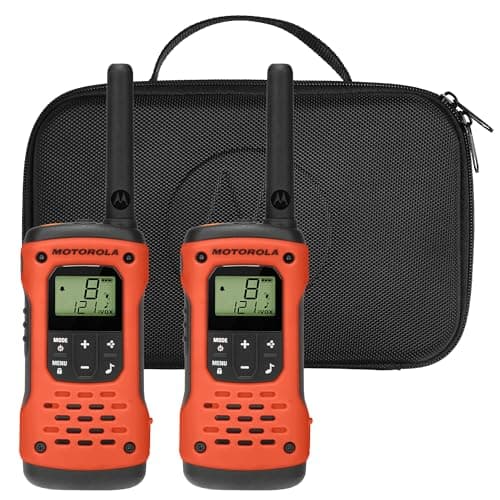 Motorola Talkabout T605 H2O (2-pack) USB-C charging for the NiMH packs, and three AA cells as the fallback: up to 9 hours on the pack, up to 23 hours on alkalines. | Best rechargeable with a battery plan BNo licenseMid-price | 6.8/10Researched | $94.45Amazon #ad · Disclosure |
| 5 | 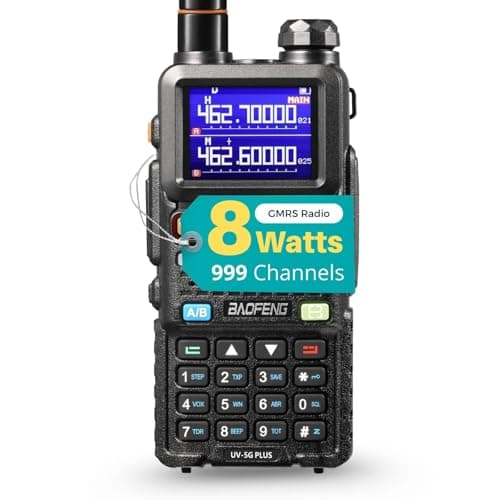 Baofeng UV-5G Plus GMRS (single radio) A 2500 mAh pack and a USB-C cable at the bottom of the GMRS price range, with a removable SMA-female antenna as a real upgrade path. | Best cheap USB-C rechargeableGMRS licenseBudget | 6.6/10Researched | $31.34Amazon #ad · Disclosure |
| 6 | 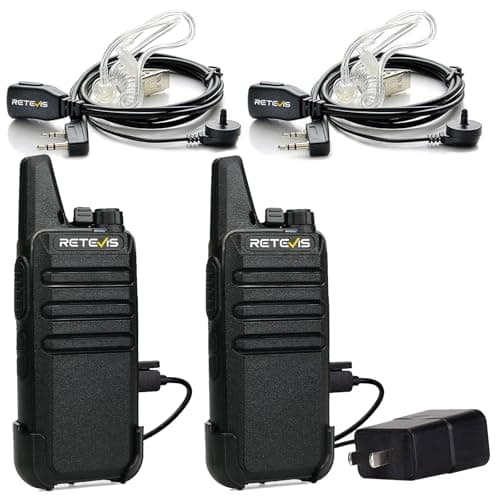 Retevis RT22 (2-pack) A screenless 1000 mAh USB-C radio that Retevis rates at 12 to 24 hours of standby and an honest 0.5 to 2 miles. | Best tiny USB-C pairNo licenseBudget | 5.5/10Researched | $39.99Amazon #ad · Disclosure |
| 7 | 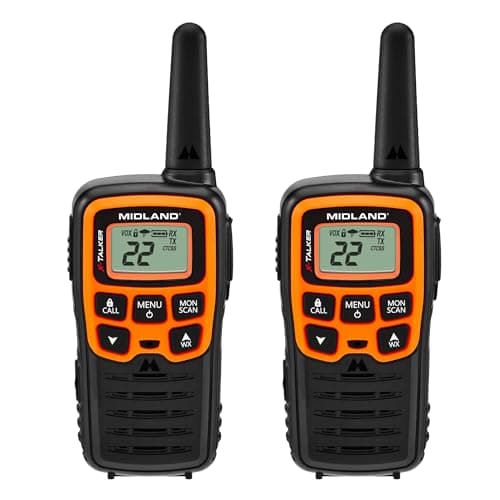 Midland X-Talker T51VP3 (2-pack) Rechargeable packs, a desktop charger and an AAA fallback at Midland's lowest rechargeable tier, with NOAA Weather Scan included. | Best budget pair with a drop-in dockNo licenseBudget | 5.6/10Researched | $54.99Amazon #ad · Disclosure |
#ad · Prices come live from Amazon, last checked October 5, 2026. Scores are ours, built from published specs, manuals and FCC rules. Photos come from each product's Amazon listing; a radio we can't show a real photo of is left blank rather than illustrated. Tap a row for the full write-up.

Walk down the radio aisle and almost nothing is sold on batteries any more. Rechargeable is printed on every box, and it means at least four different things: a sealed pack you can never replace, a swappable Li-ion you can carry a spare of, NiMH cells in a plastic shell that also takes alkalines, or a plain AAA radio with a charger thrown in. Those are not the same purchase, and the difference only shows up on day three of a trip.
This page ranks radios on the part of rechargeable the box does not advertise: whether the battery comes out, what cable fills it, and whether the maker is willing to publish a runtime at all. Every pick was confirmed orderable on the maker's own store on 2026-10-05.
What rechargeable hides
Three questions separate a radio you will still be using in five years from one that becomes landfill when the cells tire.
Can you replace the battery? Li-ion packs lose capacity with every cycle; that is chemistry, not a defect. Midland is unusually frank about it and recommends "replacing your rechargeable battery packs every 9-12 months" on its X-Talker line (Midland T71VP3 page). A radio with a removable pack takes a spare in a pocket and a new pack in year three. A radio with a sealed battery does not: Midland's own FAQ for the GXT67 PRO says the battery compartment is factory sealed and not customer-replaceable (Midland GXT67 FAQs).
What cable fills it? USB-C means the radio charges from the cable, power bank, car socket and wall brick you already own. A proprietary desktop cradle means one more thing to pack, and a dead radio if you forget it. Micro-USB sits in between: a standard plug, but one most people have stopped carrying.
Does the maker publish a runtime? Some do, in hours, with the duty cycle stated. Some publish days. Some publish nothing at all, and some publish two figures that disagree with each other. A maker willing to put a number in writing has usually thought about the battery.
How we picked
Every radio is scored on our published rubric — real-world reach, ease of use, toughness and weather, power and battery, field features and value — from the makers' own product pages, spec sheets and manuals. The method is on how we rank radios. These are research picks from published specs, not test results, and every figure on this page links to its source.
For this page the ranking weight went to the battery itself, in this order:
- A removable, buyable pack beats a sealed one, because it is the difference between a spare and a replacement.
- USB-C beats Micro-USB, which beats a cradle-only radio.
- A published runtime beats silence, and a stated duty cycle (Midland's 90-5-5) beats a bare "up to".
- A battery fallback — AA or AAA cells — is worth a lot in a kit radio and almost nothing in a weekend radio.
Two radios that would otherwise have placed were dropped for stock. Cobra's RX680 and ACXT645 both publish real rechargeable specs, and both showed "Not enough in stock" with a notify-me button on cobra.com on 2026-10-05, so neither is on the list.
The picks in detail
1. Rocky Talkie Mountain Radio: best rechargeable overall
This is the radio that treats the battery as the product. Rocky Talkie lists a replaceable 1550 mAh Li-ion, USB-C charging with the cable in the box, and a figure of "3-5 Days" per charge — a unit of time that makes sense for a radio you clip on at the trailhead and forget about (Rocky Talkie Mountain Radio page). Around it: 2 W FRS, IP56, a shatterproof screen, a climbing-rated carabiner and a channel lock that stops a group drifting off channel in a pocket.
It is also one of the very few makers that publishes terrain-by-terrain reach instead of a single box number — 1 to 5 miles in mountains, 0.5 to 3 in forest and hills, up to a mile in a city. That honesty is why it places on several lists here, including best long-range walkie-talkies.
Buy it if you want a rechargeable radio you can still re-battery in three years, and days of standby rather than a shift. Skip it if you need a pair cheaply: it is sold one radio at a time, so a pair costs twice the listed tier, and there is no NOAA receiver or VOX.
2. Rocky Talkie Expedition Radio: best for multi-day trips
The longest published runtime on this page. Rocky Talkie rates the Expedition at "4-6 days" on a replaceable 7.4 V 1800 mAh Li-ion over USB-C, inside an IP67 body rated for one meter of submersion, with 5 W GMRS, 8 repeater channels, a removable SMA-male antenna (a 7.5 cm and a 17 cm are both in the box) and NOAA weather monitoring (Rocky Talkie Expedition Radio page).
The reason it sits second rather than first is the license: GMRS needs an individual FCC license covering your immediate family (FCC GMRS page). That is a form and a fee, not an exam — see how to get a GMRS license — but it is a step the FRS picks here do not ask for.
Buy it if the trip is measured in nights and the radio has to last it. Skip it if nobody in the group wants to hold the license, or the budget will not stretch to two single radios.
3. Midland GXT67 PRO: best rechargeable GMRS for wet work
The IP67 radio in Midland's GXT line, and the best charging story here: a 7.4 V 2500 mAh internal Li-ion that fills from a USB-C PD desktop charger or a 12 V vehicle adapter, rated at 5 W with 8 repeater channels and split tones (Midland GXT67 PRO page). Midland also does something rare and publishes a plain-English reach figure: "At 5 Watts, this radio can easily reach up to 5 miles, depending on the terrain."
Two honest marks against it, both from Midland's own documents. The battery is factory sealed and not customer-replaceable, and so is the antenna — "The design of this radio does not allow it to be removed" ( GXT67 FAQs). And the runtime is published two ways: 16 hours on the spec sheet and the FAQ, "up to 4 days" on the product page. Those are not close, and on a page about batteries that matters.
Buy it if the radio works outdoors in weather and charges in a truck. Skip it if you want to carry a spare battery or fit a longer whip: both are sealed off.
4. Motorola Talkabout T605 H2O: best rechargeable with a battery plan B
The pick for a kit that has to work when nobody charged anything. Motorola lists USB-C charging for the included NiMH packs, and three AA alkalines as a drop-in alternative, with the datasheet giving up to 9 hours on the pack and up to 23 hours on AAs (T605 datasheet). The body is IP67, it floats face up on the NiMH pack, and the flashlight switches itself on in water (Motorola TALKABOUT T600 series page).
That AA number is the single most useful figure on this page for a storm kit or a boat, and it is why the T605 also places on our best waterproof walkie-talkies shortlist. Motorola notes the radio may not float with some AA batteries, which is worth knowing before you swap.
Buy it if the radios live in a grab bag and might sit for months. Skip it if you want a replaceable Li-ion with a multi-day rating: NiMH packs self-discharge faster, and 9 hours is 9 hours.
5. Baofeng UV-5G Plus: best cheap USB-C rechargeable
The cheapest way onto USB-C. Baofeng's current certified GMRS handheld (FCC ID 2AJGM-5GPLUS) ships a 2500 mAh Li-ion with a Type-C cable, a removable SMA-female antenna with a longer 15.5 in option, a 1.9 in display with dual watch, and 10 NOAA receive channels (Baofeng UV-5G Plus page). On capacity per dollar nothing else here is close.
Two caveats. Baofeng publishes no water rating at all for it, and no runtime figure — a 2500 mAh pack tells you the tank size, not the mileage. Treat it as a radio for people who want the hardware and will accept the paperwork: it is GMRS, so the license applies (FCC GMRS page).
Buy it if you are kitting out a group and want USB-C and a replaceable pack for very little. Skip it if it will be rained on, or if a menu-driven radio is the wrong tool for the people holding it.
6. Retevis RT22: best tiny USB-C pair
A pre-paired, screenless 2 W FRS pair with a 1000 mAh Li-ion and a Type-C port, which Retevis rates at "12 to 24 hours of standby time" and — refreshingly — at "0.5 to 2 miles" of range rather than a two-digit fantasy (Retevis RT22 page). At 113 g with the battery in, it is the lightest radio here.
The limits are real: 16 channels rather than the usual 22, so it cannot meet every other brand's radio on every FRS channel, no weather receiver, and only "life-water-resistant" protection against droplets and rain. None of that matters for a shop floor, a market stall or two people parking a trailer.
Buy it if you want the simplest possible rechargeable pair and the distances are short. Skip it if you need NOAA alerts or all 22 FRS channels.
7. Midland X-Talker T51VP3: best budget pair with a drop-in dock
The cheapest honest rechargeable pair on this page. Midland ships the AVP14 pack in each radio with a desktop charger and a Micro-USB cable, and 3 AAA alkalines work as the fallback; you also get 22 channels, 38 privacy codes and NOAA Weather Scan with alerts (Midland T51VP3 page).
It is on the list for the charging pattern as much as the price: drop both radios into the cradle at night and nobody has to think about it, which is exactly right for radios shared by a family or lent to visitors. What you give up is a water rating — the T50 manual tells you not to immerse it — and any published runtime figure.
Buy it if you want two rechargeable radios, a dock and weather alerts for the least money. Skip it if the radios will be out in rain, or you want to know the hours before you buy.
In detail
The picks, in full
Rank 01
Best rechargeable overall
Rocky Talkie Mountain Radio (single radio)
A replaceable 1550 mAh Li-ion charged over USB-C, with Rocky Talkie's own figure of 3 to 5 days per charge rather than a number of hours.
Published specsResearched · every figure sourced
How the 6.7 score breaks down
- Real-world reach (30%)
- 5
- Ease of use (20%)
- 9
- Toughness & weather (15%)
- 8
- Power & battery (15%)
- 8
- Field features (10%)
- 4
- Value (10%)
- 6
What the specs support
- Publishes honest terrain figures (1 to 5 miles in mountains), not just a box number
- IP56, shatterproof screen and a real climbing carabiner with a leash
- Replaceable Li-ion rated for 3 to 5 days, with USB-C
- Channel lock keeps a group from drifting off channel
Where it falls short
- Sold as a single radio, so a pair costs twice the listed tier
- No NOAA weather channel or VOX
- Fixed antenna and FRS power limit its reach like any FRS radio
Skip this if…
…Skip it if you need to reach a partner several ridges away or hit a repeater: at 2 W FRS with a fixed antenna, the GMRS Expedition Radio is the Rocky Talkie for that.
#ad · Price as of October 5, 2026 · How we make money for the link to Rocky Talkie Mountain Radio (single radio)
Rank 02
Best for multi-day trips
Rocky Talkie Expedition Radio (single radio)
The longest published runtime here at 4 to 6 days, on a replaceable 1800 mAh pack, in an IP67 GMRS radio with a removable antenna.
Published specsResearched · every figure sourced
| Service / license | GMRS (FRS compatible); GMRS license required, US use only |
|---|---|
| Transmit power | 5 W |
| Channels | 22 channels, 121 privacy codes (CTCSS and DCS); channel lock, high/low power, scan, dual channel watch |
| Repeater and antenna | Repeater capable (8 GMRS repeater channels); removable SMA-male antenna, 7.5 cm and 17 cm antennas included |
| Water rating | IP67 (1 meter submersion) |
| Battery | Replaceable 7.4 V 1800 mAh Li-ion, USB-C; "4–6 days" per chargeAdvertised |
| Weather and weight | NOAA weather channels and emergency alert monitoring; 9.1 oz |
| Advertised range | "max range of over 35 miles, with 2–8 miles more typical in backcountry terrain"Advertised |
| Maker's terrain figures | Line-of-sight 35+ miles; mountains 2 to 8 miles; forest/hills 0.5 to 5 miles; rivers 0.5 to 3 miles; city up to 1.5 milesAdvertised |
How the 7.9 score breaks down
- Real-world reach (30%)
- 8
- Ease of use (20%)
- 8
- Toughness & weather (15%)
- 9
- Power & battery (15%)
- 8
- Field features (10%)
- 7
- Value (10%)
- 6
What the specs support
- Removable SMA antenna with short and long options, plus 8 repeater channels
- IP67 with a replaceable Li-ion battery and USB-C, rated for 4-6 days
- The maker publishes terrain-by-terrain range, not just a box number
- Channel lock and a simple 22-channel layout
Where it falls short
- Sold as a single radio, so a pair lands firmly in the premium tier
- No VOX hands-free or flashlight listed by the maker
Skip this if…
…Skip it if you don't want a GMRS license: it's a GMRS radio, and Rocky Talkie's license-free Mountain Radio (FRS, 2 W) covers most trail use.
#ad · Price as of October 5, 2026 · How we make money for the link to Rocky Talkie Expedition Radio (single radio)
Rank 03
Best rechargeable GMRS for wet work
Midland GXT67 PRO (single radio)
2500 mAh charged by USB-C PD or 12 V, inside the only IP67 body in Midland's GXT line. The battery is sealed in, and Midland's own runtime figures disagree.
Published specsResearched · every figure sourced
How the 7.1 score breaks down
- Real-world reach (30%)
- 7
- Ease of use (20%)
- 7
- Toughness & weather (15%)
- 9
- Power & battery (15%)
- 7
- Field features (10%)
- 7
- Value (10%)
- 5
What the specs support
- IP67 waterproof and dustproof, where the GXT1000 and GXT3000 are splash-rated JIS4
- Rated at 5 W with 8 repeater channels and split tones
- USB-C (PD) and 12 V vehicle charging in the box
Where it falls short
- Sold as a single radio, so a pair means buying two
- Fixed antenna and a factory-sealed battery you can't swap in the field
- Midland's battery-life figures conflict (16 hours vs up to 4 days)
Skip this if…
…Skip it if you want to carry a spare battery or fit a longer antenna for the far side of the property: the battery is sealed and the antenna doesn't come off.
#ad · Price as of October 5, 2026 · How we make money for the link to Midland GXT67 PRO (single radio)
Rank 04
Best rechargeable with a battery plan B
Motorola Talkabout T605 H2O (2-pack)
USB-C charging for the NiMH packs, and three AA cells as the fallback: up to 9 hours on the pack, up to 23 hours on alkalines.
Published specsResearched · every figure sourced
How the 6.8 score breaks down
- Real-world reach (30%)
- 4
- Ease of use (20%)
- 8
- Toughness & weather (15%)
- 9
- Power & battery (15%)
- 7
- Field features (10%)
- 8
- Value (10%)
- 8
What the specs support
- IP67 and it floats face up, with a flashlight that switches on when it hits the water
- Runs on the NiMH pack or three AA batteries, so a dead pack isn't the end of the day
- The T605 pack adds a case, spare batteries and earpieces
Where it falls short
- Motorola doesn't publish the transmit power; reach is ordinary FRS
- It may not float with some AA batteries, per Motorola
- Headset use is for dry conditions only
Skip this if…
…Skip it if you need to talk between boats or trucks miles apart: IP67 keeps it alive in the lake, but a fixed-antenna FRS radio won't cover that distance.
#ad · Price as of October 5, 2026 · How we make money for the link to Motorola Talkabout T605 H2O (2-pack)
Rank 05
Best cheap USB-C rechargeable
Baofeng UV-5G Plus GMRS (single radio)
A 2500 mAh pack and a USB-C cable at the bottom of the GMRS price range, with a removable SMA-female antenna as a real upgrade path.
Published specsResearched · every figure sourced
How the 6.6 score breaks down
- Real-world reach (30%)
- 7
- Ease of use (20%)
- 6
- Toughness & weather (15%)
- 3
- Power & battery (15%)
- 8
- Field features (10%)
- 7
- Value (10%)
- 9
What the specs support
- USB-C charging, so it fills from the same cable as your phone
- 2500 mAh, the biggest pack Baofeng puts in a GMRS handheld at this tier
- Removable SMA-female antenna, so a longer whip is a legitimate upgrade
Where it falls short
- No water or dust rating published
- Sold one radio at a time, so a pair costs twice the tier
- A 7-mile claim is still a claim: expect under a mile in timber
Skip this if…
…Skip it if the radio will be out in weather: Baofeng publishes no IP rating for it, so a wet ride or a rainy hunt calls for a rated radio.
#ad · Price as of October 5, 2026 · How we make money for the link to Baofeng UV-5G Plus GMRS (single radio)
Rank 06
Best tiny USB-C pair
Retevis RT22 (2-pack)
A screenless 1000 mAh USB-C radio that Retevis rates at 12 to 24 hours of standby and an honest 0.5 to 2 miles.
Published specsResearched · every figure sourced
How the 5.5 score breaks down
- Real-world reach (30%)
- 4.5
- Ease of use (20%)
- 8
- Toughness & weather (15%)
- 3
- Power & battery (15%)
- 6
- Field features (10%)
- 4
- Value (10%)
- 8
What the specs support
- States 2 W and a realistic 0.5 to 2 mile range
- USB-C Li-ion and very light
- Pre-paired out of the box; no screen to confuse anyone
Where it falls short
- Only 16 channels, so it can't reach every FRS channel another family's radio might use
- No weather channel, and only light water resistance
Skip this if…
…Skip it if you need NOAA alerts or will match channels with other brands' 22-channel radios: it has 16 channels and no weather receiver.
#ad · Price as of October 5, 2026 · How we make money for the link to Retevis RT22 (2-pack)
Rank 07
Best budget pair with a drop-in dock
Midland X-Talker T51VP3 (2-pack)
Rechargeable packs, a desktop charger and an AAA fallback at Midland's lowest rechargeable tier, with NOAA Weather Scan included.
Published specsResearched · every figure sourced
How the 5.6 score breaks down
- Real-world reach (30%)
- 4
- Ease of use (20%)
- 8
- Toughness & weather (15%)
- 3
- Power & battery (15%)
- 6
- Field features (10%)
- 6
- Value (10%)
- 8
What the specs support
- NOAA Weather Scan and weather alerts for storms on camping trips
- Rechargeable packs plus a desktop charger, with AAA backup
- License-free and simple enough for the whole family
Where it falls short
- No water rating, and the manual warns against immersion
- No runtime figure published
Skip this if…
…Skip it if it will ride in a kayak or a wet pack: Midland gives it no water rating, so choose an IP67 radio instead.
#ad · Price as of October 5, 2026 · How we make money for the link to Midland X-Talker T51VP3 (2-pack)
Li-ion, NiMH and AA: what actually changes
Li-ion packs hold the most energy for their weight, hold charge well while sitting, and are what every multi-day rating on this page runs on. Rocky Talkie's 3-to-5-day and 4-to-6-day figures are both Li-ion numbers (Mountain Radio, Expedition). The catch is that they are a consumable: when a Li-ion radio is sealed, the radio has the life of the pack.
NiMH packs are the older family-radio standard, and the reason so many Midland and Motorola radios also take alkalines — the pack sits in the same AA or AAA bay. They self-discharge faster, so a radio left in a drawer for three months will not be full. Their one advantage is the one that matters in an emergency: the bay takes store-bought cells.
AA and AAA alkalines are not a charging technology at all, which is their point. The Motorola T605's up-to-23-hours on three AAs is the longest figure on this page (T605 datasheet), and you can buy more at a gas station. For a storm kit, pick the radio with the bay. Our best walkie-talkies for emergencies page is built around exactly that argument.
USB-C, docks and proprietary cradles
The charging port is the most under-rated spec on a walkie-talkie box, because it decides how many extra objects a trip requires.
- USB-C, cable only. The two Rocky Talkies, the Baofeng and the Retevis all charge from any USB-C source — a power bank in a pack, a truck socket, a laptop. Nothing else to carry.
- USB-C into a dock. The Midland GXT67 PRO uses a USB-C PD desktop charger or a 12 V vehicle adapter (GXT67 PRO page). Better than a wall-wart cradle, still one more item in the bag.
- Micro-USB and a cradle. The budget Midland pairs. Fine at home, awkward on the road, and the cable is one most people no longer carry.
Why published runtimes are so far apart
You will see 5 hours on one page and 4 days on another for radios of similar size. Both can be honest, because they are measuring different things.
Duty cycle is everything. Midland states its figures at "90-5-5" — 90% standby, 5% talking, 5% listening — and on that basis says the T71VP3 gets "around 5 hours at 90-5-5 when being used on Hi power" (T71VP3 page). Transmitting is what drains a radio; a radio clipped to a pack and barely used sips power.
Days-not-hours figures assume light use. Rocky Talkie's 3-to-5-day and 4-to-6-day claims describe a trip, not continuous conversation. They are still the most useful shape of number for a buyer, because they match how people actually use a radio in the field.
Some makers publish two numbers that disagree. The GXT67 PRO is the clearest case here: 16 hours on the spec sheet and in the FAQ, up to 4 days on the product page. We list both rather than pick the flattering one.
And cold eats batteries. Any lithium pack gives less in winter than on the bench. That is one reason the two radios built for mountain use here also carry the longest ratings — the margin is deliberate. See best walkie-talkies for skiing for the cold-weather version of this question.
What to look for
- A battery you can buy again. A removable pack, sold separately, is the single best signal that a radio is meant to last. A sealed pack is a clock.
- USB-C. One cable for the radio, the phone and the headlamp.
- A published runtime with a duty cycle. "Around 5 hours at 90-5-5" tells you more than "up to 4 days".
- An alkaline bay, if the radio is for emergencies rather than weekends.
- Capacity in context. 2500 mAh on a 5 W GMRS radio is not the same day as 2500 mAh on a 2 W FRS radio. Power draw, not capacity, sets the hours.
- Ignore the mileage on the box. It has nothing to do with the battery, and it is a best-case number anyway — range claims explained shows how those figures are produced.
Does a rechargeable radio need a license?
The battery has nothing to do with it; the radio service does. Four picks here are FRS, licensed by rule with no application and no fee (FCC FRS page), capped at 2 W on the main channels (47 CFR 95.531). The three GMRS picks — Expedition, GXT67 PRO, UV-5G Plus — need an individual FCC GMRS license that covers your immediate family (FCC GMRS page). If that is a dealbreaker, start at best walkie-talkies without a license; if it is not, GMRS vs FRS explains what the license buys you.
How we scored this
Every pick here is backed by the paperwork
Every pick is labeled Researched: we read each maker's published specs, manuals and range tables, check the license rules against the FCC, and score every radio on a public rubric out of 10. Every figure links to where it came from, and every range number is labeled “advertised” so you can see the difference between the box and the terrain.
Scores are our editorial judgment on that documented evidence. Commissions never set a score or decide a pick. The rubric and its weights are published.
What changed
- Published.
Questions
Frequently asked
What is the best rechargeable walkie-talkie?
Are rechargeable walkie-talkies better than AA ones?
How long do rechargeable walkie-talkie batteries last per charge?
Can you replace the battery in a rechargeable walkie-talkie?
Do rechargeable walkie-talkies charge with USB-C?
Do rechargeable walkie-talkies need an FCC license?
Receipts
Sources
- Rocky Talkie: Mountain Radio product page, battery, IP rating and terrain range (checked 2026-10-05)
- Rocky Talkie: Expedition Radio product page, 4-6 day battery, IP67 and antennas (checked 2026-10-05)
- Midland: GXT67 PRO product page, 5 W, IP67 and USB-C charging (checked 2026-10-05)
- Midland Support: GXT67 FAQs, sealed battery and fixed antenna (checked 2026-10-05)
- Motorola Solutions: TALKABOUT T600 H2O series product page (checked 2026-09-29)
- Motorola Solutions: T605 H2O datasheet PDF, NiMH and AA runtimes (checked 2026-09-29)
- Baofeng: UV-5G Plus 5W GMRS radio product page, 2500 mAh and USB-C (checked 2026-10-05)
- Retevis: RT22 product page, 1000 mAh Type-C, standby time and 0.5-2 mile range (checked 2026-10-05)
- Midland: T51VP3 X-Talker product page, AVP14 pack, desktop charger and AAA fallback (checked 2026-10-05)
- Midland: T71VP3 X-Talker product page, 90-5-5 runtime and 9-12 month pack replacement (checked 2026-10-05)
- FCC: Family Radio Service (FRS) page (checked 2026-10-05)
- FCC: General Mobile Radio Service (GMRS) page (checked 2026-10-05)
- 47 CFR 95.531, FRS channel power limits (via Cornell LII, checked 2026-10-05)
Specs and range figures come from each maker's own pages and manuals, linked on every product, and license, power and channel rules come from the FCC and 47 CFR Part 95. Range numbers are the maker's advertised claims and are labeled that way, so you can tell the box number from the terrain number. Prices come live from Amazon with the time we checked. Read the full method.