Not legal advice. This page summarizes FCC rules (47 CFR Part 95) from the official sources linked in the text. Rules and fees checked . The FCC sets its fees annually and can change its rules, so confirm the current version on fcc.gov before you rely on it.
Top pick
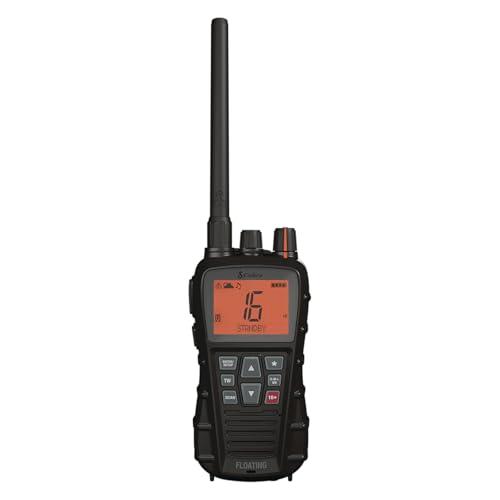
Best handheld marine radio overall
Cobra BlueBound 350 (handheld marine VHF)
Selectable 1, 3 and 6 W, IPX7, a floating core and a stated 12 hours, with a USB-C dock that charges a spare pack alongside the radio. Tri-Watch keeps channels 16 and 9 open. No DSC, so distress is a voice call.
#ad · Price as of November 19, 2026 · How we make money for the link to Cobra BlueBound 350 (handheld marine VHF)
Quick picks
The picks at a glance
| # | Product | Best for | Score | Price |
|---|---|---|---|---|
| 1 | Cobra BlueBound 350 (handheld marine VHF) Selectable 1, 3 and 6 W, IPX7, a floating core and a stated 12 hours, with a USB-C dock that charges a spare pack alongside the radio. Tri-Watch keeps channels 16 and 9 open. No DSC, so distress is a voice call. | Best handheld marine radio overallNo licenseMid-price | 9.6/10Researched | $139.95Amazon #ad · Disclosure |
| 2 | 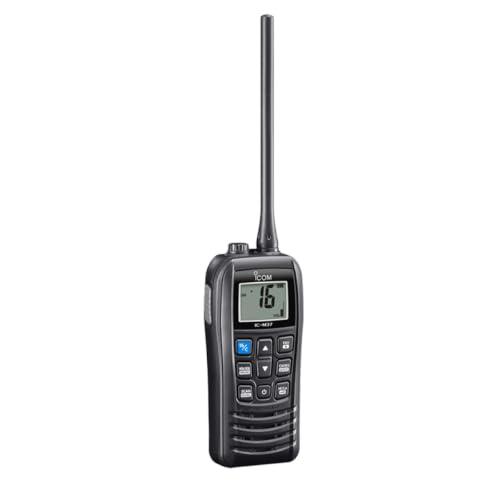 Icom IC-M37 (handheld marine VHF) 6 W, IP57, Float'n Flash, more than 12 hours and a user-replaceable BP-296 pack in the box, from the maker that introduced floating handhelds in 2006. AquaQuake shakes a water-logged speaker clear. No DSC and no GPS. | Best built, and the one with a replaceable batteryNo licensePremium | 9.6/10Researched | $178.00Amazon #ad · Disclosure |
| 3 | 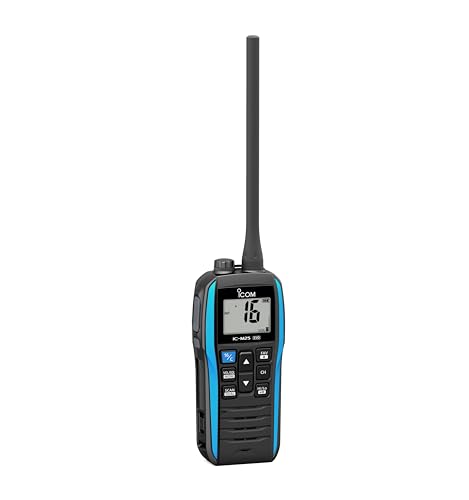 Icom IC-M25 EVO (handheld marine VHF) Eight ounces, 1.2 inches deep, IPX7, Float'n Flash with an audible alarm, and about 14 hours in Eco Mode because it drops to 2.5 W. Charges over USB-C in roughly three hours. It gives up a watt to the 6 W radios here. | Best one you will actually carryNo licenseMid-price | 9.5/10Researched | $154.80Amazon #ad · Disclosure |
| 4 | 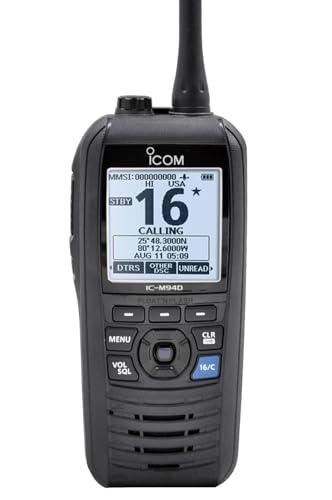 Icom IC-M94D (DSC + AIS handheld marine VHF) The only handheld here that can send a digital distress call: Class-H DSC with its own GPS, an AIS receiver showing nearby traffic, and an MOB alert that works while the radio floats and flashes. None of it does anything until an MMSI is registered. | Best for offshore and for boating aloneNo licenseHigh-end | 9.4/10Researched | $326.00Amazon #ad · Disclosure |
| 5 | 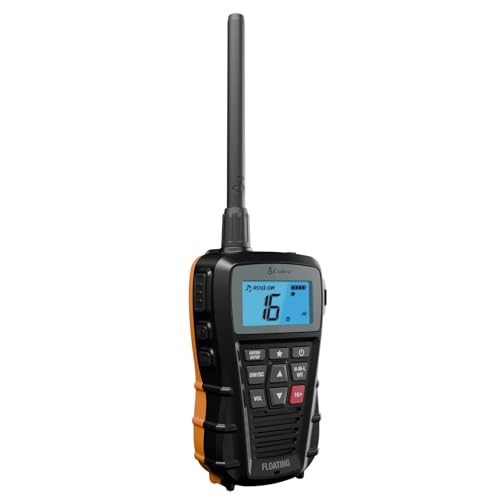 Cobra BlueBound 150 (handheld marine VHF) IPX7, the same floating core as the 350 and 12 weather channels, running on rechargeable AAA cells with USB-C charging. Switchable 0.5, 1 and 3 W, which is a short-range radio by design. | Budget pick: cheapest floating VHFNo licenseBudget | 9.1/10Researched | $99.95Amazon #ad · Disclosure |
#ad · Prices come live from Amazon, last checked November 19, 2026. Scores are ours, built from published specs, manuals and FCC rules. Photos come from each product's Amazon listing; a radio we can't show a real photo of is left blank rather than illustrated. Tap a row for the full write-up.

Every other radio on this site talks to people you brought with you. A marine VHF is different: channel 16 is monitored by the Coast Guard and by every other vessel in range, which means a $100 handheld is the cheapest piece of equipment on a boat that can bring help to you. That is the whole argument for owning one, and it is why a handheld VHF belongs in the ditch bag of a boat that already has a fixed-mount radio at the helm.
Five radios are ranked below, all of them current, all of them floating, and every figure quoted from the maker's own page.
Why a VHF, not a walkie-talkie
FRS and GMRS radios are excellent for keeping a group together and useless in an emergency at sea: nobody monitors those channels, and no rescue service listens on them. The marine VHF band is the opposite — a shared, monitored, legally structured service where a call for help reaches strangers who are obliged to respond. We lay the two side by side in marine radio vs walkie-talkie, and the short version is that a boat wants both: license-free radios for the crew chatter, a VHF for everything that matters.
How we picked
Four criteria, applied only to radios whose maker publishes the specification:
- Stated transmit power. Marine handhelds run 1 to 6 W, and the difference is real on open water where nothing blocks the path.
- Water rating, and whether it floats. Both, not one. An IPX7 radio that sinks is a lost radio, and a floating radio that leaks is a dead one.
- Battery hours and how the pack is fed. Replaceable packs, AAA cells and USB-C charging all beat a proprietary cradle on a long weekend.
- Whether it can do more than talk. DSC, GPS and AIS turn a radio into a safety device; the page is explicit about which radios have them and which do not.
The published specs side by side
Read the Transmit power row and the Water rating row together. Those two decide most of this purchase, and the gap between 3 W and 6 W is wider on water than it is anywhere on land.
DSC: the feature that changes the answer
Digital Selective Calling is the one specification on this page worth paying double for, and four of these five radios do not have it. A DSC radio sends a digital distress alert that carries who you are and where you are — your registered MMSI number and, on a radio with its own GPS, your position — at the press of a button, repeated automatically, to every DSC-equipped vessel and shore station in range. A voice mayday on channel 16 depends on somebody hearing you, understanding you, and writing down a position you may not know.
That is why the Icom IC-M94D sits on this page despite being the most expensive radio here and scoring below the Cobra on the rubric: it has a GPS receiver, a rear-panel distress button, and an MOB function that sends a man-overboard alert while the radio is in the water flashing (Icom: IC-M94D). It also receives AIS, so nearby vessel traffic shows on its display.
6 watts, 3 watts and what each reaches
Marine VHF is line-of-sight radio, which on open water means the limit is usually the horizon rather than the power. From a small boat, with the antenna a few feet above the surface, the horizon is roughly five to eight miles to another small boat and considerably further to a ship with a mast-top antenna or a shore station on a hill.
Inside that geometry, watts still matter. Going from 3 W to 6 W is double the power, which is worth roughly 1.4 times the distance in free space — the same arithmetic we work through for land radios in what watts actually buy. The practical rule: a 3 W radio is fine for a lake, a harbor, a dinghy following the mothership. If the radio is your link to a rescue service rather than to the boat next to you, buy 6 W.
Floating, IPX ratings and the overboard test
Marine handhelds are the one category where makers take water seriously, and the ratings here are genuinely comparable:
- IPX7 on the Cobra BlueBound 350 and 150 and the Icom M25 EVO and M94D means one meter of water for 30 minutes (Cobra, Icom).
- IP57 on the Icom IC-M37 adds a dust rating to the same submersion figure (Icom: IC-M37).
- Floating is a separate property, and all five float. Cobra builds an orange floating core into the BlueBound radios; Icom's Float'n Flash adds a flashing LED, and on the M25 EVO an audible alarm, so the radio tells you where it is.
One more water feature worth knowing by name: AquaQuake on the Icom radios vibrates the speaker cone to clear water out of the grille. A waterlogged speaker is the most common way a wet radio becomes useless while still working perfectly.
The licence rule for US boaters
The contrast with the rest of this site is worth stating plainly: FRS needs no licence and no paperwork, GMRS needs one individual licence for your family, and marine VHF needs no licence for most US recreational boaters but confines you to maritime use. Three services, three different rules — GMRS vs FRS covers the first two.
What is not ranked here, and why
Two names a boater sees everywhere are missing: Standard Horizon (the HX210 and HX40) and Uniden (the MHS126, Atlantis 275 and MHS338BT). Both are widely sold and both have current listings. They are not ranked because this site quotes specifications from the maker's own page, and on the day this page was built neither maker's product pages would load — standardhorizon.com returned a server error on every product URL and uniden.com returned an empty page. Ranking them would have meant copying numbers from resellers, which is exactly the shortcut that puts wrong specs on the internet.
If you are cross-shopping those radios, the rows in the table above are the ones to compare them against: stated watts, the IPX rating, whether it floats, the battery figure with its duty cycle, and DSC with GPS or without.
And if what you actually need is a radio for the crew rather than for the Coast Guard, start with best walkie-talkies for boating — a license-free pair keeps the anchor-watch chatter off the channel that matters, and Cobra's land radios are ranked separately in best Cobra walkie-talkies.
In detail
The picks, in full
Rank 01
Best handheld marine radio overall
Cobra BlueBound 350 (handheld marine VHF)
Selectable 1, 3 and 6 W, IPX7, a floating core and a stated 12 hours, with a USB-C dock that charges a spare pack alongside the radio. Tri-Watch keeps channels 16 and 9 open. No DSC, so distress is a voice call.
Published specsResearched · every figure sourced
How it scores on each criterion
- Real-world reach (30%)
- 9.7
- Ease of use (20%)
- 9.7
- Toughness & weather (15%)
- 9.7
- Power & battery (15%)
- 9.3
- Field features (10%)
- 9.3
- Value (10%)
- 9.7
Why we recommend it
- Selectable 1, 3 and 6 W, with the wattage stated rather than hidden behind high/low
- IPX7 with a floating core, which is the pairing that matters on a boat
- USB-C dock with a second battery slot, so the spare is always charged
- Tri-Watch keeps channel 16 and channel 9 open while you use a working channel
Good to know
Skip it if you go offshore or boat alone: a DSC radio with a registered MMSI sends your identity and position at the push of a button, and this one cannot.
#ad · Price as of November 19, 2026 · How we make money for the link to Cobra BlueBound 350 (handheld marine VHF)
Rank 02
Best built, and the one with a replaceable battery
Icom IC-M37 (handheld marine VHF)
6 W, IP57, Float'n Flash, more than 12 hours and a user-replaceable BP-296 pack in the box, from the maker that introduced floating handhelds in 2006. AquaQuake shakes a water-logged speaker clear. No DSC and no GPS.
Published specsResearched · every figure sourced
How it scores on each criterion
- Real-world reach (30%)
- 9.7
- Ease of use (20%)
- 9.7
- Toughness & weather (15%)
- 9.7
- Power & battery (15%)
- 9.7
- Field features (10%)
- 8.9
- Value (10%)
- 9.3
Why we recommend it
- A user-replaceable battery pack, which is what decides whether a radio lasts five seasons
- 6 W with IP57 and Float'n Flash, so it survives the two ways a handheld dies
- AquaQuake shakes a water-logged speaker clear instead of leaving it muffled
- Icom's marine accessory and service network is the deepest in the category
Good to know
Skip it if you want digital distress calling or AIS traffic on the display: that is the M94D in the same line, at roughly twice the money.
#ad · Price as of November 19, 2026 · How we make money for the link to Icom IC-M37 (handheld marine VHF)
Rank 03
Best one you will actually carry
Icom IC-M25 EVO (handheld marine VHF)
Eight ounces, 1.2 inches deep, IPX7, Float'n Flash with an audible alarm, and about 14 hours in Eco Mode because it drops to 2.5 W. Charges over USB-C in roughly three hours. It gives up a watt to the 6 W radios here.
Published specsResearched · every figure sourced
How it scores on each criterion
- Real-world reach (30%)
- 9.3
- Ease of use (20%)
- 9.8
- Toughness & weather (15%)
- 9.7
- Power & battery (15%)
- 9.7
- Field features (10%)
- 8.9
- Value (10%)
- 8.9
Why we recommend it
- Eight ounces and 1.2 inches deep, so it rides in a PFD pocket instead of staying below
- USB-C charging, which removes the one proprietary cable most marine handhelds still need
- Float'n Flash adds an audible alarm as well as the light
- About 14 hours in Eco Mode, the longest figure of the five
Good to know
Skip it if you want the longest reach a handheld can manage: the 6 W radios on this page transmit at more power, and on the water that is a real difference.
#ad · Price as of November 19, 2026 · How we make money for the link to Icom IC-M25 EVO (handheld marine VHF)
Rank 04
Best for offshore and for boating alone
Icom IC-M94D (DSC + AIS handheld marine VHF)
The only handheld here that can send a digital distress call: Class-H DSC with its own GPS, an AIS receiver showing nearby traffic, and an MOB alert that works while the radio floats and flashes. None of it does anything until an MMSI is registered.
Published specsResearched · every figure sourced
How it scores on each criterion
- Real-world reach (30%)
- 9.7
- Ease of use (20%)
- 8.9
- Toughness & weather (15%)
- 9.7
- Power & battery (15%)
- 9.3
- Field features (10%)
- 9.8
- Value (10%)
- 8.4
Why we recommend it
- DSC distress calling with a position from its own GPS, which voice alone cannot match
- An AIS receiver in a handheld: nearby vessel traffic on the screen, not just on the chartplotter
- 1500 mW of audio, which is the difference between hearing a call and missing it at speed
- Floats, flashes and can send an MOB alert after it goes over the side
Good to know
Skip it if you day-sail a lake or a harbor within sight of other boats: the DSC and AIS features are the reason for the price, and a simpler 6 W floating radio covers that kind of boating.
#ad · Price as of November 19, 2026 · How we make money for the link to Icom IC-M94D (DSC + AIS handheld marine VHF)
Rank 05
Budget pick: cheapest floating VHF
Cobra BlueBound 150 (handheld marine VHF)
IPX7, the same floating core as the 350 and 12 weather channels, running on rechargeable AAA cells with USB-C charging. Switchable 0.5, 1 and 3 W, which is a short-range radio by design.
Published specsResearched · every figure sourced
How it scores on each criterion
- Real-world reach (30%)
- 8.4
- Ease of use (20%)
- 9.7
- Toughness & weather (15%)
- 9.7
- Power & battery (15%)
- 8.9
- Field features (10%)
- 8.4
- Value (10%)
- 9.8
Why we recommend it
- IPX7 and a floating core at the bottom of the price range
- Runs on AAA cells, so a pack of alkalines from a marina store is a working backup
- USB-C charging with no dock to lose
- Twelve weather channels, the same as the 350
Good to know
Skip it if you boat anywhere you might need to reach a vessel miles away: 3 W is a short-range radio, and the step to 6 W is the one upgrade that buys distance.
#ad · Price as of November 19, 2026 · How we make money for the link to Cobra BlueBound 150 (handheld marine VHF)
Before you buy a handheld VHF
- Decide whether you need DSC. Offshore, singlehanded or with children aboard: yes, and register the MMSI before the first trip. Harbor and lake use: a 6 W voice radio is a reasonable call.
- Buy 6 W unless weight is the point. The radios here run 3 W to 6 W, and the extra power is cheap at this price level.
- Check that it floats as well as seals. Both properties, every time.
- Think about how it charges on your boat. USB-C is the format every other device aboard already uses; a proprietary cradle is one more thing to lose.
- Keep it in the ditch bag, not the glovebox. A handheld VHF earns its price in the ten minutes after something goes wrong, and only if it is where you can reach it.
The bottom line
Our recommendation
Best handheld marine radio overall
Cobra BlueBound 350
Selectable 1, 3 and 6 W, IPX7, a floating core and a stated 12 hours, with a USB-C dock that charges a spare pack alongside the radio. Tri-Watch keeps channels 16 and 9 open. No DSC, so distress is a voice call.
#ad · Price as of November 19, 2026 · How we make money for the link to Cobra BlueBound 350 (handheld marine VHF)
Runner-up · Best built, and the one with a replaceable battery
Icom IC-M37
6 W, IP57, Float'n Flash, more than 12 hours and a user-replaceable BP-296 pack in the box, from the maker that introduced floating handhelds in 2006. AquaQuake shakes a water-logged speaker clear. No DSC and no GPS.
#ad · Price as of November 19, 2026 · How we make money for the link to Icom IC-M37 (handheld marine VHF)
Brands: want your product tested? For Brands.
How we scored this
Every pick here is backed by the paperwork
Every pick is labeled Researched: we read each maker's published specs, manuals and range tables, check the license rules against the FCC, and score every radio on a public rubric out of 10. Every figure links to where it came from, and every range number is labeled “advertised” so you can see the difference between the box and the terrain.
Scores are our editorial judgment on that documented evidence. Commissions never set a score or decide a pick. The rubric and its weights are published.
What changed
- Published.
Questions
Frequently asked
What is the best handheld marine radio?
Do you need a licence for a handheld marine VHF radio in the US?
What does DSC do on a marine radio?
How far does a handheld marine radio reach?
Can I use a marine VHF radio on land?
Is a handheld VHF enough, or do I need a fixed-mount radio too?
Receipts
Sources
- Cobra: BlueBound 350 product page, 1/3/6 W, IPX7, floating core, 12-hour battery (read 2026-11-16)
- Cobra: BlueBound 150 product page, 0.5/1/3 W, IPX7, AAA cells and USB-C (read 2026-11-16)
- Icom America: IC-M37 product page, 6 W, IP57, Float'n Flash and the BP-296 pack (read 2026-11-16)
- Icom America: IC-M94D product page, Class-H DSC, AIS receiver, GPS and MOB (read 2026-11-16)
- Icom America: IC-M25 EVO product page, 5 W, Eco Mode, IPX7, weight and USB-C (read 2026-11-16)
- 47 CFR 80.13, ship stations licensed by rule (via Cornell LII, checked 2026-11-16)
- 47 CFR 80.369, distress, urgency, safety, call and reply frequencies (via Cornell LII, checked 2026-11-16)
- FCC: ship radio stations, voluntary and compulsory ships (checked 2026-11-16)
- FCC: maritime mobile service, which vessels must be licensed (checked 2026-11-16)
- US Coast Guard Navigation Center: MMSI registration for recreational vessels (checked 2026-11-16)
Specs and range figures come from each maker's own pages and manuals, linked on every product, and license, power and channel rules come from the FCC and 47 CFR Part 95. Range numbers are the maker's advertised claims and are labeled that way, so you can tell the box number from the terrain number. Prices come live from Amazon with the time we checked. Read the full method.