Almost every disappointed scanner buyer made the same mistake: they chose a scanner, then found out what their county runs. Done in that order, a perfectly good radio turns out to be deaf to the only agencies the buyer cared about — and no setting, antenna or firmware fixes it.
This guide runs the decision in the order that works, with the technical terms explained once each.
Check your county first, before anything else
Free online scanner-frequency databases list, for every county in the United States, the agencies, the system type, the frequencies and — crucially — whether traffic is encrypted. Five minutes there tells you which of three scanners you need, and occasionally tells you not to buy one at all.
Write down three answers before you shop:
- Conventional or trunked?
- If digital: P25 Phase I or Phase II?
- Encrypted or in the clear?
Conventional vs trunked
A conventional system assigns each agency or talkgroup its own fixed frequency. Fire is here, police dispatch is there. You program the frequencies and listen. Any scanner can do this.
A trunked system pools a handful of frequencies and assigns them dynamically, with a control channel directing radios to whichever one is free. A conversation hops between frequencies mid-exchange. A scanner that cannot follow the control channel hears fragments or nothing.
Following trunking is a specific capability. Uniden markets it as TrunkTracker; its BCD325P2 lists Motorola, EDACS and LTR trunked systems alongside P25 (BCD325P2). The entry-level BC125AT does not do trunking at all.
P25 Phase I vs Phase II, and the trap in the word "digital"
APCO Project 25 (P25) is the digital standard most US public-safety systems use.
- Phase I uses FDMA — one conversation per channel. Any digital scanner that lists P25 handles it.
- Phase II uses TDMA, fitting two conversations into the same channel space by splitting it in time. It is what a large share of metropolitan systems migrated to, and a Phase I scanner cannot follow it.
Simulcast, and why good scanners still garble
Large systems often broadcast the same signal from several towers at once — simulcast. Where the coverage overlaps, a receiver gets multiple copies slightly out of step, and the distortion can defeat a scanner that otherwise supports the system perfectly. The symptom is familiar: it decodes fine in one part of town and turns to mush in another.
This is the specific problem Uniden's True I/Q receiver in the SDS100 is built for; Uniden states it improves digital performance in challenging RF environments (SDS100). It is the one reason to spend flagship money, and it is worth nothing at all if you do not have the problem. Ask local scanner listeners whether your system is a simulcast problem area before paying for it.
Encryption ends the conversation
If an agency encrypts, no lawfully sold scanner decodes it. Whistler says so in its own FAQ: when a system is encrypted, the scanner will not decode those channels (Whistler FAQ). Every other maker is in the same position.
Encryption is increasingly common, and in some cities it is total. If the database shows your police department fully encrypted, a scanner can still be worth owning for fire, EMS, public works, rail, aviation and weather — but be clear with yourself about what you are buying it for.
How scanners actually get programmed
There are three routes, and they differ more than the spec sheets suggest:
- Location or database setup. Higher-end Uniden models carry a built-in database and can be set up by location, which is as close to plug-and-play as the category gets.
- Maker software and a cable. The common middle ground. The BC125AT includes its USB cable in the box (BC125AT); some models sell the cable separately, and on the BCD325P2 certain features need the BC-UTGC cable.
- Third-party PC software. Whistler's own FAQ says trunking systems are best programmed using third-party software — a real additional cost and learning curve that belongs in the price comparison.
One more thing to check: whether the maker still issues firmware. Systems get rebanded and reconfigured, and a scanner that is still updated keeps up. Uniden shipped BCD325P2 firmware as recently as late 2024.
The legal basics, and the limits of what we will tell you
Owning a scanner and listening to unencrypted public-safety traffic is lawful across the United States. Two federal statutes shape what you may do next:
- 47 U.S.C. 605 restricts divulging or using intercepted radio communications in various circumstances (text).
- 18 U.S.C. 2511, the Wiretap Act, governs interception of wire, oral and electronic communications more broadly (text).
State and local rules differ, and that is where the real variation is — particularly rules about carrying or using a scanner in a vehicle, and enhanced penalties for using one in the commission of an offense. There is no authoritative national table of those rules that we can cite, so we are not going to publish a state-by-state list we cannot source. Look up your own state's statute, or ask a local amateur radio club, before putting a scanner in a car.
What to buy
Our picks for this job
Three scanners, three different counties
Match the scanner to the answer you wrote down at the top of this page.
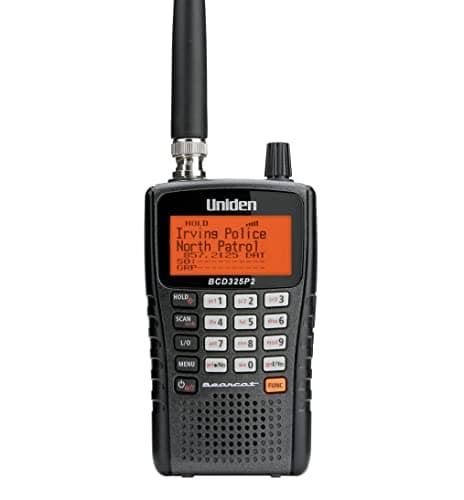
Best handheld for P25 Phase II systems
Uniden BCD325P2 TrunkTracker V Handheld Scanner
The default if your county is digital: P25 Phase I and Phase II plus Motorola, EDACS and LTR trunking, still receiving firmware updates.
$399.00Amazon#ad · Price as of November 6, 2026 · How we make money for the link to Uniden BCD325P2 TrunkTracker V Handheld Scanner
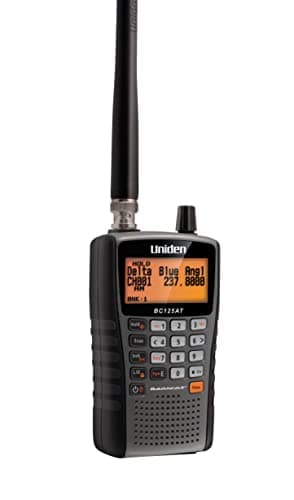
Best first scanner for analog areas
Uniden Bearcat BC125AT Handheld Scanner
The right buy if your county is conventional analog — and only then. 500 alpha-tagged channels, air band and a USB cable in the box.
$139.99Amazon#ad · Price as of November 6, 2026 · How we make money for the link to Uniden Bearcat BC125AT Handheld Scanner
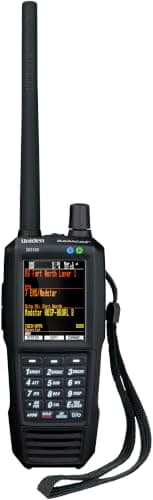
Best scanner for difficult simulcast areas
Uniden SDS100 True I/Q Digital Handheld Scanner
Buy this only for a simulcast problem. True I/Q is aimed at exactly that distortion; on a clean system it hears what the BCD325P2 hears.
$699.99Amazon#ad · Price as of November 6, 2026 · How we make money for the link to Uniden SDS100 True I/Q Digital Handheld Scanner
The ranked comparison, with the full published specs side by side, is in best police scanners.
How we scored this
Every pick here is backed by the paperwork
Every pick is labeled Researched: we read each maker's published specs, manuals and range tables, check the license rules against the FCC, and score every radio on a public rubric out of 10. Every figure links to where it came from, and every range number is labeled “advertised” so you can see the difference between the box and the terrain.
Scores are our editorial judgment on that documented evidence. Commissions never set a score or decide a pick. The rubric and its weights are published.
What changed
- Published.
Questions
Frequently asked
How do I know which scanner I need?
What does trunking mean on a scanner?
Is P25 Phase II backwards compatible with Phase I scanners?
Do I need a license to own a police scanner?
Are police scanners legal in my state?
Receipts
Sources
- Uniden: BCD325P2 product page, TrunkTracker V and P25 phases (checked 2026-11-05)
- Uniden: BC125AT product page, analog-only and included cable (checked 2026-11-05)
- Uniden: SDS100 product page, True I/Q (checked 2026-11-05)
- Whistler: scanner FAQ, encryption and third-party programming (checked 2026-11-05)
- 47 U.S.C. 605, unauthorized publication or use of communications (via Cornell LII, checked 2026-11-05)
- 18 U.S.C. 2511, interception of communications (via Cornell LII, checked 2026-11-05)
Specs and range figures come from each maker's own pages and manuals, linked on every product, and license, power and channel rules come from the FCC and 47 CFR Part 95. Range numbers are the maker's advertised claims and are labeled that way, so you can tell the box number from the terrain number. Prices come live from Amazon with the time we checked. Read the full method.