Not legal advice. This page summarizes FCC rules (47 CFR Part 95) from the official sources linked in the text. Rules and fees checked . The FCC sets its fees annually and can change its rules, so confirm the current version on fcc.gov before you rely on it.
Quick picks
The picks at a glance
| # | Product | Best for | Score | Price |
|---|---|---|---|---|
| 1 | 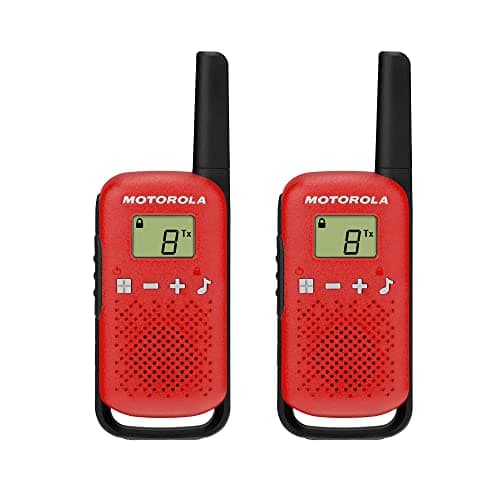 Motorola Talkabout T110 (2-pack) Easy pairing sets every radio to the same channel and code, three AAA cells run up to 19 hours, and there are triple packs plus personalisation stickers so each kid knows which radio is theirs. | Best for a family with young kidsNo licenseBudget | 4.9/10Researched | $27.49Amazon #ad · Disclosure |
| 2 | No photo Midland X-Talker T31VP (2-pack) 3.76 oz per radio, rechargeable packs with a AAA fallback, a headphone jack and a keypad lock, so a child cannot knock it off channel in a queue. | Best small-hands pickNo licenseBudget | 5.4/10Researched | Check price · Amazon #ad · Disclosure |
| 3 | 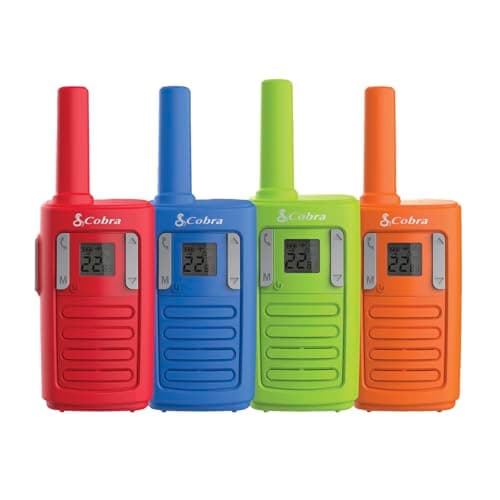 Cobra RX100-4 (4-pack) Four radios in four colors with matching clips, so a split-up group of five or six has a radio each without buying two packs. | Best for a bigger groupNo licenseBudget | 5.2/10Researched | $49.83Amazon #ad · Disclosure |
| 4 | 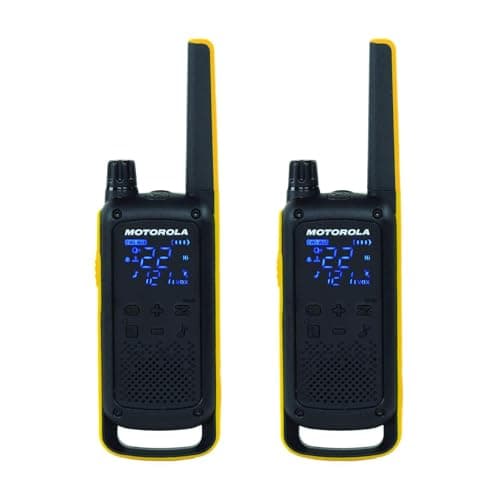 Motorola Talkabout T470 (2-pack) IPX4 against splashing water, up to 28 hours on three AA cells, VibraCall vibrate alert and a 2.5 mm headset jack. The one here that shrugs off a log flume. | Best if it has to survive the water ridesNo licenseMid-price | 6.1/10Researched | $89.99Amazon #ad · Disclosure |
| 5 | 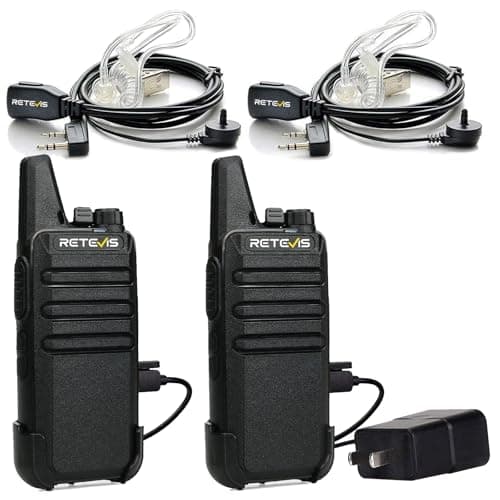 Retevis RT22 (2-pack) Screenless, channel-locked, 113 g, and pre-paired out of the box. Nothing to misconfigure, nothing glowing, and the honest 0.5 to 2 mile figure is exactly park scale. | Best for adults onlyNo licenseBudget | 5.5/10Researched | $29.98Amazon #ad · Disclosure |
#ad · Prices come live from Amazon, last checked November 2, 2026. Scores are ours, built from published specs, manuals and FCC rules. Photos come from each product's Amazon listing; a radio we can't show a real photo of is left blank rather than illustrated. Tap a row for the full write-up.

Everything that makes a radio good in the mountains is irrelevant in a theme park, and most of what matters in a park is not on the box. You need something light enough to carry for twelve hours, simple enough for an eight-year-old to use without a lesson, with a battery that survives a full day and ideally a spare set of cells you can buy anywhere. Reach is almost a non-issue: the furthest apart a split-up family gets in a park is usually under a mile, and the radio will still struggle, because of the buildings rather than the distance.
So the ranking below weights weight, battery and simplicity, and treats the advertised range figures as marketing. Four of the five radios here are the same license-free FRS radios we recommend for families generally; the park-specific question is which of their features earn their keep on a concrete-and-crowds day.
Are walkie talkies allowed at Disney?
Walt Disney World publishes a park rules page listing prohibited items. Read on 11 October 2026, two-way radios are not on that list — but "horns, whistles, large megaphones or artificial noise makers" are (Walt Disney World park rules). Park rules change and individual parks differ, so check the current page for the resort you are visiting before you travel rather than taking this as permission.
The practical reading of that rule, though, is the useful part: whatever the policy says about the radio, a radio squawking at full volume in a queue line is the behavior nobody wants near them. Turn the roger beep off, drop the volume, and use an earpiece or the vibrate alert. Every recommendation below is chosen partly on how quietly it can be run.
What range you actually get in a park
How we picked
Every radio is scored on our published rubric: real-world reach, ease of use, toughness and weather, power and battery, field features and value. The method is on how we rank radios, and every figure comes from the maker's own published specification. These are research picks, not test results.
For a park day we weighted ease of use and battery hardest, gave real credit to replaceable alkaline cells (you can buy AAs in any gift shop; you cannot charge a proprietary pack mid-afternoon), and discounted reach and NOAA weather features almost entirely.
The picks in detail
1. Motorola Talkabout T110: the family default
Twenty-two channels, easy pairing that sets every radio in the group to the same channel and code, an LCD showing channel, code, lock, scan and mute, three AAA alkaline cells per radio rated up to 19 hours, and dual or triple packs with belt clips and personalisation stickers (Motorola Talkabout T110 page). Motorola footnotes its 16-mile claim down to half a mile in a neighborhood, which is honest and about right for a park.
The pairing feature is what makes this the family pick. The classic park failure is one kid's radio drifting onto channel 7 code 3 while everyone else is on 1-0, and easy pairing plus the keypad lock closes that off. The stickers sound trivial and are not: three identical radios in three backpacks is a solvable problem only if they look different.
Buy it if you want the cheapest setup that a child can actually operate. Skip it if it will go on a water ride: there is no water rating here, and the AAA cells are not included.
2. Midland X-Talker T31VP: the small-hands pick
3.76 oz per radio, 22 channels and 38 privacy codes, two 300 mAh rechargeable packs plus a three-AAA fallback with a Micro-USB "Y" charging cable, NOAA weather channels, call alert, eVOX hands-free, a headphone jack and a keypad lock (Midland T31VP page). Midland describes it as its license-free radio for kids and families. Its manual says not to immerse it.
Weight is the quiet winner here. Under four ounces is the difference between a radio that stays clipped to a kid for a whole day and one that ends up in a parent's bag by lunchtime. The headphone jack matters too: it is the cheapest way to make a park radio polite.
Buy it if the radios are mostly for children and you want both rechargeable and disposable power. Skip it if you want a documented water rating: Midland publishes none for it.
3. Cobra RX100-4: the four-pack
Four radios in red, blue, green and orange with color-matched belt clips, 22 FRS channels, 121 privacy codes, channel scan, 10 NOAA weather channels, five-step VOX, call alert and roger beep, running on three AAA alkaline cells per radio (Cobra RX100-4 page).
Families of five or six are exactly the group that ends up buying two 2-packs and a spare, and this solves it in one box. The four colors do the same job as Motorola's stickers: nobody argues about whose radio is whose, and a dropped radio is identifiable at a glance.
Buy it if you need four radios and the group splits more than two ways. Skip it if you want rechargeable packs: these are alkaline-only, and not included.
4. Motorola Talkabout T470: for the water rides
IPX4 against splashing water from any direction, 22 channels and 121 privacy codes, an 800 mAh NiMH pack rated up to 12 hours or three AA alkaline cells rated up to 28 hours, NOAA weather channels and alerts, an LED flashlight, an emergency button, VibraCall vibrate alert, iVOX and VOX hands-free, dual watch and a 2.5 mm headset jack, at 0.30 lb per radio without batteries (Motorola Talkabout T470 page).
Three features earn their place on a park day. The 28-hour AA figure removes battery anxiety completely. The VibraCall alert lets a radio stay silent in a show or a restaurant and still get your attention. And IPX4 means a log flume, a sudden Florida afternoon downpour or a dropped drink is an inconvenience rather than a replacement purchase.
Buy it if you want one radio that handles weather, water rides and a long day without thinking about it. Skip it if you are buying for small children: it is the biggest and busiest radio here.
5. Retevis RT22: for an adults-only group
Two watts, 16 channels with CTCSS and DCS codes, a channel lock, no screen at all, a 1000 mAh Li-ion with USB-C charging, VOX, an emergency alarm, 113 g with the battery, and pairs that arrive already set to the same channel and code. Retevis publishes a flat 0.5 to 2 mile range figure (Retevis RT22 page).
The missing screen is the point. For a group of adults — a work trip, a run-club meetup, grandparents shadowing the grandkids — there is no menu to get lost in, nothing glowing in a dark ride, and nothing anyone can reconfigure. It is also the smallest radio here, and it pairs with the K1 earpieces on our earpieces and headsets page.
Buy it if the group is adults and you want the simplest possible radio. Skip it if you need NOAA weather alerts or have to share channels with 22-channel consumer radios: it has 16 channels and no weather receiver.
The published specs side by side
In detail
The picks, in full
Rank 01
Best for a family with young kids
Motorola Talkabout T110 (2-pack)
Easy pairing sets every radio to the same channel and code, three AAA cells run up to 19 hours, and there are triple packs plus personalisation stickers so each kid knows which radio is theirs.
Published specsResearched · every figure sourced
How the 4.9 score breaks down
- Real-world reach (30%)
- 3
- Ease of use (20%)
- 9
- Toughness & weather (15%)
- 3
- Power & battery (15%)
- 5
- Field features (10%)
- 3
- Value (10%)
- 7
What the specs support
- Few buttons and one-step pairing, so a child can run it
- Runs on easy-to-find AAA batteries; stickers help each kid spot their own radio
- Talks to other FRS radios on the same channel and code
Where it falls short
- Batteries are not included and there is no rechargeable option in the box
- No weather rating, NOAA channel or flashlight listed
- Motorola's own neighborhood figure is only up to half a mile
Skip this if…
…Skip it if the kids will be out of sight across a campground or down the block: Motorola's own neighborhood figure is half a mile, and it has no weather rating for rain.
#ad · Price as of November 2, 2026 · How we make money for the link to Motorola Talkabout T110 (2-pack)
Rank 02
Best small-hands pick
Midland X-Talker T31VP (2-pack)
3.76 oz per radio, rechargeable packs with a AAA fallback, a headphone jack and a keypad lock, so a child cannot knock it off channel in a queue.
Published specsResearched · every figure sourced
How the 5.4 score breaks down
- Real-world reach (30%)
- 3
- Ease of use (20%)
- 9
- Toughness & weather (15%)
- 4
- Power & battery (15%)
- 5
- Field features (10%)
- 6
- Value (10%)
- 7
What the specs support
- Marketed by Midland for kids, with a compact body for small hands
- Rechargeable packs included, with AAA batteries as a backup
- Weather alerts, call alert and hands-free eVOX
Where it falls short
- 300 mAh packs are small; Midland publishes no runtime figure
- The manual says not to immerse it in water
Skip this if…
…Skip it if the radios are for adults hiking separate trails: it's sized for backyard and neighborhood play, and the packs are small.
#ad · Price as of November 2, 2026 · How we make money for the link to Midland X-Talker T31VP (2-pack)
Rank 03
Best for a bigger group
Cobra RX100-4 (4-pack)
Four radios in four colors with matching clips, so a split-up group of five or six has a radio each without buying two packs.
Published specsResearched · every figure sourced
How the 5.2 score breaks down
- Real-world reach (30%)
- 3
- Ease of use (20%)
- 9
- Toughness & weather (15%)
- 3
- Power & battery (15%)
- 4
- Field features (10%)
- 6
- Value (10%)
- 8
What the specs support
- Four radios in four colors, so each kid knows which is theirs
- Real FRS radio with privacy codes, VOX and weather channels
- Cobra markets it as kid-friendly
Where it falls short
- Batteries not included and no rechargeables
- No water rating or flashlight listed
Skip this if…
…Skip it if the radios will live outdoors in the rain or you don't want to buy AAA batteries: Cobra lists no water rating and includes no batteries.
#ad · Price as of November 2, 2026 · How we make money for the link to Cobra RX100-4 (4-pack)
Rank 04
Best if it has to survive the water rides
Motorola Talkabout T470 (2-pack)
IPX4 against splashing water, up to 28 hours on three AA cells, VibraCall vibrate alert and a 2.5 mm headset jack. The one here that shrugs off a log flume.
Published specsResearched · every figure sourced
How the 6.1 score breaks down
- Real-world reach (30%)
- 4
- Ease of use (20%)
- 8
- Toughness & weather (15%)
- 5
- Power & battery (15%)
- 7
- Field features (10%)
- 8
- Value (10%)
- 7
What the specs support
- AA fallback with a stated 28 hours, which suits an emergency kit
- NOAA alerts, flashlight and emergency button included
- Hands-free iVOX/VOX and a standard 2.5 mm headset jack
Where it falls short
- Micro-USB charging, not USB-C
- IPX4 is splash protection only; don't drop it in water
- Motorola doesn't publish the transmit power
Skip this if…
…Skip it if it will get wet often: IPX4 handles rain, not a creek crossing or a canoe, so the IP67 T605 is the Motorola to buy.
#ad · Price as of November 2, 2026 · How we make money for the link to Motorola Talkabout T470 (2-pack)
Rank 05
Best for adults only
Retevis RT22 (2-pack)
Screenless, channel-locked, 113 g, and pre-paired out of the box. Nothing to misconfigure, nothing glowing, and the honest 0.5 to 2 mile figure is exactly park scale.
Published specsResearched · every figure sourced
How the 5.5 score breaks down
- Real-world reach (30%)
- 4.5
- Ease of use (20%)
- 8
- Toughness & weather (15%)
- 3
- Power & battery (15%)
- 6
- Field features (10%)
- 4
- Value (10%)
- 8
What the specs support
- States 2 W and a realistic 0.5 to 2 mile range
- USB-C Li-ion and very light
- Pre-paired out of the box; no screen to confuse anyone
Where it falls short
- Only 16 channels, so it can't reach every FRS channel another family's radio might use
- No weather channel, and only light water resistance
Skip this if…
…Skip it if you need NOAA alerts or will match channels with other brands' 22-channel radios: it has 16 channels and no weather receiver.
#ad · Price as of November 2, 2026 · How we make money for the link to Retevis RT22 (2-pack)
Setting them up for a park day
- Set the channel and code at home, write it on a strip of tape inside each radio's battery door, then lock the keypad. Do this on the sofa, not in a queue.
- Pick a channel and expect company. FRS channels are shared and busy near crowds. Agree a first choice and a backup, so "go to two" is a plan rather than an argument.
- Turn off the roger beep and the keypad tones, drop the volume to the lowest you can hear, and use vibrate alert where the radio has it. This is the single biggest difference between a welcome radio and an annoying one.
- Buy spare cells on the way in, not in the park. Two spare AAA or AA sets per radio covers a long day with no charging.
- Agree check-in times, not constant chatter. On the hour, plus whenever a group splits. It saves batteries and keeps the channel clear for the message that matters.
- Brief the kids on two phrases: how to call you, and what to do if the radio does not work. A radio is not a plan on its own, and inside a big building it will sometimes simply fail.
- Clip, do not pocket. A belt clip or a lanyard. Radios left loose in a bag get knocked off channel and lost on rides.
What to look for
- Light and small. Under about five ounces for a child. Weight is what decides whether it is still being carried at 6pm.
- Alkaline fallback. AAA or AA cells you can buy anywhere beat a proprietary pack you cannot charge in a park.
- A keypad lock and easy pairing. Between them they prevent the one failure that actually happens: a radio on the wrong channel.
- Vibrate alert or a headset jack, so the radio can be silent in shows, restaurants and queues.
- A splash rating if water rides and sudden rain are on the plan. IPX4 is enough; IP67 is for boats.
- Enough radios, in distinguishable colors. One each for anyone who might walk away from the group.
- Nothing else. Skip GMRS, repeater channels, long antennas and 35-mile claims. In a park they buy you nothing — see GMRS vs FRS for where the upgrade does pay off.
How we scored this
Every pick here is backed by the paperwork
Every pick is labeled Researched: we read each maker's published specs, manuals and range tables, check the license rules against the FCC, and score every radio on a public rubric out of 10. Every figure links to where it came from, and every range number is labeled “advertised” so you can see the difference between the box and the terrain.
Scores are our editorial judgment on that documented evidence. Commissions never set a score or decide a pick. The rubric and its weights are published.
What changed
- Published.
Questions
Frequently asked
Are walkie talkies allowed at Disney World?
What range do walkie talkies get in a theme park?
Do you need a license for walkie talkies at a theme park?
Are walkie talkies better than phones in a park?
How many walkie talkies does a family need for a park day?
Receipts
Sources
- Walt Disney World: park rules and prohibited items (checked 2026-10-11)
- Motorola: Talkabout T110 series product page (checked 2026-10-11)
- Motorola: Talkabout T470 series product page (checked 2026-10-11)
- Midland: X-Talker T31VP product page (checked 2026-10-11)
- Cobra: RX100-4 product page (checked 2026-10-11)
- Retevis: RT22 product page (checked 2026-10-11)
- FCC: Family Radio Service (FRS) page (checked 2026-10-11)
- FCC: Personal Radio Services consumer guide (checked 2026-10-11)
- 47 CFR 95.531, FRS channel power limits (via Cornell LII, checked 2026-10-11)
Specs and range figures come from each maker's own pages and manuals, linked on every product, and license, power and channel rules come from the FCC and 47 CFR Part 95. Range numbers are the maker's advertised claims and are labeled that way, so you can tell the box number from the terrain number. Prices come live from Amazon with the time we checked. Read the full method.