Not legal advice. This page summarizes FCC rules (47 CFR Part 95) from the official sources linked in the text. Rules and fees checked . The FCC sets its fees annually and can change its rules, so confirm the current version on fcc.gov before you rely on it.
Quick picks
The picks at a glance
| # | Product | Best for | Score | Price |
|---|---|---|---|---|
| 1 | 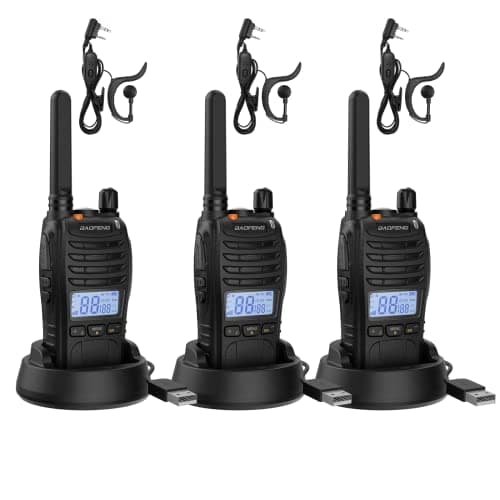 Baofeng BF-88ST Pro FRS (multi-pack) A full 2 W on the FRS channels, sold in twos, threes or fours with a headset per radio, and license-free for every player on the field. The clearest power figure Baofeng publishes on any FRS radio. | Best radio for an airsoft teamNo licenseBudget | 6.1/10Researched | $41.99Amazon #ad · Disclosure |
| 2 | 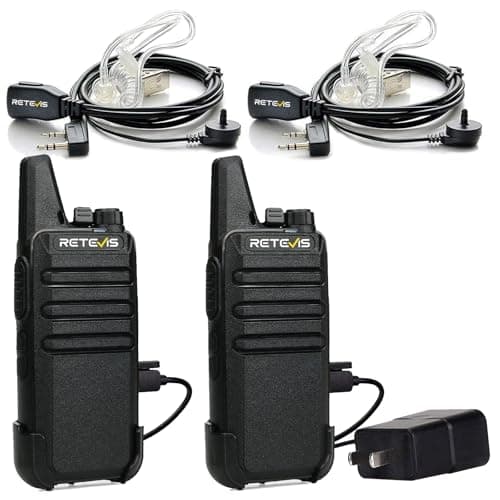 Retevis RT22 (2-pack) No screen, no menu and pre-paired out of the box, so a walk-on borrower cannot drift off channel. 113 g, which is nothing on a rig. Only 16 channels and only light water resistance. | Best loaner radioNo licenseBudget | 5.5/10Researched | $29.98Amazon #ad · Disclosure |
| 3 | 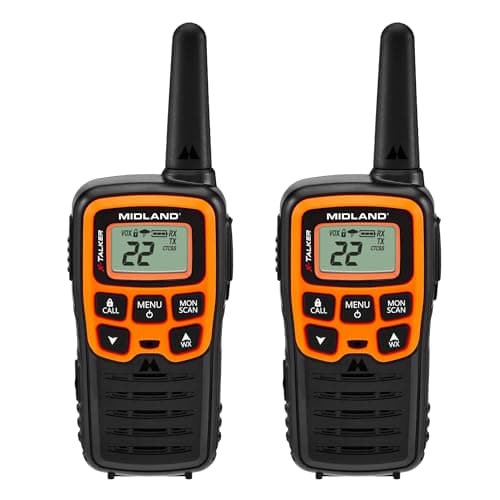 Midland X-Talker T51VP3 (2-pack) The cheap way into Midland's two-pin accessory ecosystem, including the throat mic below. AAA fallback, and no water rating at all. | Best for a matched headsetNo licenseBudget | 5.6/10Researched | $54.99Amazon #ad · Disclosure |
| 4 | 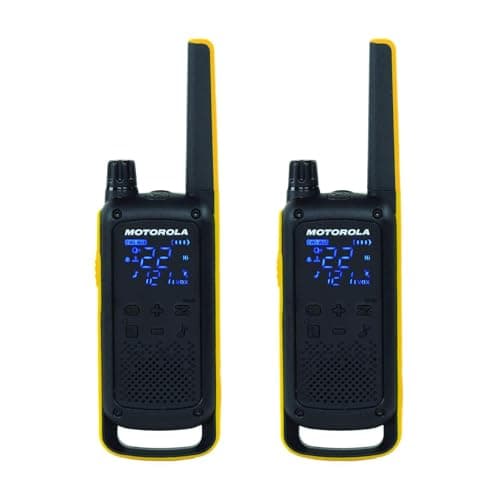 Motorola Talkabout T470 (2-pack) IPX4, AA fallback with a stated 28 hours, and a standard 2.5 mm headset jack that Motorola's own accessory chart matches to real parts. Micro-USB charging, and Motorola never states the wattage. | Best pair with a published accessory chartNo licenseMid-price | 6.1/10Researched | $89.99Amazon #ad · Disclosure |
| 5 | 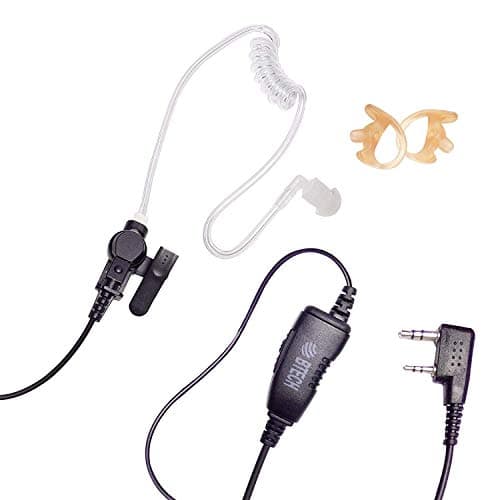 BTECH QHM07 Surveillance Earpiece and Microphone Kit A locking clear coil tube, an in-line PTT you can find with a glove, and earmold inserts — the surveillance-style setup, for Kenwood-style two-pin radios only. Check your radio's jack before you buy. | Best push-to-talk earpieceAccessoryBudget | 7.3/10Researched | $16.25Amazon #ad · Disclosure |
| 6 | 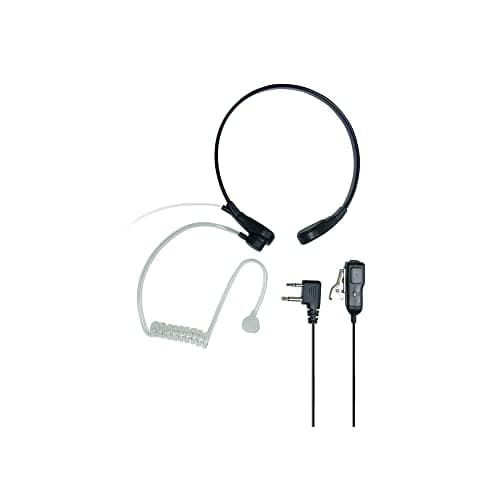 Midland AVPH8 Acoustic Throat Mic Headset A throat mic reads vibration at the neck instead of air at your mouth, which is the one microphone style a mesh mask does not muffle. Midland radios only, one per box. | Best hands-free option under a maskAccessoryBudget | 6.6/10Researched | $39.66Amazon #ad · Disclosure |
#ad · Prices come live from Amazon, last checked November 2, 2026. Scores are ours, built from published specs, manuals and FCC rules. Photos come from each product's Amazon listing; a radio we can't show a real photo of is left blank rather than illustrated. Tap a row for the full write-up.
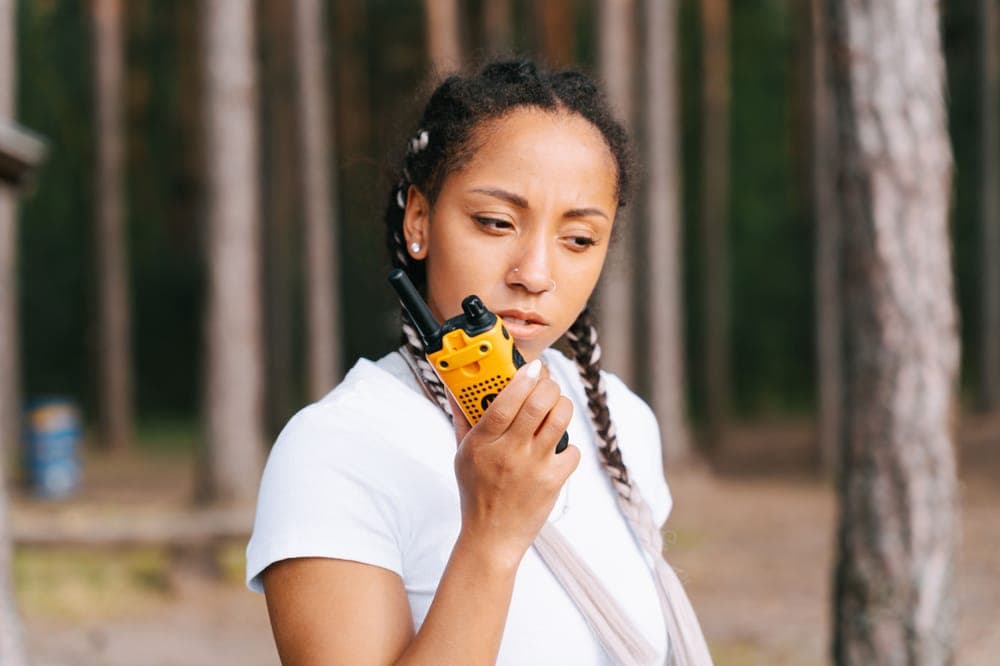
Airsoft is one of the few hobbies where the radio is part of the kit rather than a backup for it. Squad callouts, flank coordination, a marshal's start signal, a buddy pair splitting a building — all of it happens over a handheld on a chest rig, under a mesh mask, with gloved hands and ear protection in the way. That is a different set of requirements from a camping pair, and it is why the radios that win on this page are not the radios that win on best walkie-talkies.
Three things decide an airsoft radio: it has to be legal for a group of people who are not related to you, it has to be cheap enough to buy four or six of, and it has to work with an earpiece because a speaker on a chest rig under a mask is useless. Everything here is chosen and scored from published specs, manuals and the FCC rules — this site does not test radios, and the method is on how we rank.
Why FRS, and not the more powerful GMRS radio
This is the single most useful thing on the page, because it is the mistake most new players make. GMRS radios are more powerful and more capable, and plenty of airsoft gear guides recommend them. But a GMRS license is an individual license: it covers the person who holds it and their immediate family — spouse, children, grandchildren, stepchildren, parents, grandparents, stepparents, brothers, sisters, aunts, uncles, nieces, nephews and in-laws (47 CFR 95.1705). Your squad is not your family. Handing a licensed GMRS radio to five friends at a rental field does not put them under your license.
There is a second trap underneath that one. Not every GMRS radio even gives you more power: Baofeng's cheapest certified GMRS pair is rated at 2 W on the main channels, exactly the FRS ceiling, so the license buys repeater access rather than reach — see the Baofeng MP31 review.
FRS has no such problem. It is licensed by rule: anybody may use an FRS radio, with no application, no fee and no call sign (FCC: Family Radio Service). For a team sport played on a few acres, that is the right trade. The cost is power and antennas: FRS is capped at 2 W on channels 1 to 7 and 15 to 22 and at 0.5 W on channels 8 to 14 (47 CFR 95.567), and the antenna must be permanently attached (47 CFR 95.587). On a field that is usually 10 to 60 acres of woodland, neither limit is what stops you.
What actually matters on a field
- Unit price, because you are buying four. A squad radio is a consumable: it gets dropped, rained on, left in a staging area and shot at. The right budget for one is the budget most people set for a pair.
- An accessory jack with a matching earpiece. This is the whole game. A radio you cannot run an earpiece on is a radio you cannot hear under a mask, and connectors do not cross brands — see the earpiece and headset guide.
- Size and weight, in that order. A screenless 4 oz radio in a chest-rig pocket is invisible; a 9 oz radio with a long antenna snags on slings and door frames.
- Controls you can work blind, with gloves on. Big side PTT, no fiddly menus, and ideally a channel lock so a knock in a bound does not move you off channel.
- Battery you can top up between games. USB charging matters more than capacity for a weekend of 20-minute games; an AA or AAA fallback matters if you play a 12-hour milsim.
- Enough radios in one box. Multi-packs are the only way this gets cheap, and they usually arrive pre-paired on the same channel and code.
The picks in detail
1. Baofeng BF-88ST Pro — the one to buy for a team
It wins because of how it is sold: two, three or four radios in one box, each with a headset, a Li-ion pack and a USB desktop charger, at the bottom of the budget tier (BF-88ST Pro page). That is the correct shape for a squad buy, and it means the whole team is on license-free FRS from the start.
The specs back it up better than the price suggests. Baofeng states a flat 2 W on FRS, which is the ceiling the rules allow on the main channels and a clearer figure than the company publishes for its cheaper GT-18. You also get 22 FRS channels with 50 CTCSS tones and 105 DCS codes, 12 NOAA weather channels with alert scanning, dual watch, VOX, a backlit display and a flashlight. Baofeng's own range claim is a modest "up to 3 miles", which is refreshingly sane next to the 35-mile numbers on consumer boxes.
Cons: the antenna is built into the shell, so there is no upgrade path and a snapped antenna is a dead radio; no water or dust rating is published, which on a wet field is a real risk; the battery is 1200 mAh with an "8-12 hours of frequent use" claim, so a long milsim day wants a charger in the car; and the features that need a menu are driven by very few buttons.
2. Retevis RT22 — the loaner radio
Every team ends up equipping a walk-on who has never held a radio. This is the radio for that person: no screen, no menu, a channel knob and a PTT, and the pair ships set to the same channel and code (Retevis RT22 page). It is 2 W, 113 g with the battery, USB-C charged off a 1000 mAh pack, and it has VOX and an emergency alarm. Retevis publishes 0.5 to 2 miles as the range, which is one of the most honest figures any maker prints.
The screenless design is the actual feature here. There is nothing for a new player to change by accident, and a radio in a pouch cannot show a lit display at night.
Cons: 16 channels, not 22, so it cannot reach every channel a field marshal might assign; no NOAA weather receiver; Retevis describes it as "only life-water-resistant", which is droplets and rain rather than a dunk; and with no screen you cannot confirm which channel you are on by looking.
3. Midland X-Talker T51VP3 — the cheap way into a headset ecosystem
Pick this one if the earpiece matters more to you than the radio, because Midland publishes a written compatibility list for its two-pin accessories and the T51VP3 is on it — including the throat mic further down this page (AVPH8 fit list). The radio itself is a plain license-free pair: 22 channels, 38 privacy codes, NOAA Weather Scan with alerts, eVOX hands-free, and a rechargeable AVP14 pack with a 3 x AAA alkaline fallback and a desktop charger in the box (T51VP3 page).
Cons: no water rating at all, and the T50-series manual tells you not to immerse it; Midland publishes no runtime figure; the advertised "up to 28 miles" is a mountain-top-to-mountain-top number that means nothing in woodland; and AAA cells are a worse field fallback than AA.
4. Motorola Talkabout T470 — the pair with a chart you can trust
This is the most expensive radio here and it earns the slot on two things: an IPX4 splash rating, which none of the cheaper picks publish at all, and a standard 2.5 mm headset jack that Motorola matches to specific accessories on its own published accessory chart (T470 datasheet, Talkabout accessory chart). For a team that wants to buy one earpiece model and know it fits, that documentation is worth money.
You also get 22 channels and 121 privacy codes, NOAA alerts, an LED flashlight, an emergency button, VibraCall, iVOX/VOX hands-free, dual watch, and a battery story built for long days: 800 mAh NiMH rated up to 12 hours, or 3 AA alkalines rated up to 28 hours (T470 series page).
Cons: at this tier you are paying roughly what a four-pack of the Baofengs costs for two radios; charging is Micro-USB, not USB-C; Motorola does not publish the transmit power anywhere; and IPX4 is splash resistance, so a creek crossing still ends it.
5. BTECH QHM07 — the push-to-talk earpiece
The surveillance-style earpiece is the standard airsoft answer: a clear acoustic coil tube to the ear, the microphone and PTT on a lapel clip, and the radio buried in a pouch. BTECH's version locks the coil tube in with a rotating connector instead of relying on friction, has stainless strain-relief clips, and includes an in-ear bud plus left and right open-ear earmolds so you can keep one ear clear for the game (QHM07 page).
Read the connector before you buy. It is a K1 (Kenwood-style two-pin) plug. BTECH lists its own GMRS-V1, GMRS-V2 and FRS-A1, and describes the plug as fitting "standard Kenwood K1 accessory connectors" on BTECH, BaoFeng, Kenwood, AnyTone, Alinco, TYT, Arcshell and Retevis radios. It will not fit a Midland or a Motorola Talkabout, and BTECH does not even list it for its own GMRS-PRO.
Cons: "noise canceling" is in the product name but BTECH publishes no noise-reduction figure; there is no weather rating or stated warranty length; and a coil tube running from a lapel to your ear is one more thing to route under a mask strap.
6. Midland AVPH8 throat mic — the hands-free option that works under a mask
A mesh mask muffles a lapel microphone and a boom mic has nowhere to sit. A throat mic sidesteps both: the sensors read vibration at your neck rather than air at your mouth, and calls come back through an in-ear acoustic tube. Midland's has an inline VOX/PTT switch, so you can run it hands-free or press to talk (AVPH8 page). Its written fit list is long — GXT1000/1030/1050 and X-Talker T31VP through T295VP4, including the T51VP3 above — which makes it the one accessory here with a documented match to a radio on this page.
Cons: Midland lists it for Midland radios only, so it is useless with the Baofeng or the Retevis; the written list omits the GXT67 PRO and GXT3000 even though Midland links the part from both radio pages; it is one headset per box, so a four-person squad is four purchases; and Midland publishes no cable, weather or warranty details.
The published specs side by side
Getting audio under a mask and over ear pro
Three practical rules, in the order they bite:
- Match the plug, not the brand marketing. Midland uses a two-pin connector of its own, Motorola Talkabouts use a 2.5 mm jack, and most cheap Baofeng, Retevis and BTECH handhelds use the Kenwood-style K1 two-pin. An earpiece that does not fit is worth nothing, and no adapter is guaranteed.
- Keep one ear open. An open-ear earmold or a single bud leaves you the ear you need for footsteps and BB impacts. Both earpieces here ship inserts that allow this.
- Route the cable before the game, not during it. Under the rig strap, up the inside of the vest, mic on the sling side so a shouldered gun does not bury it. Then test it with the mask on, because a mask strap across a coil tube is how earpieces fail.
Your comms are not private, and that changes tactics
FRS has 22 channels, and privacy codes do not encrypt anything — a CTCSS or DCS code only stops your radio from opening its speaker for traffic that lacks the matching tone. Anyone on the same channel with codes switched off hears every word you say, which on a field with another team on cheap radios from the same store is a realistic scenario. If it matters, read what privacy codes really do.
The practical answers are tactical rather than technical. Pick a channel and code combination at staging rather than using the factory default. Keep callouts short and use positions rather than plans ("two, east window", not "we are going around the back in thirty seconds"). Assume anything said on channel can be heard, and treat the radio as a coordination tool, not a secure net. And follow the field's own rules: many sites assign channels per team, or ban radios for walk-on players entirely, and marshals need a clear channel for safety calls.
Setting a squad up, in order
- Buy one multi-pack, not four pairs. A three- or four-pack arrives on one channel and code, which saves ten minutes of setup at every game.
- Buy earpieces that match the radios you just bought. Check the connector first. This is the step people get wrong.
- Label the radios. Tape and a marker. Radios go in a staging-area pile at the end of the day and come back out mixed.
- Set a channel and code, then lock it if the radio can. Write it on the tape too.
- Charge everything the night before. Cheap Li-ion packs are the failure point of a rented field day, and an AA or AAA fallback radio is the one that is still running at 4 p.m.
- Walk the field with two radios before you rely on them. Buildings, shipping containers and wet timber all cut a 2 W signal hard — radios inside concrete buildings explains why a CQB block kills range.
In detail
The picks, in full
Rank 01
Best radio for an airsoft team
Baofeng BF-88ST Pro FRS (multi-pack)
A full 2 W on the FRS channels, sold in twos, threes or fours with a headset per radio, and license-free for every player on the field. The clearest power figure Baofeng publishes on any FRS radio.
Published specsResearched · every figure sourced
How the 6.1 score breaks down
- Real-world reach (30%)
- 5
- Ease of use (20%)
- 8
- Toughness & weather (15%)
- 3
- Power & battery (15%)
- 7
- Field features (10%)
- 7
- Value (10%)
- 8
What the specs support
- A clear 2 W figure, where the cheaper GT-18 page contradicts itself
- 12 NOAA weather channels with alert scanning
- Two, three or four radios in one box, each with a headset
Where it falls short
- Fixed antenna, so no upgrade path
- No water or dust rating published
- Dual watch and alarms are menu features on a radio with very few buttons
Skip this if…
…Skip it if you need more than about a mile in timber: this is a 2 W FRS radio with a sealed antenna, and no setting changes that.
#ad · Price as of November 2, 2026 · How we make money for the link to Baofeng BF-88ST Pro FRS (multi-pack)
Rank 02
Best loaner radio
Retevis RT22 (2-pack)
No screen, no menu and pre-paired out of the box, so a walk-on borrower cannot drift off channel. 113 g, which is nothing on a rig. Only 16 channels and only light water resistance.
Published specsResearched · every figure sourced
How the 5.5 score breaks down
- Real-world reach (30%)
- 4.5
- Ease of use (20%)
- 8
- Toughness & weather (15%)
- 3
- Power & battery (15%)
- 6
- Field features (10%)
- 4
- Value (10%)
- 8
What the specs support
- States 2 W and a realistic 0.5 to 2 mile range
- USB-C Li-ion and very light
- Pre-paired out of the box; no screen to confuse anyone
Where it falls short
- Only 16 channels, so it can't reach every FRS channel another family's radio might use
- No weather channel, and only light water resistance
Skip this if…
…Skip it if you need NOAA alerts or will match channels with other brands' 22-channel radios: it has 16 channels and no weather receiver.
#ad · Price as of November 2, 2026 · How we make money for the link to Retevis RT22 (2-pack)
Rank 03
Best for a matched headset
Midland X-Talker T51VP3 (2-pack)
The cheap way into Midland's two-pin accessory ecosystem, including the throat mic below. AAA fallback, and no water rating at all.
Published specsResearched · every figure sourced
How the 5.6 score breaks down
- Real-world reach (30%)
- 4
- Ease of use (20%)
- 8
- Toughness & weather (15%)
- 3
- Power & battery (15%)
- 6
- Field features (10%)
- 6
- Value (10%)
- 8
What the specs support
- NOAA Weather Scan and weather alerts for storms on camping trips
- Rechargeable packs plus a desktop charger, with AAA backup
- License-free and simple enough for the whole family
Where it falls short
- No water rating, and the manual warns against immersion
- No runtime figure published
Skip this if…
…Skip it if it will ride in a kayak or a wet pack: Midland gives it no water rating, so choose an IP67 radio instead.
#ad · Price as of November 2, 2026 · How we make money for the link to Midland X-Talker T51VP3 (2-pack)
Rank 04
Best pair with a published accessory chart
Motorola Talkabout T470 (2-pack)
IPX4, AA fallback with a stated 28 hours, and a standard 2.5 mm headset jack that Motorola's own accessory chart matches to real parts. Micro-USB charging, and Motorola never states the wattage.
Published specsResearched · every figure sourced
How the 6.1 score breaks down
- Real-world reach (30%)
- 4
- Ease of use (20%)
- 8
- Toughness & weather (15%)
- 5
- Power & battery (15%)
- 7
- Field features (10%)
- 8
- Value (10%)
- 7
What the specs support
- AA fallback with a stated 28 hours, which suits an emergency kit
- NOAA alerts, flashlight and emergency button included
- Hands-free iVOX/VOX and a standard 2.5 mm headset jack
Where it falls short
- Micro-USB charging, not USB-C
- IPX4 is splash protection only; don't drop it in water
- Motorola doesn't publish the transmit power
Skip this if…
…Skip it if it will get wet often: IPX4 handles rain, not a creek crossing or a canoe, so the IP67 T605 is the Motorola to buy.
#ad · Price as of November 2, 2026 · How we make money for the link to Motorola Talkabout T470 (2-pack)
Rank 05
Best push-to-talk earpiece
BTECH QHM07 Surveillance Earpiece and Microphone Kit
A locking clear coil tube, an in-line PTT you can find with a glove, and earmold inserts — the surveillance-style setup, for Kenwood-style two-pin radios only. Check your radio's jack before you buy.
Published specsResearched · every figure sourced
How the 7.3 score breaks down
- Connector fit (30%)
- 8
- Hearing & mic in the field (25%)
- 6
- Comfort & quiet use (20%)
- 8
- Durability (15%)
- 6
- Value (10%)
- 9
What the specs support
- K1 two-pin plug for the BTECH GMRS-V2, FRS-A1 and other Kenwood-style radios
- Coil tube locks in rather than relying on friction; stainless strain-relief clips
- Includes an in-ear earbud and left/right open-ear earmolds
Where it falls short
- Noise canceling is in the product name, but BTECH publishes no noise-reduction figure
- No weather rating or warranty length stated
- Not on BTECH's fit list for its own GMRS-PRO
Skip this if…
…Skip it if your radio has no Kenwood-style K1 two-pin jack (Midland, Motorola Talkabout, Rocky Talkie Expedition) or is a BTECH GMRS-PRO: BTECH lists it only for K1 radios.
#ad · Price as of November 2, 2026 · How we make money for the link to BTECH QHM07 Surveillance Earpiece and Microphone Kit
Rank 06
Best hands-free option under a mask
Midland AVPH8 Acoustic Throat Mic Headset
A throat mic reads vibration at the neck instead of air at your mouth, which is the one microphone style a mesh mask does not muffle. Midland radios only, one per box.
Published specsResearched · every figure sourced
How the 6.6 score breaks down
- Connector fit (30%)
- 7
- Hearing & mic in the field (25%)
- 7
- Comfort & quiet use (20%)
- 7
- Durability (15%)
- 5
- Value (10%)
- 6
What the specs support
- Throat microphone with vibration sensors plus an in-ear acoustic tube
- Inline VOX-PTT switch: hands-free or push-to-talk
- Long written fit list covering the GXT1000/1030/1050 and X-Talker T31 through T295
Where it falls short
- Written list omits the GXT67 PRO and GXT3000, although Midland links it from both radio pages
- One headset per box, not a pair
- No cable, weather-rating or warranty details published
Skip this if…
…Skip it if your radio isn't a Midland GXT, LXT or X-Talker from the written list (a GXT67 PRO or GXT3000 owner should confirm with Midland first): the dual-pin plug is sold for Midland radios only.
#ad · Price as of November 2, 2026 · How we make money for the link to Midland AVPH8 Acoustic Throat Mic Headset
What to look for in an airsoft radio
- FRS, not GMRS, unless every player holds their own license. The service is the first decision, not the last.
- An FCC-certified radio for that service. A ham handheld programmed to FRS channels is not an FRS radio.
- A multi-pack price per radio you would pay twice. Field radios get destroyed.
- An accessory jack, and a specific earpiece that fits it. Buy both at once or you will own a radio you cannot hear.
- Small, light and screenless if a borrower will carry it. Fewer controls means fewer ways to end up on the wrong channel.
- A battery plan. USB charging for short game days, AA or AAA fallback for milsim.
- Channel lock, VOX you can switch off, and a PTT you can find with a glove. The ergonomics matter more than the spec sheet here.
How we scored this
Every pick here is backed by the paperwork
Every pick is labeled Researched: we read each maker's published specs, manuals and range tables, check the license rules against the FCC, and score every radio on a public rubric out of 10. Every figure links to where it came from, and every range number is labeled “advertised” so you can see the difference between the box and the terrain.
Scores are our editorial judgment on that documented evidence. Commissions never set a score or decide a pick. The rubric and its weights are published.
What changed
- Published.
Questions
Frequently asked
Do you need a license for airsoft radios?
Can I use a Baofeng UV-5R for airsoft?
How far do 2 W FRS radios reach on an airsoft field?
What earpiece works with a mesh mask?
Can the other team hear our radio traffic?
How many radios does a squad need?
Receipts
Sources
- FCC: Family Radio Service (FRS) page (checked 2026-10-26)
- 47 CFR 95.561, FRS transmitter certification and the dual-service rule (via Cornell LII, checked 2026-10-26)
- 47 CFR 95.567, FRS transmit power limits (via Cornell LII, checked 2026-10-26)
- 47 CFR 95.587, FRS antenna must be permanently attached (via Cornell LII, checked 2026-10-26)
- 47 CFR 95.1705, GMRS licensee and immediate family members (via Cornell LII, checked 2026-10-26)
- Baofeng: BF-88ST Pro FRS product page (checked 2026-09-26)
- Retevis: RT22 product page and 0.5-2 mile figure (checked 2026-09-22)
- Midland: X-Talker T51VP3 product page (checked 2026-09-22)
- Midland: AVPH8 throat mic page and written fit list (checked 2026-09-22)
- Motorola Solutions: Talkabout T470 series page (checked 2026-09-22)
- Motorola Solutions: T470 datasheet, jack and battery figures (checked 2026-09-22)
- Motorola Solutions: Talkabout accessory compatibility chart (checked 2026-09-22)
- BTECH: QHM07 surveillance earpiece page and fit list (checked 2026-09-22)
Specs and range figures come from each maker's own pages and manuals, linked on every product, and license, power and channel rules come from the FCC and 47 CFR Part 95. Range numbers are the maker's advertised claims and are labeled that way, so you can tell the box number from the terrain number. Prices come live from Amazon with the time we checked. Read the full method.